

Most teams treat readiness as a documentation problem. Write the runbook, drop it in a shared folder, and assume that when a P1 incident hits or a renewal starts sliding, people will calmly open the doc and follow it. That's not what happens. Under pressure, people revert to instinct, Slack chaos takes over, and the beautiful runbook sits unopened until the postmortem.
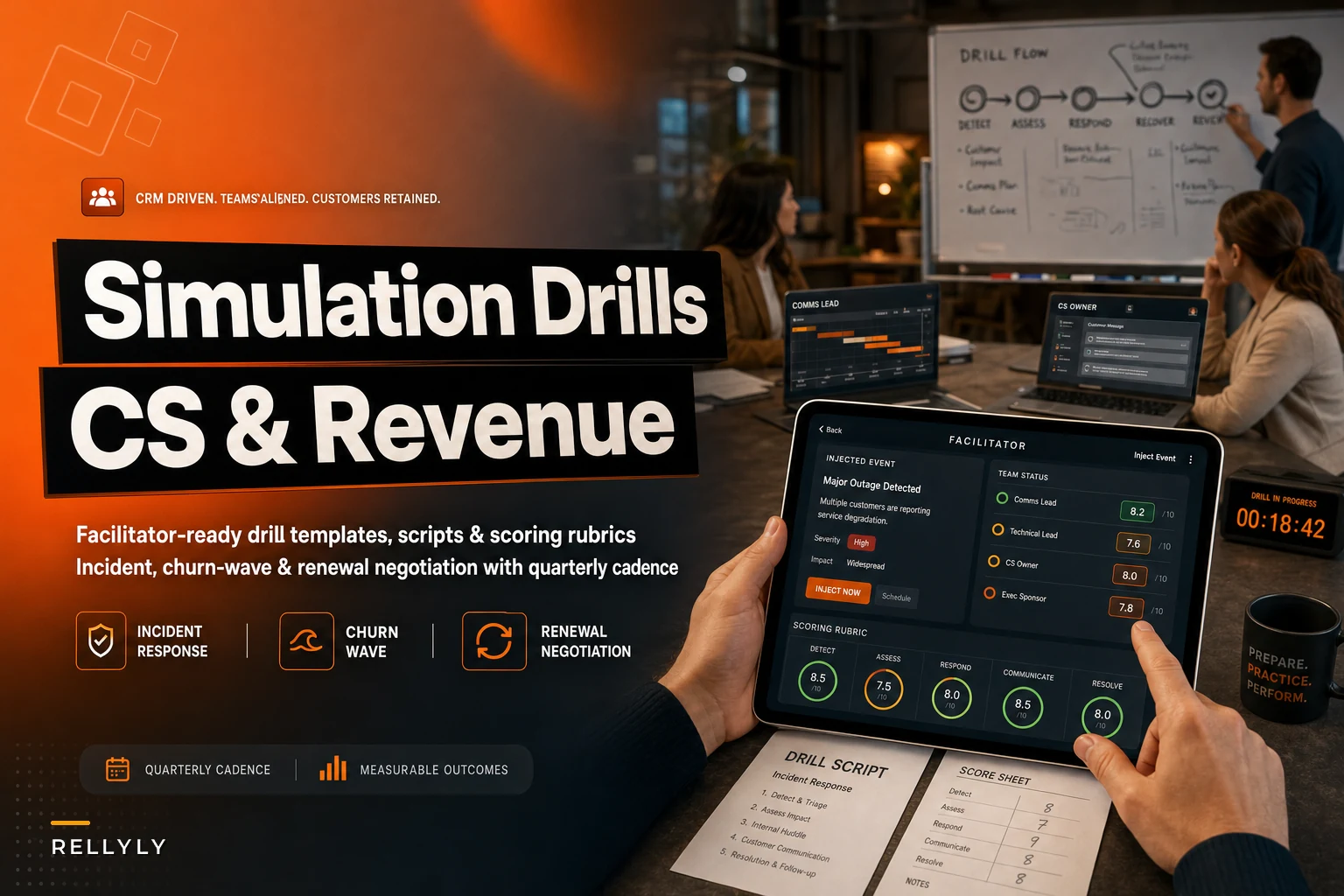
The gap between "we have a playbook" and "we can actually execute the playbook" only closes one way: by running the play before it matters. That's what a CS simulation drills playbook is for. Not a tabletop exercise where everyone nods along, but a timed, scored, slightly uncomfortable simulation where people make real decisions against a fake-but-believable scenario.
This post gives you three ready-to-run drills — incident, churn wave, and renewal negotiation — with the scripting, roles, scoring rubrics, evidence capture, and debrief structure you need to actually facilitate them. Plus a quarterly cadence so this becomes a muscle instead of a one-off.
Why most "drills" fail before they start
The drill collapses when the facilitator is also a participant. The person who built the scenario can't be in the room reacting to it, because they already know the answers. The whole thing turns into a demo of the right answer instead of a genuine test of whether the team can find it.
The second failure pattern is no scoring. If everyone walks out saying "yeah that went well," you learned nothing. You need a rubric — not to grade people harshly, but to force specificity. "We were slow on customer comms" is a feeling. "The first customer-facing update went out 41 minutes after detection against a 15-minute target" is a finding you can actually fix.
The third is skipping evidence capture. People remember the drill the way they want to remember it. Without timestamps, screenshots, and decisions captured as they happen, your debrief just becomes a negotiation about what actually occurred.
-
The facilitator never participates. They run the clock, inject new information, and take notes.
-
Everything gets scored against a rubric, even if the score is rough.
-
Evidence is captured live, not reconstructed afterward.
So before the three templates, three rules that apply across all of them:
Drill 1: The Incident Drill
Participant roles
Never miss a customer touchpoint again.
Rellyly helps you manage contacts, tasks, and sales efficiently in one platform.
- Unified customer profiles
- Automated follow-ups
- Sales pipeline tracking
No credit card required
-
Incident Commander — owns the response, makes the call on severity and escalation
-
Comms Lead — drafts and sends all customer-facing updates
-
Technical Lead — simulates triage and root-cause investigation (works from a scripted fault tree)
-
CS Owner — represents the three affected accounts, fields their "reactions"
-
Facilitator — runs injects, tracks time, scores
Minimum viable group is four people (combine Technical Lead and Incident Commander if you're short-staffed). Don't run it with fewer — the whole point is testing coordination friction.
The scenario script
> T+0 (facilitator reads aloud): "At 9:14am, monitoring flags elevated error rates on the billing API. Three enterprise accounts — including your largest, roughly $180k ARR — are reporting failed transactions. Support has two tickets open. You are the on-call team. Go."
Then the facilitator feeds injects at fixed intervals to force decisions:
-
T+8 min "The largest account's VP just emailed the CSM asking if this is a security breach."
-
T+15 min "Error rate doubled. A fourth account is now affected."
-
T+22 min "A customer posted in a shared Slack channel asking what's going on."
-
T+35 min "Engineering identifies the root cause — a bad config push. Rollback will take 20 minutes."
The injects are the whole game. They simulate the thing that actually breaks real incident response: new information arriving faster than people can process the last piece.
Scoring rubric
| Dimension | 1 (poor) | 3 (adequate) | 5 (strong) |
|---|---|---|---|
| Time to first internal acknowledgment | > 10 min | 3–10 min | < 3 min |
| Time to first customer update | > 30 min | 15–30 min | < 15 min |
| Severity classified correctly | Wrong / never set | Set late | Set within 5 min |
| Escalation to exec when threshold hit | Missed | Late | On trigger |
| Comms accuracy (no overpromising) | Guessed at ETA | Vague but safe | Clear + honest |
| Role clarity (no two people doing same job) | Chaotic | Some overlap | Clean lanes |
Evidence capture template
-
Timestamp of detection acknowledgment
-
Timestamp of first customer comm
-
Actual severity set vs. correct severity
-
Exec escalation trigger hit? When? Acted on?
-
Copy of every customer-facing message sent
-
Any moment two people assumed the same role
Visualizing the flow can help facilitators run it smoothly.
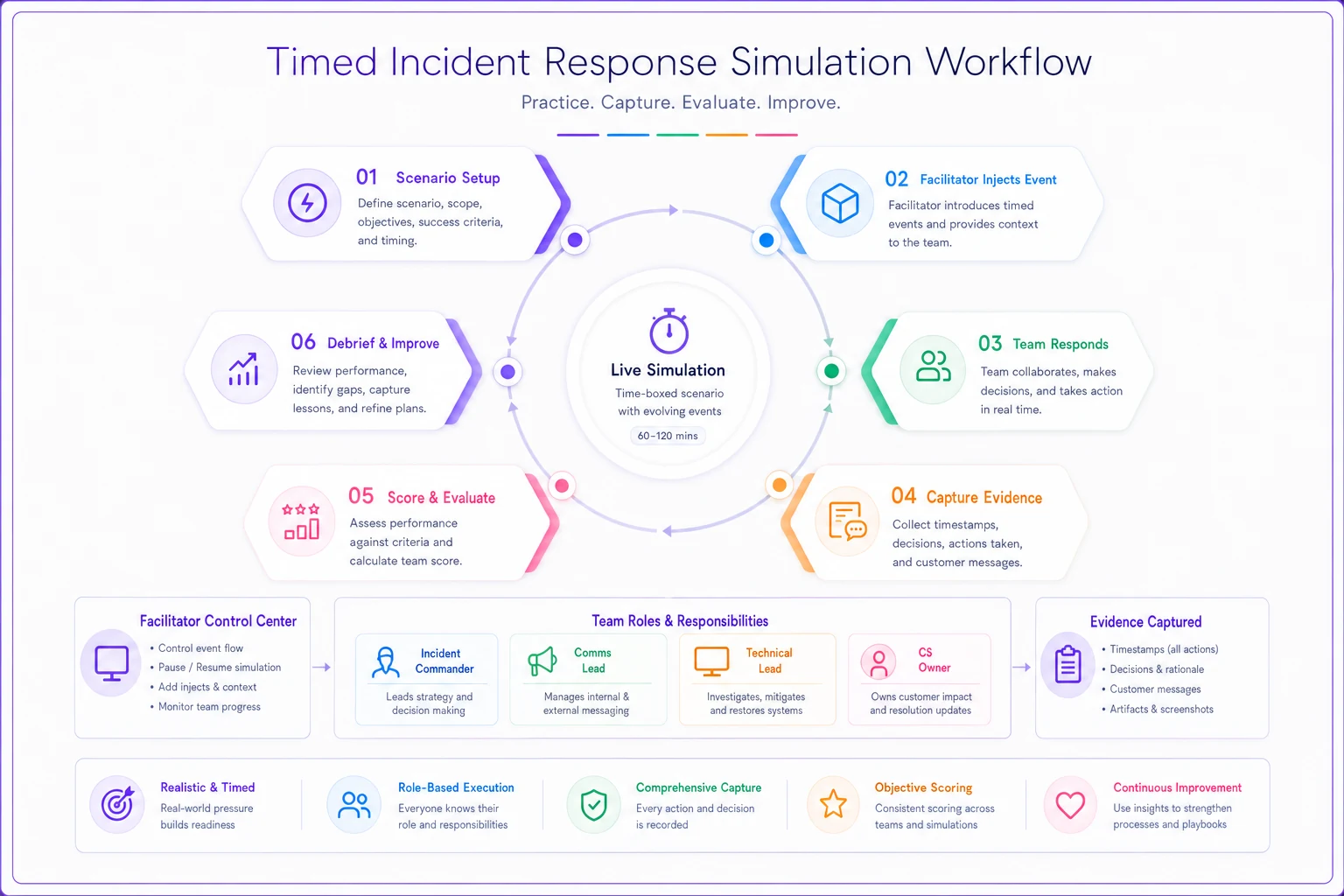
Keep the evidence capture template open and live during the drill so timestamps and messages are recorded as they happen.
Drill 2: The Churn Wave Drill
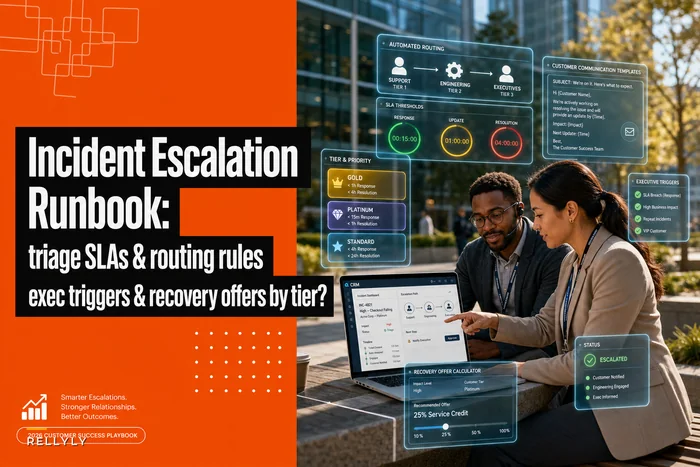
The drill pairs naturally with your written procedures — if you've built out an incident escalation runbook for high-value customers, this is how you find out whether anyone can actually follow it when the clock is running.
What it tests: whether the team can triage multiple at-risk accounts simultaneously under a resource constraint — the thing a single-account save motion never prepares you for.
Most CS teams are decent at saving one account they've seen coming for weeks. They fall apart when four accounts wobble in the same two-week window because a competitor dropped prices or a product change annoyed a segment. There's no time to run the full save motion on all of them, so prioritization is the skill being tested.
The setup
The facilitator hands each CS participant a stack of four "account cards." Each card has:
-
ARR
-
Renewal date (ranging from 3 weeks to 4 months out)
-
Health signals (usage trend, support ticket volume, exec sponsor status)
-
A triggering event (budget cut, champion left, feature gap, pricing complaint)
The constraint: participants have a simulated "week" and can only run two deep saves and three light touches total. They must choose.
The scenario script
> Facilitator: "It's Monday. Over the weekend, your health dashboard flipped four accounts from green to amber. You have one week before your QBR, where you'll report your save plan. You cannot save all four with full effort. Decide who gets what, and justify it."
Then one inject at the midpoint:
-
T+day 3 "One of the accounts you deprioritized just emailed asking for a call to 'discuss options.' One you prioritized has gone silent."
This inject tests whether the team re-prioritizes on new signal or stubbornly sticks to the Monday plan. Both can be mistakes in different directions, and the debrief is where you unpack which was actually warranted.
Scoring rubric
| Dimension | What strong looks like |
|---|---|
| Prioritization logic | Ranked by ARR × save probability × time-to-renewal, not gut feel |
| Save motion fit | Deep saves matched to recoverable accounts, not lost causes |
| Response to new signal | Adjusted plan with stated reasoning |
| Resource discipline | Stayed within the two-deep / three-light constraint |
| Handoff clarity | Clear owner and next step per account |
A realistic example
A mid-market SaaS team ran this and discovered their instinct was to throw everything at the biggest logo — around $95k ARR — even though its renewal was four months out and the champion was still engaged. Meanwhile a smaller account, roughly $28k, had a renewal in three weeks and a champion who'd just quit. In the drill they lost the small one by over-investing early in the account that wasn't actually at immediate risk. That's a cheap lesson to learn in a conference room instead of in Q4.
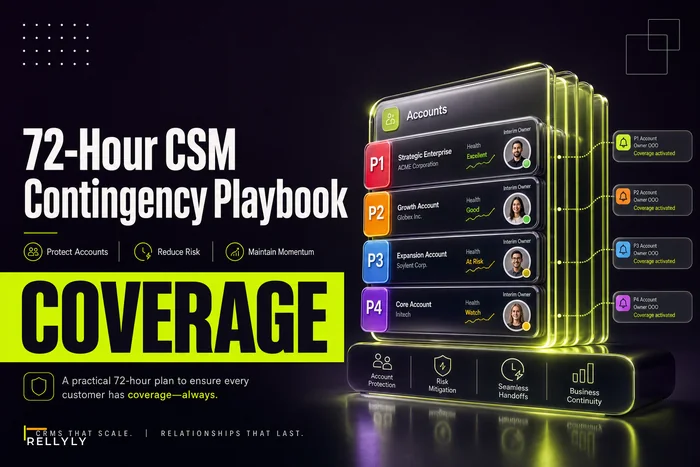
For teams building the underlying motion this drill stress-tests, the 72-hour CSM contingency playbook is a useful companion — the drill reveals whether your triage rules hold up when three alarms fire at once.
Drill 3: The Renewal Negotiation Drill
What it tests: discovery discipline, concession control, and holding margin under pressure from a well-prepared buyer.
The mistake this drill surfaces most often: reps who discount at the first sign of resistance because they haven't done the diagnostics to know whether the resistance is real or just a negotiating move. A drill with a trained "buyer" playing hardball forces them to hold the line or get exposed.
Participant roles
-
CSM / AE (the participant being tested)
-
The Buyer — played by the facilitator or a senior rep, working from a buyer script with hidden motivations
-
Observer — scores silently, says nothing during the role-play
The buyer script (facilitator's private notes)
> You renewed last year at $60k. You actually have budget and intend to renew. But your CFO told you to "get 15% off everything." You will anchor hard with "we're looking at alternatives" even though you aren't seriously. If the rep asks good discovery questions about your actual usage and outcomes, you'll soften. If they immediately offer a discount, you'll take it and push for more.
This hidden-motivation design is what makes the drill worth running. The rep can't see that the threat is soft, so their only defense is diagnostics — exactly the skill you want to build.
The flow
-
Buyer opens with pressure
"We've been happy, but honestly the budget's tight and we're evaluating a cheaper option. We'd need to see a meaningful discount to continue."
-
Rep's job
resist the reflex to discount, run discovery, re-establish value, and only concede within guardrails if at all.
-
Buyer escalates once mid-conversation
"I need an answer this week or we're going to pilot the alternative."
-
Facilitator ends the role-play at 15 minutes regardless of resolution.
Scoring rubric
| Dimension | 1 | 3 | 5 |
|---|---|---|---|
| Discovery before concession | Discounted immediately | Some questions, then caved | Full diagnostic, held value first |
| Concession discipline | Gave more than guardrail allows | Stayed in guardrail reluctantly | No concession or minimal, justified |
| Value re-framing | None | Generic feature list | Tied to the buyer's stated outcomes |
| Pressure handling | Rattled by the deadline | Steady | Reframed urgency calmly |
| Next-step control | Left it open | Vague follow-up | Clear commitment + timeline |
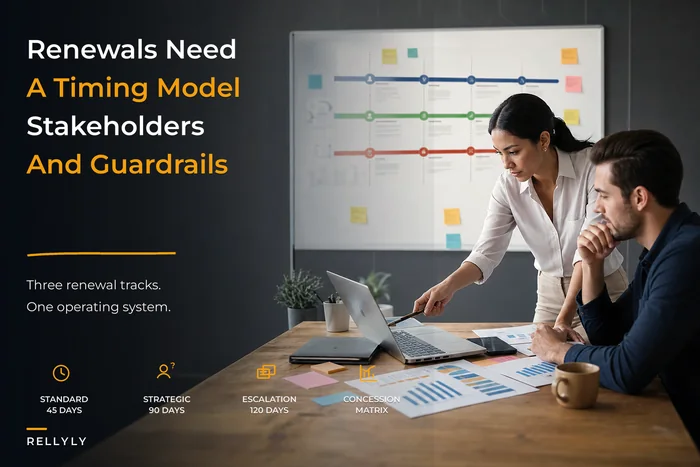
If your team is formalizing the structure behind this, a documented renewal operating model with timelines, stakeholder mapping and concession guardrails gives the drill its scoring baseline — you're testing whether reps actually operate within the guardrails you've already set.
The debrief: where the actual learning happens
A drill without a structured debrief is just theater. Run it immediately while memory is fresh — no later than 30 minutes after the drill ends. The debrief is where you convert what happened into actual changes to the playbook.
Use this sequence every time:
-
Facts first (5 min). Facilitator reads the evidence log aloud. No interpretation yet, just timestamps and what was said. This prevents the "I thought we did fine" revisionism.
-
Self-assessment (5 min). Each participant rates their own performance against the rubric before hearing anyone else's view.
-
Gap identification (10 min). Where did reality miss the target? Be specific — "comms was slow" becomes "first update at T+41 against a 15-min target."
-
Root cause (10 min). For each gap, ask whether it was a knowledge problem, a tooling problem, or a process problem. The fix differs depending on which one it is.
-
Playbook changes (10 min). Every gap must produce either a playbook edit, a training action, or an explicit "accept the risk" decision. Nothing leaves the room unassigned.
Use a shared log (timestamp + actor + message) to make "facts first" fast.
Playbook iteration checklist
-
[ ] Every gap has a named owner
-
[ ] Every playbook change has a due date
-
[ ] The scenario and injects are saved for reuse or variation next quarter
-
[ ] Rubric scores are recorded so you can trend them over time
-
[ ] One thing that went well is documented (so you don't accidentally change it)
-
[ ] Next drill date is on the calendar before people leave
That last point matters more than it looks. Readiness decays. A team that drilled incident response six months ago is not a ready team today — people have left, the product has changed, the runbook has drifted.
Success metrics worth tracking
Don't over-instrument this. A handful of trend lines across drills tells you whether readiness is actually improving:
-
Time-to-first-customer-comm in the incident drill (should drop quarter over quarter)
-
Prioritization accuracy in the churn drill (did they protect the genuinely at-risk accounts?)
-
Concession-within-guardrail rate in the renewal drill
-
Playbook changes shipped per drill (a healthy number early, declining as the playbook matures)
-
Rubric score trend per dimension, averaged across participants
If rubric scores plateau and playbook changes drop near zero, that's your signal to make the scenarios harder — add a simultaneous second incident, a tougher buyer, a fifth churn account.
Recommended quarterly cadence
One drill per quarter, rotating, keeps the whole surface fresh without overloading anyone:
| Quarter | Drill | Why this timing |
|---|---|---|
| Q1 | Incident | Fresh start, new team members onboarded |
| Q2 | Renewal negotiation | Ahead of mid-year renewal clusters |
| Q3 | Churn wave | Before the Q4 renewal pressure builds |
| Q4 | Incident (harder variant) | Pressure-test before year-end, when stakes peak |
Each drill runs 60–75 minutes including debrief. That's four short sessions a year. The cost is trivial compared to one fumbled $180k incident response or one renewal lost to a discount the rep never actually needed to give.
When this is worth it — and when it isn't
Run these drills if: you have named high-value accounts, a team of at least three or four people who coordinate during incidents or renewals, and written playbooks that nobody has tested under real pressure.
Skip or simplify if: you're a two-person team where coordination isn't the bottleneck, or you're pre-product-market-fit and your "playbook" changes every month anyway. At that stage the overhead isn't worth it — informal review is enough.
The trap to avoid: running drills as a compliance checkbox. If leadership treats a low rubric score as a performance failure rather than a readiness finding, people will sandbag the drills to look good, and you'll lose the only honest signal you had. Keep the scoring blameless. The point is to find the gaps cheaply, not to catch anyone out.
The teams that handle their worst days well are almost never the ones with the best-written runbook. They're the ones who've already lived through a version of it — on purpose, in a room, with a fake buyer or a scripted outage — and fixed the gaps while nothing was actually on fire.
The teams that handle their worst days well are almost never the ones with the best-written runbook. They're the ones who've already lived through a version of it — on purpose, in a room, with a fake buyer or a scripted outage — and fixed the gaps while nothing was actually on fire.
Ready to transform your customer relationships?
Join 2,000+ businesses using Rellyly to increase sales, improve client retention, and simplify CRM workflows.