


Most companies treat renewals like they're selling to the customer for the first time. Sales gets involved 30 days out, customer success scrambles to pull usage data, finance debates pricing, and somewhere in the mess a $400k renewal either closes late or churns entirely.
The compounding chaos of unstructured renewals
The problem isn't the people — it's that renewals run without an actual operating model. No defined paths, no clear ownership, no escalation criteria. Just a monthly fire drill where everyone hopes this month's batch doesn't blow up.
Companies that treat every renewal the same way lose money in two directions: they overspend resources on simple renewals that should auto-process, and they underspend attention on strategic accounts that need careful handling. A three-tier renewal operating model fixes both problems at once.
Why standard renewals eat 70% of your team's capacity
Walk into any CS team's Monday standup and you'll hear the same conversation. Who's handling the 15 renewals this month? Should we loop in sales for the $8k account? When do we send the first email?
Never miss a customer touchpoint again.
Rellyly helps you manage contacts, tasks, and sales efficiently in one platform.
- Unified customer profiles
- Automated follow-ups
- Sales pipeline tracking
No credit card required
These questions repeat because there's no systematic answer. Every renewal gets treated as a unique event requiring custom decisions. A $5k renewal with a happy customer gets the same multi-touch cadence as a $150k account showing usage decline. CS managers spend hours in "renewal strategy meetings" discussing accounts that could've processed automatically.
The waste compounds in predictable ways. CS reps burn 3-4 hours per week on renewals that don't need human touch — sending personalized emails to customers who just want an invoice, scheduling check-ins with accounts at 95% feature adoption, building custom renewal decks for deals that were never at risk.
Sales gets pulled in too early or too late. Either they're sitting on calls for $10k renewals that CS could handle alone, or they're getting emergency-tagged into a $200k negotiation with 5 days left on the contract.
Finance and legal enter randomly, usually when someone panics about payment terms or contract language. They lack context, slow things down, and often override earlier agreements because nobody documented the decision framework.
The result is a predictable revenue pattern: renewal rates hover around 85-88% regardless of product quality or customer satisfaction. The operational friction itself is causing somewhere in the range of 5-7% of preventable churn.
Building the three-tier framework
A functional renewal operating model starts with segmentation — but not the kind most companies try. Forget segmenting by company size, industry, or health score. Those factors matter for account management, not renewal operations.
Renewal segmentation needs to answer one question: how much coordinated human intervention does this specific renewal actually need to close?
Standard renewals (60-70% of volume) The customer uses the product consistently, pays on time, hasn't requested major changes, and the contract value stays flat or increases slightly. In a properly built system, these process through automated workflows with minimal human involvement.
Strategic renewals (20-25% of volume) These need coordinated human judgment. Maybe the account wants to expand. Maybe usage shifted. Maybe there's competitive pressure. Multiple stakeholders, a shared playbook, but within defined boundaries.
Escalation renewals (5-15% of volume) The real fires. Major downgrades, payment issues, executive-level negotiations, competitive displacement threats. Senior leadership involved, flexible negotiation authority required.
The percentages matter less than the clear boundaries between tiers. Most companies create the tiers and then let every renewal drift upward "just to be safe." Suddenly 40% of renewals are "strategic" and the whole model breaks down.
Timeline choreography that actually works
Renewal timelines fall apart when companies try to be proactive without being systematic — starting outreach 90 days early for every account, creating customer fatigue and internal confusion, or waiting until 30 days out and compressing everything into a panicked sprint.
Different tiers need fundamentally different timelines.
Standard renewal timeline (45-day cycle)
-
Day 45
Automated usage report sent to customer
-
Day 30
Automated renewal notice with invoice preview
-
Day 15
First human touch if no response (CS team)
-
Day 7
Escalation to management if still no response
-
Day 0
Auto-renewal processes or manual intervention triggers
Standard renewals should feel automatic to the customer. They're expecting to renew — they just need the logistics handled cleanly. Every human touch before Day 15 wastes resources and risks creating friction where there wasn't any.
Strategic renewal timeline (90-day cycle)
-
Day 90
Internal alignment meeting (CS + Sales leadership)
-
Day 75
CS begins usage analysis and expansion discovery
-
Day 60
First executive touch if expansion opportunity exists
-
Day 45
Formal renewal proposal sent
-
Day 30
Negotiation window opens
-
Day 15
Final pricing must be locked
-
Day 0
Contract execution
Strategic renewals need longer runways because they involve real decisions. But the timeline has to be rigid. When Day 60 arrives, the executive touch happens whether everyone feels ready or not. This prevents the common failure where teams keep "preparing" until there's no time left to actually negotiate.
Escalation renewal timeline (120-day cycle)
-
Day 120
Risk flagged in system (usually from usage data)
-
Day 105
Executive sponsor assigned
-
Day 90
Direct executive-to-executive outreach
-
Day 75
Recovery plan proposed
-
Day 60
Go/no-go decision on retention effort
-
Day 30
Final negotiation or transition planning begins
-
Day 0
Renewal or managed churn execution
Escalation renewals start earlier because saving them often requires fundamental changes. Day 60 is the critical decision point — at some point you need to decide whether you're fighting to save the account or managing a clean exit. Companies that skip this decision waste enormous resources on unwinnable renewals while neglecting accounts they could actually save.
Here's a quick visual to compare the three timelines.
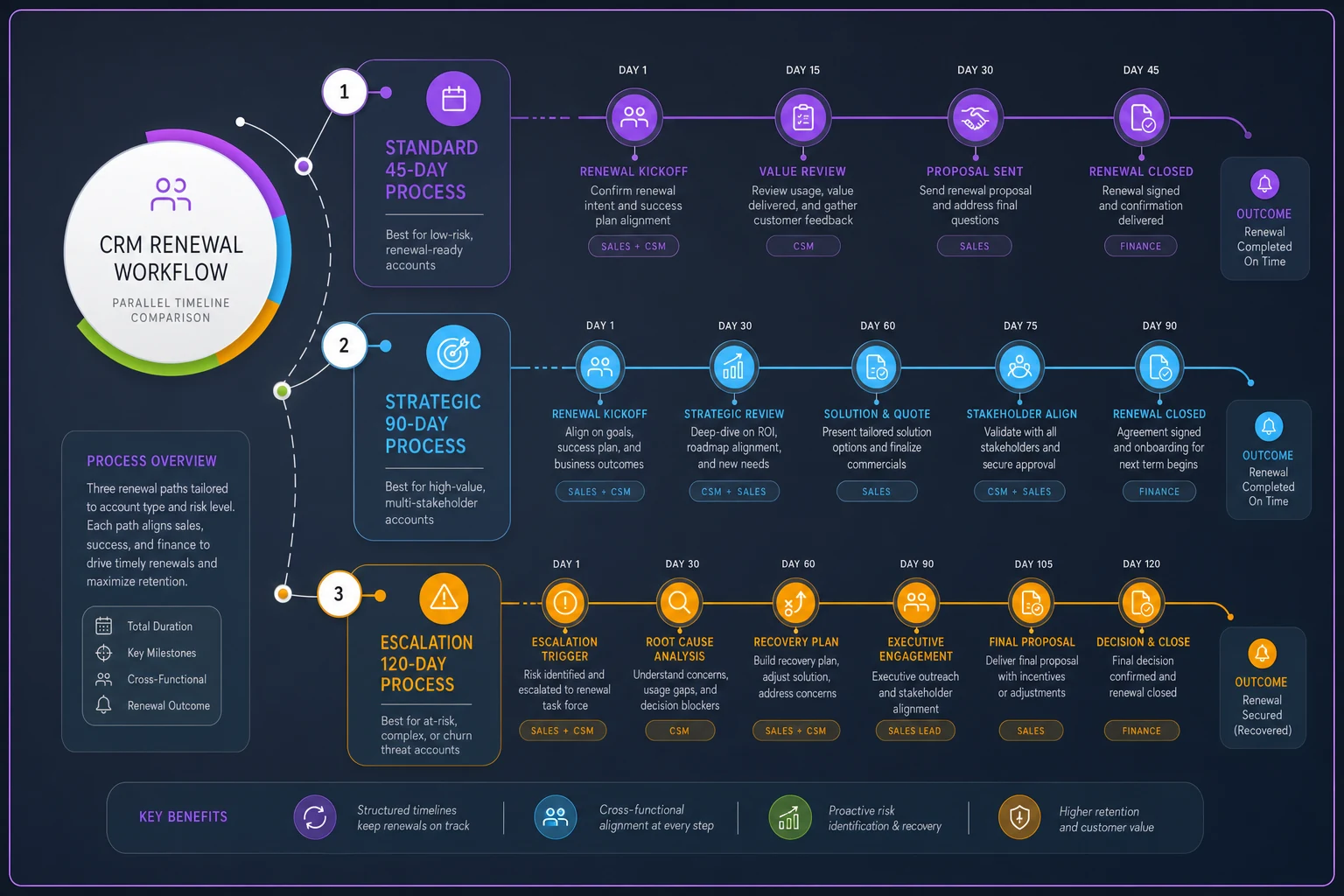
This comparison shows how runways and milestones differ by tier and why each needs a distinct cadence.
Stakeholder mapping without the politics
The biggest renewal failures happen when stakeholders collide without clear roles. Sales thinks they own the commercial relationship. CS believes they own the ongoing one. Finance wants to control pricing. Legal wants to review everything. Nobody actually owns the outcome.
Standard renewals
-
Owner
Customer Success Operations (not individual CSMs)
-
Approver
Nobody (auto-approval within parameters)
-
Consulted
Finance (payment processing only)
-
Informed
Sales (via automated reports)
Individual CSMs don't own standard renewals. The operations team owns the process; CSMs only step in when the system flags an issue. This prevents CSMs from spending half their time on routine admin instead of actual customer success work.
Strategic renewals
-
Owner
Customer Success Manager (specific person)
-
Approver
Sales Director (for pricing changes over 20%)
-
Consulted
Sales Rep (expansion opportunities), Finance (non-standard terms)
-
Informed
Executive team (via weekly renewal dashboard)
Strategic renewals need a single owner but multiple contributors. The CSM quarterbacks the process but doesn't have unilateral authority. When deals stall, this clear ownership structure prevents the finger-pointing that kills renewal momentum.
Escalation renewals
-
Owner
Executive Sponsor (VP or above)
-
Approver
CEO/CRO (for concessions over 30%)
-
Consulted
Entire account team, Legal, Finance
-
Informed
Board (for renewals over $500k at risk)
Escalation renewals need executive ownership from day one. CSMs and sales reps become advisors, not decision-makers. This prevents junior team members from negotiating away too much value trying to save a deal they don't have the authority to actually close.
Concession guardrails that preserve value
Every renewal negotiation eventually hits the concession discussion. The customer wants a discount, longer payment terms, or service credits. Without guardrails, teams either give away too much or lose winnable deals by being inflexible.
Most companies try to solve this with approval chains — anything over 10% needs manager sign-off, over 20% needs VP approval. This creates bureaucracy without preserving value. The customer waits while your team plays internal telephone, and nobody actually evaluates whether the concession makes sense.
Better concession guardrails work like predetermined negotiation boundaries.
Standard renewal concessions (pre-authorized)
-
Payment terms
Net 30 to Net 45 allowed
-
Price increase
Can waive up to 5% increase for multi-year commitment
-
Service credits
Up to $500 for documented service issues
-
Contract length
12-month standard, 24-month available with 5% discount
These are pre-approved for standard renewals. The CS operations team can apply them immediately without consultation. Fast response, preserved margin.
Strategic renewal concessions (bounded flexibility)
-
Discount authority
10-15% for competitive pressure, 20% for 3-year commitment
-
Payment terms
Net 60 for accounts over $100k ARR
-
Service modifications
Can adjust service levels within 20% of current cost
-
Contract modifications
Can add flexibility clauses with CFO approval
The negotiating team knows exactly what they can offer without going back for approval. That speeds up negotiations and cuts down on value leakage.
Escalation renewal concessions (executive discretion)
-
Discount authority
Up to 40% with clear retention rationale
-
Payment restructuring
Can convert to quarterly payments or usage-based
-
Service modifications
Complete package restructuring allowed
-
Contract terms
Can offer monthly termination rights if needed
Escalation renewals need maximum flexibility because the alternative is complete churn. But even here, boundaries exist. The 40% discount ceiling stops desperate teams from essentially giving away the product just to preserve a logo.
One implementation detail that gets skipped constantly: concession guardrails must live in the system, not in people's heads. When a negotiation starts, the team should see exactly what they can offer without needing approval. This eliminates both unauthorized concessions and unnecessary delays.
Embed concession guardrails directly in your CRM so negotiators see allowed limits in real time.
This eliminates both unauthorized concessions and unnecessary delays.
Decision matrices that remove guesswork
The final component of a functioning renewal operating model is the decision matrix — a systematic way to determine which tier a renewal falls into and what actions follow.
Most companies make these decisions on feel. This account "seems important." That customer "might be at risk." The result is inconsistency, wasted resources on false positives, and missed signals on real risks.
Tier assignment matrix
| Signal | Standard | Strategic | Escalation |
|---|---|---|---|
| Usage trend | Stable or growing | Declining 10-25% | Declining >25% |
| Support tickets | <2 per month | 2-5 per month | >5 per month |
| Payment history | Always on time | 1 late payment | Multiple late |
| Stakeholder change | None | New champion | Champion left |
| Contract value | <$50k | $50k-200k | Any size at risk |
| Expansion signal | None | Interest expressed | Active evaluation |
| Competitive mention | Never | Once | Multiple times |
When three or more signals point to a higher tier, the renewal gets upgraded. This prevents both over-escalation and under-attention.
Action trigger matrix
Immediate escalation triggers:
-
Usage drops 50% in 30 days
-
Champion leaves company
-
Competitor mentioned in two consecutive calls
-
Payment fails twice
-
Customer requests termination clause
Expansion opportunity triggers:
-
Usage hitting 80% of plan limits
-
Multiple departments requesting access
-
Customer asking about additional features
-
Recent funding or acquisition
-
Headcount growth over 25%
Risk mitigation triggers:
-
New stakeholder asks for ROI documentation
-
Customer cancels three meetings
-
Support ticket velocity doubles
-
Usage concentrates in single department
-
Customer moves to monthly payment schedule
When a trigger fires, the prescribed action happens. No debates, no delays, no dropped balls.
The trigger matrix is also where the model earns its keep over time. After six months of running it, patterns start to emerge — certain signals cluster before churn, others consistently precede expansion. That data sharpens the model in ways no amount of strategy discussion will.
The compound effect of systematic renewals
A properly implemented three-tier renewal operating model drives real improvements — renewal rates typically increase 5-8% within six months, and time spent on renewals drops 30-40% for CS teams. But the more important outcome is predictability.
The value isn't just in the individual improvements — it's in how they stack. When standard renewals process automatically, CS teams focus on actual customer success work, which improves usage metrics, which moves more renewals into the standard tier over time. When strategic renewals follow consistent timelines, sales teams can forecast pipeline accurately, which improves resource allocation and close rates downstream.
Operational software with AI automation makes this kind of systematic approach manageable at scale. It handles tier assignment, triggers stakeholder notifications, and enforces concession guardrails without manual coordination. The humans focus on relationships and strategic decisions while the system handles the operational choreography. Without that tooling, even a well-designed renewal model breaks down under the weight of manual tracking.
Making the model stick
The biggest risk to any renewal operating model is exception creep. Someone marks a $20k renewal as "strategic" because they know the CEO. Another person bypasses the concession guardrails for a "special situation." Within three months, half your renewals are exceptions and the model has collapsed.
Preventing that requires operational discipline on a few fronts.
Every exception needs to be documented and reviewed. When someone overrides the model, they explain why. Monthly, leadership reviews those exceptions. If the same one keeps appearing, either the model needs adjustment or the behavior needs correction.
The model also has to live in systems, not spreadsheets. When the CRM automatically assigns tiers based on signals, when the communication platform triggers stakeholder notifications, when the contract system enforces concession guardrails — the model becomes the path of least resistance rather than something people work around.
Finally, compensation and metrics have to align. If CS gets measured on renewal rate regardless of tier, they'll over-manage standard renewals. If sales earns full commission on heavily discounted saves, they'll give away margin. The incentive structure has to reward following the model, not gaming it.
Companies that actually make this work share one characteristic: they treat it as an operational system, not a set of guidelines. They invest in the tooling, enforce the boundaries, and measure the outcomes.
Renewals aren't sales. They're operations. And operations requires structure, not heroics.
Ready to transform your customer relationships?
Join 2,000+ businesses using Rellyly to increase sales, improve client retention, and simplify CRM workflows.