


Pull up your CRM right now and look at your pipeline. Count how many deals are sitting in "negotiation" or "proposal sent." Now ask three different reps what those stages actually mean. You'll get three different answers.
This isn't just annoying—it's destroying your ability to predict revenue. When your VP of Sales says there's $2.4M in the pipeline for Q3, that number is built on quicksand. Half your reps think "negotiation" means they sent pricing. The other half think it means contract redlines are happening. Your forecast is essentially fiction.
The problem compounds with ARR businesses. Unlike one-time sales where you can absorb some sloppiness, subscription revenue turns these errors into recurring ones. A deal you thought would close at $8K monthly that actually closes at $5K doesn't just affect this quarter—it affects every quarter going forward.
Why pipeline definitions break down in practice
Most companies inherit their pipeline stages from whatever CRM template they picked on day one. Salesforce gives you Lead → Opportunity → Proposal → Negotiation → Closed Won. HubSpot offers something similar. Teams just run with it.
Then reality hits. Your product requires technical validation that doesn't fit anywhere. Customer legal reviews take six weeks but there's no stage for that. Pilots happen before contracts but after proposals. Where do those live?
So reps start improvising. Sarah puts deals in "Proposal" when she schedules the demo. Marcus waits until he sends actual contracts. Jennifer uses "Negotiation" as a catch-all for anything that feels close. Nobody's wrong exactly—they're just using different mental models.
Multiply this across your entire team. Add in the fact that annual contracts move differently than monthly subscriptions. Enterprise deals need procurement approval. SMB deals close over email. Your pipeline stages can't capture all of this, so everyone makes it up as they go.
This seems fine when you're small. With five reps and 30 deals, you can hold the context in your head. But at 15 reps and 200 deals, things fall apart. Forecasts swing wildly. Deals you counted on disappear. Revenue you never expected suddenly appears.
The mechanics of stage definition chaos
Picture this. You're running a weekly pipeline review. A rep has a $120K annual deal sitting in "Negotiation" for three weeks. You're counting on it for the quarter.
Never miss a customer touchpoint again.
Rellyly helps you manage contacts, tasks, and sales efficiently in one platform.
- Unified customer profiles
- Automated follow-ups
- Sales pipeline tracking
No credit card required
"Where exactly are we with TechCorp?" you ask.
"They loved the demo, reviewing internally," the rep says.
Wait—they're still reviewing? That's not negotiation. That's barely qualified interest. But in your forecast model, "Negotiation" deals close 75% of the time within two weeks. You've been telling the board this is basically done.
This plays out every single week. Deals get pushed into late stages because reps want to show progress. Or they sit in early stages too long because reps are being conservative. Either way, your conversion rates become meaningless. A 40% close rate from "Proposal" means nothing if half those proposals aren't real proposals.
For ARR businesses specifically, this creates layered problems. You're not just predicting whether a deal closes—you're predicting:
-
Initial contract value
-
Expansion likelihood
-
Churn risk indicators
-
Implementation timelines that affect recognition
Vague stages make all of this impossible to forecast with any reliability.
Building stages that actually mean something
Forget the generic CRM templates. Your stages need three things to work: clear entry criteria, explicit exit criteria, and measurable validation points.
Here's what holds up for most B2B SaaS companies selling annual contracts:
Discovery (Weight: 5%)
-
Entry
Meeting scheduled with decision maker
-
Exit
Problem validated, budget range confirmed
-
Validation
BANT scorecard completed
Solution Fit (Weight: 15%)
-
Entry
Use case documented, requirements gathered
-
Exit
Technical validation complete or waived
-
Validation
Stakeholder map documented
Commercial Proposal (Weight: 30%)
-
Entry
Pricing approved internally, proposal sent
-
Exit
Verbal agreement on commercials
-
Validation
Specific pricing discussions logged
Contract Negotiation (Weight: 60%)
-
Entry
Redlines received or standard terms accepted
-
Exit
Contract fully executed
-
Validation
Legal/procurement engaged
Implementation Planning (Weight: 90%)
-
Entry
Contract signed, kickoff scheduled
-
Exit
First value milestone achieved
-
Validation
Implementation timeline confirmed
Every stage has binary gates—you're either in or you're out. A deal can't sit in "Commercial Proposal" just because you talked about price. The proposal has to be sent. Actually sent. With a document. With numbers on it.
The scoring system that makes forecasting work
Raw pipeline counts tell you nothing. A million dollars in Discovery means something very different than a million in Contract Negotiation. You need weighted pipeline values that reflect actual close probability.
Most companies screw this up by using historical close rates as their weights. "Historically, 30% of our Proposal stage deals close, so let's weight at 0.3." The problem is those historical rates were built on inconsistent stage definitions. The bad data is already baked in.
| Stage | Weight | Logic |
|---|---|---|
| Discovery | 5% | Purely exploratory, no commitment |
| Solution Fit | 15% | Problem validated but no commercial discussion |
| Commercial Proposal | 30% | Money is on the table |
| Contract Negotiation | 60% | Legal resources committed |
| Implementation Planning | 90% | Signed but not yet live |
These weights also create better incentives. Reps can't inflate their pipeline by stuffing deals into late stages—the entry criteria block it. But they get real credit for real progress.
Multiply weights by annual contract value when calculating weighted pipeline for ARR.
For ARR forecasting, multiply these weights by the annual contract value, not just the first month. A $10K monthly deal in Contract Negotiation contributes $72K to weighted pipeline ($120K annual × 0.6), not $6K.
Making the transition without chaos
You can't flip a switch and change your pipeline stages overnight. You'll break reports, dashboards, and compensation calculations. Here's what actually works:
Run parallel stages for one quarter. Keep old stages but add custom fields for the new model. Have reps update both. It's extra work, but it's the only way to maintain continuity while collecting clean data.
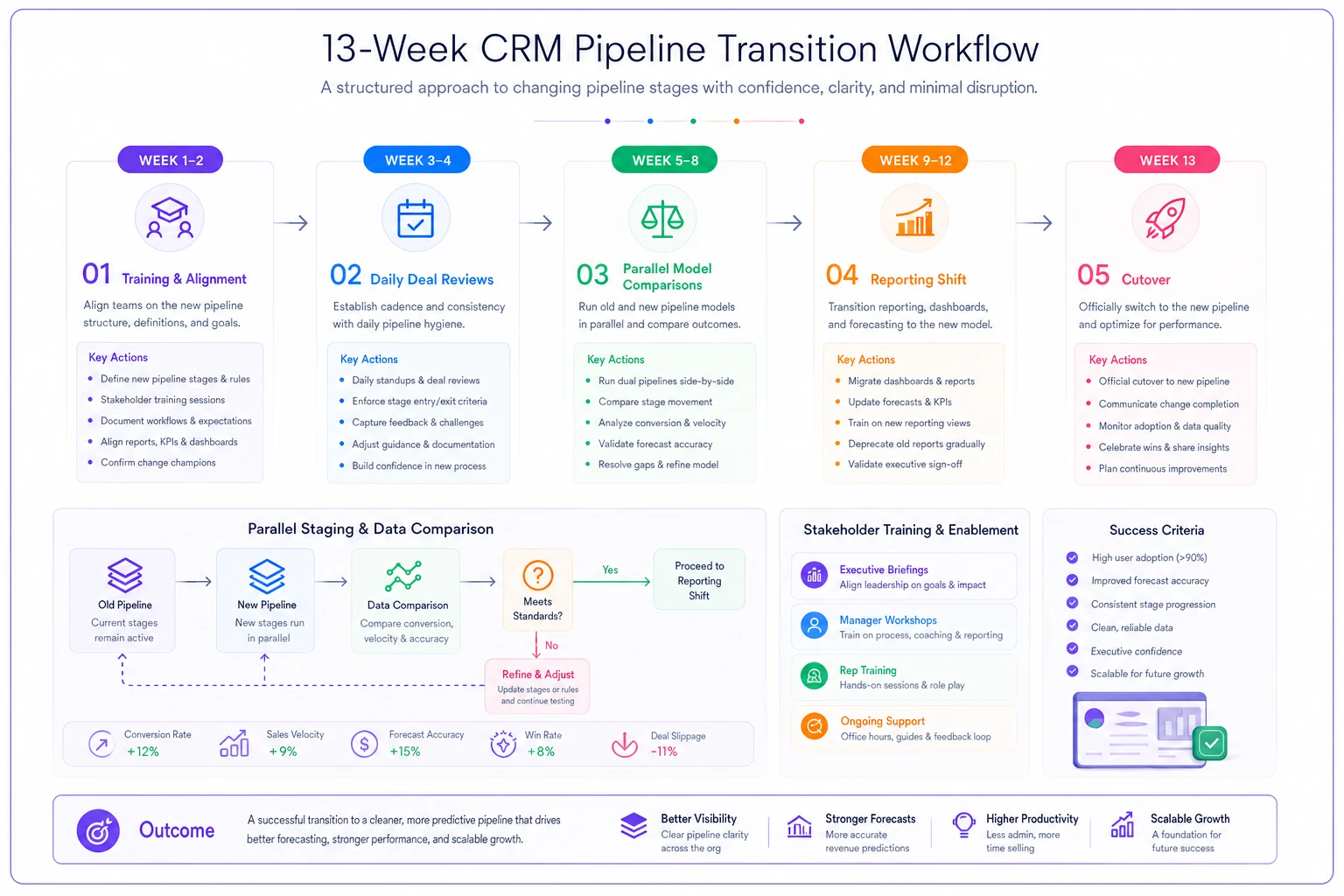
Week 1–2: Train the team on new definitions. Run sessions where everyone categorizes the same 10 deals. Talk through the discrepancies. Get real alignment, not just acknowledgment.
Week 3–4: Start daily deal reviews using new stages. Don't change the CRM yet—use a spreadsheet if needed. Focus on consistent categorization before touching systems.
Week 5–8: Run both models in parallel. Compare forecasts. The new model will almost certainly show lower pipeline value. That's a good sign. It's more accurate.
Week 9–12: Gradually shift reporting to the new model. Keep old reports available but start making decisions based on new data.
Week 13: Full cutover. Archive old stages, implement new ones.
During this transition, edge cases will surface. Renewals. Upsells. Multi-year deals. Document them and create specific rules. The goal isn't a perfect taxonomy—it's consistency.
This diagram illustrates the staged rollout and parallel running of old and new models.
The goal isn't a perfect taxonomy—it's consistency.
The technical validation problem
One area that trips up almost every B2B company: technical validation. Your product needs integration work, or a security review, or a pilot. Where does that live?
Most companies try to force it into existing stages. "Just make it part of Solution Fit." But technical validation has its own timeline, stakeholders, and risks. Burying it inside another stage makes those deals invisible in your forecast.
A parallel track works better:
-
Not Required (deal proceeds normally)
-
Validation Planned (reduces close probability by 20%)
-
Validation In Progress (extends timeline by 3–4 weeks)
-
Validation Complete (returns to normal probability)
This keeps your commercial stages clean while acknowledging technical reality. A deal can be in Contract Negotiation commercially while still in Validation In Progress technically. Your forecast reflects both dimensions without distorting either.
Getting customer success involved early
Pipeline stages typically stop at Closed Won. For ARR businesses, that's where the real work starts. Implementation, adoption, expansion—these determine actual revenue recognition and future growth.
Extend your stages past signing:
Onboarding (Days 0–30)
-
Entry
Contract executed
-
Exit
First value delivered
-
Validation
Usage data confirms activation
Adoption (Days 31–90)
-
Entry
Initial value delivered
-
Exit
Steady-state usage achieved
-
Validation
Health score above threshold
Expansion Qualified (Days 91+)
-
Entry
Usage approaching limits
-
Exit
Expansion conversation started
-
Validation
Growth opportunity documented
These post-sale stages feed back into your forecast model. Deals stuck in Onboarding signal churn risk. Fast Adoption progression predicts expansion. You're not just forecasting new business—you're forecasting the full revenue lifecycle.
Real scenario: fixing forecasts at a 50-person SaaS company
A project management software company was consistently missing quarterly targets by 20–30%. They were around $8M ARR, targeting $12M. Pipeline showed roughly $4M in opportunities each quarter, but only $2.5–3M would actually close.
The diagnosis was the classic pattern: inconsistent stage definitions. Their "Evaluation" stage included everything from initial demos to full proof-of-concept projects. Some deals sat there for six months. Others jumped straight to "Negotiation" after one call.
They implemented the framework above with one modification—they added a "Proof of Concept" stage between Solution Fit and Commercial Proposal, which matched their actual process where most deals required a 30-day trial before any commercial discussion.
The transition took about 10 weeks. First quarter with the new stages, forecast accuracy improved to within 8% of actual. More importantly, they could finally see where deals were getting stuck. Turns out most stalls happened during POCs when internal champions left or projects got deprioritized. That visibility let them focus on the actual problem—POC success—instead of just generating more pipeline.
By quarter three they were forecasting within about 5% and had improved their POC-to-close rate from 35% to 55% through better POC management. The stages didn't just improve reporting—they surfaced a fixable operational problem.
Where operational software makes the difference
Clean stage definitions are just the starting point. The harder challenge is maintaining consistency as your team grows. This is where AI-powered operational software becomes genuinely useful—not as a magic fix, but as an enforcement mechanism for the process you've designed.
Modern platforms can automatically validate stage progression based on actual activity data. Did the rep send a proposal? The system knows. Has procurement been looped in? The system tracks it. These platforms turn your stage definitions from guidelines into guardrails.
The AI component helps surface patterns that are hard to catch manually. Maybe deals from financial services companies consistently need an extra security review stage. Maybe deals over $100K ARR need executive sponsor involvement earlier than your standard process calls for. With enough deal history, these patterns become visible and actionable.
The real operational value comes from connecting pipeline stages to actual work. When a deal enters Contract Negotiation, the platform triggers legal review workflows, creates implementation planning tasks, and notifies customer success. Stages become more than forecast categories—they become triggers for the next right action.
This isn't about replacing judgment. It's about making sure that judgment gets applied consistently across the team. When every rep follows the same definitions, validated by the same system, your forecasts stop being guesses.
The bottom line on stage definitions
Your pipeline stages are the foundation of revenue predictability. Get them wrong, and every forecast is fiction. Get them right, and you can actually plan.
The key isn't complexity—it's clarity. Every stage needs unambiguous entry and exit criteria. Every deal needs to follow the same progression. Every exception needs to be documented, not improvised.
Start with the framework above, but adapt it to how deals actually move through your organization. Don't force your process into generic CRM defaults.
And treat this as an operational problem, not just a reporting one. When a deal moves stages, work should happen. Systems should trigger. Teams should know what's expected of them next.
That's when pipeline stages stop being arbitrary labels and start driving actual execution.
Your pipeline stages are the foundation of revenue predictability. Get them wrong, and every forecast is fiction. Get them right, and you can actually plan.
The key isn't complexity—it's clarity. Every stage needs unambiguous entry and exit criteria. Every deal needs to follow the same progression. Every exception needs to be documented, not improvised.
Ready to transform your customer relationships?
Join 2,000+ businesses using Rellyly to increase sales, improve client retention, and simplify CRM workflows.