


Most sales teams treat stalled deals like they're all the same. They send identical "checking in" emails, make generic "circling back" calls, and watch their conversion rates stay stuck around 8-12%.
But stalled deals aren't uniform. A deal stuck because of budget committee delays needs completely different treatment than one caught in legal review or derailed by a champion leaving. Most teams don't make this distinction - they run the same sequences regardless.
Looking at re-engagement patterns across about 400 B2B organizations, teams that sort their stalled deals by specific reasons and match their outreach accordingly see recovery rates jump to 28-35%. It's not about sending more emails or writing better subject lines. It's about matching the right approach to the actual problem.
The stall reason taxonomy that actually maps to recovery tactics
Deal stalls fall into seven main buckets. Each has its own recovery dynamics.
Budget-blocked stalls happen when the money exists but gets trapped in bureaucracy. Approved budgets sit in allocation committees. Priorities get debated. Fiscal year timing creates artificial delays. The deal isn't dead, just stuck in financial red tape.
Champion turnover stalls occur when your internal person leaves, gets moved, or loses influence. The business need remains but your human connection disappears. Often looks like ghosting but it's actually organizational shuffling.
Technical evaluation loops create endless proof-of-concept cycles, security reviews, integration questions. The prospect stays engaged but can't break out of their own evaluation maze. Engineering wants more demos, security needs more docs, IT wants integration specs.
Competing initiative conflicts emerge when other projects suddenly take priority. Your solution might be perfect, but if they just announced layoffs or pivoted strategy, your deal gets shelved.
Legal and compliance quicksand happens when contracts enter legal review and vanish into revision hell. Two-week turnarounds become two-month negotiations. Standard terms become marathon rewrites.
Executive approval delays occur with deals needing C-suite sign-off that can't get calendar time. Business case approved, budget secured, but that final signature stays "two weeks away" for months.
Price or value misalignment emerges when initial enthusiasm hits commercial reality. They like the solution but can't justify the cost. Different from budget issues - this is a fundamental value equation problem.
Each type needs different handling. Budget-blocked deals need financial reframing. Champion turnover needs relationship rebuilding. Technical loops need proof simplification.
Cadence design that matches stall physics
Standard follow-up sequences ignore stall-specific dynamics. A proper re-engagement approach maps each stall reason to customized outreach patterns.
Never miss a customer touchpoint again.
Rellyly helps you manage contacts, tasks, and sales efficiently in one platform.
- Unified customer profiles
- Automated follow-ups
- Sales pipeline tracking
No credit card required
Budget-blocked deals should sync with fiscal rhythms. Start outreach 45-60 days before their budget cycles. Focus messages on ROI docs, peer data, payment flexibility. Run longer sequences - 4-6 months with monthly touches that get more financially specific.
Early messages share cost-saving studies. Later ones offer payment plans or pilot options.
Champion turnover demands quick multi-threading. Compress cadences into 2-3 week sprints to find new stakeholders. Go broad - adjacent departments, previous meeting attendees. Each message tries to rebuild the internal coalition. Messaging shifts from maintenance to reintroduction.
Technical loops need evidence escalation. Each touch adds proof points, case studies, simplified demos. Week one gets a 5-minute overview. Week three provides compliance docs. Week five offers streamlined proof-of-concept. Goal isn't persuasion but complexity reduction.
Visual below maps how different stall types flow into customized re-engagement sequences.
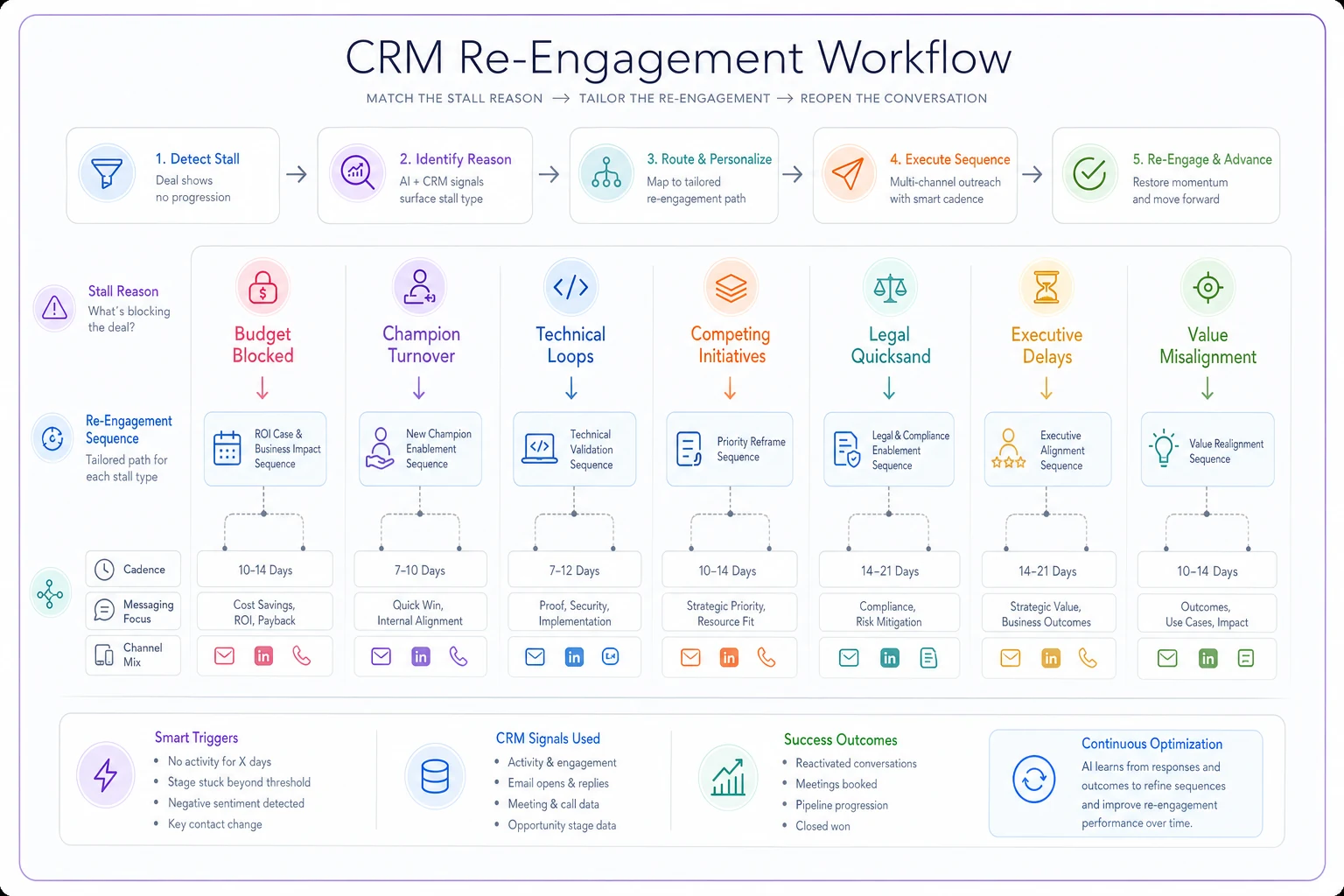
The matrix works like this:
| Stall Type | Sequence Length | Touch Frequency | Channel Mix | Message Focus |
|---|---|---|---|---|
| Budget-blocked | 4-6 months | Monthly | Email + LinkedIn | ROI proof, payment options |
| Champion turnover | 2-3 weeks | Every 3 days | Phone + Email + LinkedIn | Stakeholder discovery |
| Technical loops | 6-8 weeks | Weekly | Email + Slack/Teams | Proof escalation |
| Competing initiatives | 3-4 months | Bi-weekly | Email + Executive reach | Strategic alignment |
| Legal quicksand | 4-6 weeks | Twice weekly | Email + Phone | Contract simplification |
| Executive delays | 8-10 weeks | Weekly fade to bi-weekly | Email + Assistant engagement | Urgency creation |
| Value misalignment | 3-4 weeks | Every 4 days | Phone + Email | Reframing, alternatives |
Channel mix matters more than most realize. Budget talks often happen on LinkedIn where finance people hang out. Technical conversations move to Slack where engineers live. Legal needs phone calls to break email loops.
Measuring what actually predicts recovery
Most teams track the wrong stuff on stalled deals. Email opens, response rates, meeting bookings - these vanity metrics miss the signals that predict recovery.
Response sentiment shift shows early warming. Moving from "not right now" to "tell me more about X" signals progress even without meetings. Track language evolution in responses. Words like "interesting," "curious," or "wondering" indicate mental re-engagement before behavioral commitment.
Stakeholder expansion velocity tells you if you're breaking the stall. Count unique email domains responding, new people joining calls, LinkedIn views from the target company. Recovering deals typically show 2-3x stakeholder engagement compared to initial cycles.
Time-to-meaningful-response indicates momentum. Meaningful means more than "thanks for checking in" - actual questions, specific concerns, clear next steps. Deals recovering from stalls get meaningful responses within 14 days of targeted outreach. Those taking 30+ days rarely recover.
Internal activity resurrection tracks whether prospects are actually using your materials. Sharing documents internally, running trial reports, inviting colleagues to demos. This behind-the-scenes stuff predicts recovery better than direct communication.
One mid-market SaaS company discovered their "qualified re-engaged" definition captured false positives. Prospects taking meetings but showing no stakeholder expansion closed at 4%. Those with fewer meetings but increasing stakeholder involvement closed at 31%.
The timing experiments that revealed optimal re-engagement windows
Wrong timing kills re-engagement. Teams either jump too fast ("following up on yesterday's email") or wait too long (quarterly check-ins on dead deals). Testing reveals optimal windows vary dramatically.
Budget-blocked deals respond best 15-20 days before quarter-end and 30-45 days before fiscal planning. Prospects mentally revisit stalled initiatives when forced to think about budgets. One software company tested timing across 200 stalled deals - quarter-end minus 15 days generated 3.4x higher response rates than random timing.
Champion turnover needs immediate action. Within 72 hours of detecting the change. LinkedIn notifications, email bounces, org chart updates provide early warning. Every delay day reduces recovery probability by roughly 15%. After two weeks, recovery drops below 10%.
Technical evaluation loops work best with 7-10 day cycles early, extending to 14 days after the third touch. Shorter feels pushy to technical people. Longer loses momentum.
Competing initiative stalls need patient timing tied to external triggers. Monitor company news, earnings, leadership changes. Re-engage when strategic shifts create openings. A merger-stalled deal might reopen six months later when integration finishes.
Timing isn't universal - it's contextual. Budget delays need fiscal alignment. Champion changes need immediacy. Technical reviews need measured persistence.
The message frameworks that actually restart conversations
"Checking in" gets sub-3% response rates. Stall-specific frameworks acknowledging reality while providing new value get 15-25% meaningful responses.
For budget-blocked stalls, lead with peer data and flexibility:
"Noticed Q4 is approaching and wanted to share something interesting - three similar companies in your space found a way to fund this through operational budgets rather than capital. They're seeing 20% faster deployment since they bypassed the traditional approval chain. Would a conversation about alternative funding paths be helpful?"
Champion turnover requires acknowledging the change:
"Saw that Sarah moved to her new role at TechCo - she mentioned you might be the right person to continue our conversation about automating invoice processing. The problem she was solving (30+ hours monthly on manual reconciliation) presumably still exists. Worth a brief call to explore whether this still aligns with your priorities?"
Technical loops need aggressive simplification:
"Our last conversation got pretty deep into API specifications and security protocols. Stepping back - would it help to see a 15-minute sandboxed demo that shows just the core workflow without any integration complexity? No infrastructure needed on your end."
Value misalignment needs complete reframing:
"Been thinking about our last conversation where the full platform investment didn't align with your current scale. What if we approached this differently - would a pilot program focused just on your highest-pain workflow make more sense? Several companies your size started there and expanded after proving ROI."
Each framework acknowledges the specific stall instead of pretending it doesn't exist. Prospects appreciate honesty about why things stalled. Removes awkwardness and creates space for actual problem-solving.
The organizational mechanics of systematic re-engagement
Building this system requires more than templates and timing. The operational infrastructure determines whether it works or becomes ignored process.
-
Establish clear ownership for stalled deal recovery
-
Create dedicated "deal recovery specialists" for 30+ day stalls
-
Build stall-specific templates with 30-40% customization expectation
-
Set up automated triggers for timing-based re-engagement
-
Run weekly pattern reviews (not individual deal forensics)
-
Calculate recovery ROI by stall type for resource allocation
Someone must own recovery accountability. Some companies create dedicated specialists for deals stalled over 30 days. Others keep original rep ownership with specialized support.
Create stall-specific templates but avoid rigid use. Reps should customize 30-40% of each template for authenticity. Pure template usage cuts response rates in half compared to thoughtful customization.
Build automated triggers for re-engagement timing. Budget-blocked deals needing outreach 15 days before quarter-end should queue automatically. Manual tracking guarantees missed opportunities.
Run weekly stalled deal reviews focused on patterns, not individual forensics. Multiple legal review stalls suggests contract complexity issues. Champions consistently leaving after initial enthusiasm indicates poor coalition building.
Track recovery economics carefully. A $200k enterprise deal warrants different effort than a $2k monthly subscription. This math often reveals surprising insights about where effort should concentrate.
The process needs to be systematic without becoming mechanical. Classification guides approach but human judgment drives execution.
The AI-powered operational enhancement layer
Human judgment drives classification and message customization, but operational software can dramatically improve efficiency.
AI-powered deal management platforms automate stall detection by monitoring communication patterns, meeting attendance, and engagement metrics. These systems flag declining email responses, canceled meetings, and reduced stakeholder participation for review - typically catching stalls 10-15 days earlier than manual detection.
Intelligent timing optimization uses machine learning on historical patterns. Instead of fixed "every 7 days" rules, operational software analyzes response patterns across similar deals to suggest optimal timing. Technical evaluation at a 50-person startup needs different timing than the same stall at Fortune 500.
Message personalization becomes scalable when AI-assisted platforms help craft outreach. The system pulls recent company news, LinkedIn activity, industry trends to suggest relevant talking points. Reps still write messages but AI provides research that makes personalization feasible across dozens of opportunities.
Stakeholder mapping automation identifies new contacts when champions leave. The platform scans LinkedIn, company sites, organizational updates to suggest alternatives. When your champion moves, the system immediately suggests three other stakeholders who attended meetings or engaged with proposals.
Recovery prediction scoring helps prioritize effort. AI analyzes dozens of factors - time since stall, stakeholder engagement, company growth signals, competitive dynamics - to score recovery probability. Reps focus on high-probability recoveries instead of spreading effort evenly.
These workflow automation enhancements don't replace human judgment about which deals to pursue or recovery strategies. They eliminate manual research, timing, and tracking work that prevents teams from executing sophisticated playbooks.
The AI automation layer handles the operational complexity while preserving the human intelligence that makes recovery conversations work.
Stalled deals aren't one problem requiring one solution. They're distinct operational challenges with different recovery physics. The path from 10% to 30% recovery rates doesn't run through more aggressive follow-up or better templates. It requires systematic classification, matched cadences, and disciplined measurement.
Teams recovering the most stalled revenue classify immediately rather than generically, match tactics to specific stall reasons, and measure leading indicators instead of lagging outcomes. They've replaced "just checking in" with purposeful, timed, targeted recovery operations.
Deal recovery is a distinct operational discipline requiring its own workflows, metrics, and tools. It's not about working harder on dead deals - it's about working smarter on temporarily paused opportunities with genuine potential.
The difference between random follow-up and systematic recovery might be 20 percentage points of stalled pipeline. For most B2B companies, that's millions in recoverable revenue sitting in their CRM, waiting for the right approach to restart momentum.
Ready to transform your customer relationships?
Join 2,000+ businesses using Rellyly to increase sales, improve client retention, and simplify CRM workflows.