
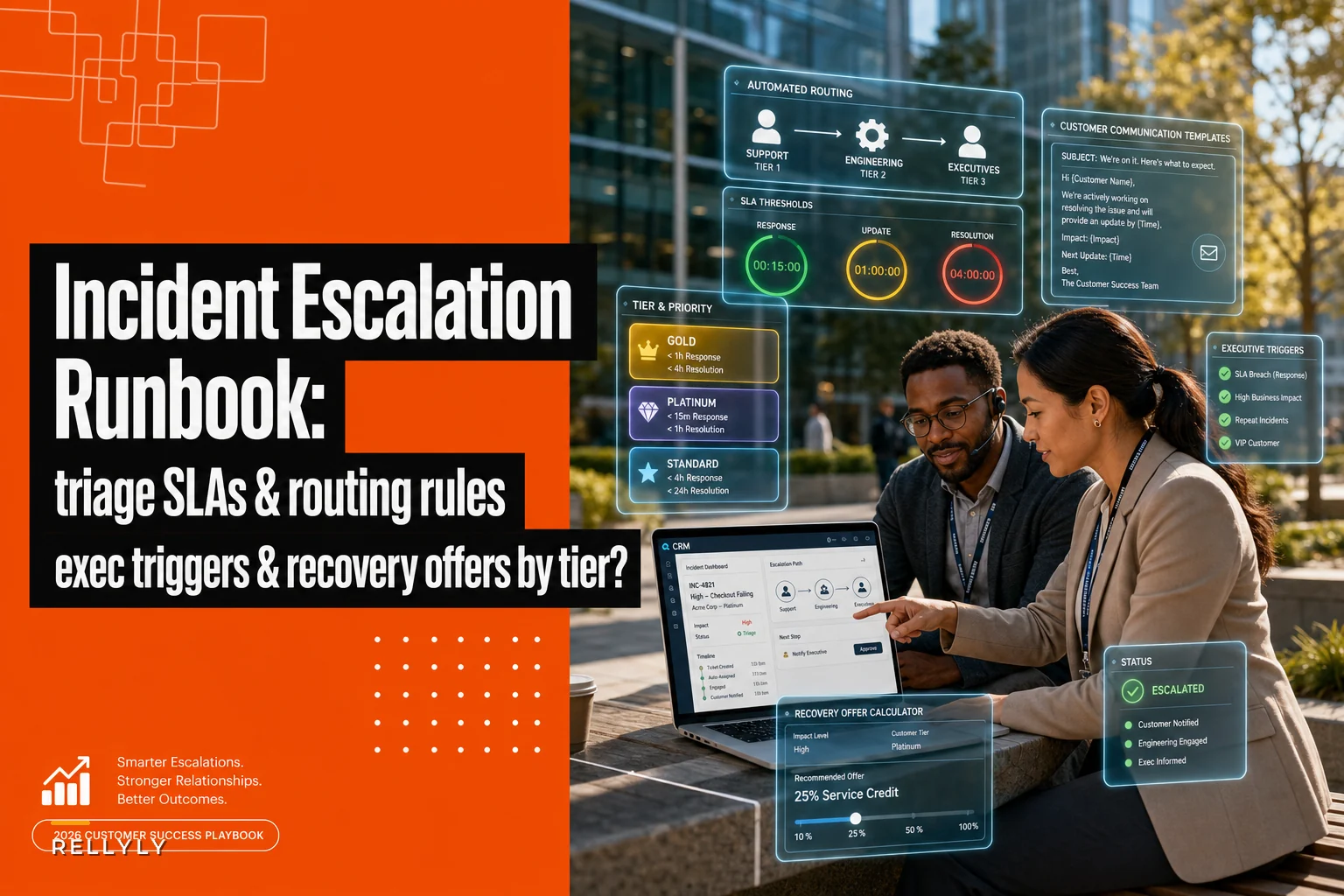

Your biggest customer just reported a critical issue. Their implementation is down. Revenue impact is $50k per hour. Your level-one support agent is staring at the ticket, unsure whether this qualifies for executive escalation.
Meanwhile, three other high-value accounts are experiencing minor issues. One CSM is writing a novel-length apology email while another is offering enterprise-level recovery credits to a startup on the basic plan.
This chaos happens because most CS teams don't have a real incident escalation playbook. Escalation decisions get made based on whoever screams loudest, not actual business impact. The result: executives get pulled into minor issues while genuinely critical problems sit in the queue, and recovery offers become random acts of generosity rather than strategic retention decisions.
The real cost of undefined escalation paths
Operating without clear escalation rules creates three distinct failures that compound over time.
First, response inconsistency destroys trust. When Account A gets instant executive attention for a login issue while Account B waits six hours on a data corruption problem, word spreads. Enterprise buyers talk to each other — at conferences, in Slack communities, during vendor evaluations. One bad incident story can quietly kill three potential deals.
Second, your team burns out. CSMs spend their days in reactive mode, never sure which issues actually need immediate attention. Every email feels urgent. Every Slack ping seems critical. That kind of operational anxiety leads to bad decisions and eventually turnover. Teams stuck in constant crisis mode churn through staff at a rate that's hard to recover from.
Third, recovery offers become expensive and inconsistent. Without a framework, individual CSMs make gut-reaction offers that vary wildly. One gives away three months of service for a two-hour outage. Another offers nothing after a full-day disruption. Those inconsistencies create precedent problems — customers learn to escalate aggressively because they've figured out that squeaky wheels get bigger credits.
Building your customer tier matrix
The foundation of any escalation playbook starts with customer segmentation, but not the generic enterprise/mid-market/SMB buckets most teams default to.
Never miss a customer touchpoint again.
Rellyly helps you manage contacts, tasks, and sales efficiently in one platform.
- Unified customer profiles
- Automated follow-ups
- Sales pipeline tracking
No credit card required
Real segmentation needs four data points: contract value, strategic importance, churn risk, and reference potential. A $500k/year customer locked into a three-year contract might actually be Tier 2, while a $200k customer approaching renewal with a vocal champion deserves Tier 1 treatment.
Here's how that looks in practice:
-
Tier 1 (Executive Response) - Annual contract value above $500k OR - Strategic logo with reference value OR - Renewal within 90 days above $250k OR - Multi-product expansion potential above $1M
-
Tier 2 (Senior Team Response) - Annual contract value $100k–$500k OR - Growth accounts with 50%+ expansion in the last 12 months OR - Industry influencer accounts regardless of spend
-
Tier 3 (Standard Response) - All other active customers - Pilot accounts under evaluation - Monthly contracts under $100k
The important detail here is the "OR" conditions. Traditional tiering uses "AND" logic that creates rigid, inflexible buckets. Dynamic tiering recognizes that a $50k customer who runs a popular industry podcast might deserve Tier 1 treatment during certain incidents.
Triage rules that actually work under pressure
Most triage frameworks fail because they require too much thinking during a crisis. Your team needs binary decision trees, not philosophical debates about severity levels.
Start with impact classification:
Critical (P0): Core functionality broken, data loss risk, security breach, or the customer's revenue/operations are directly affected. If they cannot conduct business, it's P0. No exceptions, no debates.
High (P1): Degraded performance affecting multiple users, workarounds available but painful, or specific workflows blocked. The customer can operate but with significant friction.
Medium (P2): Single user affected, cosmetic issues, or problems with easy workarounds. Business continues normally with minor inconvenience.
Low (P3): Feature requests, minor bugs, or edge-case issues. No immediate business impact.
Keep P0 definitions strictly binary to remove debate during initial triage.
Now combine tier and priority for response rules:
-
Tier 1 + P0 = Executive escalation within 15 minutes
-
Tier 1 + P1 = Senior team response within 30 minutes
-
Tier 2 + P0 = Senior team response within 30 minutes
-
Tier 2 + P1 = Standard escalation within 2 hours
-
Everything else follows standard SLA
Notice the overlap between Tier 1/P1 and Tier 2/P0? That's intentional. A critical issue for a mid-tier customer gets the same initial response as a high-priority issue for your largest account. This prevents the common mistake of under-responding to genuine crises just because the account is smaller.
SLA thresholds by customer tier
SLAs only matter when they trigger specific actions — not when they're just numbers sitting in a contract. Most companies set SLAs and forget about them until renewal negotiations.
Operational SLAs need three components: initial response, update cadence, and resolution commitment.
| Customer Tier | Issue Priority | First Response | Update Frequency | Resolution Target |
|---|---|---|---|---|
| Tier 1 | P0 | 15 minutes | Every 30 min | 4 hours |
| Tier 1 | P1 | 30 minutes | Every 2 hours | 24 hours |
| Tier 1 | P2 | 2 hours | Daily | 72 hours |
| Tier 2 | P0 | 30 minutes | Hourly | 8 hours |
| Tier 2 | P1 | 2 hours | Every 4 hours | 48 hours |
| Tier 2 | P2 | 4 hours | Daily | 5 days |
| Tier 3 | P0 | 2 hours | Every 4 hours | 24 hours |
| Tier 3 | P1 | 4 hours | Daily | 72 hours |
| Tier 3 | P2 | 24 hours | Weekly | 10 days |
What most playbooks skip entirely: breach protocols. What actually happens when you miss an SLA?
For Tier 1 breaches, automatic escalation goes to VP of Customer Success plus proactive customer notification with a recovery plan. For Tier 2, escalation goes to Director level with an internal review. Tier 3 breaches trigger a process review but don't necessarily require customer notification.
Update frequency is equally critical. Nothing frustrates enterprise buyers more than radio silence during an active incident. Even "no update yet, still investigating" beats nothing. Set calendar blocks for your team during active P0/P1 issues so updates actually happen on schedule.
Templated communications that don't sound robotic
Templates fail when they read like templates. But winging it during incidents creates inconsistent messaging and forgotten commitments. The fix is modular communication blocks that your team combines naturally depending on the situation.
Initial acknowledgment components:
-
Opening acknowledgment
- "We've received your report about [specific issue described in customer's words]" - "I can confirm we're seeing [specific symptoms] affecting your [specific workflow/users]"
-
Impact recognition
- "We understand this is blocking your [specific business process]" - "We recognize the urgency given your [specific deadline/event/situation]"
-
Next steps commitment
- "I'm escalating this to our infrastructure team immediately" - "Our senior engineering team is investigating with highest priority" - "[Name] from our technical team will join this thread within [specific time]"
-
Update components
- Status context: - "Quick update on the [specific issue] investigation" - "Progress report on your [system/feature] issue" - Current findings: - "We've identified [specific finding] as a contributing factor" - "Our investigation shows [specific technical detail]" - "We're seeing similar behavior in [specific scenario]" - Next actions: - "Next steps: [specific action with timeline]" - "We're now testing [specific solution]" - "Estimated update in [specific timeframe] after we complete [specific task]"
Train your team to pick components that fit the situation rather than copy-pasting entire scripts. A Tier 1 P0 pulls from every urgency-focused component available. A Tier 3 P2 can be more measured and educational about the investigation process.
Executive escalation triggers
Executive involvement should be strategic, not reactive. Some teams never escalate to executives, leaving major accounts feeling undervalued. Others escalate constantly, burning out leadership and making the escalation feel meaningless. Clear triggers remove the guesswork.
Automatic CEO/President escalation:
-
Any Tier 1 P0 unresolved after 4 hours
-
Multiple Tier 1 accounts affected simultaneously
-
Security breach affecting any customer data
-
Public complaint from a Tier 1 customer on social media
Automatic VP escalation:
-
Any Tier 1 P1 unresolved after 24 hours
-
Tier 2 P0 unresolved after 8 hours
-
Three or more Tier 2 accounts reporting the same issue
-
Customer explicitly requests executive involvement
Director escalation:
-
SLA breach for any Tier 1 or Tier 2 issue
-
Pattern of issues with the same customer (3+ in 30 days)
-
Customer threatens to churn or take legal action
One thing most teams miss: executive preparation. Don't just forward the ticket. Build a one-page brief that includes:
-
Customer context (contract value, renewal date, key stakeholder names)
-
Issue timeline with all actions taken
-
Proposed resolution and recovery offer
-
Talk track for the executive conversation
That preparation is the difference between a scrambling executive trying to piece together what happened versus a confident leader who walks into the conversation already armed with a solution.
Recovery offers by tier and impact
Recovery offers shouldn't be improvised negotiations. When CSMs make up compensation on the spot, you get inconsistency that becomes precedent. One customer tells another about the generous credit they received, and suddenly everyone expects the same treatment for minor issues.
| Customer Tier | Issue Type | Service Impact | Recovery Offer |
|---|---|---|---|
| Tier 1 | P0 - Full outage | 4+ hours | 1 month service credit + executive follow-up |
| Tier 1 | P0 - Full outage | 1–4 hours | 2 weeks service credit |
| Tier 1 | P1 - Degraded service | 24+ hours | 1 week service credit |
| Tier 1 | SLA breach | Any | Custom recovery plan |
| Tier 2 | P0 - Full outage | 8+ hours | 2 weeks service credit |
| Tier 2 | P0 - Full outage | 2–8 hours | 1 week service credit |
| Tier 2 | P1 - Degraded service | 48+ hours | 3 days service credit |
| Tier 3 | P0 - Full outage | 24+ hours | 1 week service credit |
| Tier 3 | P0 - Full outage | 4–24 hours | 3 days service credit |
One critical detail: recovery offers should be proactive, not reactive. Don't wait for the customer to ask for compensation. When you offer appropriate recovery before they demand it, you flip a negative experience into a trust-building moment. The customer remembers that you showed up without being pushed.
For Tier 1 accounts, recovery goes beyond credits. Consider:
-
Executive business review to address root cause
-
Priority feature requests fast-tracked
-
Dedicated technical resource for 30 days
-
Invitation to the customer advisory board
These non-monetary recoveries often matter more to enterprise accounts than a billing credit ever would.
Implementing escalation workflows in your operational stack
The best incident escalation playbook is worthless if your team can't execute it consistently under pressure. Manual processes break down fast. That CSM who memorized every escalation rule? They're on vacation when your biggest customer hits a crisis.
This is where AI-powered operational software changes incident management from reactive scrambling to systematic response. Instead of CSMs making judgment calls about tier classification and escalation triggers, your operational platform automatically routes incidents based on your defined rules.
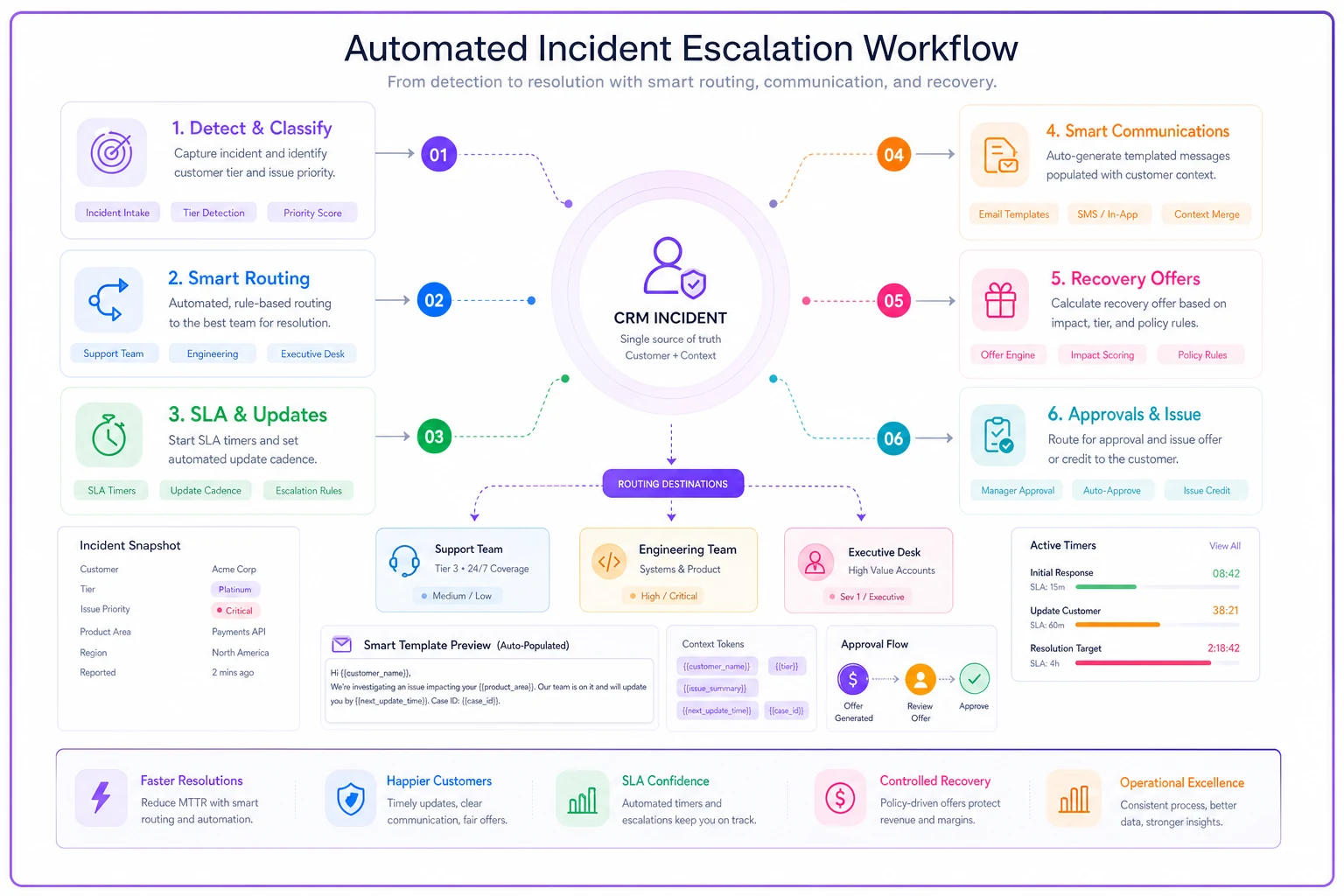
When a Tier 1 customer reports a P0 issue, AI automation can immediately trigger the full response workflow: executive notification, engineering escalation, communication templates pre-populated with customer context, and SLA countdown timers. Your team stays focused on solving the problem, not managing the process.
The coordination piece matters even more during complex incidents. Automating recurring check-ins without burning customers: throttling rules and escalation triggers covers how systematic follow-up prevents issues from escalating in the first place. When that's integrated with your incident escalation playbook, automated check-ins can surface problems before they ever reach P0.
Recovery offer standardization through operational software also eliminates the awkward on-the-spot negotiations that create inconsistency. The platform calculates the appropriate recovery based on your matrix, generates approval workflows for anything above standard, and tracks precedent so similar situations get consistent treatment.
Common escalation failures to avoid
The hero complex failure. One senior CSM becomes the unofficial escalation point for all major issues. They know every customer, remember every precedent, handle every crisis. It works — until they burn out, quit, or take a two-week vacation. Then everything collapses. Build systems, not heroes.
The crying wolf failure. Teams that escalate everything to seem responsive actually reduce executive impact over time. When your CEO gets pulled into five "critical" issues every week, none of them feel critical anymore. Reserve executive escalation for situations with genuine business impact.
The precedent amnesia failure. Without tracking what recovery offers you've made previously, every incident turns into a fresh negotiation. That customer who got three months credit for a two-hour outage? They'll expect six months next time. Document every recovery offer and reference it when the next incident comes up.
Building your short-run escalation runbook
Start with customer tiers, but keep it to three maximum. More than that creates confusion during crisis moments.
Define binary triage rules. If your team is still debating whether something is P1 or P2 after 30 seconds, your definitions need work.
Create modular communication templates, not rigid scripts. Train your team to combine components based on the situation, not paste from a form.
Set escalation triggers that remove individual judgment. "Should I escalate this?" should never be a question during an active incident.
Build recovery matrices before you need them. Negotiating compensation in the middle of a crisis leads to expensive, inconsistent mistakes.
Most importantly, get all of this embedded in an operational platform that enforces the rules automatically. An incident escalation playbook that lives in a PDF nobody reads is just documentation theater. It should be built into your daily operational workflow where AI automation ensures consistent execution regardless of who's on shift.
Similar to how when deals stall: a reason-driven re-engagement cadence matrix to recover mid-funnel opportunities systematizes sales recovery, your incident escalation playbook should systematize how your team responds to customer crises.
The companies that actually maintain customer trust through inevitable technical issues don't have better infrastructure. They have better incident response operations. They've turned crisis management from heroic scrambling into repeatable execution.
Your customers don't expect perfection. They expect a professional response when imperfection happens. A proper incident escalation playbook delivers exactly that.
Ready to transform your customer relationships?
Join 2,000+ businesses using Rellyly to increase sales, improve client retention, and simplify CRM workflows.