
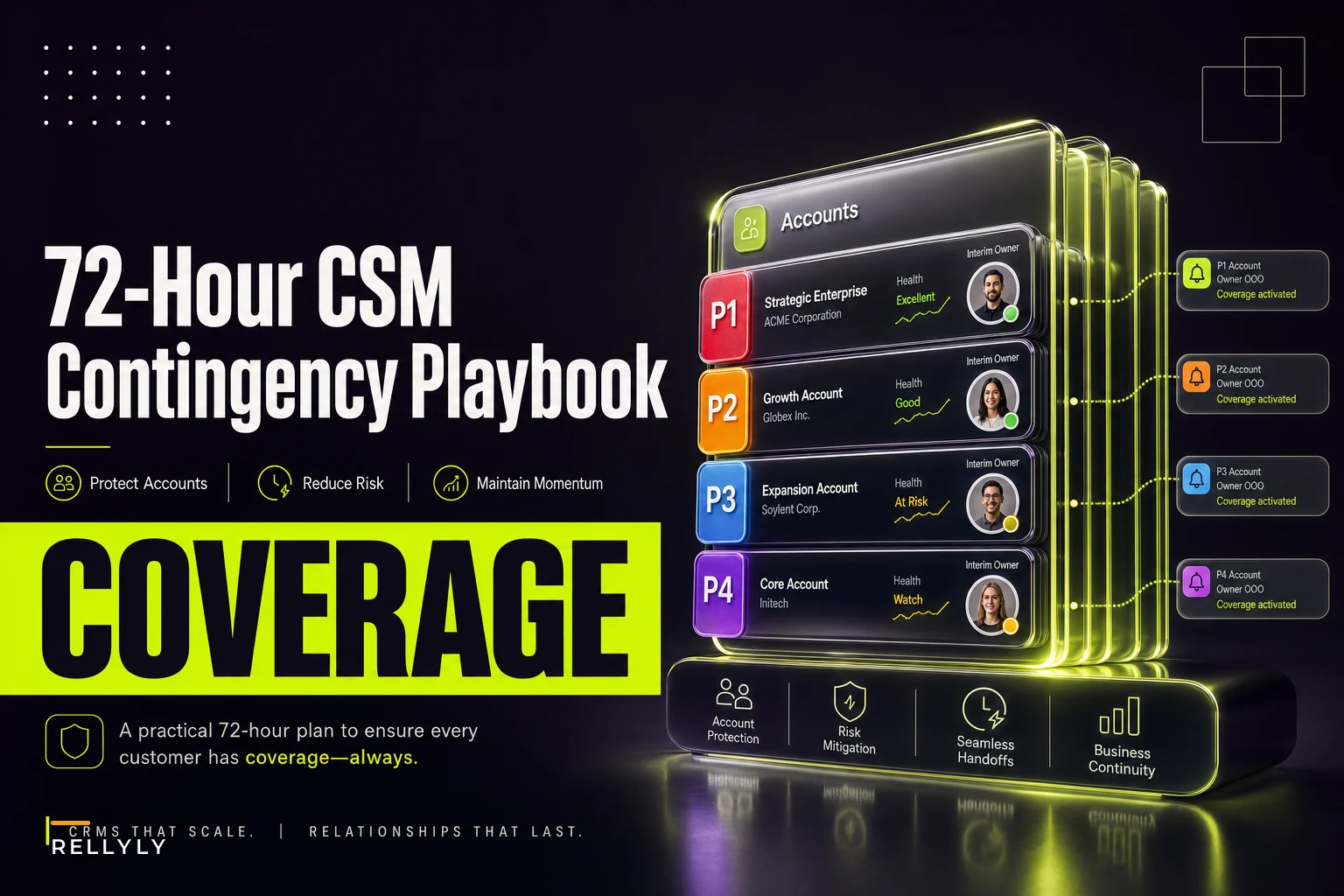

A CSM goes out cold on a Tuesday — hospitalization, family emergency, a resignation that gets escalated to "leave today." Their calendar has 14 accounts, three of which are mid-renewal, and one is an enterprise logo threatening to escalate if their integration bug isn't fixed by Friday. Nobody else knows the account context. The Slack DMs die with the person who's gone. The clock on your SLAs keeps running like nothing happened.
That gap — the first 72 hours — is where most retention damage actually happens. Not because the team is incompetent, but because nobody agreed in advance who owns what, which accounts get touched first, and what a customer should hear before they notice the silence.
This is a tight runbook for exactly that window. No org-chart theory, no "build a culture of resilience." Just the moves that keep SLAs intact and stop a temporary absence from turning into a churned account.
Why the first 72 hours break coverage (and it's rarely the workload)
The failure isn't that there's too much to do. It's that the work is invisible until someone tries to pick it up.
When one person owns an account end to end, the actual state of that relationship lives in three places that don't transfer: their inbox, their memory, and a couple of half-updated CRM fields. So when they're suddenly gone, whoever gets handed the book is starting from zero on accounts that have months of context behind them.
There's a pattern that shows up almost every time: the team spends the first day just figuring out which accounts are actually at risk instead of working the risk. By the time someone realizes the mid-market renewal was 11 days out and the customer already sent an unanswered pricing question, you've burned a third of your window on diagnosis.
The other quiet killer is the notice problem. Customers don't churn because their CSM changed. They churn because they emailed on Wednesday, heard nothing by Friday, and concluded nobody's minding the account. Silence reads as neglect. And in a coverage gap, silence is the default unless you actively fight it.
The triage cut: sort the book in 30 minutes, not a day
Before anyone touches a single account, the book gets sorted. The goal is a fast, ruthless pass — you're not building a perfect risk model, you're deciding who gets attention in the next 72 hours and who can wait.
Never miss a customer touchpoint again.
Rellyly helps you manage contacts, tasks, and sales efficiently in one platform.
- Unified customer profiles
- Automated follow-ups
- Sales pipeline tracking
No credit card required
Here's the triage cut that works. It maps every account to one of four tiers based on two questions: how time-sensitive is it and how much revenue is exposed.
| Tier | Trigger condition | Response window | Who owns it |
|---|---|---|---|
| P1 – Critical | Open renewal <30 days, active escalation, or churn-risk flag | Contact within 4 hours | Manager or senior CSM directly |
| P2 – Exposed | High ARR, no immediate deadline but recent unresolved thread | Contact within 24 hours | Assigned backup CSM |
| P3 – Stable | Healthy usage, no open threads, no near-term renewal | Notice within 48 hours | Pooled coverage |
| P4 – Low-touch | Small ARR, self-serve, no signals | Standard notice, no live outreach | Automated notice only |
The mistake teams make is over-weighting ARR. A $90k account that's healthy and 8 months from renewal is not your first call. A $22k account that's 12 days from renewal and sent a frustrated email last week is. Time-sensitivity beats account size in a 72-hour window almost every time — the damage you're preventing is time-bound.
One practical rule: cap P1 at whatever your covering person can genuinely handle in a single day.
If your triage produces 11 P1 accounts, your triage is wrong. Re-sort. Real P1s are the ones where not acting in hours causes irreversible damage.
Visualizing this flow clarifies who acts and when.
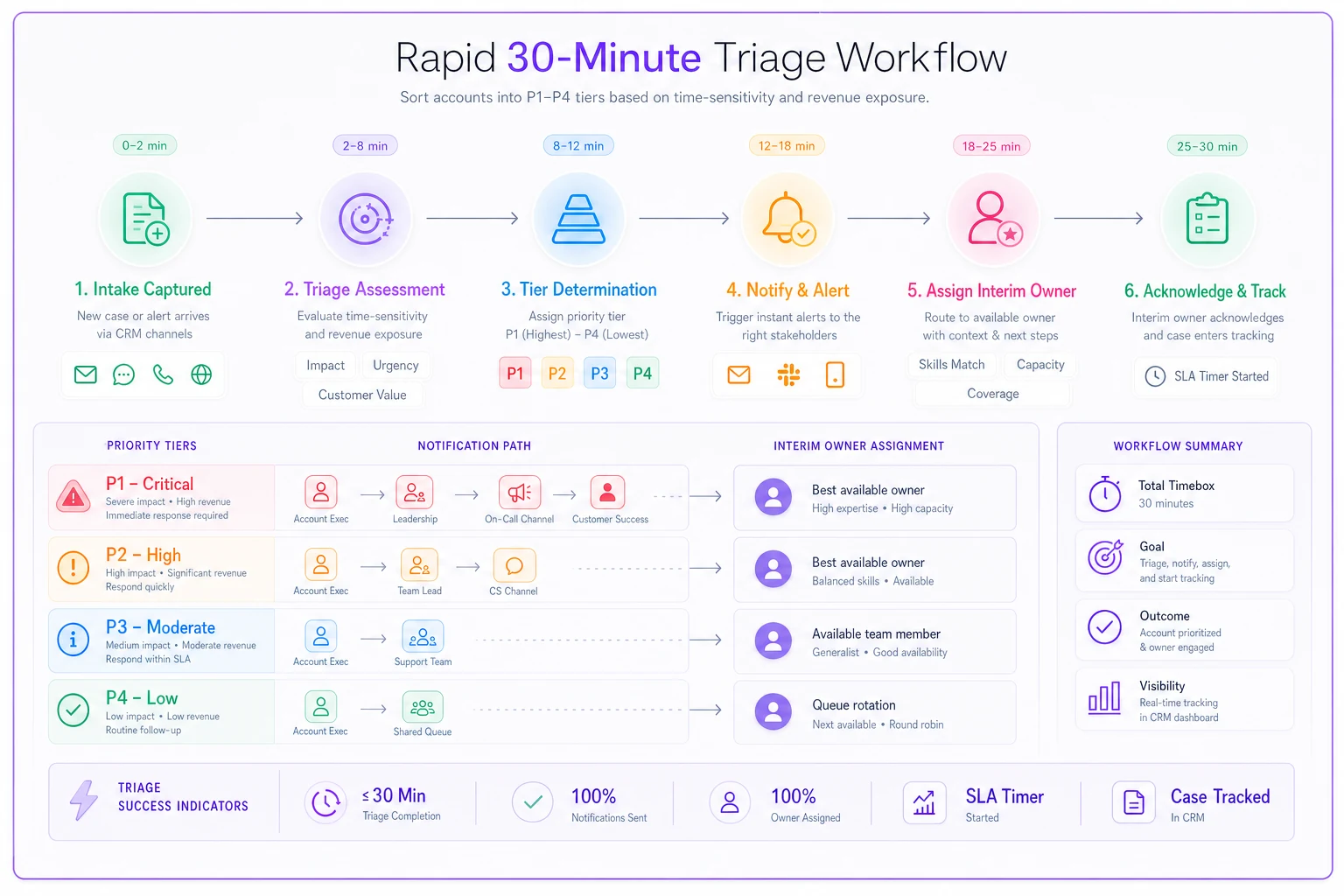
Time-sensitivity beats account size in a 72-hour window almost every time — the damage you're preventing is time-bound.
Automated client notices: what customers hear before they notice silence
The single highest-leverage move in the first hour is getting the right notice out to the right tier. Not a mass "your account manager has changed" blast — those often create anxiety where none existed.
-
P1 accounts get a personal note from the covering senior person or manager. Named individual, direct line, and a specific reference to their open issue. "I'm covering your account this week and I've already pulled up the integration ticket — here's where it stands." Context signals control.
-
P2 accounts get a warm but lighter note from the backup CSM, introducing themselves and inviting the customer to reach out. No mention of "your CSM is out" — just "I'm working with your account this week alongside the team."
-
P3 and P4 get a short, templated status note only if they have an open thread. Otherwise nothing, because a notice about a change they'd never have noticed just creates unnecessary noise.
The tone rule that matters: don't apologize for something the customer hasn't experienced yet. A notice that opens with "we apologize for any disruption" creates the perception of disruption. Lead with continuity, not contrition.
This is also where sane automation earns its place. Sending tiered notices manually under pressure is exactly how P2 accounts get missed. Setting up throttled, tier-based outreach so nobody gets spammed and nobody gets forgotten is the same discipline covered in automating recurring check-ins without burning customers — the difference in a contingency is that the trigger is a coverage gap instead of a calendar interval.
Interim ownership rules: temporary, explicit, and reversible
The messiest part of any coverage gap is decision authority. Who can approve a credit? Who can commit to a fix date? Who signs off on a concession to save a renewal? When that's unclear, one of two bad things happens: either nobody decides and the account stalls, or someone over-commits and you're cleaning it up for weeks.
-
Assign a single named interim owner per P1/P2 account. Not a team, not a channel — one person whose name the customer sees and who is accountable for the next 72 hours.
-
Define the decision ceiling. Interim owners can approve up to a set threshold (a service credit up to a fixed dollar amount, or a support-priority bump) without escalation. Above that, it goes to the manager. This stops both paralysis and overreach.
-
Set an explicit expiry. Interim ownership ends when the original CSM returns or at a hard date, whichever comes first. Temporary rules that don't expire become permanent confusion.
-
Log every commitment made to the customer. Any date, promise, or concession the interim owner gives goes into a shared record immediately — because the returning CSM needs to honor it, and they won't know it exists otherwise.
The pattern that quietly wrecks handbacks: an interim owner makes a verbal promise ("we'll have that fixed early next week"), it never gets logged, the original CSM comes back, the customer references the promise, and the CSM has no idea what they're talking about. That single dropped thread can undo everything the coverage did right.
Temporary ownership needs to be written down before the crisis, not improvised during it.
The interim status packet: the one document that makes this work
Everything above depends on one artifact — a lightweight status packet per priority account that lets a covering person walk in cold and sound like they've been there all along.
This is not a full account plan. It's a one-screen brief. If it takes more than a few minutes to read, it's too long to be useful during a triage.
What goes in it:
-
Current state in one line — "Renewal in 12 days, leaning positive, blocked on a pricing question from Nov 3."
-
Open threads — every unresolved email, ticket, or promise, with dates.
-
The people — who the actual decision-maker is versus who you've been emailing.
-
Landmines — anything sensitive. "Don't mention the outage from last month, still a sore spot."
-
Next action — the single most important thing to do in the next 24 hours.
The uncomfortable truth: most teams can't produce this packet in a crisis because the underlying information was never captured anywhere. It only lives in the absent person's head. The fix isn't heroics during the emergency — it's making the packet a byproduct of normal work, so it's already 80% there when you need it.
That's the same principle behind how small sales teams cut lead-to-activation time with a task-orchestration playbook — when the state of the work lives in the system instead of in one person's inbox, handoffs stop being a scramble. Contingency coverage is really just an emergency handoff, and it succeeds or fails on the same thing: whether the context was captured before it was needed.
A real scenario: the mid-market book that didn't churn
A B2B SaaS company, roughly 40-person team, had a CSM go out on unplanned medical leave with about 18 accounts. Two were mid-renewal, combined ARR somewhere around $130k. Total book value in the low seven figures.
Their first instinct — before any of this was in place — would have been the manager triaging by memory, DMing whoever had bandwidth, and hoping nothing slipped. The renewal customer's unanswered pricing email had already been sitting for four days.
What they actually did: ran the triage cut in about 30 minutes, flagged the two renewals and one escalation as P1, and got personal notices out within the first few hours. The covering senior CSM had a rough status brief on each P1 account — not perfect, but enough to reference the open pricing thread by name on the first call. The customer's read was "they're on top of this," not "my contact vanished."
Both renewals closed. One came in roughly on time; the other slipped about a week but held. The escalation got a same-day acknowledgment and a fix committed inside the interim owner's decision ceiling, no manager bottleneck required. Nothing in the P3/P4 tier needed live attention.
The honest takeaway wasn't that the coverage was flawless — a couple of P2 accounts got lighter touch than ideal. It was that the priority accounts, the ones where 72 hours of silence would have been fatal, never went dark.
When this playbook actually makes sense — and when it's overkill
This is built for a specific situation: an unplanned, short-duration gap where a real book of accounts is exposed. It's worth the setup if you have named-account CSMs carrying meaningful ARR, and if a single person's absence genuinely creates risk.
When it's overkill: if your model is fully pooled and self-serve, and no single account depends on one person's context, you don't need interim ownership rules — you need a support queue. Don't build ceremony around a problem you don't have.
Who should not run this as-is: very early teams where the "CSM" is also the founder. In that case the gap isn't a coverage problem, it's a business-continuity problem, and the answer is documentation and shared logins, not a triage tier system.
The tell that you do need this: every time someone goes on vacation, there's a low-grade panic about who's watching their accounts. That recurring anxiety is the symptom. The runbook is the treatment.
The one thing to set up before you need it
You can't build this during the emergency. The triage tiers, the notice templates, the decision ceilings, the status-packet format — all of it has to exist before the Tuesday call. The teams that ride out coverage gaps cleanly aren't faster under pressure; they just moved the hard thinking to a calm week.
Pick one afternoon. Draft the four-tier triage rules for your book, write the three notice templates, set the decision ceiling for interim owners, and agree on what a one-screen status packet looks like. Then make the packet a normal habit, not a crisis document. When the gap comes — and over a long enough stretch, it always does — you'll be working the risk in hour one instead of still trying to figure out where it is.
Pick one afternoon. Draft the four-tier triage rules for your book, write the three notice templates, set the decision ceiling for interim owners, and agree on what a one-screen status packet looks like. Then make the packet a normal habit, not a crisis document. When the gap comes — and over a long enough stretch, it always does — you'll be working the risk in hour one instead of still trying to figure out where it is.
Ready to transform your customer relationships?
Join 2,000+ businesses using Rellyly to increase sales, improve client retention, and simplify CRM workflows.