

Most revenue teams don't struggle with whether to use AI in their workflows. They've already got lead scoring, churn prediction, next-best-action suggestions, auto-drafted emails, and renewal risk flags running somewhere in the stack. The real problem shows up later — when a model quietly sends a 15% discount offer to an account that was never at risk, or suppresses a renewal outreach on a six-figure account because a health score dipped for the wrong reason.
That's the gap this article is about. Not whether the model is accurate, but what the model is allowed to do on its own, and what has to pass through a human first. The difference between a mature revenue operation and a chaotic one usually isn't model quality. It's governance. Specifically, whether the team has drawn a clear line between reversible and irreversible actions, and tied that line to real ARR impact.
Why the "accuracy" conversation misses the point
Teams spend months arguing about whether a model is 82% accurate or 88% accurate, as if those two percentage points are what's keeping them up at night. They aren't. What keeps revenue leaders up at night is consequence asymmetry.
A model that recommends which accounts to call today can be wrong half the time and cost you almost nothing, because a wrong call is still a call, and reps filter in real time. But a model that auto-applies account credits, auto-sends cancellation confirmations, or auto-changes a contract renewal date can be right 95% of the time and still blow up a quarter — because the 5% includes actions nobody can cleanly undo.
So the governing question isn't "how good is the model." It's "what happens when this specific action is wrong, and how hard is it to reverse?"
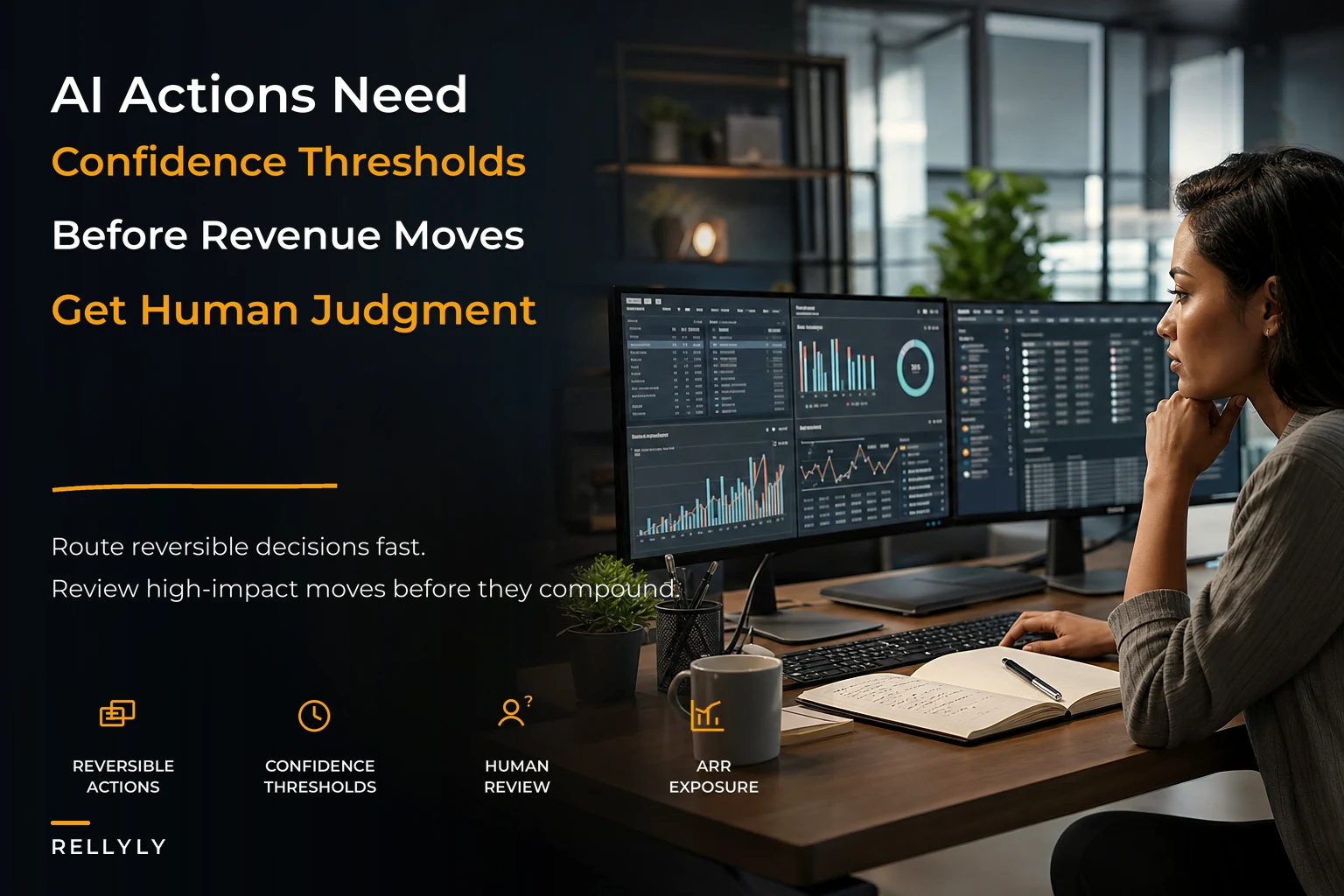
Once you frame it that way, the design falls out naturally. Reversible, low-impact actions should run automatically at high volume. Irreversible or high-ARR actions should require a human, no matter how confident the model is. And a big messy middle needs a routing system that decides based on confidence and dollar exposure together.
The core decision: reversible vs irreversible, not high-risk vs low-risk
"Risk" is too fuzzy to govern with. Two things make an action safe to automate: can you undo it, and how much money is on the line if you're wrong. Score every AI-driven action on those two axes and most of your decisions make themselves.
Never miss a customer touchpoint again.
Rellyly helps you manage contacts, tasks, and sales efficiently in one platform.
- Unified customer profiles
- Automated follow-ups
- Sales pipeline tracking
No credit card required
-
Fully reversible, low ARR exposure — logging an activity, updating a lead score, drafting (not sending) an email, surfacing a suggestion. Let it run.
-
Reversible with friction, moderate exposure — sending a templated nurture email, creating a task for a rep, adjusting a non-contractual health flag. Automate with sampling and audit.
-
Hard to reverse, meaningful exposure — applying a discount, pausing outreach to an at-risk renewal, triggering a win-back offer with a real dollar value. Human review required.
-
Effectively irreversible, high ARR exposure — anything touching contract terms, cancellations, credits above a threshold, or exec-level communications. Human signature, always, with a second approver above a dollar line.
The mistake teams make is treating all AI output as one category. They either automate everything because "the model's good enough," or they route everything to a human queue because one bad incident scared them. Both are wrong. The first creates silent revenue leaks. The second creates a review queue so bloated that humans rubber-stamp everything — which is worse than no review at all, because now you've added latency and kept the risk.
A confidence-and-dollars decision table
This is the heart of the governance playbook. The rule is simple: the action an automated system is allowed to take depends on both model confidence and the ARR exposure of the account or decision. Neither alone is enough.
| Model confidence | Low ARR exposure (<$5k) | Moderate exposure ($5k–$25k) | High exposure (>$25k) |
|---|---|---|---|
| High (≥0.90) | Auto-execute, log only | Auto-execute, sample 10% for review | Route to human review queue |
| Medium (0.70–0.89) | Auto-execute reversible only; queue irreversible | Human review queue | Human review + second approver |
| Low (<0.70) | Suggest to rep, no auto-action | Suggest only, flag for coaching | Suppress action, escalate to owner |
A few things worth calling out here. Notice that a high-confidence action on a high-exposure account still goes to a human. Confidence doesn't buy you out of the dollar check. Teams get burned precisely because a model was extremely confident about an action on their biggest account — and confidence on edge cases is exactly where models tend to be overconfident.
Also notice the bottom-left cell. Even at low exposure, a low-confidence model shouldn't auto-execute. It should suggest. A wrong suggestion costs a few seconds of rep attention. A wrong auto-action costs trust in the whole system, and once reps stop trusting the automation, they start working around it — and then your clean data falls apart. This connects directly to broader thinking on what to automate and what to keep human — the thresholds here are a quantified version of that same judgment.
Designing the human-review queue so it doesn't become a graveyard
Routing an action to "human review" sounds responsible until you look at the queue three weeks later and find 2,400 items, nobody's touched it since Tuesday, and the SLA is a fiction. A review queue that isn't designed for throughput becomes a place where revenue goes to wait.
-
Every queued item carries context, not just a verdict. The reviewer should see the account, the ARR, the action proposed, the model's confidence, the top signals that drove it, and the reversal cost. If the reviewer has to go dig in the CRM to understand what they're approving, the queue is already failing.
-
Items expire with a default. Each queued action has a time-to-live and a defined fallback — either "do nothing" or "escalate to owner." A renewal-risk suppression that sits unreviewed for 48 hours should default to not suppressing, because the safe default is the status quo.
-
Volume caps per reviewer. If more than roughly 40–50 items hit one person's queue in a day, that's not a queue — that's a signal the threshold is miscalibrated. Humans reviewing 200 items a day aren't reviewing, they're clicking.
-
Routing by exposure, not round-robin. High-ARR items go to senior owners. Low-ARR reversible items that landed in review by accident should get kicked back to auto-execute, and the threshold adjusted.
Limit per-reviewer daily items to roughly 40–50 to avoid rubber-stamping and preserve review quality.
A healthy queue is a small queue. If yours is growing week over week, the thresholds are too conservative and you're paying for it in latency. If it's near-empty and incidents are still happening, the thresholds are too loose. Queue size is itself a governance metric.
Queue routing logic, in plain terms
The routing flow that tends to work looks roughly like this. An action gets proposed by the model. The system checks reversibility first — if irreversible and exposure is above the line, it goes straight to human review regardless of confidence. If reversible, it checks confidence against the exposure band from the decision table. Above threshold, it executes and may get sampled for after-the-fact review. Below threshold, it either becomes a suggestion to the rep or gets suppressed entirely. Every branch writes to the audit log, including the ones that auto-executed — because auto-executed actions are the ones you'll most need to reconstruct later.
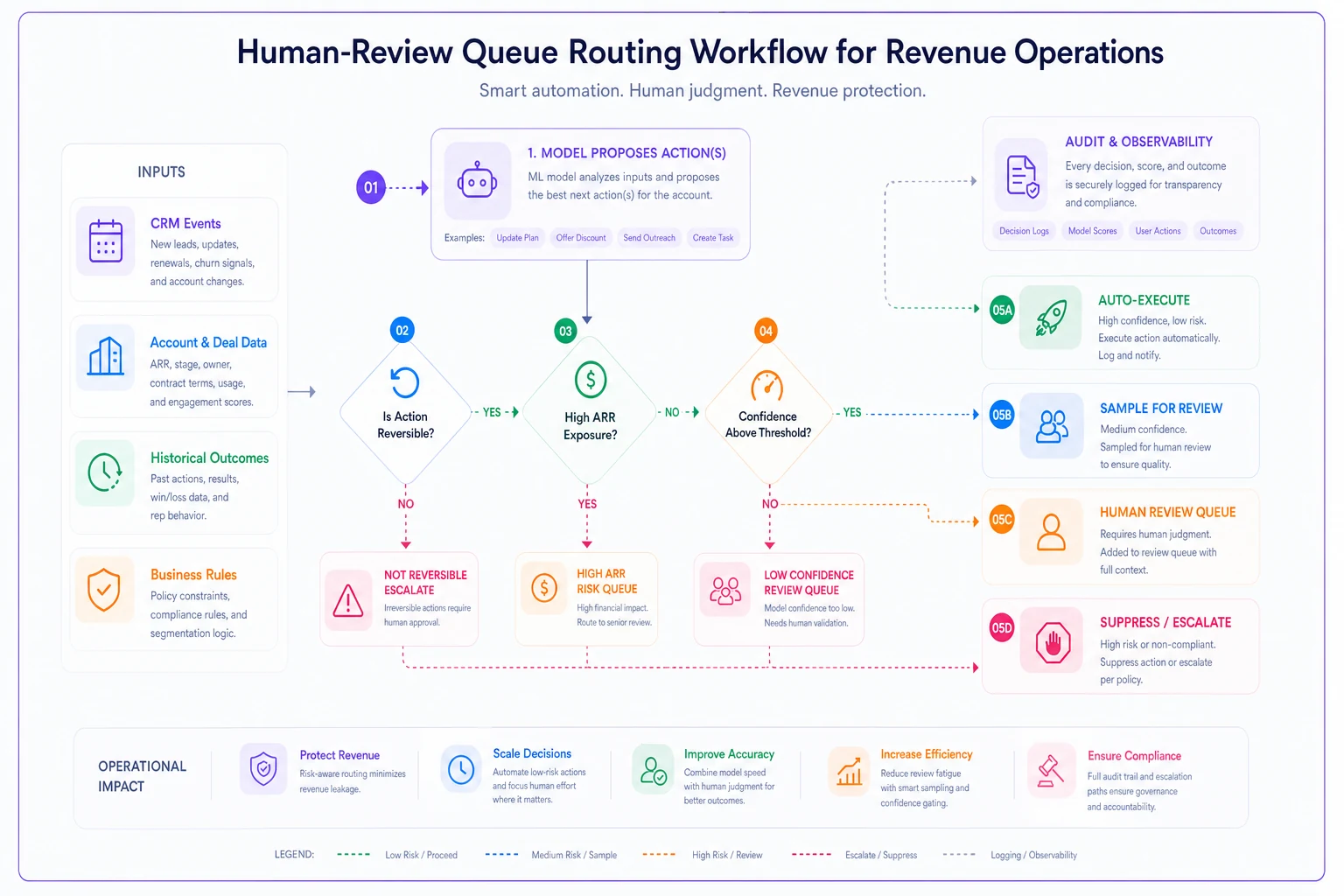
The diagram above sketches the routing flow and highlights where audit logs and escalation paths fit into the process.
Audit logging: the part everyone skips until an incident
Nobody builds the audit log until the first time an executive asks "why did we send a 20% discount to this account" and the honest answer is "we're not sure." Then it becomes the top priority overnight.
-
The action taken and whether it was auto-executed, human-approved, or suppressed
-
The model version that produced it
-
The input signals at decision time, not the current state of the record
-
The confidence score and which threshold band it fell into
-
The human who approved it, if any, and how long it sat in queue
-
The reversal status — was it later undone, and why
The signals-at-decision-time detail matters more than people expect. A record in your CRM is constantly changing. If you log "account was at risk" but don't capture what made it look at risk at 2:14pm on Tuesday, you can't reconstruct whether the model was reasonable or whether the input data was bad. A lot of the time, the model behaved correctly and the real culprit was a broken upstream signal — which is a data problem, not a model problem. Getting this right depends heavily on instrumentation and data lineage across your revenue stack, because an audit log is only as trustworthy as the signals feeding it.
Model-change governance: the silent cause of most incidents
Here's a failure mode that's easy to miss. The model was fine. The thresholds were fine. Then someone retrained the model on fresh data, confidence scores shifted half a point, and suddenly a batch of actions that used to sit just below the auto-execute line are now just above it. Nobody changed the governance rules. The model changed underneath the governance rules.
-
No silent retrains. A model version change is a governed event with a changelog, an owner, and a sign-off.
-
Shadow-run before promotion. New model versions run alongside the old one for a period, producing decisions that get logged but not executed, so you can compare what would have shipped.
-
Threshold re-calibration on every version. A 0.85 confidence on the old model is not the same action-worthiness as 0.85 on the new one. Thresholds are a property of the model version, not a universal constant.
-
A rollback plan tied to specific metrics. If post-promotion incident rate, queue volume, or reversal rate exceeds a defined band within the first week, you revert to the prior version.
Teams that skip shadow-running are the ones who discover a bad model version through a spike in reversals — which is the most expensive possible way to find out.
When full automation actually makes sense
Not every action deserves this ceremony. There are plenty of places where auto-execution is clearly correct and a review queue would just add cost:
-
Updating lead and account scores that only inform human prioritization
-
Logging activity and enriching records
-
Drafting content a human sends
-
Surfacing recommendations and ranked lists — like the kind of signal work behind timing upsell outreach with activity scoring, where the model informs the rep but the rep makes the move
The common thread: the action is reversible, low-exposure, or non-binding. If a human was always going to make the final call anyway, routing the suggestion through a review queue is pure overhead.
When this governance is overkill
If you're a five-person team running one lightweight scoring model that only re-ranks a task list, building out shadow-running, approval tiers, and expiring queues will slow you down for no real benefit. Governance should match the blast radius. The first irreversible, dollar-attached action — the first auto-discount, the first auto-suppression of outreach, the first auto-credit — is the moment to put real governance in. Before that, lighter-weight logging and a simple "humans approve anything that touches money" rule is enough.
The mistake in the other direction is just as real. A team that has eight models touching contracts and credits with no audit log and no change control is one retrain away from a quarter-ending incident.
A realistic scenario
A mid-market SaaS company around $9M ARR had an automated renewal-risk workflow that would pause scheduled outreach and trigger a retention play when an account's health score crossed a threshold. It worked well on paper. In practice, a usage-data pipeline hiccup caused a cluster of healthy accounts to look suddenly at-risk, and the system auto-paused renewal outreach on roughly a dozen accounts — a couple of them in the $30k–$50k range — for about two weeks before anyone noticed.
Nothing was technically unrecoverable, but two of those renewals slipped into the next quarter and one churned, partly because the outreach that would have caught the problem never fired. Somewhere in the $60k–$80k ARR range of avoidable damage, most of it from a single account.
The fix wasn't a better model. They added a dollar threshold to the pause action — anything above $25k exposure now routes to a CSM for a one-click confirm instead of auto-pausing — and started logging signals at decision time, which immediately exposed the upstream data glitch as the root cause. Review volume stayed small, under a dozen items a week, because only high-exposure pauses hit the queue. The incident didn't repeat. The model never changed.
The incident and reversion playbook
When something does go wrong — and it will — the difference between a bad afternoon and a bad quarter is having a reversion procedure written down before you need it. A templated runbook for an automated-action incident:
-
Freeze the action class. Flip the affected action type from auto-execute to human-review immediately. Don't debug while the system keeps shipping.
-
Pull the audit log for the blast window. Identify every action of that type since the suspected onset, using the logged model version and timestamps.
-
Triage by exposure. Sort affected items by ARR. The high-exposure ones get hand-reviewed and reversed or confirmed first.
-
Reverse what's reversible, communicate what isn't. For irreversible actions, the runbook should specify who owns the customer conversation and what the recovery offer is by tier.
-
Root-cause
model, threshold, or data.
Check whether a recent model change, a threshold drift, or an upstream data break caused it. In practice, the upstream data break is the most common and the most overlooked. -
Hold the action frozen until a named owner signs off on the fix and the re-calibrated thresholds.
The emotional temptation during an incident is to turn the whole system off. Resist it. Freezing one action class while the rest keeps running is almost always the right move — a blanket shutoff creates its own revenue gaps and usually overcorrects.
Pulling it together
Human-in-the-loop revenue ops isn't about keeping a person in front of every decision. It's about drawing a deliberate line — by reversibility and by dollars — that lets the safe, high-volume actions run free while the irreversible, high-ARR actions always get a human. The decision table, the exposure-aware queue, the audit log, and the model-change discipline are four parts of one system, and skipping any one of them is usually how a team discovers the other three the hard way.
Start with the question that actually matters: for each automated action, what's the cost of being wrong, and can you take it back? Build your thresholds around that, keep the review queue small and sharp, log everything at decision time, and treat every model change like a governed event. Do that, and the automation stops being a liability you're nervous about and becomes something you can actually scale behind.
Start with the question that actually matters: for each automated action, what's the cost of being wrong, and can you take it back? Build your thresholds around that, keep the review queue small and sharp, log everything at decision time, and treat every model change like a governed event. Do that, and the automation stops being a liability you're nervous about and becomes something you can actually scale behind.
Ready to transform your customer relationships?
Join 2,000+ businesses using Rellyly to increase sales, improve client retention, and simplify CRM workflows.