

Most revenue teams don't have a system. They have a pile of plays, a tangle of Slack threads, and a shared understanding that lives inside three or four senior people's heads. That works fine until you grow past about 15 people on the revenue side, and then the cracks start showing up in ways that are genuinely hard to trace back to a cause.
A deal stalls because nobody was sure whose job it was to loop in security. A renewal slips because the CSM thought sales owned the expansion conversation and sales thought the opposite. A support escalation sits for two days because the handoff from CS had no defined clock on it. None of these are skill problems. They're structural — the connective tissue between teams was never designed, so it fails under load.
Revenue operating system design is the work of building that connective tissue on purpose. Not as a doc nobody reads, but as an enforceable layer that routes work, sets expectations, and catches failures before they reach the customer. This article walks through how the pieces fit: a playbook catalog that packages repeatable work, a service-catalog taxonomy that names who does what, and an SLA/SLO layer that makes the whole thing enforceable instead of aspirational.
Why cross‑team execution breaks (and why it's rarely obvious)
The usual diagnosis after a bad quarter is "we need better alignment." Everyone nods, a few workshops happen, and six weeks later the same handoff fails again. Alignment isn't the problem. The problem is that work moves across team boundaries with no contract governing the transfer.
Think about the lifecycle of a single expansion opportunity. It might touch an AE, a CSM, a solutions engineer, deal desk, legal, and finance. Each of those people has their own tooling, their own queue, their own sense of priority. When the opportunity passes from one to the next, what actually transfers? Usually a Slack ping and a hope. No defined context packet, no clock, no owner-of-record, no agreed definition of "done" for that stage.
-
Early stage (under ~10 people) everything works because the whole team sits in one conversation. Coordination is free.
-
Middle stage (~15–40 people) coordination stops being free. People specialize, queues form, and the informal handoffs that used to work start dropping things. This is where most teams first feel the pain but misread it as a hiring or morale issue.
-
Scaled stage (40+) the informal system has fully collapsed. Teams build local workarounds that conflict with each other. Nobody trusts the "official" process because there isn't really one.
One thing most people miss: the system doesn't degrade gradually. It holds up fine and then falls apart over a pretty narrow growth band. If you wait until it's obviously broken to design it, you're rebuilding under fire.
The three layers that actually hold a revenue OS together
A working revenue operating system is three layers stacked on top of each other. Skip any one and the other two can't do their job.
Never miss a customer touchpoint again.
Rellyly helps you manage contacts, tasks, and sales efficiently in one platform.
- Unified customer profiles
- Automated follow-ups
- Sales pipeline tracking
No credit card required
The common mistake is building only the first layer. Teams write dozens of playbooks, store them somewhere, and wonder why execution is still chaotic. A playbook without a taxonomy doesn't know who runs it. A playbook without an SLA has no clock. The three layers are only useful together.
-
Playbook catalog — the packaged, repeatable units of work.
-
Service-catalog taxonomy — the map of who owns what, and what each team offers the others.
-
SLA/SLO layer — the enforceable contracts that govern transfers and timing.
The common mistake is building only the first layer. Teams write dozens of playbooks, store them somewhere, and wonder why execution is still chaotic. A playbook without a taxonomy doesn't know who runs it. A playbook without an SLA has no clock. The three layers are only useful together.
Layer 1: The playbook catalog
A playbook catalog is your library of repeatable plays — renewal motions, security-review responses, churn-save sequences, deal-desk approvals. The problem usually isn't that teams lack plays. It's that the plays aren't packaged consistently, so nobody can find, run, or trust them.
Packaging rules matter more than people expect. A play that's just a Google Doc of advice is not a catalog entry. A real catalog entry has a fixed anatomy:
| Element | What it defines | Why it matters |
|---|---|---|
| Trigger | The event or condition that starts the play | Removes ambiguity about when to run it |
| Owner role | The role (not person) accountable for execution | Survives turnover and team changes |
| Inputs required | The context packet needed to start | Prevents "I didn't have what I needed" stalls |
| Steps | The ordered actions, with decision branches | Makes the play runnable by someone new |
| Exit criteria | The explicit definition of "done" | Stops silent incomplete handoffs |
| SLA clock | The time allowed per step or overall | Turns the play into something enforceable |
The versioning and discoverability of these plays is its own discipline — if people can't find the current version, they'll reinvent a worse one. The mechanics of keeping a catalog trustworthy are covered in revenue knowledge management: playbook versioning, discoverability and governance for repeatable plays, and it's worth treating that as the foundation under this layer.
One pattern worth naming: teams tend to over-document rare plays and under-document the frequent ones. The renewal motion that runs 200 times a quarter is often the least documented because "everyone already knows it." That's exactly the play that costs you the most when a new hire runs it badly.
Layer 2: The service-catalog taxonomy
This is the layer most revenue teams never build, and it's the one that makes cross-team work legible. A service catalog treats each team as a provider of defined services to the other teams. Deal desk provides pricing approvals. Security provides pre-sales review responses. CS provides onboarding and health monitoring.
The taxonomy names these services, categorizes them, and — critically — attaches an owner and a request path to each. Here's a simplified cut of what that looks like:
| Service category | Service | Provider team | Requested by | Standard turnaround |
|---|---|---|---|---|
| Deal support | Non-standard pricing approval | Deal desk | AE | 1 business day |
| Deal support | Security questionnaire response | Security/CS | AE | 2 business days |
| Lifecycle | Onboarding kickoff | CS | AE (post-close) | 3 business days |
| Lifecycle | Health-risk escalation | CS → CS leadership | CSM | 4 hours |
| Expansion | Upsell qualification | CS + AE | CSM | 2 business days |
| Retention | At-risk renewal intervention | CS + deal desk | CSM | Same day |
The value here isn't the table itself — it's what the table forces. Once a service has a named provider and a turnaround, you can't hide behind "I wasn't sure who to ask." The request path is explicit. And because the taxonomy is tied back to who owns which revenue lever, it connects naturally to how you've structured accountability overall. If you haven't formalized that yet, the work on team charters, RACI and quarterly prioritization tied to ARR levers is what makes the service catalog stick rather than becoming shelfware.
A subtle failure mode: teams define services but not the inputs a requester must provide. Requests arrive half-formed, the provider bounces them back, and the clock everyone thought was running was never actually running. Every service entry needs a required-inputs definition — same as a good API has required parameters.
Layer 3: The enforceable SLA/SLO layer
This is where most "operating systems" turn out to be decorative. People write SLAs, publish them, and then never instrument or enforce them. An SLA you don't measure is just a wish with a number attached.
The distinction worth holding onto: an SLA is the promise you make (e.g., "security questionnaires returned in 2 business days"), while an SLO is the internal target you manage to — usually tighter than the SLA (e.g., "95% of questionnaires returned in 1.5 days"). You manage to the SLO so you have buffer before you breach the SLA.
For an SLA layer to actually work, three things have to be true:
-
Every clock has a defined start event and stop event that can be detected, not guessed.
-
Every SLA has a breach consequence — an escalation that fires automatically, not a vague "we'll follow up."
-
Every breach gets logged so you can see patterns, not just one-off fires.
That last point is where instrumentation matters, and it's easy to underbuild.
Instrumentation points: what to actually measure
You can't enforce what you can't see. The question is which points in the workflow you actually drop a timestamp and a status.
-
Handoff moments — the exact second work transfers from one team's queue to another. This is where context and time both leak. Timestamp the transfer, record the context packet, record the receiving owner.
-
Stage entry/exit — when an opportunity or ticket enters and leaves each defined stage. Without this, you can't compute cycle time per stage, which is where bottlenecks hide.
-
SLA clock start/stop — tied to the service-catalog definitions. The clock starts when a valid request (with required inputs) lands, not when someone finally looks at it.
-
Exit-criteria satisfaction — a positive signal that "done" was actually met, so you catch silent incomplete handoffs.
-
Breach events — logged with enough context to triage later.
A practical note: don't instrument everything on day one. Pick the three handoffs that cause the most customer-visible failures and start there.
A practical note: don't instrument everything on day one.
Trying to measure the whole system at once is how instrumentation projects die.
SLA breach‑to‑escalation recipes
An SLA with no teeth trains people to ignore it. The fix is a defined escalation recipe for each breach type — predictable, proportional, and automatic enough that it doesn't depend on someone noticing.
-
At 75% of SLA time elapsed a nudge to the owning individual. Quiet, no manager visibility. Most things resolve here.
-
At 100% (breach) notification to the owner's team lead, and the item flagged in the daily queue review. Now it's visible.
-
At 150% escalation to cross-functional leadership, because a sustained breach usually means the handoff itself is broken, not just one person being slow.
-
At 200% or on a high-value account executive trigger, with a short written reason-for-breach required before close.
The point of the ladder isn't punishment. It's to make breaches visible early and to force a root-cause note when they persist. A breach that happens once is noise. The same breach on the same handoff every week is a design flaw — and the logged escalation data is what makes that pattern obvious.
This connects directly to how you run your forecast and review rhythms. Escalation ladders only work if there's a standing meeting cadence where the patterns get looked at and acted on. The mechanics of those rhythms are worked out in the forecast governance playbook on meeting rhythms, escalation ladders and forecast‑hygiene SOPs, and the same escalation discipline applies across any cross-team service.
A real scenario
A roughly 60-person B2B software company — maybe $12M–$14M in ARR, selling to mid-market IT buyers — kept losing deals in the final stretch. Not to competitors, but to time. Security reviews were the choke point. An AE would forward a questionnaire, it would land in a shared inbox, and it would sit. Nobody owned the clock.
When they mapped it, the median turnaround on security questionnaires was close to nine business days, with a long tail running past three weeks. Deals that hit a security review were closing at a noticeably lower rate than deals that didn't — and reps had started quietly trying to avoid triggering reviews at all, which creates its own problem.
The fix wasn't a new tool. It was defining the security questionnaire as a named service in the catalog, assigning a specific owner role, setting a 2-business-day SLA with the required inputs spelled out, and wiring a breach escalation at day two to a team lead. Within a quarter, median turnaround dropped to under two days and the long tail mostly disappeared. The win-rate gap between security-touched and security-clean deals narrowed to the point where reps stopped gaming it. No new headcount — just a clock, an owner, and an escalation that actually fired.
Governance: the checklists that keep it alive
The hardest part isn't launching a revenue OS. It's keeping it from rotting. Systems like this decay quietly — a service gets added without an SLA, a playbook goes stale, an escalation path points at someone who left six months ago. Governance is the maintenance discipline.
-
[ ] Every service in the catalog has a current named owner (not a departed employee)
-
[ ] Every SLA has been measured against actuals in the last 30 days
-
[ ] Any SLA breached more than 3x this month has a documented root-cause note
-
[ ] Every playbook run more than 20x this quarter has been reviewed for accuracy
-
[ ] New services added this month have inputs, owner, SLA, and escalation defined
-
[ ] Escalation paths tested — do they actually reach a live person?
-
[ ] Instrumentation gaps identified (handoffs with no timestamp data)
Quarterly, go deeper: retire plays nobody runs, re-tier SLAs that are consistently too loose or too tight, and reconcile the service catalog against how work actually flows. It always drifts.
Governance fails when it's nobody's explicit job. A revenue OS needs an owner — one person or a small ops function accountable for the catalog's health, the same way a product has a PM. Without that, the whole thing reverts to tribal knowledge within a couple of quarters.
A 90‑day rollout plan with gates
Rolling this out all at once is the most common way it dies. The approach that works is sequenced, with gates between phases so you don't build the next layer on a broken one.
Days 1–30: Taxonomy and top plays. Map the service catalog for your three highest-pain cross-team handoffs. Define owners, inputs, and request paths. Package the 5–8 most frequently run plays into proper catalog entries. Don't set SLAs yet — you don't have baseline data.
Gate to proceed: the three target handoffs have named owners and defined inputs, and you've started logging timestamps on them.
Days 31–60: Instrument and baseline. Instrument the start/stop clocks on those three handoffs. Collect actual turnaround data. Resist setting targets from guesses — let the data tell you where you actually are. This is also when you'll discover services you forgot existed.
Gate to proceed: at least three weeks of real turnaround data on each instrumented handoff.
Days 61–90: Set SLAs and wire escalations. Now set SLAs grounded in your baseline (target somewhere achievable, not aspirational), define SLOs tighter than the SLA, and wire the breach-to-escalation ladders. Run the governance checklist for the first time.
Gate to declare rollout complete: escalations fire automatically, breaches are logged, and you've run one full governance cycle.
Here's a visual of the rollout sequence.
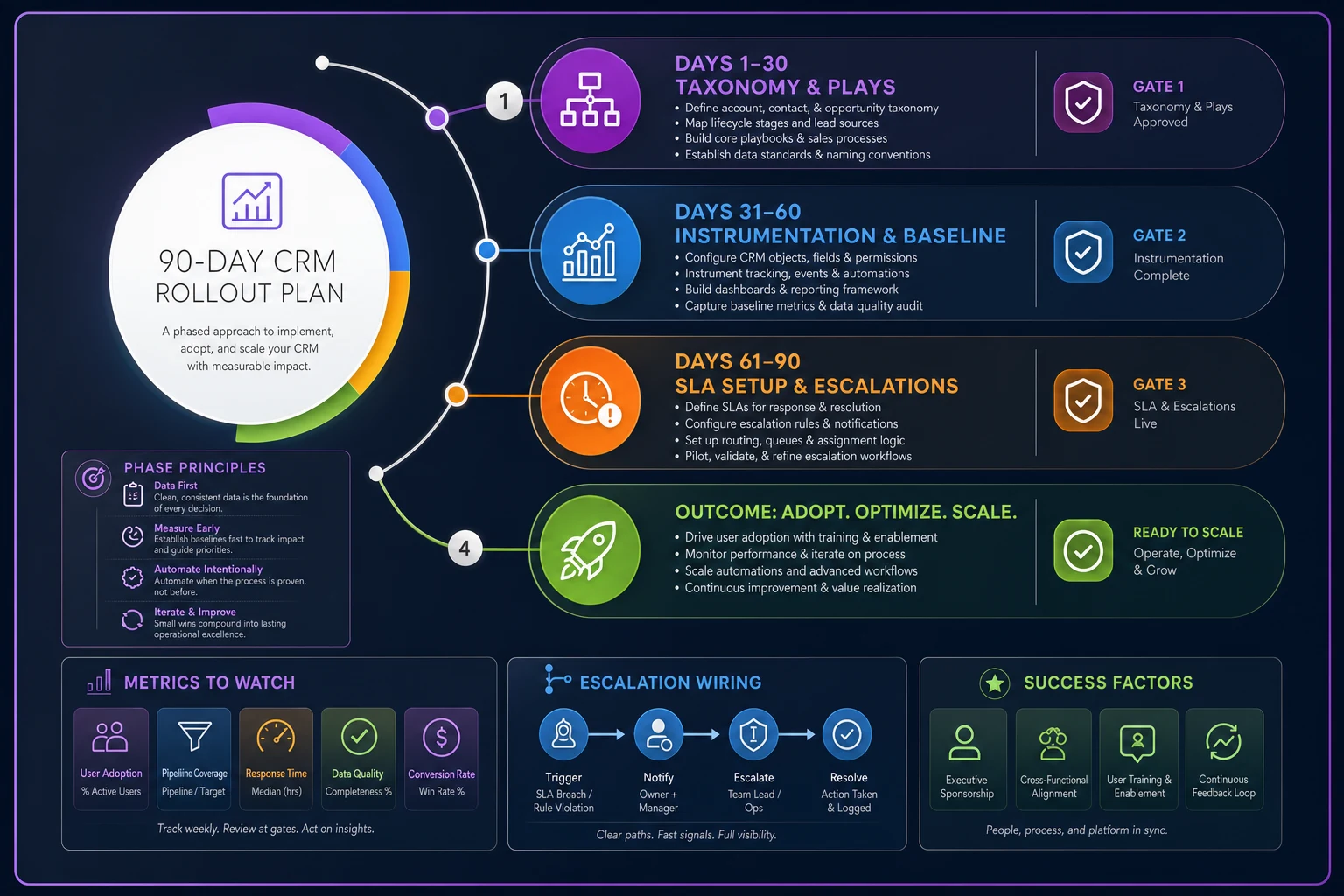
Metrics to watch through the rollout: median and tail turnaround per instrumented handoff, SLA attainment rate, breach frequency by handoff type, and — the one that matters most — the share of cross-team work moving through defined paths versus ad-hoc Slack. That last ratio is your real adoption signal.
When this makes sense — and when it doesn't
This is a lot of machinery, and it's genuinely wrong for some teams.
When it makes sense: You're past the point where everyone fits in one conversation. You have specialized roles, repeatable motions, and handoffs that fail often enough to notice. You're feeling coordination pain that hiring doesn't fix. That's the band where a revenue OS pays for itself fast.
When it's a bad idea: You're under ~10 people and informal coordination still works. Building heavy process here just slows you down and nobody will follow it. Or the plays aren't repeatable yet — you're still figuring out what works, and premature systematization will lock in the wrong motion.
Who should not do this: Teams that will build the artifacts and then not assign an owner to maintain them. A half-built, abandoned revenue OS is worse than none — people learn to distrust the official process, which makes any future rollout harder. If you can't commit someone to governance, start smaller: fix one handoff properly before you try to systematize all of them.
Bringing it together
The teams that execute well across functions aren't staffed with more disciplined people. They've made the coordination explicit — the plays are packaged, the services are named, and the clocks are real. When a handoff fails, they can see where and why, and the system corrects instead of silently bleeding deals and renewals.
Start with the handoffs that hurt most. Name the services. Instrument the clocks before you set the targets. Wire escalations that actually fire. Then put someone in charge of keeping it honest. The blueprint above is prescriptive on purpose, but the sequencing matters more than the completeness — a small, enforced slice of this beats a comprehensive catalog nobody runs.
Ready to transform your customer relationships?
Join 2,000+ businesses using Rellyly to increase sales, improve client retention, and simplify CRM workflows.