



Most revenue ops problems don't announce themselves as revenue ops problems. They show up as a renewal that slipped because nobody knew who owned the executive relationship. Or a pricing exception that got approved twice by two people who didn't know the other existed. Or a customer onboarding that stalled for eleven days because the CSM assumed sales was handling the kickoff and sales assumed the CSM had it.
None of those are individual failures. They're structural gaps — places where the system doesn't say who does what, when, and against which goal. And they get exponentially worse as you grow, because every new hire inherits the ambiguity and then invents their own workaround for it.
This is a blueprint for putting structure around that. Not org-chart theater, but actual working documents: team charters that define scope, RACI grids that kill ownership fights, a service catalog so stakeholders stop treating your team like a help desk, and a quarterly ritual that ties all of it back to the ARR levers that actually matter.
Why revenue ops fractures as you scale (and what it looks like)
At five people, coordination is verbal. Everyone's in the same Slack channel or the same room. You don't need a charter because you are the charter — the CEO knows every deal and every at-risk account. Decisions happen in hallway conversations.
The trouble is this model breaks silently. It doesn't collapse at 30 people; it degrades from around 12 onward, and by the time it's obviously broken you've already baked bad habits into three teams.
The pattern that shows up repeatedly across growing revenue teams:
-
Sales starts handing off "closed" deals that aren't actually implementation-ready. No shared definition of what "ready" means, so CS inherits messes.
-
Two or three people quietly become the load-bearing humans for every cross-team question. When one of them takes PTO, work stops.
-
The forecast and the health scores drift apart because sales owns one system of truth and CS owns another, and nobody reconciles them.
-
Every request to RevOps becomes a fire. No intake, no prioritization — just whoever screams loudest.
In practice, the tipping point usually looks like this: you hire your fourth or fifth CSM, and suddenly nobody can answer "who owns expansion in the mid-market segment?" without a 20-minute meeting. That meeting is the tax you pay for undefined scope. Multiply it across a quarter and you've lost real selling time.
The fix isn't more meetings. It's writing things down in a way people actually use.
The team charter: the document nobody writes and everybody needs
A charter is a one-page answer to "what is this team actually responsible for, and how do we know if we're winning?" It sounds obvious. Almost nobody has one.
Never miss a customer touchpoint again.
Rellyly helps you manage contacts, tasks, and sales efficiently in one platform.
- Unified customer profiles
- Automated follow-ups
- Sales pipeline tracking
No credit card required
Without it, teams expand their scope by accident. CS starts doing light sales because a customer asked. Sales starts doing implementation because a deal was at risk. Everyone's busy, nothing's owned, and quarter-end reviews turn into finger-pointing.
A good charter is short and answers five things:
-
Mission — one sentence on why the team exists.
-
Scope — what's explicitly in and, more importantly, what's explicitly out.
-
Primary metrics — the 2-3 numbers this team is accountable for.
-
Key interfaces — which other teams they hand off to and receive from.
-
Decision rights — what they can decide alone vs. what needs escalation.
Here's a sample charter for a mid-market Customer Success team:
> Mission: Drive net revenue retention across the mid-market book by preventing avoidable churn and surfacing expansion opportunities early. > > In scope: Onboarding after contract signature, adoption milestones, renewal preparation, health-score monitoring, expansion identification (not closing). > > Out of scope: New-logo prospecting, closing expansion deals over $15k ARR (routed to Account Management), contract redlines (routed to Deal Desk). > > Primary metrics: Gross retention, net revenue retention, time-to-first-value. > > Key interfaces: Receives from Sales (closed-won handoff), hands to Account Management (qualified expansion), escalates to Support (technical incidents). > > Decision rights: Can offer up to 1 month service credit for satisfaction issues; anything larger escalates to CS lead.
Notice how much of the value is in the "out of scope" and "decision rights" lines. That's where accidental scope creep and double-approvals get killed. Most teams write the aspirational mission and skip the boring boundaries — which are really the entire point.
RACI examples that actually prevent fights
RACI (Responsible, Accountable, Consulted, Informed) gets a bad reputation because people build 40-row spreadsheets nobody reads. The trick is to only RACI the handoffs and decisions that actually cause conflict, not every task.
The single most important rule: there is exactly one "A" (Accountable) per row. If you have two, you have no owner. This is where most teams quietly fail — they mark three people as accountable to avoid hurting feelings, and then nobody is.
Here's a focused RACI for the moments where sales and CS collide most:
| Activity | Sales AE | CSM | Account Mgmt | Deal Desk |
|---|---|---|---|---|
| Closed-won handoff quality | A | R | I | I |
| Onboarding kickoff | C | A/R | I | I |
| Renewal forecast | I | R | A | C |
| Expansion identified | I | R | A | I |
| Expansion closed | I | I | A/R | C |
| Pricing exception | C | I | R | A |
| At-risk escalation | I | R | A | I |
A few things worth calling out. The closed-won handoff has Sales as Accountable — because the quality of what gets handed over is a sales responsibility, even though CS does the receiving work. That one line resolves the "you sold them something we can't deliver" argument before it starts.
Expansion is split intentionally: CSM identifies (Responsible), Account Management owns the number and the close (Accountable). This stops the common failure where CSMs sit on obvious expansion signals because they're not sure whether it's their job, and it stops AEs from parachuting into accounts they don't understand.
In practice, the RACI only works if it lives somewhere people actually see it during the workflow — not buried in a wiki nobody opens. Whatever workflow or business management platform you're using to route deals and accounts, the ownership rules should be encoded there so the right person gets pulled in automatically instead of relying on someone remembering the grid exists.
The service catalog: stop being everyone's help desk
There's a failure mode specific to RevOps and enablement teams: they become an unbounded request queue. Marketing wants a new report. A rep wants a custom field. Finance wants the pipeline sliced differently. Leadership wants a dashboard by Friday. No menu, no SLA, no prioritization — just an inbox that never empties.
A service catalog fixes this by defining what your ops function actually offers, how to request it, and how long it takes. It turns "can you just quickly..." into a real intake process.
A simple catalog looks like this:
-
Standard report request — turnaround 3 business days, submitted via intake form.
-
New CRM field or workflow change — turnaround 5-10 business days, requires business justification and owner sign-off.
-
Ad-hoc analysis — turnaround varies, triaged in weekly ops standup, may be declined if not tied to a priority.
-
Urgent forecast/board prep — same-day, but only during the two weeks before board meetings.
-
Data cleanup project — scheduled work, planned quarterly, not on demand.
Publish the catalog where people submit requests so they see SLAs before asking.
Once you publish this, the volume of low-value requests tends to drop on its own. People self-select out when they see "5-10 business days" next to a nice-to-have. The catalog does the prioritization for you by making cost visible.
The mistake teams make is publishing a catalog and then breaking it the first time an executive asks for something off-menu. If the catalog only applies to people without power, it isn't a catalog — it's a suggestion.
The quarterly prioritization ritual tied to ARR levers
This is the piece that ties everything together, and it's where most teams have nothing at all. They plan reactively, quarter to quarter, chasing whatever felt urgent last week.
The idea is straightforward: every quarter, you rank the work not by who asked for it, but by which ARR lever it moves. There are really only a handful:
-
New ARR — win rate, deal size, pipeline volume.
-
Expansion ARR — upsell/cross-sell rate, expansion deal size.
-
Retention — gross churn reduction, at-risk recovery.
-
Efficiency — cost or time per closed deal, per onboarded account.
Every proposed initiative — a new sequence, a process change, a tooling investment, a data cleanup — has to declare which lever it moves and roughly how much. If it can't be tied to a lever, it goes to the bottom of the list by default.
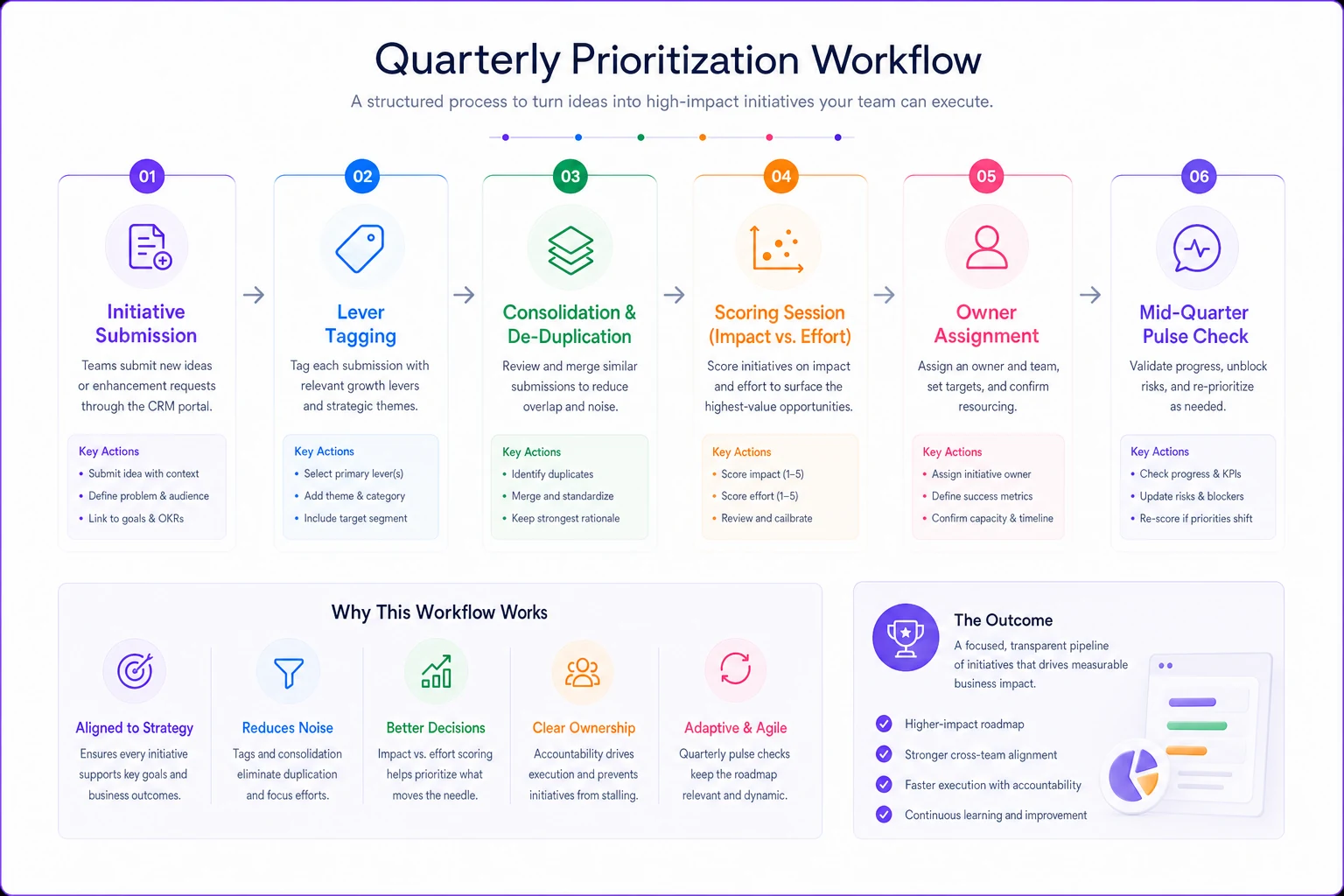
This workflow shows how submissions flow from teams through Lever tagging to an owned cut list and a mid-quarter pulse.
-
Two weeks out every team submits proposed initiatives, each tagged to a single primary ARR lever with a rough impact estimate.
-
One week out RevOps consolidates and de-dupes. Overlapping requests get merged. Anything untied to a lever gets flagged.
-
The session (90 minutes) leadership scores each initiative on impact vs. effort. Only the top items that fit actual capacity make the cut.
-
Same day the cut list gets owners (one Accountable each, using your RACI) and a review date.
-
Mid-quarter check a 30-minute pulse to kill or double-down on in-flight work.
A useful discipline: cap the number of "yes" initiatives to your real capacity, and force a "not this quarter" pile that's visible to everyone. The pile matters more than the list. When people can see their request was considered and consciously deferred — not lost — the politics calms down considerably.
The impact estimates don't need to be precise. "This should recover maybe 3-4 at-risk accounts worth roughly $60k-$80k" is more than enough to rank against "this saves reps about an hour a week on manual entry." Directional beats perfect. If you want to get more rigorous about testing whether these bets actually pay off, a structured revenue experimentation approach with a hypothesis pipeline and learning loops pairs well with this ritual — the quarterly session decides what to try, the experiment framework decides whether it worked.
A real scenario: a 40-person SaaS company that couldn't hand off cleanly
Consider a B2B SaaS company, roughly 40 people, somewhere in the $6M-$7M ARR range. Sales and CS were both hitting their individual targets, but net revenue retention was stuck around 98% — flat, when it should have been climbing given the product.
The root cause was handoff and ownership, not skill. Closed deals were reaching CS with half the implementation context missing. Expansion signals were being spotted by CSMs and then dying, because nobody owned the close and the AEs were focused on new logos. Pricing exceptions were getting approved inconsistently because there was no single accountable owner.
They didn't hire anyone. They wrote three things: charters for each team, a RACI focused only on the seven collision points, and a quarterly ritual that forced every initiative to name its ARR lever.
Within about two quarters, expansion started actually closing — CSMs handed qualified signals to Account Management, who owned the number. The handoff quality problem shrank once Sales was formally accountable for it and it showed up in their reviews. NRR moved from the high 90s into the low 100s. Not a miracle, just the leak sealed. The bigger unlock was that the load-bearing humans stopped being single points of failure, because the ownership was written down instead of living in their heads.
When this makes sense — and when it doesn't
This kind of structure is worth building when:
-
You're past roughly 12-15 people on the revenue side and coordination is starting to eat real time.
-
You have more than one team touching the same accounts.
-
You've had at least one painful renewal or expansion die because of unclear ownership.
When it's a bad idea: if you're a five-person team where everyone genuinely knows every account, writing charters and RACIs is premature overhead. You'll spend more time maintaining documents than they save you. Keep it verbal until the verbal model actually breaks.
Who should NOT do this: teams that will write these documents and then never enforce them. A charter you ignore is worse than no charter, because it signals that written commitments don't matter here. If leadership won't hold to the service catalog and the RACI when it's inconvenient, don't bother — you'll just train everyone to route around the system.
Keeping the system alive without drowning in overhead
The failure mode after you build all this is that it goes stale. Charters get written once and forgotten. RACIs describe last year's org. The catalog exists but nobody follows the SLAs.
The way to keep it alive is to make the structure part of the actual workflow rather than a separate documentation project. Ownership rules should be encoded where work gets routed, so the right person gets pulled into a deal or an at-risk account automatically. Intake requests should flow through a real form and queue, not a Slack DM. The quarterly ritual needs a standing calendar hold, not a quarterly scramble to find a time.
A lot of the day-to-day enforcement can be handled through the same operational platform you run deals and accounts through — routing handoffs to the accountable owner, flagging when an account has no clear owner, nudging when a service request breaches SLA. The point isn't to automate the judgment; it's to automate the remembering, so the humans spend their energy on actual decisions instead of chasing who's supposed to do what. The same logic applies to figuring out which coordination tasks to systematize versus keep human — worth thinking through with an automation decision framework for what to automate and what to keep human.
Pulling it together
Organizing revenue ops isn't about adding process for its own sake. It's about replacing the invisible, verbal coordination that worked at ten people with something that survives at fifty. Charters define scope so teams stop colliding. RACIs assign single owners so decisions stop stalling. A service catalog protects your ops function from becoming a bottomless queue. The quarterly ritual makes sure all of that effort points at the ARR levers that actually move the business.
Start with the collision points that hurt most right now — probably the sales-to-CS handoff and expansion ownership. Write those down first. Get one clean quarter of the prioritization ritual under your belt. Then expand the structure as the gaps reveal themselves. The goal is a system that scales with you, not another set of documents that gather dust while everyone quietly goes back to figuring it out in the hallway.
Start with the collision points that hurt most right now — probably the sales-to-CS handoff and expansion ownership. Write those down first. Get one clean quarter of the prioritization ritual under your belt. Then expand the structure as the gaps reveal themselves. The goal is a system that scales with you, not another set of documents that gather dust while everyone quietly goes back to figuring it out in the hallway.
Ready to transform your customer relationships?
Join 2,000+ businesses using Rellyly to increase sales, improve client retention, and simplify CRM workflows.