


Most forecast problems don't come from bad math. They come from the fact that nobody actually agreed on what a number means, who's allowed to change it, and what happens when a rep's gut disagrees with the pipeline data.
You can have clean stages, a decent CRM, and reps who genuinely try — and still walk into a board meeting defending a number you don't fully trust. That's a governance gap, not a data gap. A forecast governance playbook closes it: the meeting rhythms, the escalation rules, and the hygiene standards that turn a forecast from an opinion into something the whole revenue org actually stands behind.
This isn't about adding more meetings. Most teams already have too many. It's about making the meetings you run decide things, and making the days between them run on rules instead of vibes.
Why forecasts drift even when the data looks fine
Two reps, same stage, same deal size, same close date. One deal is real — champion identified, budget confirmed, legal already looped in. The other is a hopeful "they said Q1 looks good." Both show up in the forecast as identical weighted numbers.
The stage was clean. The forecast was still wrong. Because stages describe where a deal is, not how confident anyone actually is that it closes on time.
-
The rep-to-manager seam — reps sandbag or inflate depending on comp timing, and managers "adjust" without a documented reason.
-
The manager-to-VP seam — regional numbers get rolled up, but the qualitative context (why a deal slipped) evaporates in the aggregation.
-
The VP-to-board seam — the number gets a "haircut" for safety that nobody can trace back to specific deals.
By the time the forecast reaches leadership, it's been quietly rewritten three times by three people with different incentives, and none of those edits are logged anywhere. When the number misses, there's no real post-mortem because there's no record of who believed what, when.
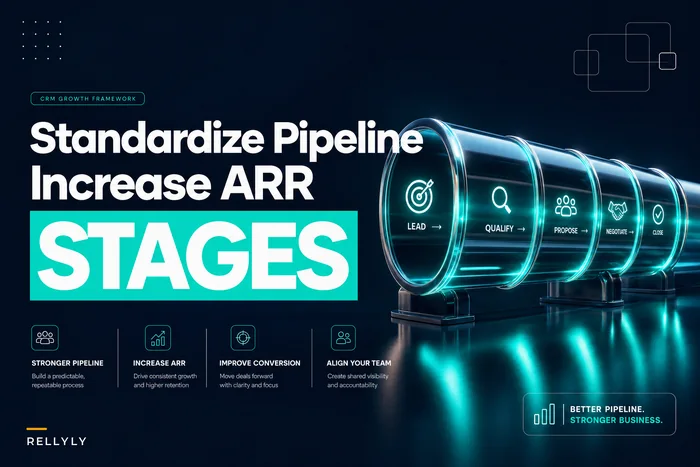
If your stage definitions are still fuzzy, governance won't save you — fix that layer first. The work on standardizing pipeline stages for ARR accuracy is the foundation this whole playbook sits on. Governance without clean stages is just organized guessing.
The core idea: confidence scoring separate from stage
The single most useful change most teams can make is to stop treating stage as a proxy for confidence.
Never miss a customer touchpoint again.
Rellyly helps you manage contacts, tasks, and sales efficiently in one platform.
- Unified customer profiles
- Automated follow-ups
- Sales pipeline tracking
No credit card required
Add a confidence score to every committed deal — a simple 1–5 or a High/Medium/Low that the rep sets and the manager can challenge. The score answers one question: "If I had to bet my own money, how sure am I this closes for this amount, on this date?"
The magic isn't the score itself. It's that the score becomes a separate, visible, challengeable field. When a rep marks a deal Commit but scores it a 2, that mismatch is a conversation the system forces into the open. When a manager overrides it, they leave a note. Every adjustment has a fingerprint.
A workable confidence rubric:
| Confidence | What has to be true | Forecast treatment |
|---|---|---|
| 5 – Locked | Verbal yes, paper in motion, mutual close plan on date | Full value, Commit |
| 4 – Strong | Champion + economic buyer engaged, no open blockers | Full value, Commit |
| 3 – Real but soft | Right people involved, one open risk (budget, timing, legal) | Best Case, not Commit |
| 2 – Hopeful | Interest confirmed, no confirmed path or date | Pipeline only |
| 1 – Wishful | Rep "feels good," no evidence | Exclude from forecast |
The rule that makes this bite: nothing enters Commit below a 4. A deal can be at your latest stage and still get held out of Commit because the confidence isn't there. You're forecasting belief backed by evidence, not stage position.
Meeting rhythms that actually decide things
Governance lives or dies on cadence. Not more meetings — the right meetings, each with a distinct job and a required pre-read so nobody's reading the pipeline for the first time in the room.
-
Weekly rep-manager 1
1 (30 min)
— deal-level. The manager pressure-tests confidence scores, not just stages. Any deal that moved into or out of Commit gets a reason logged. This is where hygiene gets enforced at the source. -
Weekly team forecast call (45 min) — roll-up level. The manager presents the committed number with the confidence distribution. A number that's all 3s reads very differently than a number that's all 5s, even if the dollar totals match. Deals that slipped get named out loud, with a reason.
-
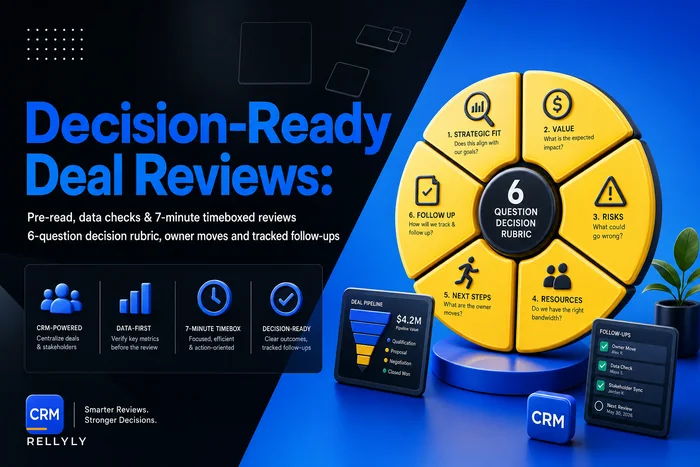
Bi-weekly deal review (60 min) — top deals only. This is where the qualitative context that usually evaporates actually gets captured and challenged. If you don't already run these with real teeth, the deal-review blueprint that forces action pairs directly with this rhythm — the decision rubric there is what keeps the review from turning into a status update.
-
Monthly forecast governance review (60 min) — leadership. Not "what's the number." Instead: how accurate were we last month, and why did we miss? You compare committed-vs-closed by rep and by confidence tier. This is the meeting that makes the whole system self-correcting.
The pre-read rule that changes everything
Every one of these meetings requires a pre-read circulated at least a few hours ahead. No pre-read, the meeting gets rescheduled.
That sounds harsh. It's also the highest-leverage rule in this entire playbook. When people know they have to write down their forecast and their reasoning before the meeting, the quality of the number improves immediately. Half the inflated commits quietly disappear the moment a rep has to put their reasoning in writing where a manager will read it.
The pre-read doesn't need to be fancy. Committed number, confidence distribution, what changed since last week, top three risks. One page. That's it.
The escalation ladder
Governance needs a clear answer to "what happens when something goes wrong between meetings." That's the escalation ladder — a documented set of triggers and routing.
-
Tier 1 — Rep handles, logs it. Any deal moves down a confidence tier, or slips its close date within the same month. Rep updates the note, flags it in the weekly call. No escalation needed.
-
Tier 2 — Manager reviews within 48 hours. A Commit deal drops below a 4, or slips out of the current quarter. Manager and rep build a recovery plan or formally move it out.
-
Tier 3 — VP loop, same week. Any single deal above a size threshold (often 3–5% of the quarter's target) that slips or dies, or a cluster of deals slipping together — which usually signals something systemic, not deal-specific.
-
Tier 4 — Immediate. The committed number moves enough to threaten the quarter's board commitment. This goes up the same day, not at the next scheduled review.
The threshold numbers matter less than the fact that they exist and everyone knows them. When a big deal wobbles, nobody should be wondering whether to say something. The ladder already answered that.
Forecast-hygiene SOPs
Meetings and ladders only work if the underlying data is maintained on a schedule instead of scrambled together the night before the forecast is due. Hygiene SOPs are the boring, unglamorous rules that keep the pipeline honest between meetings.
-
Close dates are real dates. No deal keeps a close date that's already passed. If it's in the past, it moves or it's marked lost — end of week, every week.
-
Every Commit deal has a next step with a date. A Commit with no scheduled next action isn't a Commit; it's a wish.
-
Confidence scores get touched weekly. A score that hasn't been updated in three weeks is treated as stale and defaults down a tier until reviewed.
-
Stage changes require the required fields. You can't advance a deal without the evidence that stage demands. This is where clean stage definitions do the heavy lifting.
-
Slipped deals keep their history. When a date moves, the old date and the reason stay logged. This is how you learn whether a rep is chronically optimistic by exactly two weeks — a pattern you can actually adjust for.
That last one is quietly the most valuable. Once you have a few months of slip history per rep, the forecast stops being about trust and starts being about calibration. If a rep's Commits consistently land two weeks late at 85% of stated value, you can adjust for that mechanically instead of arguing about it every quarter.
Keep slip history per rep to enable mechanical calibration of commit adjustments.
Where the software layer helps
None of this requires fancy tooling to start — a disciplined team can run it in a spreadsheet for a quarter. But it breaks down at scale, because someone has to chase the stale scores, flag the missing next steps, and assemble the pre-reads by hand. That manual chasing is usually where governance quietly dies around 15–20 reps.
AI-assisted operational tooling earns its place here. A workflow platform that automatically flags deals with past-due close dates, nudges reps when a confidence score goes stale, and pulls together the weekly pre-read from live CRM data removes the human bottleneck that kills most governance efforts. The rules stay human-defined; the enforcement and reminders get automated so managers spend their time on judgment calls instead of chasing data.
The 13-week cutover plan
You can't flip governance on overnight — reps will revolt and the data will be garbage for a month. Rolling it in over a quarter lets the new rules become habit before they carry real weight.
-
Weeks 1–2 — Define and socialize. Lock the confidence rubric, the escalation thresholds, and the hygiene SOPs. Walk the whole team through them. No enforcement yet.
-
Weeks 3–4 — Shadow mode. Reps start scoring confidence on every deal. Nobody's held to it. You're building the habit, not testing the rules.
-
Weeks 5–6 — Pre-reads go live. Every forecast meeting now requires the one-page pre-read. Managers start challenging confidence scores in 1:1s.
-
Weeks 7–8 — Hygiene enforcement. The SOPs turn on. Past-due close dates and missing next steps get flagged and cleaned every week. This is the messy stretch — expect the pipeline to shrink as wishful deals get scored honestly and pulled from Commit.
-
Weeks 9–10 — Escalation ladder activates. Triggers go live. Managers and VPs run their first real escalations. You'll find the thresholds need tuning; tune them.
-
Weeks 11–12 — Governance review kicks in. Run the first monthly accuracy post-mortem: committed vs closed, by confidence tier. This is where the team sees the payoff.
-
Week 13 — Lock it. The new rules are now the rules. The forecast coming out the other side is the one you defend to the board.
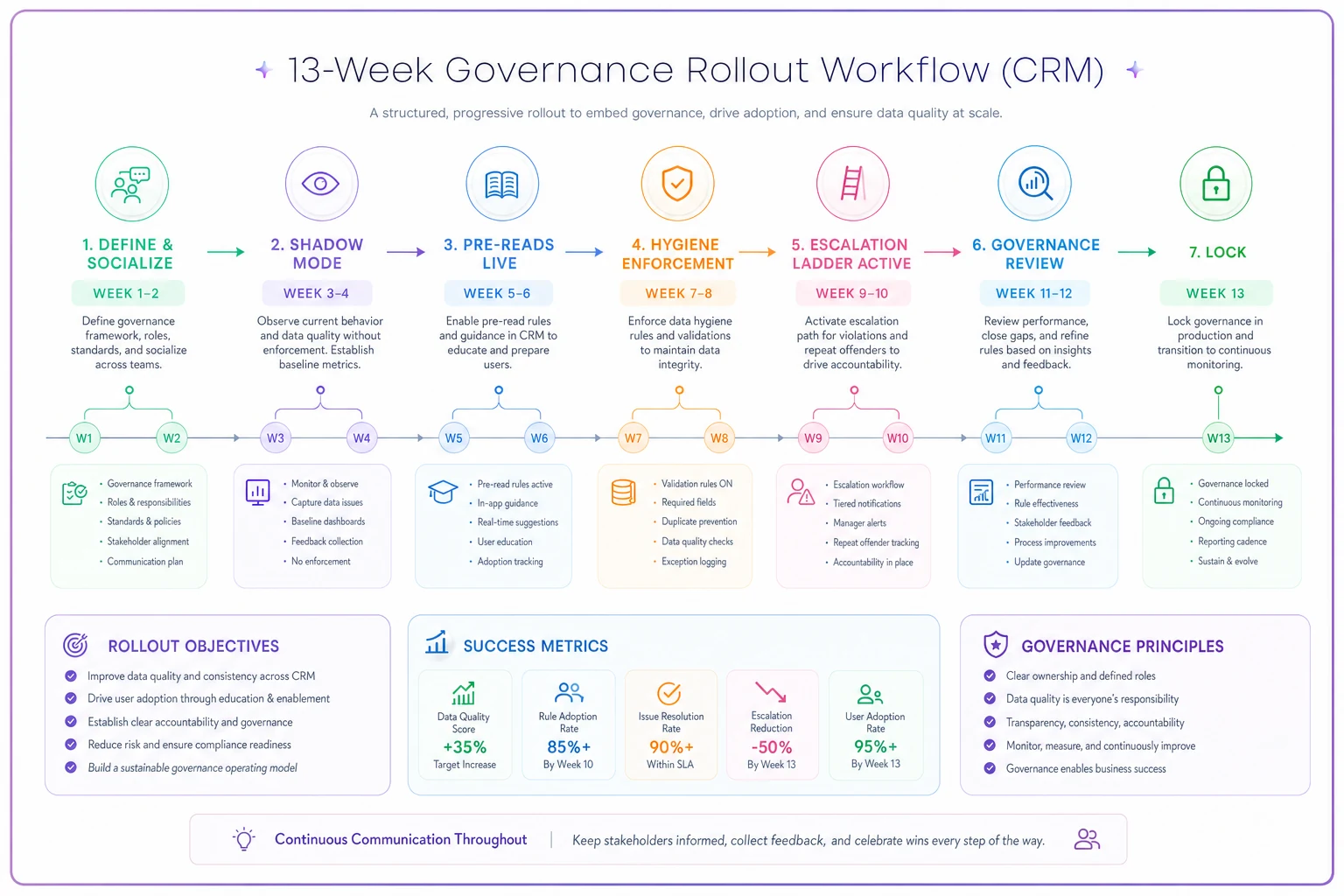
The reason for 13 weeks instead of "next Monday" is that trust in the new number has to be earned by watching it hold up. By week 12, when you can show that Commit deals actually closed at the rate the confidence tiers predicted, the arguments stop.
When this makes sense — and when it doesn't
This full playbook is built for teams where forecast misses have real consequences — board commitments, hiring plans tied to bookings, investor updates. At that stage, the overhead pays for itself the first quarter you don't get surprised.
It's overkill if: you've got three reps and the founder knows every deal personally. At that size, governance ceremony is just friction — a shared doc and a Friday check-in does the same job. Don't bureaucratize a team that fits around one table.
It's a bad idea to rush if: your stages aren't defined yet. Layering confidence scoring and escalation ladders on top of mushy stages just adds structure to chaos. Get the stage foundation solid first, then govern it.
Who should absolutely not skip this: any team that has missed forecast two quarters in a row and can't explain why. That "can't explain why" is the tell. It means the edits, the slips, and the reasoning aren't captured anywhere — which is exactly the gap this system exists to close.
A real scenario
A mid-market SaaS team — around 14 reps, roughly $9M in annual bookings — was missing forecast by 15–20% every quarter, always to the downside, and nobody could say which deals were the problem. Managers were haircutting numbers by feel, and leadership had started adding their own haircut on top, so the board number was essentially a guess sitting on a guess.
They rolled in confidence scoring and the pre-read rule over a quarter. The first month was ugly — committed pipeline dropped noticeably once wishful deals got scored honestly and pulled out of Commit. That drop was uncomfortable but accurate. By the end of the second full quarter under the system, their committed-to-closed variance had tightened to inside 8%. More importantly, when they did miss, they could point to the exact two deals and the exact reasons. The board conversations changed tone entirely. They stopped defending a number and started explaining a system. The forecast wasn't dramatically higher — it was just believable, and that turned out to be worth more than anyone expected going in.
The takeaway
A forecast is only as good as the process behind it, and most forecasting processes are held together by individual reps' good intentions and a manager's gut. That works until it doesn't — usually right when the stakes are high enough that a miss actually hurts.
Governance replaces intention with structure: confidence scored separately from stage, meetings that decide instead of report, a ladder that tells everyone what to do when a deal wobbles, and hygiene rules that keep the data honest between the meetings. Roll it in over a quarter, let the accuracy prove itself, and the number you carry into the board room stops being the thing you lose sleep over. It becomes the one part of the quarter you're actually sure about.
Ready to transform your customer relationships?
Join 2,000+ businesses using Rellyly to increase sales, improve client retention, and simplify CRM workflows.