

Your typical deal review runs 47 minutes. Someone shares their screen, walks through 14 opportunities, everybody nods, and nothing actually changes. Three weeks later, that $180k enterprise deal you all discussed? Still stuck in procurement. The expansion opportunity with your biggest customer? Nobody followed up with legal.
The meeting that creates more meetings (and kills deals)
Deal reviews have turned into performance theater. Sales managers go through the motions, reps protect their deals from real scrutiny, and leadership gets sanitized updates that miss the blockers actually killing pipeline.
After building operational platforms for over a hundred sales organizations, the pattern is pretty clear: most deal review meetings are information dumps dressed up as decision forums. No clear ownership, no forced choices, no accountability for what happens after everyone logs off.
Why deal reviews fail to drive decisions
The core problem isn't the people in the room. It's the structure—or lack of it.
Never miss a customer touchpoint again.
Rellyly helps you manage contacts, tasks, and sales efficiently in one platform.
- Unified customer profiles
- Automated follow-ups
- Sales pipeline tracking
No credit card required
Most teams treat deal reviews like status updates. The rep talks for eight minutes about why their deal is "definitely closing this quarter," the manager asks a few soft questions, someone mentions they should loop in product, and everyone moves on. No decisions. No assigned actions. No consequences for inaction.
Reps show up with information in completely different formats—one has detailed notes in Salesforce, another has bullet points in a Google Doc, someone else is just going from memory. Discussion meanders through deal history instead of focusing on specific blockers. Critical context surfaces halfway through when someone casually mentions the champion just changed jobs.
The meeting ends with vague commitments. "Let's circle back on pricing." "We should probably reach out to procurement." "Keep me posted on that redline." Nobody owns these things. Nobody tracks whether they happen. The deal sits in the same stage for another two weeks while competitors move faster.
This isn't a knowledge problem. Your team knows these deals. But without a forcing function for decisions and clear ownership, that knowledge doesn't translate into action.
The operational cost of ineffective reviews
Bad deal reviews compound into revenue problems faster than most managers realize.
Take a mid-market SaaS company running weekly pipeline reviews with eight people. That's roughly 6.5 hours of collective time per week just in the meeting itself. Add prep time, follow-ups, and the scattered conversations trying to figure out what was actually decided—you're burning 12–15 hours weekly on reviews that don't move deals forward.
But time waste is the small problem.
Deals lose momentum waiting for the next review cycle. A customer ready to sign gets cold feet because nobody responded to their security questionnaire for nine days. Your champion at a Fortune 500 account takes another meeting with your competitor because executive sponsor outreach sat in limbo for two weeks. The pricing exception that needed VP approval finally gets discussed three review cycles later, after the customer's budget got reallocated.
Forecast accuracy degrades because deals aren't getting real scrutiny. That $240k opportunity everyone's banking on? Nobody's actually pressure-tested whether procurement will approve before year-end. The renewal marked "probable"? Customer success knows they've gone dark, but that hasn't made it into the review discussion.
Building a deal review blueprint that forces action
A functional deal review runs on three principles: standardized inputs, forced decisions, and tracked accountability.
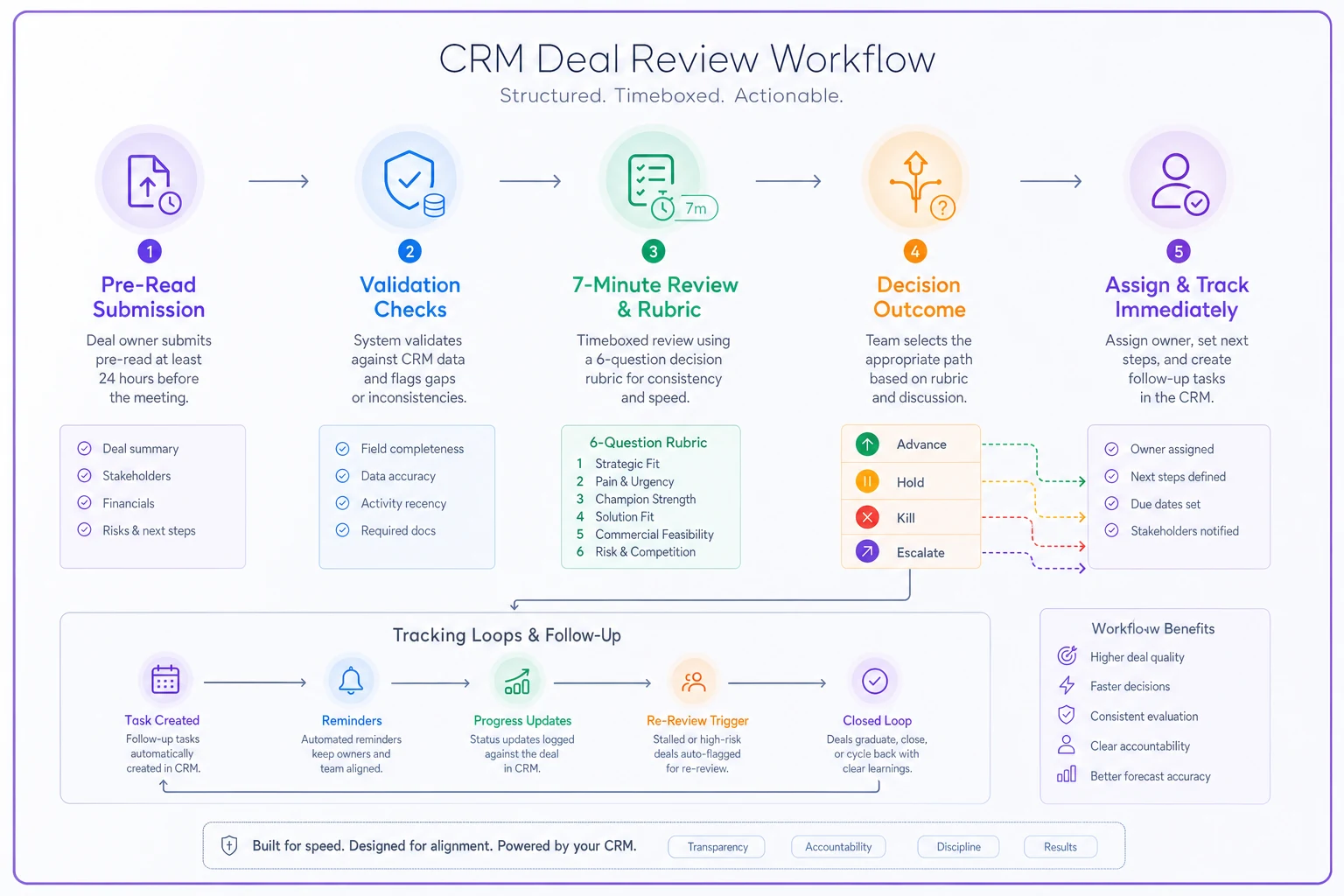
Start with the pre-read structure. Every deal presented needs six specific data points submitted 24 hours before the meeting:
-
Current blockers (not general status)
-
Days stuck in stage versus typical velocity
-
Last meaningful customer interaction
-
Specific ask for the review team
-
Concrete next step with date
-
Decision needed (advance/hold/kill/escalate)
This isn't about more documentation. It's about focusing discussion on decisions, not discovery. When everyone walks in knowing the deal context, you skip the storytelling and get straight to problem-solving.
The meeting itself follows a rigid cadence. Each deal gets seven minutes maximum:
-
90 seconds
Rep states the specific decision needed
-
3 minutes
Structured Q&A using the six-question rubric
-
2 minutes
Team discussion
-
90 seconds
Decision and owner assignment
No narratives. No backstory. Just the current situation and what needs to happen next.
A simple workflow shows how pre-read, the six-question rubric, the 7-minute cadence, and owner assignment connect.
No narratives. No backstory. Just the current situation and what needs to happen next.
The six-question decision rubric
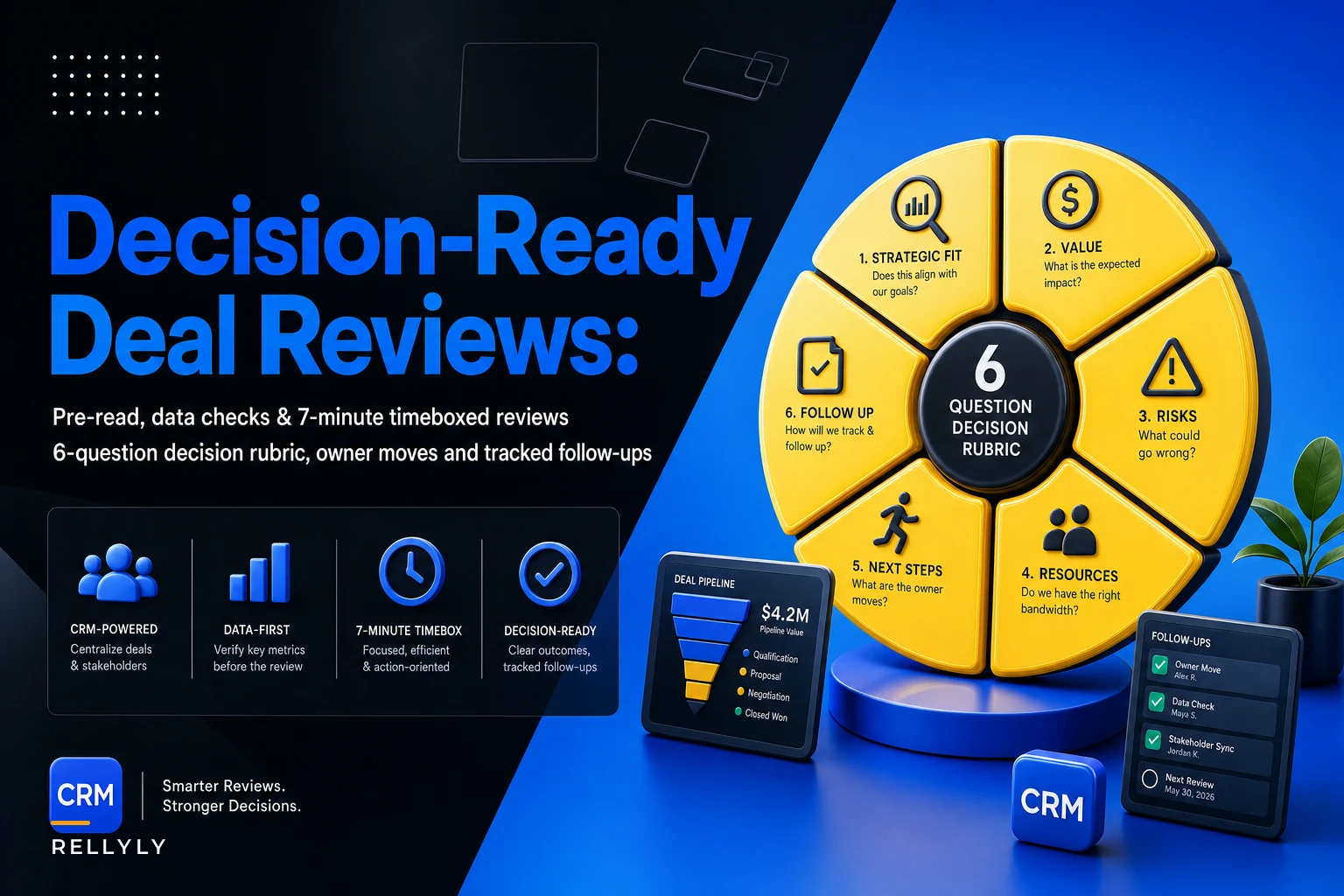
These six questions, asked in order, surface the real deal status and force clarity on next steps.
1. What will kill this deal? Not "what might go wrong"—the specific thing most likely to end this opportunity. Forces honest assessment of actual risk.
2. When did the customer last confirm timeline? Not when you last spoke to them, but when they specifically confirmed their buying timeline. Reveals whether you're operating on assumptions or facts.
3. Who besides the champion has confirmed budget exists? Names and roles, not "the CFO is aligned." Exposes single-threading risk and actual budget validation.
4. What's the customer doing if they don't buy from us? Not who they'll buy from, but what specific action they take. Clarifies whether status quo is your real competitor.
5. What contractual terms have they already rejected? Surface deal-breakers early, not after three weeks of negotiation. Include pricing, payment terms, SLAs, anything they've pushed back on.
6. If we do nothing for seven days, what changes? Reveals actual urgency. If nothing changes, you probably don't have a real opportunity yet.
These questions cut through the optimism bias that infects most pipeline reviews. They force specifics over generalities and expose the gap between what reps hope is happening and what's actually happening.
Owner assignment and accountability tracking
Decisions without owners are just suggestions.
Every deal discussion ends with one of four outcomes, each with a designated owner and timeline:
| Outcome | Owner | Timeline | Tracking |
|---|---|---|---|
| Advance | Original rep | Next milestone within 5 business days | Daily check-in until milestone hit |
| Kill | Rep documents why and logs lessons learned | Removed within 24 hours | Manager reviews killed deals monthly for patterns |
| Hold | Rep + designated supporter for unblocking | Maximum 14-day hold before forced decision | Escalates automatically if not resolved |
| Escalate | Manager or executive sponsor takes lead | Escalation action within 48 hours | Daily updates until resolved or reassigned |
The critical element: ownership transfers immediately in the meeting, not after. If a deal needs executive intervention, that executive confirms they're taking action before anyone leaves. If a rep needs support from product or legal, that supporting owner joins the next review to report progress.
This eliminates the post-meeting scramble where everyone tries to remember what they committed to. It also creates peer accountability—when Sarah owns unblocking a security review, she knows the entire team will hear about it in seven days.
Pre-meeting data checks and validation
The pre-read isn't optional, and it's not self-reported.
-
Stage duration
Flag any deal sitting 50% longer than median
-
Activity gaps
Highlight deals with no customer contact in 7+ days
-
Close date movement
Track how many times the date has pushed
-
Engagement depth
Count unique stakeholders engaged
-
Next step specificity
Verify there's an actual date and owner
This validation happens before the meeting, not during. When discrepancies surface—the CRM shows no contact for two weeks but the rep claims they spoke yesterday—that becomes the starting point for discussion, not a distraction in the middle of it.
Some teams automate these checks. Others run manual reports. The mechanism matters less than the consistency. Every deal gets the same scrutiny, which removes the politics of which opportunities get questioned and which get waved through.
The validation also creates a feedback loop for data hygiene. When reps know their CRM data gets checked before every review, they start maintaining it proactively. That $300k enterprise deal suddenly has detailed notes about security review requirements. The expansion opportunity gets its close date updated after the customer mentions budget freezes.
Meeting timing rules and cadence optimization
Standard weekly deal reviews waste time on deals that haven't changed. Instead, run dynamic review cadences based on deal characteristics.
-
Daily reviews (5 minutes each)
- Deals in final stages (contract, negotiation) - Anything pushed from committed - Escalated opportunities - Days remaining in quarter < 14
-
Weekly reviews (full process)
- Active pipeline ($50k+ or strategic accounts) - Stuck deals (2x normal stage duration) - New opportunities over threshold
-
Monthly reviews (strategic discussion)
- Account planning for top 20% of pipeline - Win/loss analysis - Process improvements - Team patterns and coaching needs
This staged approach means you're not reviewing the same stalled deal every week while it waits for procurement. You're also not ignoring the fast-moving opportunity that needs daily coordination to close.
Start with the highest-risk deals, not the biggest ones.
Timing rules within meetings matter too. Start with the highest-risk deals, not the biggest ones. If you run out of time, you've at least addressed the opportunities most likely to slip. Set hard stops—when seven minutes are up, make the decision with available information. This forces preparation and kills the circular discussions that eat reviews alive.
When forcing decisions backfires
This blueprint works across transactional to enterprise deals, but three scenarios need modified approaches.
Complex, multi-phase enterprises: When you're selling $2M transformation projects with 18-month sales cycles, forcing advance/kill decisions every week creates false urgency. These need monthly strategic reviews with different success metrics—stakeholder expansion, technical validation progress, business case development.
Channel or partner-driven deals: When you don't control the sales process, the six-question rubric might surface problems you can't solve. Focus instead on partner enablement metrics and support quality.
Early-stage or founder-led sales: If the CEO is closing every deal, formal review processes might slow things down. Keep the pre-read and documentation, but compress the decision timeline.
The framework also assumes reasonable deal volume. If you're reviewing 200+ opportunities weekly, you need segmentation—only bringing edge cases and high-value deals to group review while automating standard assessment for the rest.
Transitioning from talking to doing
Most teams know their deal reviews need work. They've tried different formats, added more people, built better dashboards. But without the forcing function of assigned ownership and tracked accountability, these changes just create more sophisticated ways to avoid decisions.
Start with your next review. Pick three deals and run them through the six-question rubric. Time it. Assign owners. Track what actually happens before the following week.
You'll quickly see which reps can't answer basic questions about their deals. Which opportunities have been stuck without anyone noticing. Which managers default to "let's see what happens" instead of making calls.
The resistance will be immediate. Reps don't want their deals killed. Managers don't want to own specific outcomes. Leadership doesn't want to see how much of the pipeline is fictional.
But after a few cycles, something shifts. Deals move faster because blockers get addressed immediately instead of sitting until next week's meeting. Forecast accuracy improves because weak opportunities get culled early. The team spends less time in reviews but accomplishes more because every discussion drives to a specific decision with clear ownership.
Teams using AI-powered operational platforms can automate a lot of the administrative burden here—tracking assignments, flagging overdue actions, surfacing patterns across deals without anyone having to manually compile reports. That frees your team to focus on actually moving deals forward rather than chasing down status updates.
Making review decisions stick
A blueprint means nothing if decisions evaporate after the meeting ends.
The most effective teams build three reinforcement mechanisms.
-
Daily stand-ups focus only on assigned actions from reviews. Not general updates—just "I owned X, here's what happened." Takes five minutes and creates immediate accountability.
-
Decision logs track every advance/kill/hold/escalate decision with rationale. Three months later, when you're analyzing why deals died, you have actual data instead of memories.
-
Escalation triggers flag when assigned actions don't happen. If someone committed to executive outreach within 48 hours, their manager gets alerted at hour 47. No manual tracking needed.
These mechanisms reveal patterns pretty fast. Maybe every deal Tom marks as "advance" actually stalls two weeks later. Perhaps Lisa consistently underestimates procurement timelines. Legal reviews always blow past committed deadlines. This stuff only becomes visible when you're tracking decisions over time, not just running the same meeting on repeat.
Without this follow-through, you're just having more structured conversations about deals that still won't close. The forcing function only works when decisions have consequences and ownership has accountability.
Your next deal review is probably in the next few days. You can run it like the last hundred—everyone shares updates, some deals might close, most won't move. Or you can implement one element from this blueprint. Time-box discussions. Use the six-question rubric. Assign specific owners before anyone leaves the room. The deals won't manage themselves, but with the right operational blueprint, your reviews can actually drive the decisions and actions that close them.
Ready to transform your customer relationships?
Join 2,000+ businesses using Rellyly to increase sales, improve client retention, and simplify CRM workflows.