


Most revenue teams don't have a knowledge problem. They have a knowledge lifecycle problem.
The plays exist. Someone wrote the killer renewal script, the objection-handling matrix, the onboarding checklist that cut time-to-value by a third. The issue is that nobody can find it, nobody knows if it's current, and nobody owns whether it should still be used. Six months later there are four versions floating around, two of them contradict each other, and a new AE is confidently following the one that was deprecated in Q1.
Revenue knowledge management is the system that governs how a play gets authored, approved, discovered, used, and eventually retired. Not a wiki. Not a shared drive. A lifecycle with ownership and gates — the same way you'd treat code or contracts. When that lifecycle is missing, the symptom isn't "we don't have playbooks." It's "we have too many, and nobody trusts any of them."
This is the part of revenue ops that quietly breaks as teams grow, because the thing that worked at 6 reps — everyone just asks Dana — stops working at 25 reps when nobody knows who Dana is anymore.
The failure isn't missing content — it's content with no lifecycle
Content accumulates faster than it's governed. That's the pattern across almost every team that scales fast.
In the early days, a playbook is whoever's head it lives in. Someone writes a few things down. Those docs get shared in Slack, pinned, forgotten. A manager spins up a Notion workspace. Someone else prefers Google Drive. A new CS lead imports their template library from their last job. None of it is wrong — it's just uncoordinated.
-
A renewal play references a discount tier that pricing killed two quarters ago. The AE quotes it. Deal desk bounces it. Customer's now annoyed.
-
There are three onboarding checklists with slightly different milestone definitions, so "activated" means something different depending on which CSM you ask.
-
The security questionnaire template everyone copies still has last year's SOC 2 date hardcoded in it.
None of these are authoring problems. Somebody wrote all of these well. They're lifecycle problems — no versioning, no owner, no expiry.
The four stages every play actually moves through
Think of a play less like a document and more like something with a shelf life. It gets created, it gets blessed, it gets found and used, and eventually it gets pulled. Each stage has its own failure mode.
Never miss a customer touchpoint again.
Rellyly helps you manage contacts, tasks, and sales efficiently in one platform.
- Unified customer profiles
- Automated follow-ups
- Sales pipeline tracking
No credit card required
| Stage | What should happen | How it usually breaks |
|---|---|---|
| Authoring | Written from a consistent template so plays are comparable and complete | Freeform docs; every play has a different shape, half are missing the "when NOT to use this" part |
| Approval | A named reviewer checks accuracy before it's published | Plays go live the moment someone hits share; nobody signs off |
| Discovery | Reps find the right play at the moment of need, in the tool they're already in | Content lives three clicks away in a separate wiki nobody opens mid-call |
| Deprecation | Outdated plays get flagged, archived, or replaced on a schedule | Nothing ever gets retired; the library only grows |
The deprecation column is the one almost everyone skips. Teams are great at creating and okay at approving. Almost nobody has a rule for killing a play. So the library becomes an archaeological dig — layers of good intentions, newest on top, nothing ever removed.
The stages aren't complicated on their own. The problem is that each one needs someone to actually own it, which is where most teams quietly fail.
Here's a simple view of that lifecycle.
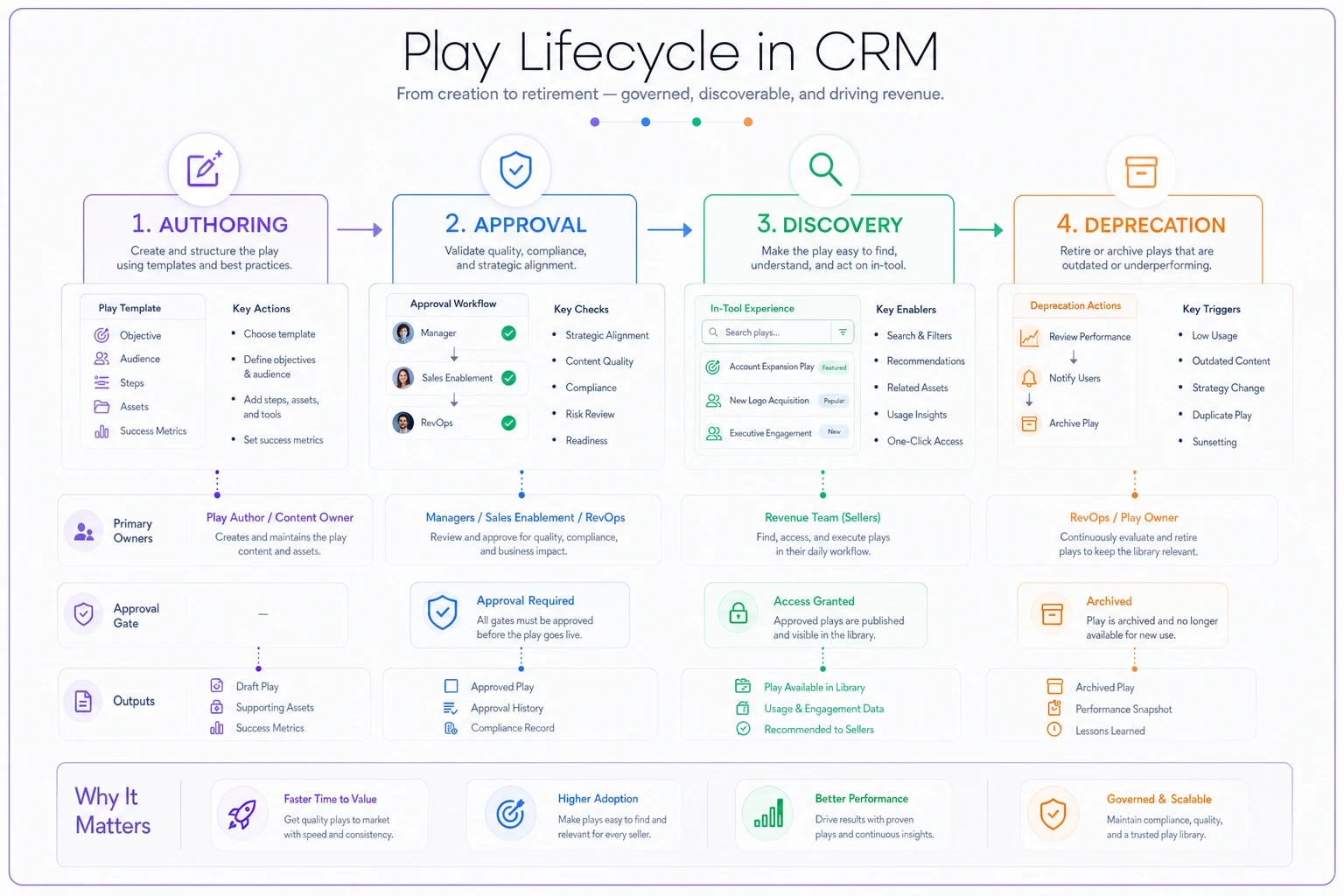
The stages aren't complicated on their own. The problem is that each one needs someone to actually own it, which is where most teams quietly fail.
Authoring: templates are the cheapest quality control you'll ever get
The fastest way to raise the quality of every future play is to standardize the shape of a play before anyone writes one.
When plays are freeform, you get wildly inconsistent depth. One renewal play is three bullet points. Another is a 2,000-word essay. A rep comparing them can't tell which is more authoritative, so they default to whichever is shorter or more recent. A template forces every play to answer the same core questions, which makes them scannable and comparable.
-
Trigger — when does this play apply? (e.g. "renewal within 90 days AND health score below 7")
-
Owner — who maintains this, by name or role
-
Steps — the actual sequence, numbered
-
Assets — linked email templates, call scripts, decks
-
When NOT to use this — the part everyone forgets, and the part that prevents the most damage
-
Last reviewed date — the single field that makes deprecation possible later
That "when NOT to use this" line does more work than people expect. A play that tells you its own boundaries is a play reps actually trust. The renewal motion for a happy enterprise account is not the renewal motion for a mid-market account that's missed two QBRs — and a template that forces you to spell out which one you're writing prevents reps from misapplying it. If you've already standardized your renewal timelines and concession guardrails, the play template is where that logic gets operationalized. Our renewal operating model breakdown goes deep on the guardrail side of this.
Make the "Last reviewed date" a required field so deprecation workflows can automatically surface stale plays.
The mistake people make is building a gorgeous template and then never enforcing it, so half the library is templated and half isn't. A template that's optional is just a suggestion, and suggestions don't survive a busy quarter.
Approval gates: the difference between "published" and "someone shared a doc"
The question that exposes whether you have real governance: who is allowed to make a play official?
In most teams, the answer is "anyone, implicitly." Someone writes something, drops the link, and it spreads. There's no moment where a knowledgeable person says "yes, this is accurate and current, ship it." That missing moment is why wrong information propagates — not because people are careless, but because there's no checkpoint designed to catch errors before they reach a rep on a live call.
-
Accuracy gate — someone who owns that domain confirms the facts are right (pricing confirms the discount logic, deal desk confirms the approval thresholds, security confirms the compliance dates).
-
Publish gate — a knowledge owner confirms it's formatted to template, tagged for discovery, and marked with a review date before it goes live.
The weight of the gate should scale with the blast radius. A play that touches pricing or legal commitments needs real sign-off. An internal note on how to log a particular call type does not. Over-governing low-risk content is how you kill adoption — people route around a process that treats every change like a board decision. The same logic applies to high-stakes deal decisions; the deal-review blueprint is a useful reference for forcing accountability without drowning a fast-moving motion in process.
Deprecation rules: the stage everyone forgets exists
A knowledge base with no deprecation strategy isn't a knowledge base. It's a landfill with search.
What actually happens when you never retire content: the library grows, search gets noisier, and the ratio of current-to-stale plays quietly inverts. A rep searches "renewal," gets eleven results, and five of them are from different eras of your pricing and process. They can't tell which is live. So they pick wrong, or they give up and ask a human — which is the exact behavior the library was supposed to eliminate.
-
Every play carries a review date. If it hasn't been reviewed in, say, 6 months, it auto-flags to its owner. No owner response in two weeks? It gets demoted out of search or archived.
-
New version supersedes old by default. When a play gets replaced, the old one doesn't just sit alongside the new one. It's archived, with a pointer to the replacement.
-
Ownerless plays get a deadline. If a play's owner leaves and nobody claims it within 30 days, it's archived until someone does.
-
Triggered deprecation beats scheduled. When pricing changes or a process shifts, that event should flag every play tagged to it — not wait for a calendar.
That last one is where most teams get burned. A pricing change doesn't just update the pricing doc; it invalidates every play that referenced the old numbers. If you don't have a way to trace which plays depend on a particular fact, a single pricing update can silently poison a dozen downstream plays. It's a quiet kind of damage that usually only surfaces when a customer quotes something back to you that stopped being true months ago.
Discoverability: the play nobody can find doesn't exist
You can author perfect, approved, current plays and still get near-zero value from them if reps can't find them at the moment they need them.
The core problem is context-switching. If the knowledge lives in a separate tool, a rep on a live call or mid-email isn't going to tab out, open the wiki, search, scan eleven results, and pick one. They'll just do it from memory. In-tool discoverability — surfacing the right play inside the CRM or wherever the work actually happens — is what closes the gap between "we have a play for that" and "the play got used."
-
Tag plays to triggers, not just topics. Reps don't think "I need a retention document." They think "this account just downgraded, what do I do?" Plays surfaced by situation beat plays filed by category.
-
Fewer, better entry points. One canonical place to search beats five competing wikis. If content lives in four tools, people learn to trust none of them.
-
Surface the review date next to the result. Showing "last reviewed 3 weeks ago" vs "last reviewed 14 months ago" lets reps self-filter for freshness instantly.
-
Promote the canonical version. When multiple plays match, the current, owned one should win placement. Stale duplicates should never outrank the live play.
This is also where AI-assisted operational platforms earn their keep without a lot of fanfare. When your knowledge base is wired into the CRM, automation can surface the relevant play based on the actual state of the account — the stage, the health score, the trigger that just fired — instead of making a rep remember what to search for. It can also handle the quiet maintenance work: flagging plays past their review date, nudging owners, routing a new draft to the right approver. The point isn't to replace human judgment. It's to remove the context-switching and manual upkeep that cause good plays to rot in the first place.
Ownership maps: the thing that makes all of this actually hold
Every stage above depends on one quiet foundation: knowing who owns what. Without ownership, templates don't get enforced, approvals have no approver, deprecation never triggers, and discovery surfaces orphaned content.
An ownership map is simple. For every play — or every category of plays — you name:
-
Owner — who maintains accuracy and responds to review flags
-
Approver — who signs off before publish
-
Domain authority — who's the source of truth for the facts it depends on (pricing, legal, security)
What breaks at scale is that ownership gets assumed instead of assigned. "The CS team owns onboarding plays" sounds fine until an onboarding play goes stale and three people each assume one of the other two has it. Assumed ownership is the same as no ownership. The map has to name a person or specific role, not a team.
When someone leaves, the ownership map is what prevents the orphan problem. Reassignment becomes a checklist item in offboarding instead of a discovery you make eight months later when a customer quotes something that stopped being true.
A real scenario: a 30-person SaaS team cleaning up play sprawl
A mid-market SaaS company — around 30 people across sales and CS — had accumulated somewhere between 80 and 90 "playbooks" across Notion, Google Drive, and a couple of pinned Slack channels. Nobody had a real count.
The symptoms were familiar. New reps took weeks to figure out which docs were real. Two renewal plays referenced pricing tiers that no longer existed, and one AE quoted an expired discount on a six-figure renewal, which turned into an awkward walk-back with the customer. Onboarding "activation" was defined three different ways depending on which checklist a CSM had grabbed.
-
Inventoried every play into one list and tagged each as current, stale, or duplicate. Roughly a third turned out to be deprecated or redundant.
-
Archived the stale and duplicate ones — not deleted, moved out of the way so search stopped surfacing them.
-
Re-templated the survivors into one consistent shape with trigger, owner, and a review date.
-
Assigned an owner and approver to every play. The ones nobody would claim got archived by default.
-
Set a 6-month review cadence with auto-flags to owners.
Results weren't dramatic in a press-release way, but they were real. New-rep ramp on "finding the right play" dropped from a couple of weeks of asking around to a few days. The library shrank by about a third and got more useful, not less. The expired-discount category of mistake basically stopped, because the plays that referenced pricing were now tied to pricing as a domain authority and flagged the moment anything changed.
The lesson wasn't "write better plays." Their plays were fine. It was that plays need a lifecycle, and the lifecycle needed owners.
When this level of governance makes sense — and when it doesn't
When it's worth it:
-
You're past roughly 15 people and "just ask someone" has stopped scaling.
-
You've had at least one real mistake traced to stale content — wrong price, wrong commitment, wrong process.
-
You have multiple tools holding overlapping content and nobody's sure which is canonical.
-
Reps have quietly stopped using the knowledge base.
When it's overkill:
-
You're a small team where everyone genuinely knows every play. Formal approval gates on a 5-person team add friction with no payoff.
-
The content is low-stakes and rarely wrong. You don't need deprecation rules on internal notes about where the Zoom link lives.
Who should hold off: teams that don't have a content problem so much as a content gap. If you barely have plays written down at all, go author the core ones first. Lifecycle governance on an empty shelf is premature. Build the plays, then build the system that keeps them alive.
The shift that actually matters
Stop thinking of playbooks as documents and start thinking of them as things with a lifespan. A document is something you write once and forget. A play is something that gets created, blessed, found, used, and eventually retired — and every one of those stages needs an owner.
The teams that get this right aren't the ones with the most content. They're the ones whose reps trust the content, because every play they find is current, owned, and clearly scoped to when it applies. That trust is the whole game. Once reps believe the library, they use it, and the knowledge you paid to build actually compounds instead of rotting.
Everything else — the templates, the gates, the review dates, the ownership map — exists to protect that trust. Get the lifecycle right and the knowledge base stops being a graveyard of good intentions and starts being the thing that makes your repeatable plays actually repeatable.
Stop thinking of playbooks as documents and start thinking of them as things with a lifespan. A document is something you write once and forget. A play is something that gets created, blessed, found, used, and eventually retired — and every one of those stages needs an owner.
The teams that get this right aren't the ones with the most content. They're the ones whose reps trust the content, because every play they find is current, owned, and clearly scoped to when it applies. That trust is the whole game. Once reps believe the library, they use it, and the knowledge you paid to build actually compounds instead of rotting.
Everything else — the templates, the gates, the review dates, the ownership map — exists to protect that trust. Get the lifecycle right and the knowledge base stops being a graveyard of good intentions and starts being the thing that makes your repeatable plays actually repeatable.
Ready to transform your customer relationships?
Join 2,000+ businesses using Rellyly to increase sales, improve client retention, and simplify CRM workflows.