

Most CRM integrations don't fail loudly. They fail in slow, embarrassing ways. A renewal shows up as closed-won in Salesforce but never makes it into the billing system. An ACV number in the finance dashboard is $40k off the CRM because someone changed how a field maps and nobody noticed for six weeks. A customer gets two "welcome" emails and one angry Slack message from a CSM who swears the account was never handed off.
None of these are integration crashes. The pipes are technically working. The problem is that two systems disagree about what happened, when it happened, and which version is the truth. That's the real failure mode of CRM integration — not downtime, but silent disagreement between systems that both think they're right.
Teams that depend on clean ARR and ACV reporting — sales ops, CS, finance — usually inherit this mess without having designed it. The fix isn't "better field mapping." It's treating the flow of data between systems like a contract with rules: how events are named, how they're versioned, what happens when the same event arrives twice, and how you reconcile when things inevitably drift. That's what event-driven CRM integration patterns are actually about, and it's where most of the durable wins live.
The core problem: your systems don't share a definition of "what happened"
There's a pattern underneath almost every integration bug. One system thinks in terms of state — "this account is Active, ARR is $84k." The other thinks in terms of events — "subscription upgraded at 2:14pm, delta +$12k." When you wire them together naively, you get a tug-of-war. The state-based system overwrites things it shouldn't. The event-based system replays things it already processed. Nobody agrees on the order things happened in.
In real operations this usually surfaces when a deal gets amended. Rep closes a $60k deal. Two days later legal adds a clause and the ACV changes to $72k. If your integration is just syncing the current state of the opportunity on a schedule, that's fine — the latest snapshot wins. But the moment you have downstream systems reacting to changes — provisioning, billing, CS onboarding — a snapshot sync is lying to them. They need to know an upgrade happened, not just that the number is different now.
What breaks at scale is coordination. With two systems and one engineer who remembers how everything's wired, you can hold it in your head. With six systems, a reverse‑ETL job, three automation platforms, and a finance team pulling their own extracts, the "I remember how this works" strategy collapses. The number of ways two systems can silently disagree grows faster than your ability to babysit them.
Event naming and schema versioning: boring on purpose
The cheapest thing you can do to prevent integration chaos is name events like an adult and version the schema from day one. This sounds trivial. It's the thing teams skip, and it's the thing that costs them the most later.
Never miss a customer touchpoint again.
Rellyly helps you manage contacts, tasks, and sales efficiently in one platform.
- Unified customer profiles
- Automated follow-ups
- Sales pipeline tracking
No credit card required
A good event name describes a business fact that already happened, in past tense, tied to the object it affects. Not updateaccount. Not sync. Something like subscription.upgraded or opportunity.closedwon. Past tense matters because it forces you to think of the event as an immutable record of something that occurred — not an instruction that can be re-run or reinterpreted.
The versioning part is where people get burned. The first time you need to add a field to an event payload, you have two bad options if you didn't plan: break every consumer, or quietly jam the field in and hope nothing chokes. Schema versioning gives you a third option — evolve without breaking.
A workable convention looks like this:
| Element | Convention | Example |
|---|---|---|
| Event name | object.pasttenseverb | subscription.renewed |
| Schema version | explicit integer, lives in the payload | "schema_version": 3 |
| Breaking change | new major version, old one runs in parallel | v2 → v3, both live for a window |
| Additive change | same version, field is optional with a default | add discount_pct, default null |
| Deprecation | announced, dated, logged before removal | "v2 retires 2025‑04‑01" |
The rule that saves you: additive changes never break consumers; breaking changes get a new version and a deprecation window. If a field is new, it's optional. If you're removing or changing the meaning of a field, that's a new version and the old one keeps running until every consumer has moved over. You don't get to flip it overnight.
One pattern worth internalizing — the consumer should ignore fields it doesn't recognize rather than reject the whole event. A surprising number of outages come from a strict parser throwing on an unexpected field that was added for a totally different downstream system. Tolerant readers, strict writers.
Idempotency: the rule that stops double-counted ARR
If there's one concept that separates integrations that survive from integrations that make finance lose trust, it's idempotency. Plainly: processing the same event twice should produce the same result as processing it once.
Why this matters so much for revenue data — networks retry. Queues redeliver. Someone reruns a backfill. A webhook fires, times out on your end, and the sender tries again even though you actually processed it the first time. Without idempotency, every one of those retries risks double-counting an upgrade, double-provisioning a seat, or firing a handoff automation twice.
The mechanism is simple and you should enforce it everywhere:
-
Every event carries a stable, unique
event_idgenerated by the producer — not the timestamp, an actual ID. -
The consumer keeps a record of processed
event_ids (a dedupe table is fine). -
Before processing, the consumer checks
have I seen this
event_id? If yes, acknowledge and skip. If no, process and record it. -
The check-and-record happens in the same transaction as the work, so you can't crash in between.
Here's what a dedupe check looks like in practice:
-- Attempt to claim the event; if it already exists, we skip. INSERT INTO processedevents (eventid, eventname, processedat) VALUES (:eventid, :eventname, now()) ON CONFLICT (eventid) DO NOTHING; -- Only proceed with the ARR mutation if we actually claimed it. -- (rowsaffected = 0 means we've seen this before)
Pro-tip: generate stable
event_ids (e.g., UUIDs) at the producer so consumers can reliably dedupe.
The mistake people make is putting idempotency "somewhere in the middle" — relying on the queue, or the integration platform, to dedupe for them. That works until it doesn't, usually during a backfill when someone replays three months of events and the "middle" doesn't dedupe across the replay boundary. Make the consumer that mutates ARR responsible for its own idempotency. It's the last line of defense and the only one that actually protects the number.
Reverse‑ETL contracts: treat the warehouse-to-CRM push like an API
Reverse‑ETL — pushing data from your warehouse back into the CRM and operational tools — is where a lot of modern integration damage happens, because it feels low-stakes. It's "just syncing a computed field." Then that computed health score or usage-based ACV estimate starts driving renewal plays, and suddenly a modeling change in the warehouse quietly shifts which accounts CS considers at-risk.
The fix is writing the reverse‑ETL flow as an explicit contract between the producer (your warehouse/analytics team) and the consumer (the CRM and whoever builds automations on top of it). A contract template that's held up well:
-
Field name and type — stable, documented, not renamed casually
-
Source of truth — which model or query produces this, and where it lives
-
Refresh cadence — hourly, daily, real-time, so consumers know how fresh it is
-
Null semantics — what
nullmeans vs. zero vs. "not computed yet" -
Allowed consumers — who's allowed to build automation on this field
-
Change policy — how changes get announced and to whom
-
Rollback behavior — what happens to the field if a sync fails mid-run**
That second-to-last point is underrated. If marketing or CS builds a critical automation off a reverse‑ETL field they didn't know was experimental, you've created a dependency nobody signed off on. The contract makes ownership explicit. This connects directly to how you define your canonical data model and the required objects and validation rules — the reverse‑ETL contract is basically the canonical model extended across the system boundary.
A practical guardrail: never let a reverse‑ETL job do a destructive full-replace on a field the CRM also writes to. A nightly job can wipe manually-entered CSM notes if the sync owns the whole column and the warehouse has nulls. Pick one writer per field, or merge explicitly. Two writers on one field is a data loss incident waiting for a date.
Transactional guarantees: know what your integration actually promises
Most integrations make promises they don't keep because nobody stated what the guarantee was supposed to be. There are three levels, and you need to know which one each flow gives you:
-
At-most-once — the event might get dropped, but never duplicated. Fine for low-stakes notifications, dangerous for revenue.
-
At-least-once — the event will arrive, possibly more than once. This is what most real systems give you, and it's only safe when the consumer is idempotent.
-
Exactly-once — the holy grail, rarely truly achievable end-to-end, usually approximated with at-least-once delivery plus idempotent consumers.
The honest answer for almost every CRM integration: build at-least-once delivery and make your consumers idempotent, which gives you effectively exactly-once for the thing that matters — the final state of ARR. Chasing true exactly-once delivery across webhooks, queues, and a CRM API is usually wasted engineering.
Where this bites is a cross-object update that has to touch two systems at once. Rep closes a deal → opportunity updates in CRM and a subscription record gets created in billing. There's no shared transaction across those two systems. If the CRM update succeeds and the billing call fails, you're half-committed. The pattern that handles this is the outbox — write the event to a local table in the same transaction as the CRM change, then have a separate process reliably deliver it. The business change and the "I need to tell billing" record commit together or not at all. That one pattern eliminates a whole category of half-finished integrations.
Reconciliation: assume drift, detect it before finance does
No matter how clean your event design is, two systems will drift. A webhook gets dropped during an outage. A manual edit bypasses the event flow. A bug double-processes something before idempotency catches it. Reconciliation is how you find the drift on your schedule instead of during a board meeting.
A reconciliation runbook isn't glamorous — it's a scheduled job that compares the two sides and flags disagreements. The core query for ARR reconciliation between CRM and billing looks something like this:
-- Find accounts where CRM ARR and billing ARR disagree beyond a tolerance SELECT c.accountid, c.arr AS crmarr, b.arr AS billingarr, (c.arr - b.arr) AS delta FROM crmaccounts c JOIN billingaccounts b ON b.accountid = c.account_id WHERE ABS(c.arr - b.arr) > 100 -- tolerance, not zero ORDER BY ABS(c.arr - b.arr) DESC;
A few things you learn running this regularly: use a tolerance, not exact equality — rounding and proration will always produce tiny deltas, and if you alert on every penny, people stop reading the alerts. Set a threshold that actually matters. Reconcile on a cadence tied to the risk: daily for anything feeding the forecast, real-time flags for the big accounts. And log the resolution, not just the detection. Every discrepancy should end in one of a known set of causes — dropped event, manual edit, timing lag, actual bug. If you track the why, patterns emerge and you fix root causes instead of re-reconciling the same accounts forever.
A reconciliation runbook worth having on paper:
-
Scheduled compare runs, writes discrepancies to a review table.
-
Triage — anything over tolerance gets a cause assigned within one business day.
-
Classify — dropped event, manual override, timing, or bug.
-
Remediate — replay the event, correct the record, or file the bug.
-
Backfill if a systemic cause is found (and remember
idempotency makes the backfill safe).
-
Log the resolution so the pattern is visible next quarter.
This is the same muscle as broader revenue data observability — instrumentation, lineage, and alerting. Reconciliation is observability pointed specifically at the seam between two systems.
Cutover: where all of this gets tested at once
Standing up new event-driven integration — or swapping one system for another — is where every weakness in your naming, versioning, idempotency, and reconciliation gets exposed simultaneously. A clean cutover depends on all the earlier pieces actually working.
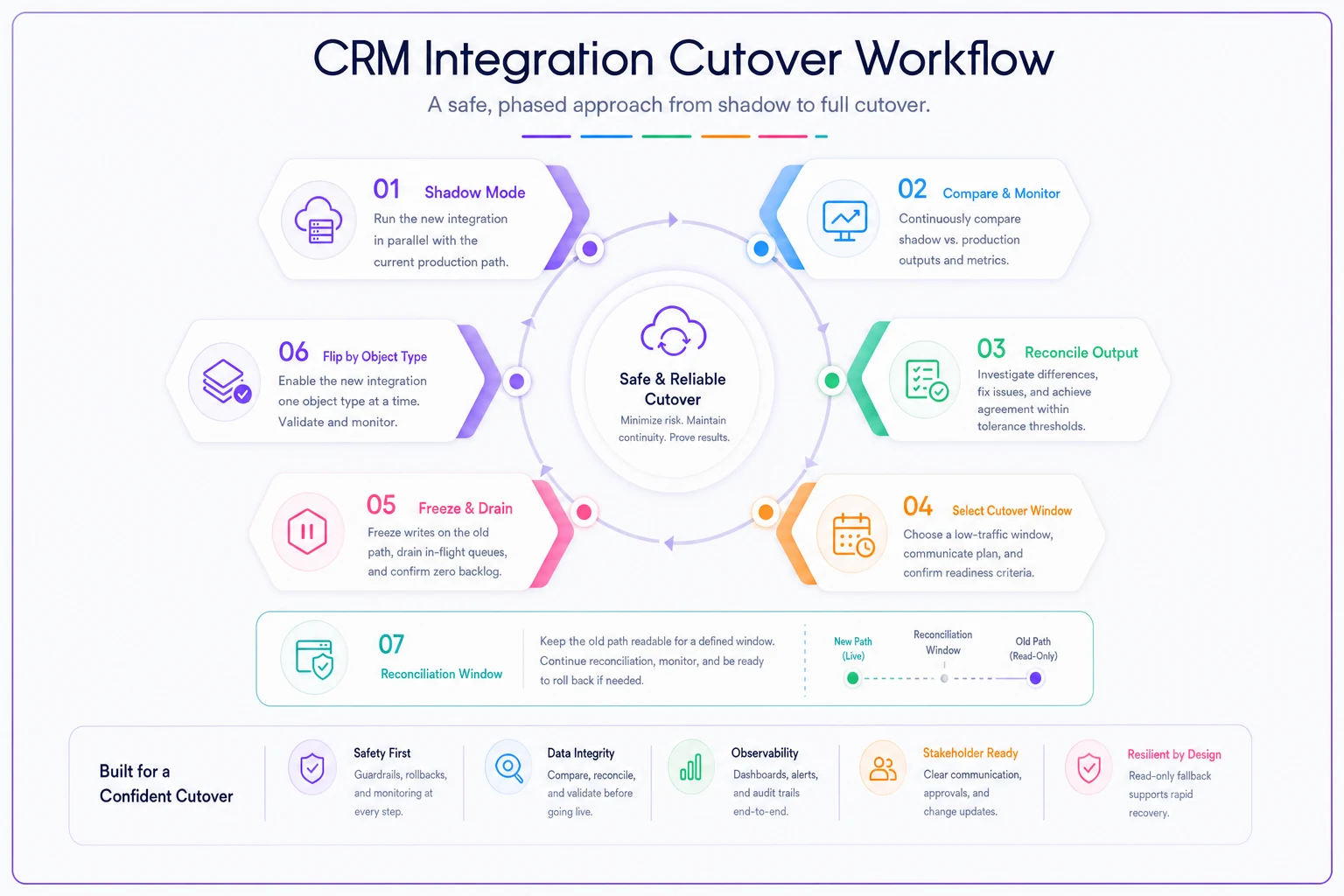
The recipe that's survived contact with reality:
-
Run in shadow mode first. The new integration consumes events and writes to a parallel set of records without touching production ARR. Compare the shadow output to the real system for a week or two.
-
Reconcile the shadow. Use the same reconciliation queries against shadow vs. production. If they agree within tolerance, your confidence is earned, not assumed.
-
Pick a quiet cutover window. Not month-end, not quarter-end. Finance will thank you.
-
Freeze writes briefly, drain the queue. Let in-flight events finish processing before you flip the switch so nothing's stuck half-delivered across the boundary.
-
Flip one object type at a time if you can — accounts, then subscriptions, then opportunities — rather than everything at once. Smaller blast radius if something's wrong.
-
Keep the old path readable, not deleted, for a reconciliation window. You want to be able to compare for a few cycles before you tear it down.
This diagram summarizes the cutover workflow.
The deeper mechanics of protecting ARR through a system change are their own discipline — the CRM migration cutover playbook for preserving ARR integrity goes into the sequencing in more detail. The point here is that event-driven design makes cutovers safer, because idempotent consumers mean you can replay the whole history into the new system without fear of double-counting.
When event-driven patterns make sense — and when they're overkill
This isn't a "do it everywhere" recommendation. The overhead is real.
It makes sense when multiple systems react to the same business change — billing, provisioning, CS onboarding all triggered by a closed deal. Or when finance and sales ops need ARR/ACV numbers to agree across tools. Or when you're past the point where one person remembers how everything's wired, and order of operations matters because upgrades, downgrades, and amendments stack on each other.
It's overkill when you have one CRM, one source of truth, and a nightly snapshot sync that nobody's ever complained about. Don't build an event bus to feel modern. Same goes for data flowing between systems that's read-only reporting and can tolerate being a day stale. And if you're a small team where the integration complexity would cost more than the drift it prevents, skip it.
Who should not rush into this: a two-person sales team with a single CRM and no billing integration. Spend that energy on data hygiene and clean field definitions first. Event-driven architecture solves a coordination problem you may not have yet. Build it when the coordination pain is real, not preemptively.
A real scenario
A B2B software company at roughly $6M ARR was running Salesforce for sales, a separate billing platform, and a warehouse pushing usage data back via reverse‑ETL. Their monthly close took close to five days, and about one in six of those closes surfaced a material disagreement between CRM ARR and billing ARR — usually from amended deals that updated in one place and not the other. Finance had stopped trusting the CRM number entirely and was rebuilding ARR by hand from billing exports.
The root causes weren't exotic. No idempotency meant a few webhook retries had double-counted upgrades. Events were named inconsistently (accountUpdate in one place, account.updated in another), so a couple of consumers were silently ignoring half their feed. And the reverse‑ETL job owned a field the CS team also edited, quietly overwriting notes.
They didn't rebuild everything. They renamed events to a consistent past-tense convention, added an event_id and a dedupe table to the ARR consumer, split the shared reverse‑ETL field so each field had one writer, and stood up a daily reconciliation query with a $100 tolerance. Within a couple of months the monthly close dropped to under two days and the material disagreements became rare — most closes now reconciled clean. Finance started trusting the CRM number again, which was honestly the whole point. The remaining deltas were almost always a single manual edit they could spot and explain in minutes.
The takeaway for revenue teams
Integration failures aren't usually an engineering tragedy — they're a definitions problem dressed up as a technical one. Two systems disagree because nobody wrote down what "upgraded" means, which version of the number wins, what happens when an event arrives twice, and how you check for drift.
Event naming conventions, schema versioning, idempotent consumers, reverse‑ETL contracts, honest transactional guarantees, and a reconciliation runbook are the boring scaffolding that lets sales, CS, and finance all look at the same ARR and believe it. Get those right and most "integration failures" stop happening — not because the pipes got better, but because the systems finally agree on what happened.
Ready to transform your customer relationships?
Join 2,000+ businesses using Rellyly to increase sales, improve client retention, and simplify CRM workflows.