


Most ARR reporting problems don't come from bad forecasting. They come from two teams looking at the same account and describing it completely differently in the CRM.
Sales logs a deal as "$60k." Finance sees $54k because there's a discount schedule buried in the contract nobody mapped. CS thinks the account renews in March, but the CRM says June because the "start date" field was set to the day the deal closed, not the day the contract actually went live. Nobody is lying. There's just no agreed-upon definition of what any of these fields mean, or which object is the authority when two systems disagree.
That's the real job of a CRM canonical data model — not to add more fields, but to decide, once and for all, what each object represents, which fields are required, and what rules keep them clean. Then you wrap it in a lifecycle so it doesn't quietly decay the moment you stop paying attention.
This is the piece underneath everything else. Pipeline stages, health scores, renewal timelines — they all inherit the reliability (or the mess) of the underlying schema.
Why ARR numbers drift even when everyone's "doing their job"
The frustrating part is that data drift rarely comes from laziness. It comes from three teams optimizing for different things.
Sales optimizes for closing. They'll put whatever number gets the deal through approval and worry about the details later. CS optimizes for the relationship, so they track things sales never touches — usage, sentiment, the champion who left. Finance optimizes for recognized revenue, which is a completely different calculation than booked ARR. None of these views is wrong. But without a canonical model sitting underneath them, each team builds its own shadow definitions. You end up with:
-
Three different "ARR" numbers depending on who exports the report
-
Accounts that exist twice because someone typed "Acme Inc" and someone else typed "Acme, Inc."
-
Renewal dates that mean different things across records
-
Products logged as free-text line items, so nobody can cleanly total ARR by product
A typical example: a 25-person SaaS company pulls board numbers from Salesforce, the CS team pulls from their success platform, and finance runs off a spreadsheet exported from billing. All three "reconcile" the week before the board meeting. That reconciliation eats two full days every quarter and still produces a footnote explaining a 4–6% variance.
The reconciliation isn't the problem. It's the symptom. The problem is that no object was ever declared the authority.
The core objects you actually need (and what each one owns)
A canonical model works when every important concept lives in exactly one place, and every other system references it instead of copying it. Here's the minimum object set that keeps ARR trustworthy.
Never miss a customer touchpoint again.
Rellyly helps you manage contacts, tasks, and sales efficiently in one platform.
- Unified customer profiles
- Automated follow-ups
- Sales pipeline tracking
No credit card required
| Object | What it owns | Common failure when missing |
|---|---|---|
| Account | Legal entity, canonical name, hierarchy (parent/child) | Duplicate accounts inflate logo counts and split ARR |
| Contact | People, roles, employment status | Renewals sent to champions who left months ago |
| Opportunity | New/expansion bookings, close date, stage | Expansion counted twice as "new" ARR |
| Subscription / Contract | The authoritative ARR value, term dates, billing schedule | Sales-entered deal size ≠ contracted revenue |
| Product / Line Item | Structured SKUs, per-product ARR | Can't segment ARR by product without manual tagging |
| Renewal | Renewal date, status, owner | Renewal timing scattered across mismatched date fields |
The single most important decision here: the Subscription/Contract object owns ARR, not the Opportunity. The opportunity is what sales hoped to sell. The subscription is what the customer actually agreed to pay. When those two disagree — and they will — the contract wins. Every board number should trace back to it.
The second decision that saves constant pain: model the Account hierarchy early. A parent company with four subsidiaries needs to roll up as one logo for retention math but four contracts for billing. Flatten that, and your net revenue retention number becomes fiction the first time one subsidiary churns.
Required fields and validation rules that actually hold
Making a field "required" in the CRM UI is the weakest form of governance. People type "N/A," "TBD," or "123" just to move on. Real validation checks that the value makes sense, not just that it exists.
Here's the difference between fields that look clean and fields that are clean:
-
Canonical account name — enforced against a normalized format, deduped on creation. Not "required," validated.
-
ARR value — must be numeric, greater than zero for active subscriptions, and must reconcile to the sum of line items. If the total doesn't match the parts, the record can't be marked active.
-
Contract start and end dates — end must be after start; term length must match the stated billing frequency. A "12-month" term that spans 18 months on the calendar gets flagged.
-
Renewal date — auto-derived from contract end date, not hand-entered. Manual override requires a reason code.
-
Product SKU — picklist only. No free text. Ever.
-
Currency — required on every monetary field. Multi-currency ARR without a currency field is a slow-motion reporting disaster.
The pattern worth internalizing: derive fields wherever you can instead of asking humans to enter them. Every hand-typed date is a future discrepancy. Renewal date should come from contract end date. Days-to-renewal should come from today minus that. The fewer fields a rep touches manually, the fewer places your numbers can quietly split.
This connects directly to broader hygiene practices — if you haven't already, the CRM data-hygiene playbook for SMB sales teams covers the day-to-day cleanup side that keeps these validations from being overwhelmed by existing mess.
The data contract: the part everyone skips
Most teams stop after building a clean schema. They document it once and assume it'll stay clean. Six months later it's a swamp again.
A data contract is the agreement between the people who produce data (sales reps, CS managers, billing) and the people who consume it (finance, RevOps, the board deck). It states, in writing:
-
Which object is the source of truth for each metric
-
What each required field means and its accepted format
-
Who is responsible for entering it and by when
-
What happens when the contract is violated (record blocked, flagged, escalated)
-
Who has to approve a change to any of it
The contract turns "clean data" from a vibe into an enforceable spec. Without it, every new hire invents their own conventions, every integration adds fields nobody governs, and the schema erodes one well-meaning workaround at a time.
A realistic version of a single contract line reads like this: "ARR is owned by the Subscription object. It equals the sum of active line-item annual values in the account's base currency. Sales cannot edit it directly after contract execution. Finance owns changes. Any variance over 2% between Subscription ARR and billing ARR triggers a reconciliation task within 3 business days."
That one sentence eliminates an entire category of quarterly arguments.
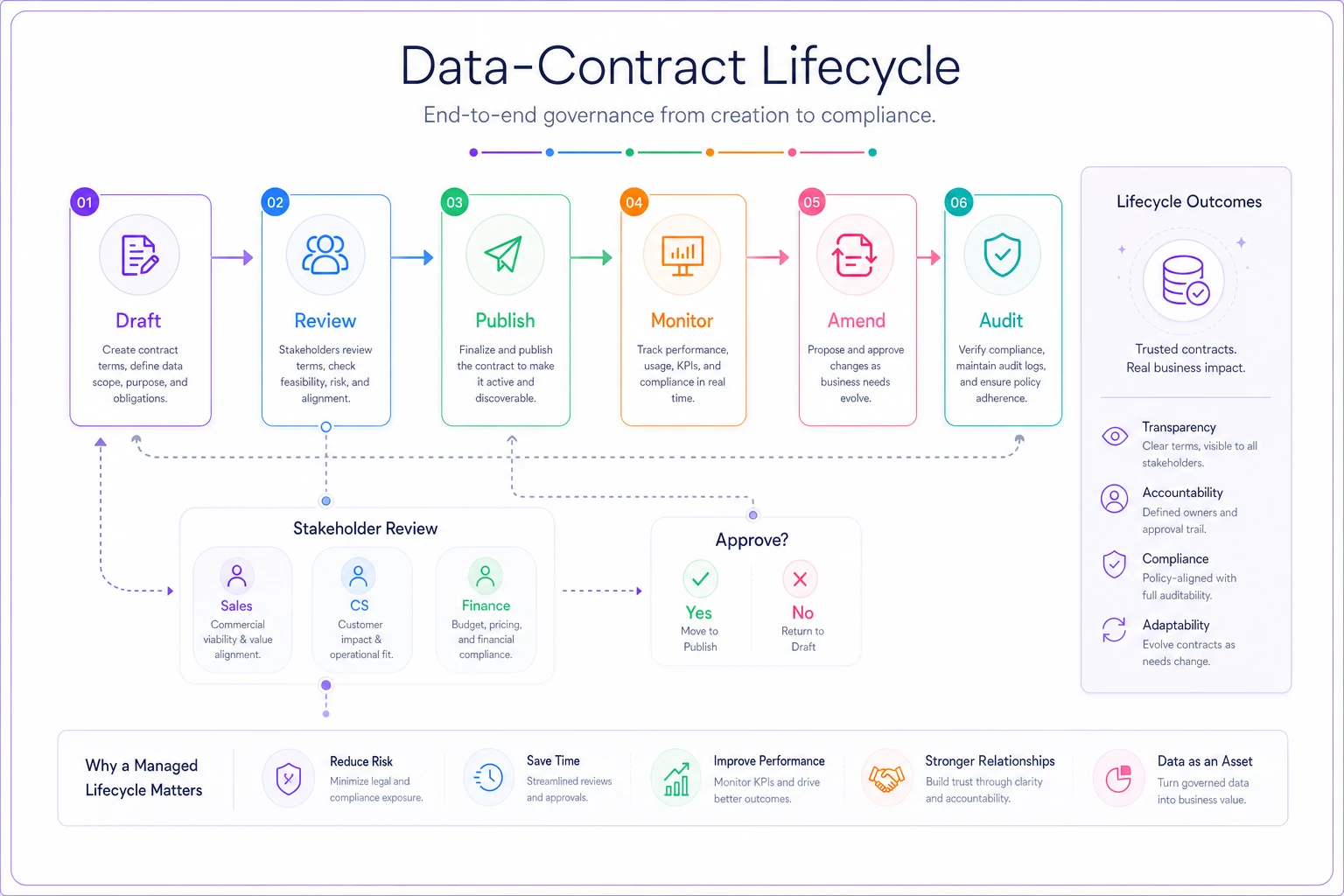
The data-contract lifecycle: keeping it alive
Schemas don't fail all at once. They rot. A new product launches and someone adds a free-text field "just for now." A partnership needs a custom flag. An integration pushes data into a field it wasn't designed for. Six months of small exceptions later, you're back to reconciling spreadsheets.
-
Draft — Define the object, fields, validation rules, and ownership. Write the contract in plain language, not just field-level config.
-
Review — Get sales, CS, and finance to sign off. If finance won't agree that the Subscription object owns ARR, you have your fight now instead of at the board meeting.
-
Publish — Enforce validations, document the contract somewhere people actually read, and onboard existing records against it.
-
Monitor — Run scheduled checks for violations
mismatched ARR, missing currencies, orphaned renewals, duplicate accounts.
-
Amend — When a genuine new need appears, change the contract deliberately, with approval, instead of letting someone bolt on a field quietly.
-
Audit — Quarterly, sample records and confirm they still match the contract. Retire dead fields nobody uses.
The step people consistently underestimate is Monitor. Validation rules catch problems at data entry, but they can't catch drift that happens after entry — a contract amended in the real world but not in the CRM, or an integration that started writing garbage last Tuesday. Scheduled checks catch what point-of-entry validation misses.
This is also where lightweight automation earns its keep — not as some headline feature, just as a quiet background process.
Something that flags accounts where Subscription ARR and billing ARR have drifted, or where a renewal date sits three months past contract end, means someone gets a task instead of finance discovering it during close.
Lightweight automation earns its keep — not as some headline feature, just as a quiet background process.
The point isn't the automation itself; it's that nobody has to remember to look.
An onboarding template that keeps new records clean from day one
The fastest way to pollute a clean model is sloppy account creation. New records are where duplicates and missing data are born, because that's the moment someone is in a hurry.
A tight onboarding template for a new account should require, before the record can be saved:
-
Deduplication check — search existing accounts by normalized name and domain before creating
-
Canonical name — entered in the standard format
-
Parent/child relationship — assigned if the account belongs to a hierarchy
-
Primary currency — set at account level
-
At least one contact with a defined role
-
Owner — assigned, not left blank
Then, at contract execution, a second gate:
-
Subscription object created and linked
-
ARR entered as structured line items, currency attached
-
Term dates entered, renewal date auto-derived
-
Products selected from the SKU picklist
Two gates, both enforced. A record that skips either one shouldn't count in ARR reporting until it's complete. This is unglamorous work, and it's exactly why teams skip it — and exactly why their numbers drift.
When this level of rigor makes sense — and when it doesn't
Not every company needs a formal data contract with approval workflows. Building this before you need it wastes time you don't have.
When it makes sense:
-
You have more than one team touching ARR-relevant records (sales and CS and finance)
-
Your board or investors care about NRR, gross retention, and ARR by segment
-
You've already had at least one painful reconciliation where numbers didn't match
-
You're past roughly 100–150 accounts, where manual eyeballing stops working
When it's overkill:
-
You're a founder-led team of 5 with 20 accounts you know by heart
-
One person owns the entire CRM and reporting
-
You're still figuring out your pricing and product — locking the schema now just means rebuilding it in three months
Early-stage teams still changing their business model weekly should probably wait. A canonical model assumes your core concepts are stable. If what counts as "a customer" or "a subscription" is still shifting, formalizing it prematurely creates rigid rules you'll constantly fight against. Get the concepts stable first, then lock them.
A real scenario
A roughly 30-person B2B SaaS company, around $4M ARR, spread across about 180 accounts. Board reporting came from three sources — CRM, a success platform, and finance's billing export — and the three ARR numbers never matched. Quarterly reconciliation took two people the better part of two days, and they still shipped the deck with a variance note explaining a gap somewhere around 5%.
The fix wasn't a new tool. It was declaring the Subscription object the single owner of ARR, moving product tracking from free-text to a SKU picklist, deriving renewal dates from contract end dates, and writing a one-page data contract that finance actually signed off on. Existing records got onboarded against the new rules over about three weeks — the ugly part, since roughly 40 accounts had ARR that didn't reconcile to their line items and had to be corrected by hand.
After a full quarter on the new model, the three-source variance dropped under 1%, and reconciliation went from two days to a couple of hours — mostly just confirming the monitoring checks hadn't flagged anything. No dramatic revenue jump. Just numbers everyone trusted, and a board meeting where nobody had to explain a footnote.
Where this connects to everything else
A canonical model isn't a standalone project. It's the foundation the rest of your revenue operations stand on. Pipeline stages only produce reliable forecasts if the underlying opportunity and subscription data is clean — which is why standardizing pipeline stages for ARR accuracy works far better once the schema beneath it is solid. Health scores, renewal timelines, expansion tracking — all of them inherit the reliability of the objects underneath.
The mistake most teams make is treating data quality as a cleanup project — something you do once when the CRM gets messy. It's not a project. It's a contract with a lifecycle. You define what's true, agree on who owns it, enforce it at entry, monitor it after, and amend it deliberately when the business genuinely changes.
Do that, and ARR reporting stops being a quarterly argument and starts being something you can actually build decisions on. Skip it, and no amount of dashboard polish will save you — you'll just have prettier versions of three numbers that still don't agree.
Ready to transform your customer relationships?
Join 2,000+ businesses using Rellyly to increase sales, improve client retention, and simplify CRM workflows.