

Most win-back programs fail for one dumb reason: they treat every churned customer the same. Someone who left because your pricing jumped 40% gets the exact same email as someone who churned because support ghosted them for three weeks. Both get a generic "Here's 20% off, come back!" message. Both ignore it.
The pricing customer doesn't want a temporary discount — they need to understand the value math again. The support customer doesn't care about a discount at all — they want proof that the thing that burned them won't happen again. Sending both the same offer is like prescribing the same medication for a broken arm and a fever.
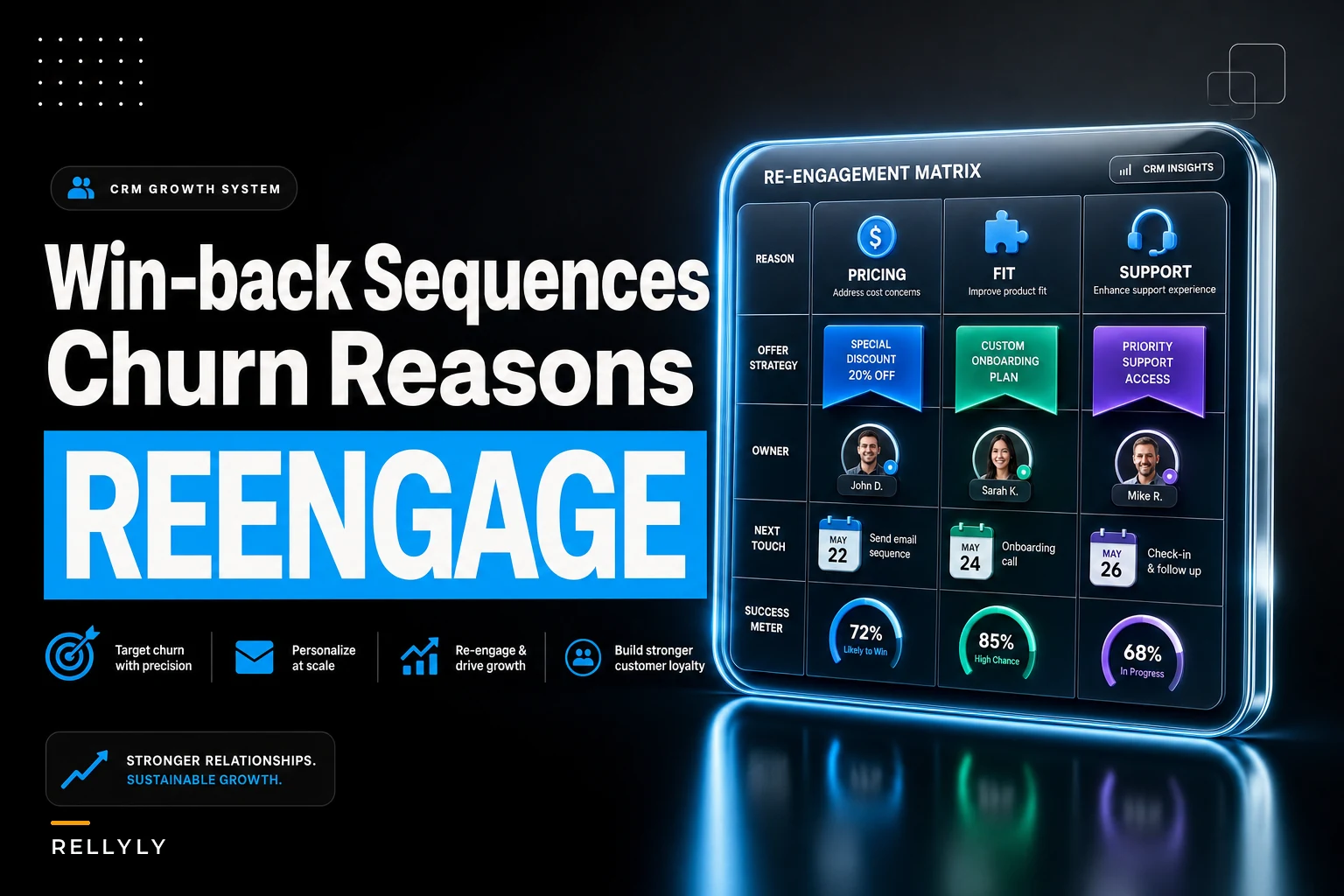
If you want to actually win back churned customers, you have to start from the reason they left, then work backward to the offer, the owner, the timing, and what "success" even means for that segment. This article is a matrix for doing exactly that — with ready-to-send templates for the three churn buckets that make up the majority of recoverable accounts: pricing, fit, and support.
Why reason-blind win-backs quietly lose money
The pattern shows up constantly in CS orgs. The team exports a list of everyone who churned in the last 90 days, drops it into a sequence, and blasts three emails over two weeks. Open rates look okay. Reply rates are near zero. Someone concludes "win-back doesn't work for us" and the program dies.
-
People who left because the price no longer matched their budget or usage
-
People who left because the product never fit their workflow in the first place
-
People who left because a support failure broke their trust
-
A smaller group who churned for reasons you genuinely can't fix — company shut down, got acquired, sponsor left
Each of these responds to a different message, a different offer, and a different owner. When you average them all into one campaign, you optimize for nobody. The pricing folks needed a payment plan or a right-sized tier. The fit folks needed a different use case or a feature that shipped after they left. The support folks needed an apology and an escalation path — not a coupon.
Reason-blind win-backs also burn goodwill. A support-churned customer who gets a chipper "we miss you!" email often reads it as tone-deaf, because from their side you didn't miss them at all — you dropped them. That's the difference between a warm door and a slammed one.
Get the churn reason right before you write a single template
You can't map offers to reasons if your churn reasons are garbage. And in most CRMs, they are. The dropdown says "Other" for 60% of cancellations because the rep clicked whatever closed the ticket fastest.
Never miss a customer touchpoint again.
Rellyly helps you manage contacts, tasks, and sales efficiently in one platform.
- Unified customer profiles
- Automated follow-ups
- Sales pipeline tracking
No credit card required
-
Force a specific reason at cancellation, not a free-text box. Give reps or the self-serve flow 5–7 concrete options: price, missing capability, poor fit for use case, support/reliability issue, champion left, went with competitor, business closed.
-
Add a one-line "what would have kept you" field. This single line is gold for the win-back writer later. "Would've stayed if the export worked with QuickBooks" tells you exactly what to say in six months.
-
Tag whether the account is recoverable. Business-closed and acquired accounts should be flagged non-recoverable so they never enter a sequence. Nothing looks worse than emailing a company that no longer exists.
-
Timestamp the churn and the reason separately. Sometimes the reason evolves — a "price" churn was really a "value" churn once you dig into the exit call.
That one-line "what would have kept you" answer is often the single most useful line for later personalization.
The moment you replace the "Other" dropdown with real reasons, your recoverable segment becomes obvious. You stop chasing the un-winnable and start focusing effort where offers actually move people.
The win-back matrix: reason → offer → owner → timing → success criteria
Three recoverable segments, mapped end to end.
| Churn reason | Re-engagement offer | Owner | Timing after churn | Success criteria |
|---|---|---|---|---|
| Pricing (too expensive, price increase, budget cut) | Right-sized tier, annual prepay discount, or usage-based plan — not a random coupon | AE or CS with pricing authority | 30–45 days (let the budget reset, avoid looking desperate) | Reactivation at a sustainable price OR a clear "revisit next fiscal year" callback booked |
| Fit (missing feature, wrong use case, workflow mismatch) | "We built the thing you needed" — feature/roadmap update, tailored onboarding for their real use case | Product-savvy CSM or solutions person | Trigger-based: when the missing capability actually ships (could be 60–180 days) | Booked demo of the new capability + reactivation at original or higher tier |
| Support (slow response, unresolved bug, trust broken) | Sincere accountability + named senior contact + concrete process change — no discount as the lead | CS leader / senior CSM, ideally someone new to the account | 14–21 days (fast enough to show you noticed, slow enough to have a real fix) | Trust re-established: a reply, a call taken, reactivation at same terms |
A few things worth calling out here.
The timing varies wildly — 14 days for support, up to 180 for fit. That's on purpose. A support win-back that arrives 90 days late feels like you never cared. A pricing win-back that arrives 3 days after cancellation feels desperate and teaches customers that threatening to leave gets them a discount. The fit sequence is the only one that's event-driven rather than calendar-driven, because there's no point pitching a feature that doesn't exist yet.
The owner also changes by segment. For support churn especially, sending the same rep who dropped the ball is a mistake. A fresh senior contact signals "this is being taken seriously at a higher level" — which is exactly what a burned customer needs to hear.
Segment 1: Pricing churn
Pricing churn is the most over-discounted and least understood of the three. The reflex is to slash the price. The better move is figuring out whether they left because of absolute cost (budget genuinely shrank) or value mismatch (they didn't feel they got their money's worth). The offer is different for each.
For a budget-driven exit, offer a smaller tier or a different payment structure — monthly instead of annual, or a usage-based plan that scales with them. For a value-driven exit, re-anchor on outcomes before you talk numbers.
Timing: wait about 30–45 days. Reaching out too fast rewards the cancellation.
Ready-to-send template (pricing):
> Subject: A plan that actually fits [Company] > > Hi [First name], > > When you canceled, the note said the plan had gotten too expensive for where the team is right now. Totally fair — I'd rather find you the right fit than lose the relationship. > > Two options that might work better:
-
[Right-sized tier] at [price], which covers [the 2–3 things you actually used most]
-
Annual prepay that brings the effective monthly cost down to [price]
> No pressure to decide today. If it's easier, I can hold your old data and settings for 30 days so nothing's lost if you come back. > > Worth a 15-minute call? > > [Name]
The line about holding their data and settings matters more than the discount for a lot of accounts. Re-implementation friction is a real reason people don't return even when they want to.
Segment 2: Fit churn
Fit churn has the longest fuse and, honestly, produces the highest-quality reactivations. These customers didn't hate you — the product just didn't do the one thing they needed. When that thing finally ships, they come back and they stick, because the original objection is gone.
The mistake is sending generic "we've made improvements!" emails. Nobody re-engages over a vague changelog. You have to tie the message directly to the specific gap they flagged on the way out — which is exactly why that "what would have kept you" field is worth so much.
Timing: event-driven. The trigger is the feature shipping, not a date on the calendar. This is where a lot of teams drop the ball — the feature ships and nobody circles back to the accounts that churned specifically because it was missing. The connection between the roadmap and the churned-customer list needs to be a real, owned workflow, not something living in someone's memory.
Ready-to-send template (fit):
> Subject: The [feature] you needed is live > > Hi [First name], > > When [Company] moved on, the reason was [the specific gap — e.g., "we didn't sync with your inventory system"]. I made a note to reach back out if that ever changed. > > It changed. [Feature] shipped last month and it does exactly [the thing you needed]. Here's a 90-second look: [link]. > > Since you already know the rest of the product, getting back up and running would take one short call — I'll handle the setup for the [feature] side myself. > > Want me to walk you through it live? > > [Name]
For teams juggling a lot of these, the timing discipline here has a lot in common with knowing when not to reach out — the same instinct behind throttling recurring check-ins so you don't burn people. Fit win-backs work because they're rare and relevant, not because they're frequent.
Segment 3: Support churn
This is the one people handle worst. Support churn is a trust wound, and every instinct to "make it up to them" with a discount actually makes it worse — it signals you think the problem was about money. It wasn't. It was about being ignored, or a bug that never got fixed, or a promise that got broken.
The offer here is accountability first, incentive last (if at all). What actually repairs support churn:
-
An honest acknowledgment of what specifically went wrong
-
A named senior person who owns the account now
-
A concrete description of what changed so it won't repeat
-
Only then, maybe, a goodwill gesture
Timing: move fast — 14 to 21 days. Support-churned customers are still emotionally warm about the failure. Wait too long and the warmth turns into indifference, which is much harder to recover from.
Who should send it: ideally not the person or team associated with the failure. A CS lead or a new senior CSM carries more weight.
Ready-to-send template (support):
> Subject: I owe you a straight answer, [First name] > > Hi [First name], > > I looked into what happened with [Company], and honestly, we dropped it. [Specific failure — e.g., "your export bug sat open for three weeks with no update"]. That's not the experience you paid for and I'm not going to pretend otherwise. > > Two things have changed since:
-
[Concrete fix — e.g., "the bug is resolved and we've added monitoring so it can't silently break again"]
-
I'm personally your point of contact now — direct line, not a queue
[contact]
> I'm not going to lead with a discount, because I don't think that's what this was about. But if you're open to it, I'd like 15 minutes to show you it's genuinely different now. > > [Name]
The "I'm not going to lead with a discount" line does real work. It tells the customer you actually understand why they left, which is the thing they most doubt about you right now.
The workflow that keeps this running
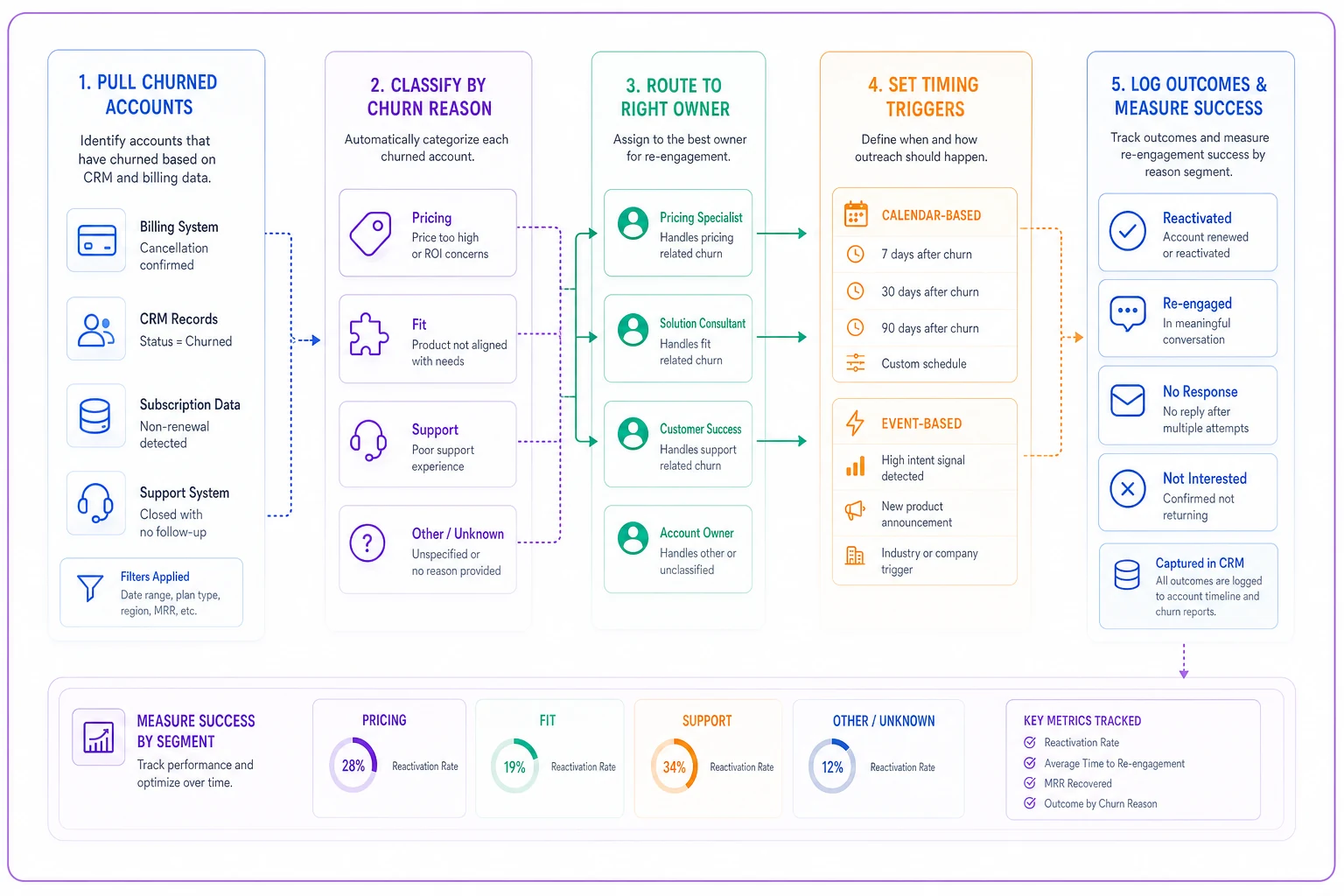
A matrix is useless if it lives in a doc nobody opens. Here's the operating loop that makes reason-based win-backs actually happen, month after month:
-
Weekly, pull churned accounts from the last period and confirm each has a real, specific reason (not "Other") and a recoverable flag.
-
Route each account into its segment — pricing, fit, or support — and assign the correct owner per the matrix.
-
Set the timing trigger. Calendar-based for pricing and support; event-based (tied to the roadmap) for fit.
-
Owner runs the segment-specific template, personalized with the exit note details.
-
Log the outcome against the segment's success criteria — reactivation, callback booked, demo taken, or a clean "no."
-
Review win rates by segment monthly and kill or rework whichever offer isn't converting.
That last step is where most programs go from mediocre to good. When you track results by reason, you learn things like "our pricing offer converts at 12% but our support offer only at 4% — our support fix isn't credible enough yet." You can't see that when everything's blended into one number.
This is the same reason-driven logic that works for stalled deals earlier in the funnel — if you've built a reason-driven re-engagement cadence for mid-funnel opportunities, win-back is just the post-churn version of the same discipline.
A quick real scenario
A roughly 30-person B2B software company was running a single blanket win-back sequence to everyone who canceled — somewhere around 40–50 churned accounts a quarter. Reactivation hovered around 3%, and the CS team had basically written off win-back as a waste of time.
They split the list into the three segments. It turned out about half their churn was fit-related — people who'd left because of two specific integration gaps that had already shipped months later, and nobody had told them. They built the event-triggered fit sequence, sent the tailored "the thing you needed is live" email to that group, and reactivated a handful of accounts within about six weeks. Support churn got the accountability template from a senior CSM instead of the original rep.
Overall reactivation moved from around 3% to somewhere in the 9–11% range over the following two quarters. Not dramatic on paper, but on 40-odd accounts a quarter it added up to a meaningful chunk of recovered ARR that would've otherwise stayed dead — and the fit segment alone drove most of it.
When this is worth it — and when it isn't
When reason-based win-back makes sense:
-
You have enough monthly churn (say 15+ recoverable accounts) to segment meaningfully
-
Your product is actively shipping, so fit churn regularly becomes recoverable
-
Your contract values justify a human-owned, personalized outreach
When it's a bad idea:
-
Your churn reasons are mostly "business closed" or "acquired" — non-recoverable, and no template fixes that
-
You're a tiny self-serve product where the economics don't support personalized owner-driven sequences
-
Your product genuinely hasn't improved, so the fit and support templates would be dishonest — customers smell that instantly
Who should not do this: any team that hasn't fixed churn-reason capture yet. If your cancellation data is 60% "Other," build that first. Segmenting garbage just gives you smaller piles of garbage.
The point
Winning back churned customers isn't about a cleverer subject line or a bigger discount. It's about respecting the fact that people leave for genuinely different reasons and deserve genuinely different conversations. The pricing customer needs the math to work. The fit customer needs the thing they were missing. The support customer needs to trust you again — and no coupon buys that. Get the reason right, map it to the correct offer, owner, and timing, and measure success per segment. Do that consistently and win-back stops being the graveyard everyone ignores and becomes a repeatable, measurable source of recovered revenue.
Ready to transform your customer relationships?
Join 2,000+ businesses using Rellyly to increase sales, improve client retention, and simplify CRM workflows.