
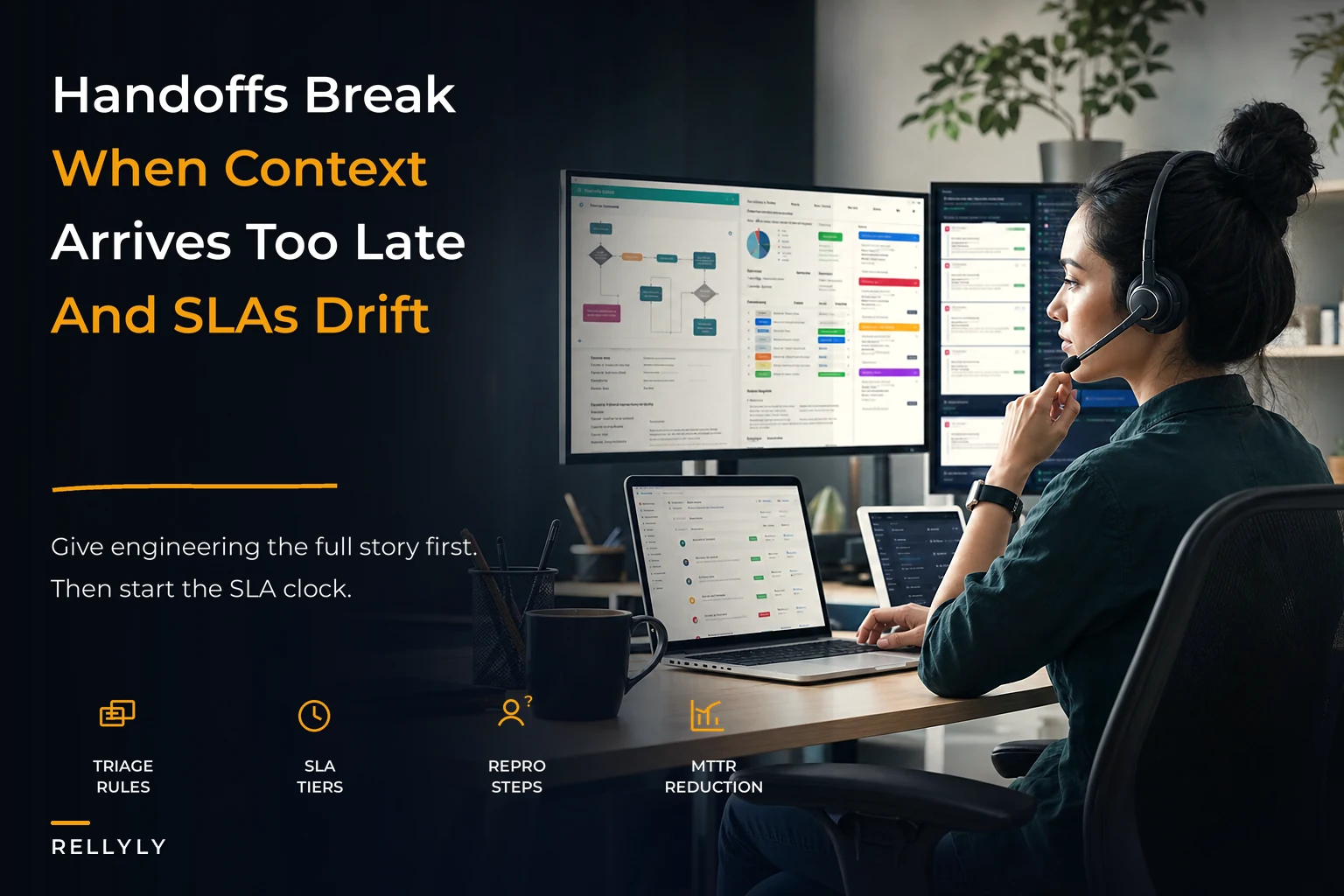

Most teams obsess over engineering fix time. They track deploy speed, measure how long a patch takes, argue about on-call rotations. But when you actually pull apart a slow incident and lay it out on a timeline, the fix is rarely the slow part.
The slow part is the handoff.
It's the 40 minutes support spends deciding whether something is a real bug or a confused customer. It's the ticket that lands in engineering's queue with the subject line "customer says it's broken" and nothing else. It's the back-and-forth where an engineer asks "what account, what environment, what were they actually doing" and support has to go back to the customer, who has since gone to lunch.
That dead space between detection and diagnosis is where MTTR quietly balloons — and it's almost entirely fixable with process, not headcount. That's what a real support engineering handoff playbook is for. Not to make support smarter about code, but to make sure that when something crosses into engineering, it crosses with everything needed to act immediately.
Where the handoff breaks, and why it breaks the same way everywhere
The failure isn't random. It follows a pattern you can predict once you've looked at enough incident postmortems.
Support doesn't know when to escalate. Some agents escalate too fast to protect their SLA numbers, dumping half-diagnosed tickets on engineering. Others sit on real incidents too long because they're afraid of looking like they can't handle it. Both behaviors come from the same root cause: there's no clear rule for what qualifies as an engineering issue versus a support issue.
The context is in someone's head. Support knows the customer was on the beta plan, was mid-migration, and had a weird workaround in place. None of that makes it into the ticket. Engineering starts from zero, reconstructing what support already knew.
Nobody owns the packet. On a lot of teams, the escalation is just a Slack message or a forwarded email. No standard object, no required fields, no clear owner. Every handoff gets improvised, and improvised handoffs are slow handoffs.
Teams tend to treat escalation as a communication problem when it's actually a data-completeness problem. More Slack channels and faster pings don't help if the ping is missing the account ID. The fix isn't more talking — it's making sure the right structured information moves with the ticket, every time, without depending on whoever happened to catch it.
What breaks as you scale
At five support agents and three engineers, tribal knowledge works. Everyone knows who to grab. The engineer recognizes the customer name. The whole thing runs on relationships.
Never miss a customer touchpoint again.
Rellyly helps you manage contacts, tasks, and sales efficiently in one platform.
- Unified customer profiles
- Automated follow-ups
- Sales pipeline tracking
No credit card required
Then you hit 20 agents, three shifts, and an engineering team split across squads, and the informal system falls apart in specific, predictable ways.
-
Shift boundaries kill context. An incident opened at 4pm by the day shift gets picked up by night support who has no idea what's already been tried.
-
Routing becomes a guessing game. With one engineering team, everything goes to "engineering." With five squads owning different services, support now has to know the architecture to route correctly — and they don't.
-
Repeat incidents stop being recognized. At small scale, someone remembers "oh, this is the same thing that happened in March." At scale, the same root cause hits three times across different agents and nobody connects the dots.
-
SLA promises get made without SLA capacity. Sales promised a one-hour response to a Tier 1 account. Support doesn't know that account is Tier 1. Engineering doesn't know the clock is running.
Handoff quality degrades faster than volume grows. Double the tickets and the handoff chaos more than doubles, because the number of possible miscommunication paths grows with every new person and every new service boundary.
The four pieces that actually fix it
A working handoff system has four moving parts. They only work together — pick two and you'll still leak time.
1. Triage rules that remove the judgment call
The goal is to make "is this an engineering issue" answerable in under a minute by someone who isn't an engineer. That means concrete, observable criteria — not vibes.
-
Is the customer able to reproduce it? Yes / No
-
Does it affect more than one account? Yes / No / Unknown
-
Is there a workaround support can apply directly? Yes / No
-
Is data loss or a security concern involved? Yes / No
If data loss or security is a yes, it skips normal routing entirely and goes straight to the incident path. This is the same logic that underpins a good incident escalation runbook for high-value customers — the severity of what's happening should override the normal queue, automatically.
The mistake people make here is writing triage rules that require the agent to already know the answer. "Escalate if it's a backend bug" is useless — the agent can't tell. "Escalate if the error persists after clearing cache and confirming the account is active" is something they can actually check.
2. SLA tiers that everyone can see
SLAs fall apart when the tier lives in the CRM and the person doing the work is in the ticketing tool. The account tier, the response commitment, and the resolution target all need to travel with the incident.
| Tier | Who | First response | Update cadence | Resolution target |
|---|---|---|---|---|
| P1 – Critical | Any tier, service down / data risk | 15 min | Every 30 min | 4 hours |
| P2 – High | Strategic accounts, major feature broken | 30 min | Every 2 hours | 1 business day |
| P3 – Standard | Single account, degraded but usable | 4 hours | Daily | 3 business days |
| P4 – Low | Cosmetic, minor, has workaround | 1 business day | As needed | Backlog |
The important nuance: severity and account tier are two different axes, and P1 can be triggered by either. A P4-looking cosmetic bug on a strategic account might still warrant faster communication even if the fix waits. Keeping these separate stops the two most common failures — treating every big-account issue as critical, and ignoring genuine critical issues on small accounts.
3. Templated context packets
This is the single highest-leverage piece. A context packet is a standardized set of fields that must be filled before an escalation is accepted. Not suggested — required.
A solid packet includes:
-
Account identity account ID, plan tier, SLA tier, current MRR/ARR band
-
Environment region, version, any active migrations or feature flags
-
Reproduction exact steps, expected vs. actual, timestamp of last occurrence
-
Scope one account or many, first occurrence or recurring
-
What support already tried so engineering doesn't repeat it
-
Customer impact and mood are they blocked, are they escalating internally, is there a renewal in play
-
Links the original ticket, relevant logs, related past incidents
The reason this works isn't that the information is exotic. Making the fields required forces collection to happen before the handoff instead of after. In practice, the delay isn't gathering the information — it's gathering it twice, across two teams, after the customer has gone quiet.
4. Automation recipes that populate the packet
Filling that packet by hand for every incident would take support 15 minutes and they'd skip half the fields under any real ticket volume. This is where automation earns its place — not as a replacement for judgment, but as a way to pre-fill the mechanical parts.
-
On escalation trigger, auto-pull account data. When an agent flags a ticket as an engineering issue, the system fetches the account ID, plan, SLA tier, and ARR band from the CRM and drops them into the packet. The agent never types them.
-
Auto-attach recent activity. Pull the last error logs, recent deploys to that customer's region, and any open feature flags automatically.
-
Match against past incidents. Search closed incidents for similar signatures and surface the top matches, so repeat incidents get flagged as repeats immediately.
-
Route by service ownership. Map the affected component to the owning squad and route there, instead of a generic engineering queue.
-
Start the SLA clock and set update reminders based on the tier the moment the packet is created.
If you're deciding which of these to build first: automate the data-gathering and the routing, keep the judgment human. That line — what to hand to a machine and what to keep with a person — is worth thinking through carefully, and the automation decision framework for customer success is a useful lens for drawing it. The triage decision stays human. The packet population becomes automatic.
How the workflow runs end to end
``
Customer reports issue
        ↓
Support runs triage decision tree
        ↓
Meets engineering escalation bar?
    ↓ Yes
Agent triggers escalation
        ↓
Automation pre-populates context packet
(account data, environment, past incident matches, deploy history)
        ↓
Agent adds reproduction steps + customer context
        ↓
System routes to owning squad + starts SLA clock
        ↓
Engineer opens complete packet → begins with working hypothesis
        ↓
Resolution logged → packet archived as searchable record
``
Walk through a single incident with the system in place. A customer reports that exports are failing. Support runs the triage tree: reproducible, affects one account so far, no workaround, no data loss. It clears the "engineering issue" bar. The agent hits escalate.
Here's a visual of that workflow.
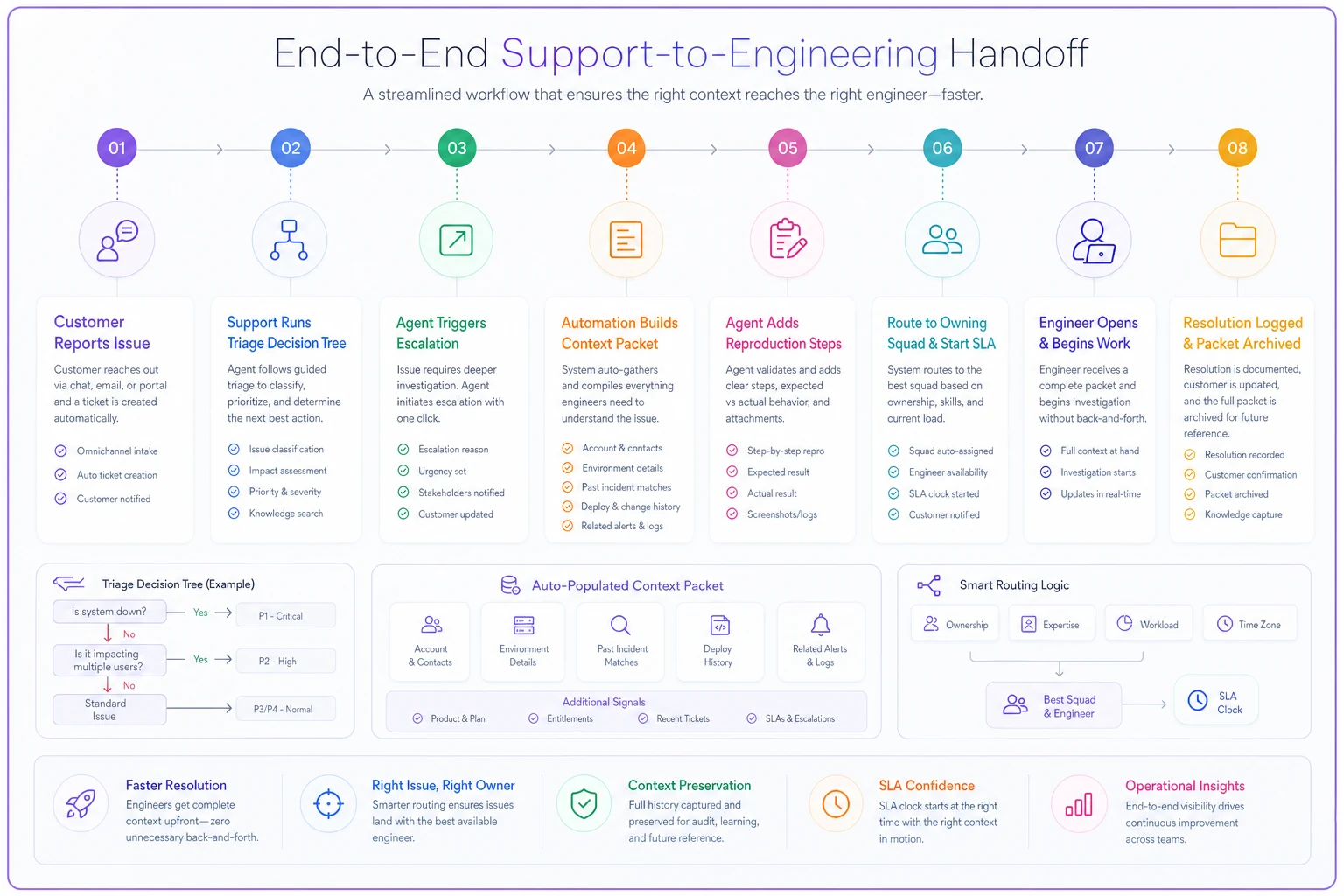
The moment they do, the packet auto-populates. Account ID, plan (Growth), SLA tier (P2 strategic), ARR band, region (EU), current version, and a note that a deploy hit EU two hours ago. The system also surfaces two closed incidents with matching export-failure signatures from the past quarter. It routes to the Data Services squad, not the general queue, and starts the P2 clock — 30-minute first response.
The agent adds the two things automation can't know: exact reproduction steps and the fact that this customer has a renewal call Thursday. Total time from escalation to a complete, routed packet: under three minutes.
The engineer opens it and immediately sees the recent EU deploy and the matching prior incidents. Instead of starting from "customer says exports broken," they start from a strong hypothesis. That's where the MTTR savings actually come from — not from engineers working faster, but from them starting warmer.
A real scenario
A B2B analytics company, roughly 30 support agents and four engineering squads, was running everything through Slack escalations. Their median time from escalation to an engineer actively working was sitting around 90 minutes, and a noticeable chunk of incidents were repeats they'd already fixed before.
They put in a required context packet, a two-axis SLA tier system, and three automation recipes — auto-pull account data, past-incident matching, and squad routing.
The change over a couple of months wasn't dramatic in any single incident, but it added up. Median escalation-to-active-work dropped to somewhere around 35 minutes. More interesting: the past-incident matching flagged that roughly one in five of their P2s were recurrences of already-solved problems. Once those got tagged and root-caused instead of re-diagnosed each time, the total incident load eased noticeably. Engineers stopped feeling like they were fixing the same thing on a loop.
No new headcount. The gain came entirely from information arriving complete instead of trickling in.
When this is worth building — and when it isn't
Build the full system when:
-
You have multiple support shifts or multiple engineering squads
-
Handoffs currently happen over chat or email with no standard format
-
You're seeing repeat incidents that nobody's connecting
-
Sales is making SLA promises support and engineering can't see
Keep it lightweight when:
-
You're small enough that everyone knows every customer by name
-
Your incident volume is low enough that a shared doc still works
-
You have one engineering team and no routing ambiguity
One thing worth being direct about: teams that haven't yet agreed on what actually counts as an engineering escalation should not build this yet. If your triage rules are still fuzzy, automating the packet just makes fuzzy escalations arrive faster. Fix the definitions before you build the machinery, because automating a broken process gives you a faster broken process.
The part most teams skip: closing the loop on repeats
Cutting MTTR gets the attention because it's measurable and immediate. But the bigger long-term win is preventing the incident from recurring a third and fourth time.
That only works if the packet doesn't disappear when the incident closes. The resolved packet — root cause, fix, the triage signature that identified it — should become a searchable record that future escalations get matched against. That's the mechanism that turns "we fixed it" into "we recognize it instantly next time."
Most teams treat incident records as compliance paperwork, filed and forgotten. The teams that actually reduce repeat incidents treat them as a growing library of known signatures. Every closed incident makes the next triage faster, because there's a real chance the next one has been seen before.
The handoff isn't a moment — it's a system that either gets smarter each time it runs, or starts from zero every time. Which one you get depends entirely on whether the information moves with the work, or stays stuck in someone's head.
The handoff isn't a moment — it's a system that either gets smarter each time it runs, or starts from zero every time. Which one you get depends entirely on whether the information moves with the work, or stays stuck in someone's head.
Ready to transform your customer relationships?
Join 2,000+ businesses using Rellyly to increase sales, improve client retention, and simplify CRM workflows.