
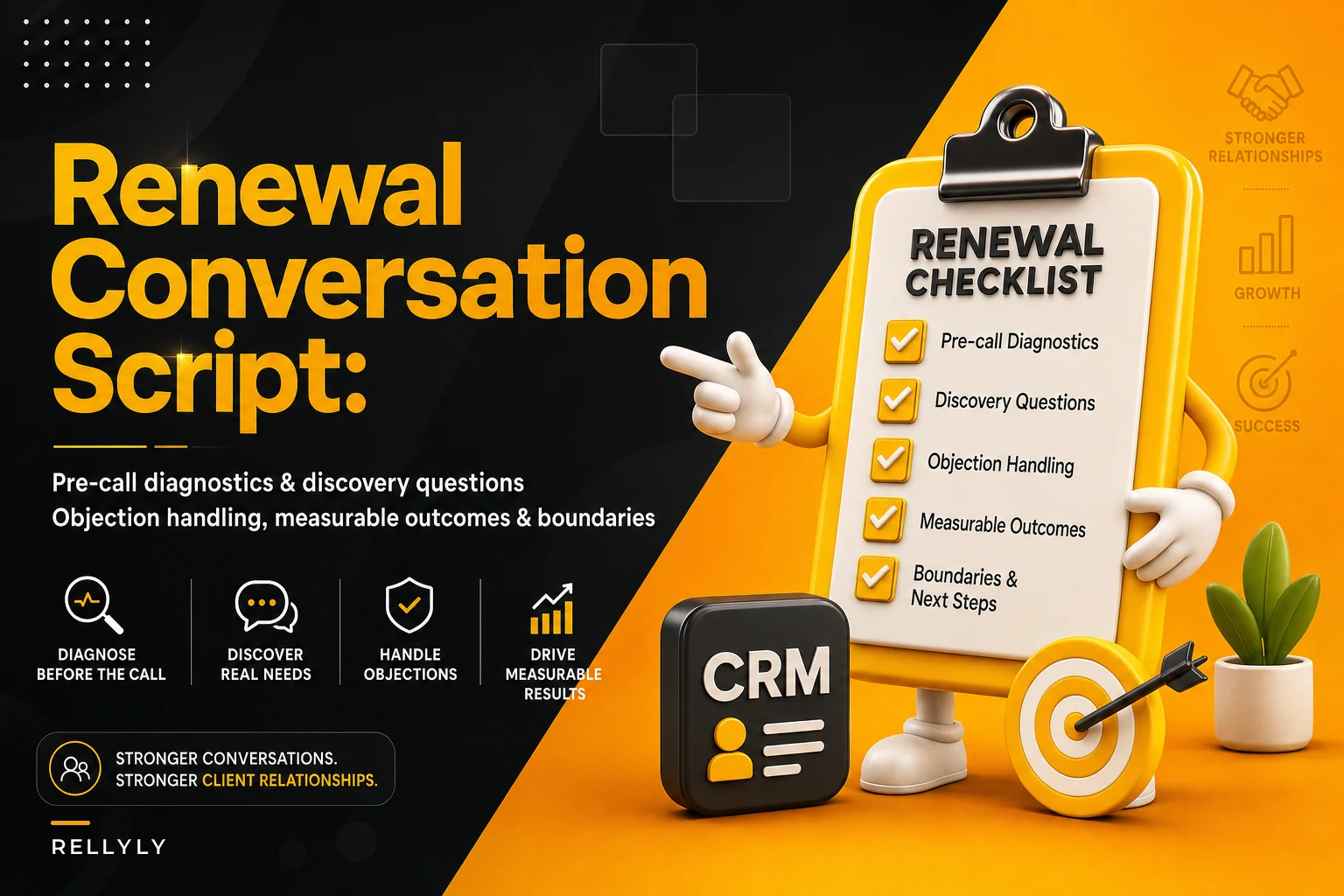

Mid-market renewals fail for predictable reasons. The champion leaves. Budget priorities shift. Usage quietly drops below any threshold that would justify keeping the contract. And yet most renewal scripts focus on selling value instead of diagnosing what went wrong.
Teams hitting somewhere around 85% gross retention versus those stuck in the low 70s — the gap usually comes down to preparation. Not the renewal call itself, but what happens 90 days before it.
The best renewal conversations start with operational data, not relationship assumptions. Teams that systematically track usage patterns, stakeholder changes, and outcome metrics walk into renewal discussions knowing where the account actually stands. They don't guess at objections. They anticipate them because the behavioral signals were there weeks earlier.
Pre-call diagnostic checklist that surfaces real renewal blockers
Most renewal prep focuses on the wrong things. Contract value, relationship strength, NPS — these are lag indicators. They tell you what already happened, not what's about to happen.
The diagnostics that actually matter track operational integration. Is the product embedded in critical workflows? Are multiple departments depending on it? Has usage grown beyond the original use case?
Start with usage depth, not breadth. An account using three features daily beats one using ten features monthly. Check login patterns across user types. When admins log in weekly but end users disappear, you're looking at a tool that never made it into actual work.
Track outcome achievement against initial goals. Pull the original business case. Match promised metrics to current reality. When a customer bought expecting a 20% efficiency gain but only got 8%, that gap is your entire renewal conversation.
Document stakeholder turnover carefully. New economic buyers often seem friendly — until renewal arrives. They didn't choose your solution; they inherited it. Map every stakeholder change against usage trends. When new leadership correlates with declining adoption, you're usually dealing with relationship risk that's showing up dressed as budget scrutiny.
Watch competitive signals through feature requests. Customers rarely announce they're evaluating alternatives. Instead, they start asking about capabilities your competitors heavily market. A pattern of three or more questions about features you don't have is worth paying close attention to.
Support ticket patterns matter too. Volume alone means nothing — resolution times, escalation frequency, and recurring issues reveal where operational friction is building. Accounts carrying unresolved technical debt rarely renew at full value.
Your pre-call diagnostic framework:
Usage Health Indicators
-
Daily active usage by department
-
Feature adoption beyond initial purchase driver
-
Workflow integration depth (manual checks vs automated processes)
-
Admin-to-user activity ratio
-
Mobile vs desktop usage patterns
Outcome Tracking
-
Original success metrics vs current performance
-
Time-to-value achievement
-
ROI documentation status
-
Comparative metrics to industry benchmarks
-
Executive visibility into results
Relationship Mapping
-
Champion stability (same person, same role, still engaged)
-
Economic buyer changes
-
New stakeholder influence levels
-
Internal advocate development
-
Cross-functional adoption status
Competitive Signals
-
Feature request patterns matching competitor strengths
-
Integration requests with competitive products
-
Pricing model questions indicating comparison
-
Contract flexibility inquiries
-
References to alternative approaches
Technical Debt Assessment
-
Open issues over 30 days
-
Recurring problems
-
Configuration complexity
-
Integration stability
-
Performance complaints
Score each category before entering any renewal conversation. Accounts scoring below roughly 60% need some kind of intervention before negotiation even starts — otherwise you're negotiating blind.
Discovery questions that uncover hidden objections before they become blockers
Generic discovery wastes everyone's time. "How's everything going?" gets you nowhere. By renewal time, customers reasonably expect you to already know their business.
Never miss a customer touchpoint again.
Rellyly helps you manage contacts, tasks, and sales efficiently in one platform.
- Unified customer profiles
- Automated follow-ups
- Sales pipeline tracking
No credit card required
Effective renewal discovery is about confirming hypotheses from your diagnostic work, not learning about the account from scratch.
Start with outcome verification: "Your team initially aimed to reduce processing time from four days to two. Where did you actually land?" That forces specificity. Vague satisfaction becomes measurable reality. When they can't answer, you've found a tracking gap that's going to undermine renewal justification.
Probe workflow evolution: "Walk me through how your process changed since implementation — what shifted that you didn't expect?" Changes reveal both value creation and friction points. New workflows mean deeper integration. Abandoned workflows signal erosion.
Challenge assumptions about alternatives: "If our solution disappeared tomorrow, what would your contingency plan look like?" This surfaces real competitive threats — in-house development, competitor trials, manual workarounds already in motion. The answer tells you your actual competitive position, not the one you're assuming.
Explore expansion impediments: "Which departments would benefit from this but haven't adopted yet? What's blocking them?" Non-adoption reasons are objection predictors. Technical barriers, change resistance, resource constraints — the same things blocking expansion often threaten renewal.
Test price sensitivity indirectly: "How has your tech stack budget shifted this year? What's getting more investment?" Direct pricing questions trigger defensiveness. Budget allocation questions reveal priorities. When adjacent categories are growing while yours stays flat, pricing pressure is probably coming.
Map stakeholder dynamics: "Who else gets involved when you're making renewal decisions on tools like ours?" New names mean new evaluation criteria. Procurement involvement means pricing focus. IT means security review. Finance means they'll want documented ROI.
Your discovery question progression:
Opening Context Setting
"Looking at the data, I noticed [specific usage pattern]. Help me understand what's driving that."
Outcome Verification
-
"You mentioned [original goal] — where did you actually end up?"
-
"Which metrics matter most to your leadership when evaluating tools like ours?"
-
"How do you currently track and report on [key outcome]?"
Workflow Integration
-
"Walk me through a typical week using our platform — what does that actually look like?"
-
"What manual processes still exist around our solution?"
-
"Which integrations became critical that you didn't expect?"
Competitive Positioning
-
"What would reverting to your old process look like today?"
-
"Which alternatives has your team evaluated recently?"
-
"What capabilities do you need that we should know about?"
Expansion Barriers
-
"What's preventing [Department X] from adopting this?"
-
"If budget wasn't a constraint, how would you expand usage?"
-
"Which use cases are you solving outside our platform?"
Stakeholder Mapping
-
"Who's now involved in these decisions that wasn't before?"
-
"How has the evaluation process changed since initial purchase?"
-
"What questions is leadership asking about the tool?"
Don't ask these questions without having a likely answer already from your diagnostics. Discovery should be confirming or challenging what you already think — not replacing preparation.
Objection handling tied to measurable business outcomes
Traditional objection handling fails because it argues with perception. "We're too expensive" turns into a features-versus-price debate. "We're switching to a competitor" triggers desperate retention offers. Both responses miss the operational reality underneath.
Every objection represents an unmet outcome expectation. Price concerns usually mean ROI isn't visible. Switching threats indicate workflow friction. Feature gaps suggest misaligned use cases. Address the outcome gap, not the stated objection.
When facing pricing objections, quantify current value before touching cost. Pull actual usage data. Calculate time savings. Document error reduction. Show process acceleration. Make the math hard to argue with before price ever comes up.
To give a concrete sense of how this plays out: a logistics company pushes back on a $4,200 monthly renewal, claiming the platform is overpriced. Instead of negotiating, the CS team pulls six months of operational data — meaningful time savings on routing, fewer delivery delays, documented reduction in overtime. The pricing conversation changes shape pretty quickly. The exact numbers vary widely by account, but the point is having the data ready to make the discussion concrete rather than theoretical.
For competitive switching threats, focus on switching costs, not feature comparisons. "Help me understand the migration plan." Make them articulate data transfer complexity, integration rebuilding, retraining, process redesign, workflow disruption. Make switching cost visible before you defend anything.
Feature gap objections need use case reframing. "That feature would solve [problem X] — let's look at how you could handle that today." Show workarounds. Demonstrate alternative approaches. Connect to roadmap timing. Sometimes the feature isn't really the issue — it's the underlying problem they're trying to solve differently.
Pricing/Budget Objections
Map current value:
-
Hours saved weekly/monthly
-
Error reduction percentages
-
Process acceleration metrics
-
Cost avoidance calculations
-
Efficiency gains documented
Then position investment:
-
"Based on your usage, you're getting [$X value] monthly"
-
"Compared to [alternative solution], total cost including migration would be..."
-
"Would a different payment structure better align with your budget cycles?"
Competitive Switching
Surface switching costs:
-
"Walk me through the migration timeline you're considering"
-
"How long would retraining take across [number] users?"
-
"What happens to historical data during transition?"
-
"Which integrations would need rebuilding?"
-
"What's the contingency if migration delays?"
Feature/Functionality Gaps
Reframe requirements:
-
"That would solve [problem] — here's how others handle it today..."
-
"While that's on our roadmap for Q3, you could accomplish similar results by..."
-
"Is this blocking current work or future initiatives?"
-
"What percentage of use cases does this gap affect?"
Usage/Adoption Concerns
Identify blockers:
-
"What's preventing broader adoption?"
-
"Where specifically are users getting stuck?"
-
"Would additional training help, or is this a workflow issue?"
-
"Should we adjust the configuration for your use case?"
No Clear ROI
Build the business case:
-
"Let's calculate the specific impact on [their metric]"
-
"Compared to your baseline, where are the gains?"
-
"Which outcomes matter most for renewal justification?"
-
"How can we better track and report value?"
Never accept surface objections at face value. Every pricing concern hides an ROI question. Every feature request reveals a workflow problem. Every adoption issue points to change management gaps somewhere. Diagnose root causes, then solve for outcomes.
Negotiation boundaries based on account signals
Negotiation without boundaries leads to margin erosion. But rigid policies ignore account reality. The better approach is signal-based negotiation boundaries that flex based on measurable account indicators.
Define your walk-away point before entering renewal discussions — not a discount percentage, but an account profile. Low usage, single stakeholder, high support burden, payment delays. When multiple risk signals line up, protecting margins matters more than chasing retention at any cost.
For strategic accounts showing genuine growth signals — multi-department adoption, usage expansion, executive championship — there's more room to move.
Within those boundaries, structure gives based on future value, not past relationships:
| Account Zone | Profile | Max Flexibility |
|---|---|---|
| Red Zone (Walk-away ready) | Usage below 40% of capacity, single user/department, no executive visibility, support costs exceeding ~20% of contract value, payment issues, competitive RFP in progress | 0–10% discount, standard terms only |
| Yellow Zone (Selective investment) | Moderate usage (40–70% capacity), limited expansion, stable but not growing, neutral support burden, clean payment history, no competitive threats | 10–20% discount, minor term adjustments |
| Green Zone (Strategic retention) | High usage/expansion trajectory, multi-department adoption, executive championship, documented outcomes, reference-willing, growth potential identified | 20–30% discount, creative deal structures, multi-year incentives |
The zone logic plays out in uncomfortable ways sometimes. A data analytics firm pushing hard for a 30% reduction on an account that's solidly in the red zone — holding firm at 10% and watching them churn is genuinely difficult. But the math usually holds up over time. And on the other side: a green zone account getting a meaningful discount tied to a two-year expansion commitment and actually growing into it validates the whole framework. These aren't abstract scenarios; versions of them show up in most mid-market renewal portfolios eventually.
Document every concession with success criteria. Discounts tied to usage commitments. Payment terms tied to volume guarantees. Feature requests tied to adoption metrics. Make every give conditional on a measurable get.
Track concession patterns across the portfolio over time. Which discounts actually drive expansion? Which payment terms improve retention? Let those patterns shape how your boundaries evolve.
Building your renewal conversation cadence
Renewal success happens through systematic preparation, not last-minute heroics. The best teams run consistent pre-renewal cadences that surface risks early and address objections before formal discussions ever begin.
Start your renewal motion 120 days out, not 30. This gives actual time for intervention when diagnostics reveal problems. Usage declining? Launch enablement. Stakeholder changed? Rebuild the relationship. ROI unclear? Go document value. Competitive threats emerging? Start demonstrating differentiation.
-
Days 120–90
Diagnostic Phase
— Complete pre-call diagnostic scorecard, analyze usage trends and patterns, map stakeholder changes, document outcome achievement, identify expansion opportunities, score account health. -
Days 90–60
Intervention Phase
— Address adoption gaps through enablement, rebuild stakeholder relationships, document and communicate ROI, surface and handle early objections, explore expansion possibilities, align on success metrics. -
Days 60–30
Negotiation Prep
— Run discovery conversations, confirm renewal decision makers, build business case documentation, define negotiation boundaries, prepare competitive positioning, structure potential deal terms. -
Days 30–0
Renewal Execution
— Present value documentation, handle remaining objections, negotiate within boundaries, document agreement terms, secure commitment, plan post-renewal expansion.
Running this kind of systematic cadence transforms renewal conversations from reactive scrambles to proactive value discussions. When you know account health 120 days out, interventions actually have time to work. When objections surface early, your response feels consultative rather than desperate.
The compound effect shows up in retention metrics over time. Teams running diagnostic-driven renewal processes tend to outperform those relying on relationship intuition — and they identify expansion opportunities earlier, which drives meaningfully higher net retention through proactive upsell conversations rather than last-minute scrambles.
Visualize this renewal cadence as a 120–0 day workflow.
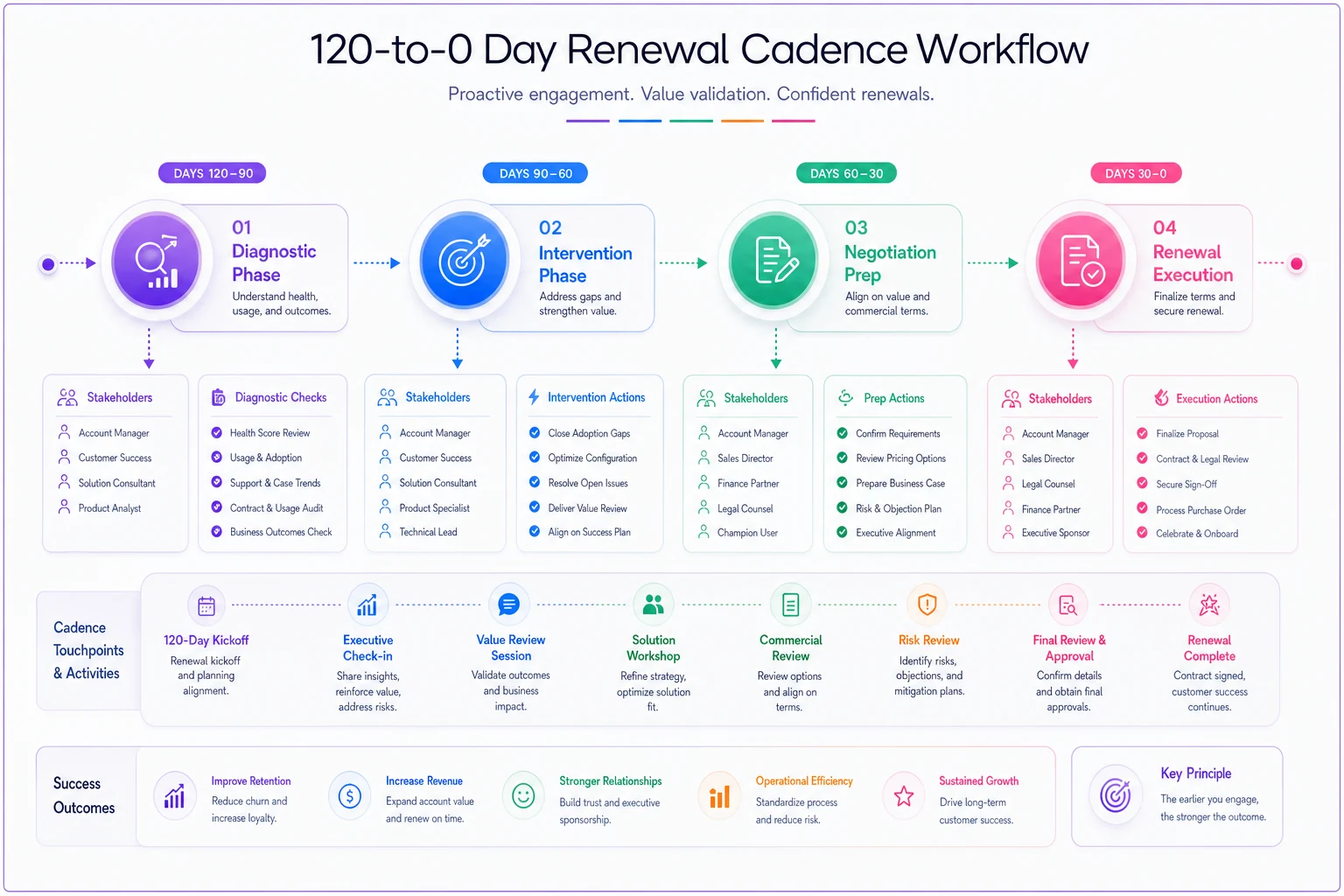
Start diagnostics 120 days out to give interventions time to work.
The compound effect shows up in retention metrics over time. Teams running diagnostic-driven renewal processes tend to outperform those relying on relationship intuition — and they identify expansion opportunities earlier, which drives meaningfully higher net retention through proactive upsell conversations rather than last-minute scrambles.
Making renewal conversations predictable through operational discipline
Volatile renewal results versus predictable retention comes down to operational consistency. Teams that treat renewals as quarterly fire drills always underperform. Those who build systematic processes around diagnostics and account data create something closer to a predictable growth engine.
A renewal conversation script for mid-market accounts only works when supported by the right operational foundation. Diagnostics require data collection. Discovery needs stakeholder mapping. Objection handling demands outcome tracking. Negotiation boundaries need account scoring. Without those foundations, even a solid conversation framework falls apart in execution.
Start by building out data collection — usage analytics, outcome tracking, stakeholder monitoring, support analysis, competitive intelligence. Make diagnostic scoring as automatic as possible rather than a manual task someone does the week before renewal. Let account signals drive renewal timing, not just contract dates sitting in a spreadsheet.
The operational discipline pays off beyond individual renewals. Patterns emerge across the portfolio. Which usage thresholds actually predict churn? Which stakeholder profiles drive expansion? Which objections keep surfacing? Those insights improve product development, customer success, and sales positioning over time — not just this quarter's renewal numbers.
Worth noting: mid-funnel deal recovery techniques apply to struggling renewals. The same re-engagement frameworks that rescue stalled new business opportunities work for at-risk renewals when applied early enough.
The path to reliable mid-market renewals isn't through stronger relationships or aggressive discounting. It's through operational discipline that turns renewal conversations from relationship tests into value confirmations. Build the diagnostics. Run the discovery. Handle objections systematically. Negotiate within defined boundaries. Make renewal success a process, not a performance.
Ready to transform your customer relationships?
Join 2,000+ businesses using Rellyly to increase sales, improve client retention, and simplify CRM workflows.