

Most sales and CS teams don't discover their data architecture is broken until a deletion request comes in, or a prospect's security team asks a question nobody can answer, or a regulator sends a letter. By then it's not a quick fix — it's buried in six years of copy-paste fields, Zapier flows, spreadsheet exports, and "temporary" marketing tables that became permanent.
The frustrating part is that compliance and revenue get treated like opposites. Legal wants to lock everything down. Sales wants every data point available to score, segment, and personalize. Because neither side owns the actual plumbing, the architecture ends up serving neither — you lose analytical richness and you still can't prove where a customer's phone number ended up.
A privacy-first customer data architecture is really just a design choice: decide up front how consent, identity, retention, and access behave as data moves through your systems — before the data volume makes those decisions irreversible. This isn't a legal exercise. It's an operations problem, and it breaks in predictable ways.
Why this breaks across almost every growing company
The pattern is remarkably consistent. A company starts with one CRM, one source of truth, a handful of fields. Consent is "they filled out the form, so we can email them." Life is simple.
Then revenue tooling multiplies. Marketing automation, an enrichment vendor, a product analytics tool, a data warehouse, a BI layer, a support desk, maybe a CDP. Each one copies customer records. Each copy has its own retention behavior, its own access model, and its own idea of what a "customer" is.
Nobody designed this. It accreted. And that's the core problem — the architecture becomes the sum of integration decisions made by different people under deadline pressure, none of whom were thinking about consent state or retention windows.
-
A lead unsubscribes in the marketing tool. The CRM still shows them as marketable because the webhook only syncs one direction.
-
An enrichment vendor appends a personal mobile number to a record. Nobody knows if that counts as data collected with consent.
-
A customer asks to be deleted. You delete the CRM record. Their data still sits in the warehouse, in three BI extracts, and in last quarter's board deck CSV.
-
Analytics breaks the moment you try to actually honor privacy, because every dashboard was built on raw PII joins.
That last one is the trap that keeps teams stuck. The honest reason companies don't clean this up is that the "clean" version seems to kill their reporting. So they stall.
The four states you actually have to model
Before touching schemas, the useful shift is to stop thinking about "a customer record" and start thinking about four independent dimensions that every record carries. When these get collapsed into one blob, everything downstream gets fragile.
Never miss a customer touchpoint again.
Rellyly helps you manage contacts, tasks, and sales efficiently in one platform.
- Unified customer profiles
- Automated follow-ups
- Sales pipeline tracking
No credit card required
| Dimension | What it controls | Where it breaks |
|---|---|---|
| Consent state | What you're allowed to do with the data (email, call, profile, share) | Lives in multiple tools, syncs inconsistently, no timestamp of when consent was given |
| Identity/linkage | How you connect records across systems without exposing raw PII everywhere | Every system joins on raw email, so PII is smeared across your whole stack |
| Retention clock | When data must be minimized or deleted | No per-field clock; everything lives forever by default |
| Access policy | Who (person or system) can see what, at what fidelity | All-or-nothing access; a BI analyst can see raw phone numbers they never need |
The key point: these four dimensions change at different speeds and for different reasons. Consent changes when a customer acts. Retention changes with time. Access changes with roles. Identity is mostly stable. Modeling them separately is what lets you honor a deletion request without nuking your funnel analytics.
Consent-state modeling that doesn't fall apart
Consent is not a boolean. The most common mistake is a single emailoptin checkbox that can't answer any of the questions that actually matter: when did they consent, to what, through what channel, and is it still valid?
``json
{
"subjectid": "cust8842",
"consents": [
{
"purpose": "marketingemail",
"state": "granted",
"source": "webformpricingpage",
"capturedat": "2024-02-11T14:32:09Z",
"expiresat": "2026-02-11T00:00:00Z",
"basis": "explicitoptin"
},
{
"purpose": "productanalytics",
"state": "granted",
"source": "tosacceptancev4",
"capturedat": "2024-02-11T14:30:00Z",
"basis": "contract"
},
{
"purpose": "dataenrichment",
"state": "denied",
"source": "preferencecenter",
"captured_at": "2024-09-03T09:15:44Z"
}
]
}
``
Purpose-scoped, timestamped, with a source and a basis. Once consent is modeled this way, your automation can check consent at send time instead of assuming. That one change prevents the most common failure mode — emailing someone who opted out in a tool that never synced back.
In practice, the consent object should be queried by your sequencing and campaign logic, not copied into every segment. A segment is a point-in-time snapshot; consent is live. When they diverge, you get violations.
Pseudonymization layers that keep analytics alive
This is where most teams get it wrong, and it's the reason "privacy-first" feels like it costs revenue.
The fear: if we stop joining on raw PII, our reports break. But you don't need raw PII for the vast majority of analytics. You need a stable, consistent identifier that behaves the same across systems. You almost never need the actual email address sitting in the warehouse.
The architecture that works in practice has three tiers:
-
The vault — a tightly controlled store holding raw identifiers (email, phone, name). Very few people and very few systems touch it directly. Everything here has a retention clock and full audit logging.
-
The pseudonym layer — every raw identifier maps to a stable token (
cust_8842). Analytics, BI, product telemetry, and most of your CRM logic operate on tokens. Cohort analysis, funnel reporting, LTV — all of it works on tokens. -
The re-identification bridge — a controlled, logged path to resolve a token back to a real person only when the business reason requires it (sending an email, a rep making a call, a support ticket).
The elegant thing about this split: deletion becomes a vault operation. Break the link between the token and the raw identifier, and your warehouse still has fully intact behavioral history under an anonymous token — which is now genuinely anonymous and no longer personal data. Your analytics survive. Your deletion is real.
A common mistake is pseudonymizing only the obvious fields and leaving quasi-identifiers in the clear. A record with company name, job title, city, and signup date can re-identify a person even without the email. The pseudonym layer has to be designed with that in mind, not just slapped onto the email column.
If you're already working on a clean data foundation, this layer sits naturally on top of a well-defined canonical data model with required objects and validation rules — the token becomes the join key your canonical objects reference instead of raw email.
Retention and access: the rules nobody writes down until it's too late
Retention is where "we'll deal with it later" compounds into a liability. The default behavior of almost every system is keep everything forever. Nobody chose that — it's just what happens when no one sets a clock.
The practical fix is field-level retention policies, not record-level. Different data types have different useful lifespans and different risk profiles:
-
Raw contact identifiers
retain while the relationship is active + a defined window after churn
-
Enrichment data
shorter, because it ages fast and carries consent questions
-
Behavioral/product telemetry (tokenized)
can live much longer because it's pseudonymized
-
Support transcripts
often the highest-risk, longest-ignored data you hold
-
Exported CSVs and BI extracts
the real problem — data that escaped the governed system entirely
That last one is the silent killer. Every manual export is a retention policy you can't enforce. A pattern worth adopting: treat any export as a copy that bypasses your controls and minimize exports by giving people governed access instead.
Treat exports as copies that bypass controls and give people governed access instead of CSV downloads whenever possible.
| Role | Vault (raw PII) | Pseudonym layer | Re-ID bridge |
|---|---|---|---|
| BI / analyst | No | Yes | No |
| SDR / AE | No | Yes | Yes, logged, for assigned accounts |
| CSM | No | Yes | Yes, logged, for owned accounts |
| Marketing ops | No | Yes | Via tooling only |
| Data engineer | Rarely, break-glass | Yes | No |
The principle: most people should be doing their job on tokens, and touching real identities only when there's a concrete reason — and that touch should be logged.
This is the same discipline that security reviewers probe in enterprise deals. If you've worked through the pre-sales security checklist that enterprise buyers run, you've seen these exact questions: who can access PII, how is it minimized, how do you prove deletion. A clean architecture turns those answers from an anxious scramble into a one-line response.
Audit logs: the difference between "we think we deleted it" and "here's proof"
An audit trail is what converts a policy into something defensible. Without it, every compliance conversation is you asserting you did the right thing with no evidence.
The failure mode is logging at the wrong layer — capturing that a database row changed but not who requested it, for what purpose, under what consent. A useful audit event is about intent and authorization, not just the mechanical change.
A workable audit log format:
``json
{
"eventid": "evt0f93a2",
"timestamp": "2025-03-14T16:08:21Z",
"actor": {
"type": "user",
"id": "ae221",
"role": "accountexecutive"
},
"action": "reidentify",
"subjectid": "cust8842",
"purpose": "outboundcallassignedaccount",
"fieldsaccessed": ["phone"],
"consentchecked": true,
"consentresult": "granted",
"justification": "scheduledrenewalcall",
"source_system": "crm"
}
``
Two fields make this defensible: purpose and consentchecked. They prove the access was both authorized and consent-aware. When a deletion request lands, you query by subjectid and produce a complete history of every system that touched that person, what it did, and why.
For deletion specifically, the audit record should capture the cascade:
``json
{
"eventid": "evtdel7781",
"action": "erasurerequest",
"subjectid": "cust8842",
"requestedat": "2025-04-01T10:00:00Z",
"systemscascade": [
{"system": "vault", "status": "linksevered", "completedat": "2025-04-01T10:00:04Z"},
{"system": "crm", "status": "piiremoved", "completedat": "2025-04-01T10:02:11Z"},
{"system": "marketing", "status": "suppressed", "completedat": "2025-04-01T10:05:00Z"},
{"system": "warehouse", "status": "tokenanonymized", "completedat": "2025-04-01T10:06:33Z"}
],
"verifiedby": "privacy_ops"
}
``
This is what separates a 20-minute response to a regulator from a two-week scramble.
A workflow that ties it together
Here's how a single customer interaction moves through a privacy-first architecture, end to end:
-
A prospect submits the pricing form. The consent object is created with purpose-scoped grants, timestamped, with source recorded.
-
Their raw identifiers go into the vault; a stable token is issued. Downstream systems receive the token, not the email.
-
Enrichment runs — but only if the
data_enrichmentconsent is granted. If denied, that step is skipped automatically, not after a manual check. -
Analytics, lead scoring, and segmentation run entirely on the token. Dashboards never touch raw PII.
-
An AE wants to call. The CRM uses the re-identification bridge to surface the phone number, checks live consent for
phone_contact, and writes an audit event with purpose and justification. -
Six months after churn, the retention clock fires. Enrichment data is purged, raw identifiers minimized, behavioral history retained under an anonymized token.
-
A deletion request arrives. The vault link is severed, the cascade runs, and the audit log produces proof.
Revenue workflows don't slow down. Scoring, segmentation, and reporting run normally — they just run on tokens. The consent and access logic sits in the plumbing, checking automatically instead of relying on anyone to remember.
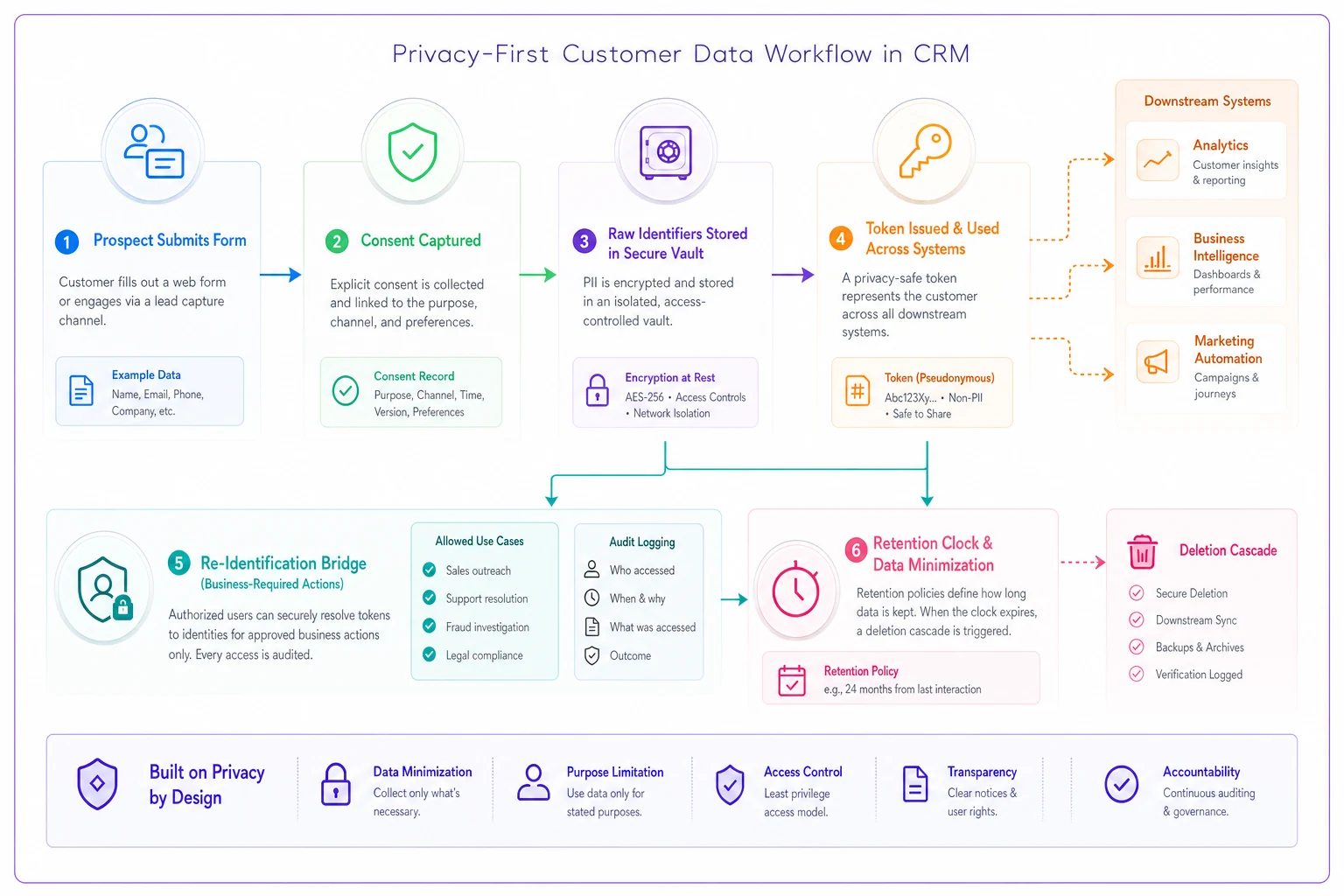
A simple visual clarifies the handoffs and where controls live.
A real scenario
A B2B SaaS company, roughly 40 people, around 18,000 contacts spread across a CRM, a marketing tool, an enrichment vendor, and a warehouse feeding BI. No vault, no tokens — every system joined on raw email, and exports flew around freely.
A deletion request came in from an EU contact. It took the ops team close to two weeks to track down every place that person's data lived, and even then they weren't confident they'd caught everything in old BI extracts. Around the same time, an enterprise deal stalled because the buyer's security team asked how PII access was controlled and the honest answer was "it mostly isn't."
They rebuilt the identity layer over about a quarter. Raw identifiers moved into a controlled store, tokens got issued, the warehouse and BI tools got re-pointed. The painful part wasn't the vault — it was untangling dashboards built on raw email joins, which ate most of the effort.
After the rebuild, deletion requests dropped from a two-week scramble to a same-day, auditable cascade. The enterprise security review that had stalled cleared in a single call because they could point to logged, purpose-scoped access. Analytics barely changed — cohort and funnel reporting all ran on tokens. The thing they expected to lose was the thing they kept.
When this makes sense — and when it doesn't
This is worth building when:
-
You handle regulated data or sell to customers who do
-
You're getting consistent security questionnaires that slow deals
-
You operate across jurisdictions with real deletion and consent requirements
-
Your data is already spread across four or more systems
-
You're about to scale contact volume significantly — build the layer before the volume
This is overkill when:
-
You're a small team with one system and a few hundred contacts
-
You have no regulated data and no enterprise buyers asking
-
You'd be building a vault to protect data you shouldn't be collecting in the first place — in that case, collect less first
Who should genuinely not start here: teams who haven't defined what a "customer" even is across their systems. If your records are a mess of duplicates and inconsistent fields, fix the canonical model first. A pseudonymization layer built on top of chaotic identity just gives you well-encrypted chaos.
The real takeaway
Compliance and revenue feel like enemies almost entirely because of architecture. When consent, identity, retention, and access are tangled into a single customer blob scattered across every tool, you can't honor privacy without breaking analytics, and you can't do analytics without hoarding risk.
Separate those four dimensions, run your business on tokens instead of raw identifiers, keep audit logs that record intent and not just mechanical changes — and the trade-off mostly disappears. Faster deletions, cleaner security reviews, reporting that doesn't depend on hoarding personal data. The architecture is the product. Build it before the data volume makes the decision for you.
Ready to transform your customer relationships?
Join 2,000+ businesses using Rellyly to increase sales, improve client retention, and simplify CRM workflows.