
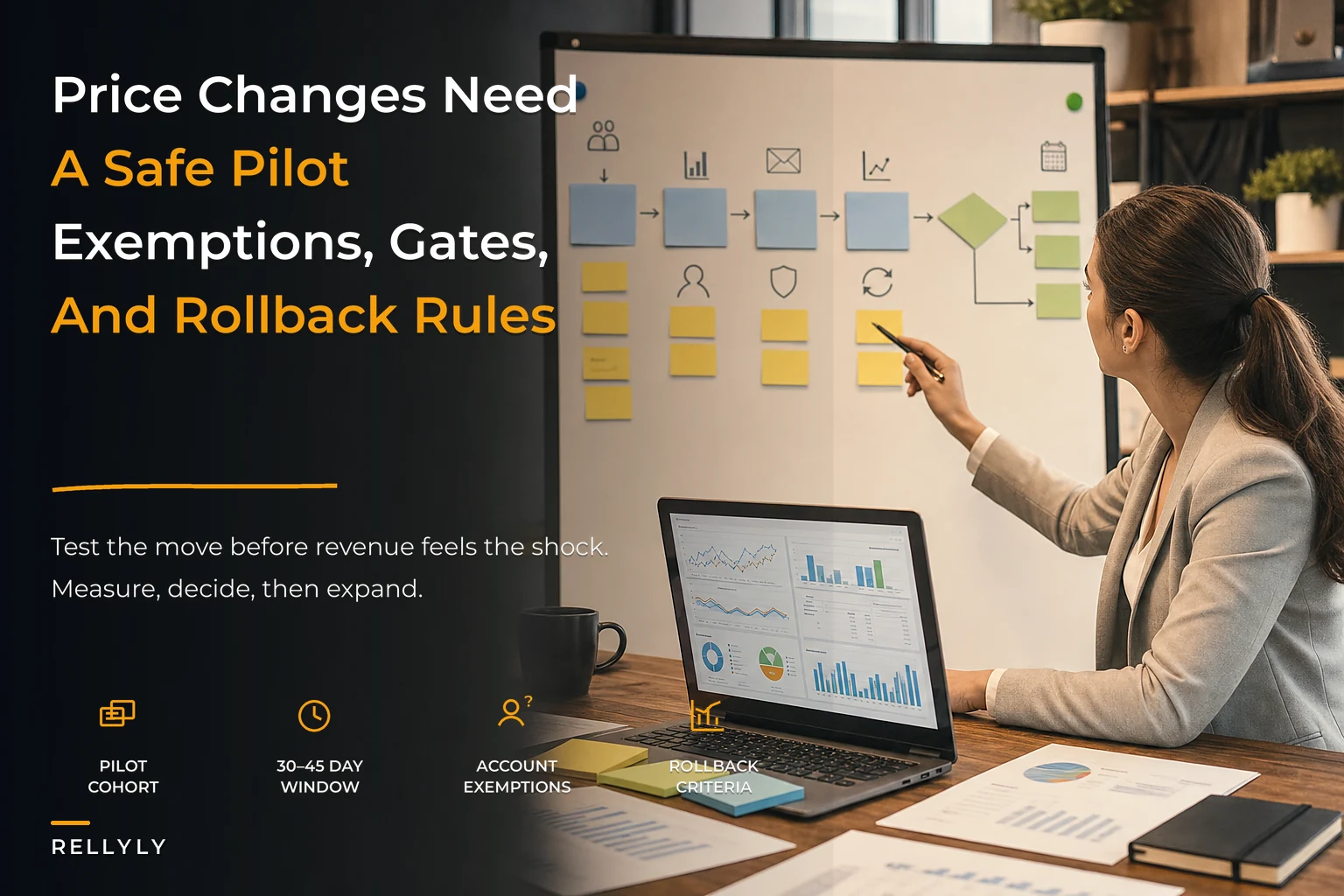

Most price increases don't fail in the pricing spreadsheet. They fail in the two weeks after the announcement, when a CSM finds out their top account got a 22% bump they were never warned about, a sales rep discovers a mid-cycle deal now has stale pricing in the proposal, and finance can't tell whether the revenue lift is real or just deferred cancellations that haven't hit yet.
The pricing math is the easy part. The hard part is the operating model around it — who gets exempted, how the message lands, what signals tell you to keep going, and what threshold forces you to stop. That's what this piece is about. Not "should you raise prices," but how to move price safely across a live customer base without breaking coordination between sales, CS, billing, and finance.
Why price changes break in the seams, not the strategy
There's a pattern that shows up almost every time a growing company raises prices for the first time at scale. Leadership treats it as a decision. The org treats it as an event. Nobody treats it as a rollout, and that's where the damage happens.
A decision is a meeting. A rollout is a sequence of dependent steps across teams that don't normally coordinate on pricing. Sales has open deals mid-flight. CS owns renewal timing that may or may not line up with the change. Billing has to actually apply the new rate on the right invoice date. Finance needs to measure whether it's working. When any one of those loses the thread, you get the classic messes: grandfathered accounts charged the new rate anyway, a rep quoting old pricing because nobody updated the deal desk, or a churn spike that looks catastrophic because three enterprise accounts happened to renew in the same month.
The failure is almost never the percentage. A 7% increase executed badly does more damage than a 15% increase executed cleanly. The number gets the attention. The mechanics get the churn.
So the operating model has four load-bearing parts, and they need to be designed before anyone sees a new price:
-
Pilot design — proving the change on a small, representative slice before it touches everyone
-
Exemption rules — deciding in advance who is protected and why, so it isn't negotiated account-by-account under pressure
-
Rollout gates — the checkpoints that let you expand from pilot to full base
-
Rollback criteria — the pre-agreed revenue thresholds that force you to pause or reverse
Skip any of these and you're not running a pricing change operating model. You're running a bet.
Designing the pilot: prove it on a slice, not a spreadsheet
The instinct is to model the price change in a spreadsheet, look at the projected ARR lift, and roll it to everyone at once because "the model says it works." The model doesn't capture the reaction. A pilot does.
Never miss a customer touchpoint again.
Rellyly helps you manage contacts, tasks, and sales efficiently in one platform.
- Unified customer profiles
- Automated follow-ups
- Sales pipeline tracking
No credit card required
A good pilot isn't your easiest accounts and it isn't your hardest. It's a representative cross-section — enough of each segment that the results actually predict the full rollout. If you pilot only on healthy, high-usage accounts, you'll get a clean result that lies to you about what happens when the increase hits low-engagement accounts sitting one bad quarter away from cancelling.
-
Pick 8–12% of the affected base, stratified by segment (SMB, mid-market, enterprise) and by health tier so the mix roughly mirrors your whole book.
-
Deliberately include some at-risk accounts. You want to see the downside early, while it's small and reversible.
-
Set a fixed observation window — usually 30 to 45 days, long enough to catch delayed reactions but short enough that you're not sitting on a decision for a quarter.
-
Freeze the message. Everyone in the pilot gets the same communication, delivered by the same owner type (rep for sales-led, CSM for CS-led). No freelancing, or you can't tell what caused the reaction.
-
Instrument it before you send anything. Baseline churn rate, baseline downgrade rate, baseline support ticket volume for the segment. You can't measure a lift or a spike without a before.
The mistake is treating the pilot as a formality — sending the increase to a handful of accounts, seeing no immediate cancellations, and declaring victory in week two. The reactions that matter often show up at the next touchpoint: the renewal call, the QBR, the invoice. A pilot that ends before those touchpoints happened didn't test anything.
Include at least a couple of lower-health accounts so you surface downgrades early rather than after wide rollout.
One pattern worth naming: silent acceptance is not the same as agreement. An account that doesn't push back on the increase but quietly starts evaluating alternatives is your real risk. That's why you watch engagement and usage during the pilot, not just cancellation counts. A drop in logins or a stalled expansion conversation right after the notice is a leading signal that the number landed wrong.
Here's a quick visual of the pilot workflow.
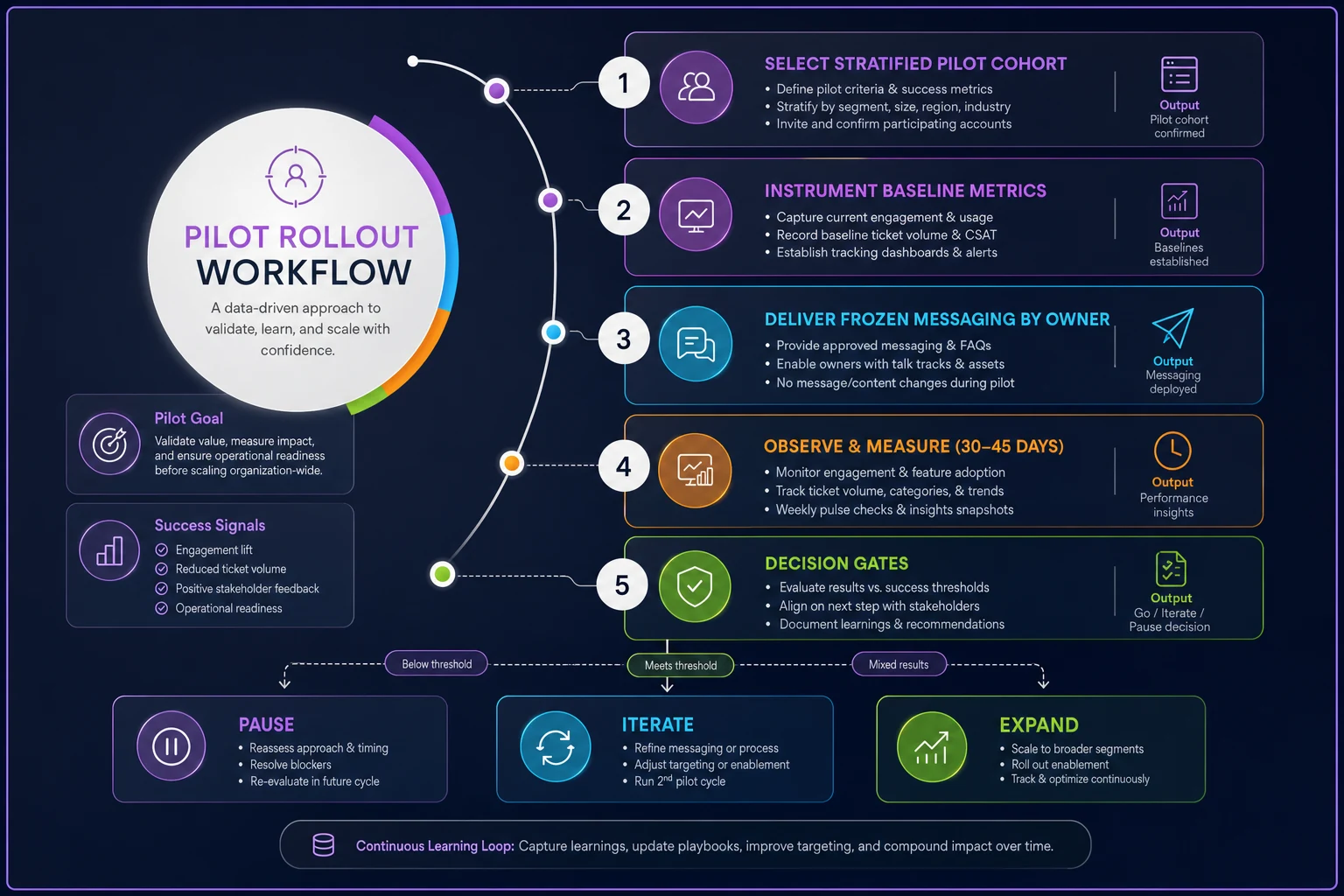
The reactions that matter often show up at the next renewal or invoice, so instrument and observe those touchpoints before declaring success.
Account exemptions: decide the rules before anyone asks
The single fastest way to turn a clean price change into chaos is to handle exemptions reactively. The moment a rep escalates "this account will churn if we raise them," and leadership grants a one-off exception, you've set a precedent. Now every rep has a reason their account is special, and your pricing change quietly stops applying to anyone with a loud enough account owner.
Exemptions have to be a policy, defined up front, with objective criteria. Not a negotiation.
| Exemption type | Criteria | Who approves | Duration |
|---|---|---|---|
| Contractual grandfather | Signed rate-lock or multi-year term still active | Auto-applied, no approval | Until contract end |
| Recent increase | Already took a price increase in the last ~12 months | Auto-applied | Until next cycle |
| Strategic/reference | Named logo used in sales, case study, or advisory | Deal desk + CS lead | Time-boxed, reviewed quarterly |
| At-risk protection | Health score below threshold + active save motion | CS lead only | Single cycle, must re-justify |
| Discretionary | Rep judgment ("they'll leave") | Requires VP sign-off | One cycle max |
The point of the table isn't the specific tiers — it's that "discretionary" sits at the bottom, requires the highest approval, and is capped. When you make discretionary exemptions the hardest to get, reps stop reaching for them first. When you make them easy, discretionary becomes the default and your realized increase collapses.
A realistic failure mode: a company plans a 12% increase across 400 accounts, projects a solid lift, then grants exemptions to around 60 accounts during the rollout because owners pushed back. The exempted accounts are — of course — the largest ones, because big accounts have the loudest owners. The realized increase ends up well under 12% because the exemptions carved out most of the revenue the model was counting on. The math was fine. The exemption discipline wasn't.
Grandfathering deserves its own note. Grandfathering is a promise, and promises need to be tracked. If billing doesn't have a clean, queryable list of who is grandfathered and until when, you will eventually charge a grandfathered account the new rate — usually the reference customer you least wanted to annoy. The exemption list is an operational artifact, not a mental note in someone's head.
Communication: the message is part of the mechanism
Communication templates get treated as a marketing task — write a nice email, hit send. In practice the communication is the price change from the customer's side. They don't experience your spreadsheet. They experience the email and the conversation.
A few things separate a rollout that lands from one that generates a churn spike:
-
Owner-delivered, not blast-delivered, for high-value accounts. SMB can take a well-written email. Mid-market and enterprise need the CSM or rep to deliver it, ideally before any system-generated notice hits their inbox. Nothing damages trust faster than a customer learning about a price increase from an automated billing email while their CSM is on a call telling them everything's great.
-
Lead time that matches contract value. A 30-day notice for a $500/month account is fine. For a six-figure account, 60–90 days and an actual conversation is the floor.
-
Reason, not apology. Customers accept increases tied to visible value — new capabilities, expanded scope, cost realities. They resist increases that read as "we decided to charge more." You don't need to over-explain, but the "why" belongs in the message.
-
Sequenced by segment, not sent all at once. If you notify everyone the same day and something's wrong with the message, you find out at full scale. Stagger by segment so the pilot learnings actually feed the templates.
The coordination trap here is timing overlap with other conversations. If an account is mid-renewal or in the middle of an escalation, dropping a price increase into that window is a self-inflicted wound. Sales and CS need shared visibility into what else is happening on the account — the renewal motion, open support issues, expansion talks. The mechanics of that timing are worth getting right on their own; the way stakeholder mapping and concession guardrails work in a renewal operating model applies directly to sequencing a price notice so it doesn't collide with the renewal conversation.
Rollout gates: the checkpoints between pilot and full base
A gate is a specific, pre-defined condition that must be true before you expand the rollout to the next segment. Without gates, "the pilot went okay" turns into "roll it to everyone," and you've skipped the part where you actually check.
The gates that matter tie directly to revenue KPIs, not gut feel:
-
Churn gate — voluntary churn in the pilot cohort stays within an acceptable band of the segment baseline (e.g., no more than roughly 1.5x normal).
-
Downgrade gate — downgrade/downsell rate hasn't spiked beyond a set threshold. Downgrades are the sneaky one; a customer who downgrades instead of cancelling looks fine on a churn report but you still lost the revenue you were trying to add.
-
Realized-rate gate — the actual increase applied, after exemptions, is close enough to the planned increase. If exemptions have already eaten most of the lift in the pilot, expanding won't fix that.
-
Support-load gate — ticket volume and escalations from the pilot cohort are manageable and not trending up. A price change that buries support is a coordination failure waiting to scale.
-
Owner-readiness gate — reps and CSMs have actually delivered the message and logged the outcome. If half the pilot accounts never got the conversation, you don't have pilot data, you have a delay.
Each gate should be a go/no-go, decided in a short review, with a clear owner. This is the same discipline that makes deal reviews useful instead of theatrical — a defined rubric and forced decisions rather than a status update. The pre-read-and-decision-rubric approach in the deal-review blueprint maps well onto a gate review: you walk in with the numbers, apply the criteria, and make an actual call to proceed, pause, or roll back.
Rollback criteria: decide when to stop before you're emotionally invested
Nobody wants to trigger a rollback. By the time the numbers turn bad, the price change has become somebody's initiative, leadership has told the board about the projected lift, and reversing feels like admitting failure. Which is exactly why you define the rollback thresholds before the rollout — while everyone's still rational.
Rollback criteria should be numeric and non-negotiable. Some examples of the shape they take:
-
Churn threshold breached — if voluntary churn in a segment exceeds a defined multiple of baseline for two consecutive weeks, pause that segment.
-
Net revenue negative — if the churned and downgraded revenue exceeds the incremental revenue from the increase, the change is losing money. That's the whole point of the exercise failing.
-
Concentration risk — if a disproportionate share of the loss comes from strategic or reference accounts, pause regardless of the aggregate number, because the aggregate hides the strategic damage.
-
Support saturation — if the change is generating escalations faster than the team can handle them, the coordination cost exceeds the revenue benefit.
The distinction that trips people up is pause versus reverse. Pause means you stop expanding and hold the current cohort while you diagnose. Reverse means you roll affected accounts back to old pricing. Pausing is cheap and reversible. Reversing is expensive and damages credibility, so you want your gates catching problems early enough that pause is almost always the answer and reverse is rare.
Rollback also isn't just a number-watching exercise — it's an operational one. When you pause, someone has to notify the affected accounts that haven't been changed yet, freeze the billing update, and tell the reps to stop quoting the new rate. If those steps aren't defined, "we're pausing" turns into a second wave of confusion on top of the first.
When a formal operating model is overkill — and when it isn't
Not every price change needs this whole apparatus. If you're changing the list price for new customers only and leaving the existing base untouched, most of this doesn't apply — there's no exemption problem and no churn risk from current customers.
The full operating model earns its weight when:
-
You're increasing prices on the existing base, where churn and downgrade risk are live.
-
The affected base is large enough that a bad rollout can't be un-done account by account.
-
Revenue is concentrated, so a handful of strategic accounts reacting badly can outweigh the aggregate lift.
-
Sales and CS both touch the affected accounts, meaning coordination failures are likely.
Who should not run this as a heavy process: very early-stage companies with a few dozen customers and a founder who knows every account personally. At that size, the "operating model" is a conversation. The formality only pays off once no single person can hold the whole customer base in their head — which usually hits somewhere around the point where you have more accounts than any one owner can name from memory.
A realistic scenario
A B2B software company, mid-market focus, about 380 paying accounts, decides to raise prices on its existing base for the first time in three years — a blended increase in the low double digits.
The first draft plan was to email everyone on the same day and apply the new rate at each account's next invoice. Before sending, they pulled the plan into a proper rollout: a pilot of roughly 40 accounts across segments and health tiers, a defined exemption policy that auto-grandfathered anyone with an active term and time-boxed the strategic exemptions, and rollback thresholds tied to churn and net revenue.
The pilot surfaced two things the spreadsheet never would have. First, downgrade requests — not cancellations — were the main reaction in the lower-health segment. Accounts staying but shrinking. Second, a couple of reference accounts had been about to be charged the new rate despite an informal promise from years back that nobody had documented.
They adjusted: softened the increase for the low-health tier, cleaned up the grandfather list, and gave mid-market accounts a CSM-delivered heads-up before the billing notice went out. Rolling to the full base after that, churn stayed close to normal seasonal levels and the realized increase came in a few points under plan — the exemptions cost some lift, but it was known cost, decided on purpose, not a surprise. The version that would have gone out on day one, blasted to everyone at once, would almost certainly have produced a downgrade wave and at least one embarrassing invoice to a reference customer.
Where the coordination actually lives
The recurring theme across all of this is visibility. Exemption lists, grandfather promises, renewal timing, open escalations, who's been notified, what the realized rate actually is — a price change fails when these live in separate systems and separate heads. The rep doesn't know the account is grandfathered. The CSM doesn't know billing already sent the notice. Finance can't separate real lift from deferred churn.
This is where having the account's full context in one place stops being a nice-to-have. When the renewal date, health signals, exemption status, notification history, and open issues sit on the same account record — rather than scattered across a billing tool, a CRM, and a few spreadsheets — the gates and rollback checks become something you can actually run, because the data exists in one queryable place instead of being reconstructed by hand every week. Operational platforms that centralize that account context are what make a pricing rollout auditable instead of anecdotal. The tooling isn't the point, though. The point is that a safe price move depends on everyone touching the account seeing the same picture at the same time.
Price changes reward boring discipline: pilot before you commit, decide exemptions as policy instead of pressure, gate the expansion on real KPIs, and agree on the stop conditions while you can still think clearly. Do that, and the percentage on the price sheet becomes the least interesting part of the whole thing — which is exactly how it should be.
Price changes reward boring discipline: pilot before you commit, decide exemptions as policy instead of pressure, gate the expansion on real KPIs, and agree on the stop conditions while you can still think clearly. Do that, and the percentage on the price sheet becomes the least interesting part of the whole thing — which is exactly how it should be.
Ready to transform your customer relationships?
Join 2,000+ businesses using Rellyly to increase sales, improve client retention, and simplify CRM workflows.