

Your customer just gave you a 4 on their NPS survey. Another gave you a 2. A third customer—one of your biggest accounts—just dropped a 6 with a comment about "considering alternatives."
Most teams handle this the same way: dump the scores into a spreadsheet, assign someone to "follow up," and hope for the best. Maybe someone reaches out in a few days. Maybe they don't. Maybe the CSM fires off a generic "we value your feedback" email. Meanwhile, the detractor has already started evaluating competitors. That scattered approach kills revenue. Not because teams don't care, but because there's no system that matches response urgency to actual risk.
The hidden cost of slow NPS response
A technology services company I worked with found something pretty alarming when they dug into their churn data. Customers who scored 6 or below and didn't receive outreach within 48 hours churned at a nearly 47% higher rate than those contacted within 24 hours.
Their average response time for detractors? Six days.
The CSM team was buried—renewals, QBRs, escalations. NPS follow-up kept sliding to the bottom of the list. By the time anyone reached out, customers had already mentally moved on or started competitor trials.
This pattern is everywhere. Teams collect NPS data religiously but treat remediation like a nice-to-have. They miss the window where intervention actually matters.
Building a score-severity matrix that actually works
Raw NPS scores tell you almost nothing about remediation priority on their own. A 5 from your largest enterprise account needs completely different handling than a 5 from an SMB customer who signed up six weeks ago. Most teams treat them the same, and that's where things fall apart.
Never miss a customer touchpoint again.
Rellyly helps you manage contacts, tasks, and sales efficiently in one platform.
- Unified customer profiles
- Automated follow-ups
- Sales pipeline tracking
No credit card required
Here's a triage framework that actually drives results:
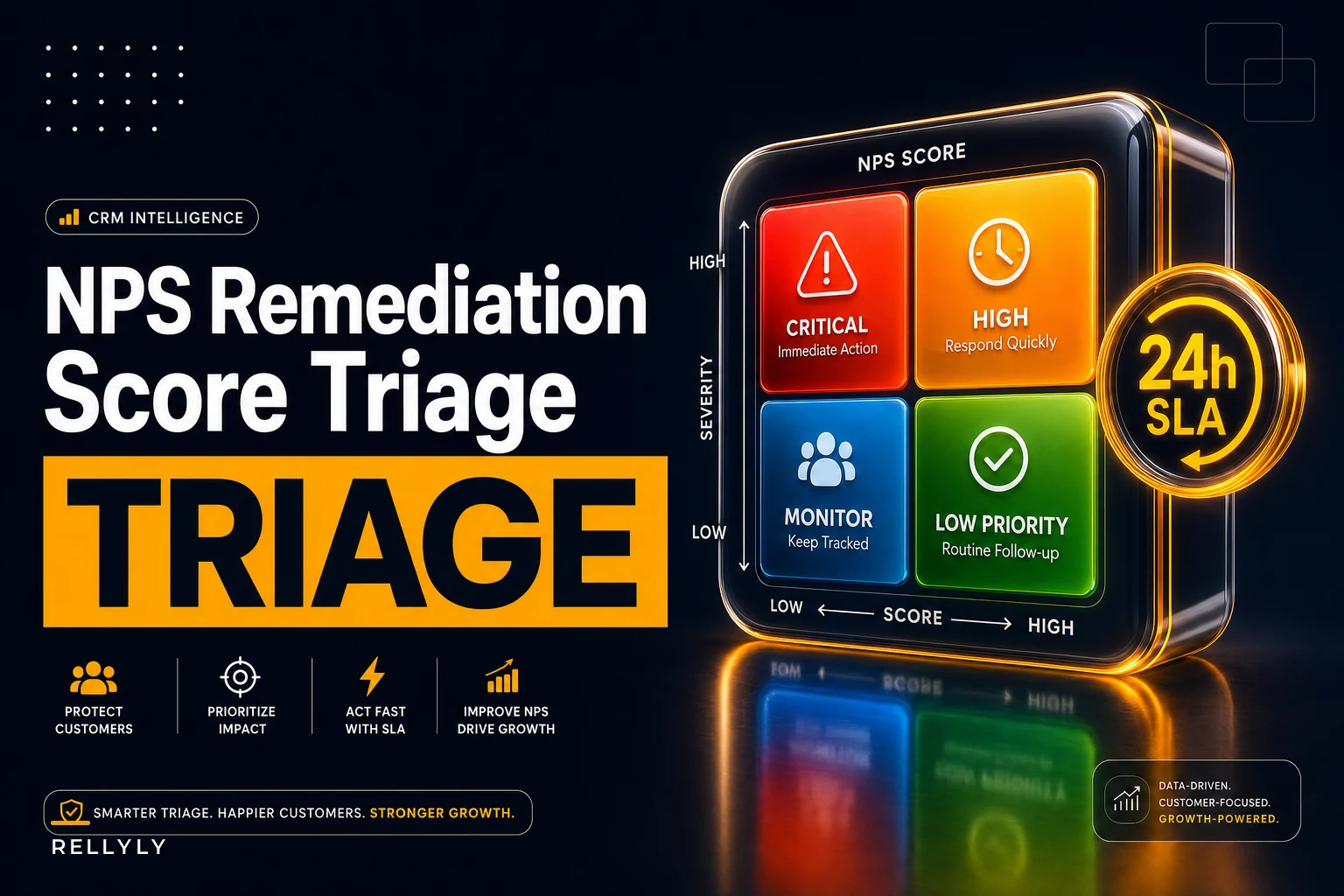
Critical Priority (Immediate executive outreach):
-
Score 0-3 from top 20% revenue accounts
-
Score 0-4 from accounts in renewal window (90 days)
-
Any detractor score with competitor mentions
-
Score 0-6 from accounts showing usage decline (>30% drop)
High Priority (24-hour CSM outreach):
-
Score 4-6 from top 20% revenue accounts
-
Score 0-6 from mid-tier accounts
-
Any detractor with specific feature complaints
-
Passive scores (7-8) from enterprise accounts
Standard Priority (48-hour outreach):
-
Score 7-8 from all segments
-
Score 0-6 from bottom 30% revenue accounts
-
Detractors outside renewal window with no usage issues
Automated Response (with monitoring):
-
Score 9-10 (promoters) — thank you message with referral request
-
Passive scores from SMB accounts — educational content series
The real leverage comes from combining score severity with business context. A medical device distributor implemented this matrix and saw their detractor-to-promoter conversion rate move from 12% to 34% within four months. They stopped treating all low scores equally and started calibrating response intensity to actual business risk.
The 24-hour outreach playbook
Speed matters, but what you say in that first outreach matters more. Generic "sorry to hear about your experience" emails accomplish nothing. You need to show understanding, ownership, and a concrete path forward.
Effective 24-hour outreach follows this structure:
Opening acknowledgment: Reference their specific score and any comments they left. Show you actually read their feedback, not just the number.
Immediate value prop: Offer something concrete in the first message—a call with their CSM, a session with a product specialist, or access to a beta feature they've requested.
Clear next step: Don't ask "how can we help?" Tell them what you're going to do and when. "I've scheduled 30 minutes for tomorrow at 2pm PT to walk through your workflow concerns. If that doesn't work, here are three other times."
Escalation transparency: Let them know who else is aware. "I've flagged this with our product team and my director. You'll hear directly from our head of product about the features you mentioned within 48 hours."
Reference the customer's exact comment in the first sentence to show you read their feedback and to increase reply rates.
One SaaS company tested this against their previous generic template. The structured approach generated roughly 3x higher response rates and more than double the recovery conversations. Customers felt heard rather than processed.
Remediation offers tied to contract value
Not every detractor warrants the same recovery investment. That sounds harsh, but it's just operational reality. Your remediation offers should scale with account value and growth potential.
| Account Tier | Annual Contract Value | Remediation Options |
|---|---|---|
| Enterprise | >$100k | Executive sponsor assignment, custom feature roadmap session, dedicated Slack channel, quarterly business reviews, free professional services credits |
| Mid-Market | $25k-$100k | Additional training sessions, monthly check-ins with senior CSM, priority support upgrade, usage optimization audit |
| SMB Growth | $5k-$25k | Automated tips series, group training invites, community access upgrade, discount on annual plan |
| SMB Standard | <$5k | Knowledge base priority, community forum support, automated workflow templates |
A logistics software company implemented tiered remediation and cut enterprise churn by 31% while keeping remediation costs roughly flat. They stopped over-investing in low-value accounts and under-investing in the ones that actually moved the needle.
The key is being transparent with your team about these tiers. CSMs need to know exactly what they can offer without chasing down approvals. Nothing kills remediation momentum faster than waiting three days for management to sign off on a training credit.
The 30/60/90 recovery roadmap
Initial outreach is just triage. Real NPS remediation happens through sustained engagement over the following quarter. Most teams fumble this part by treating remediation as a single conversation rather than a process.
Days 1-30: Stabilization Phase
-
Complete root cause analysis with the customer
-
Deliver the specific remediation offer for their tier
-
Fix any technical issues or bugs they've reported
-
Establish weekly check-in rhythm (even if brief)
-
Document everything in a shared recovery plan
Days 31-60: Recovery Phase
-
Show tangible progress on their specific concerns
-
Introduce power features they haven't adopted
-
Connect them with successful customers in similar industries
-
Review usage data together to find optimization opportunities
-
Start measuring sentiment improvement
Days 61-90: Reinforcement Phase
-
Run a fresh NPS survey to measure improvement
-
Celebrate wins and document value achieved
-
Establish an ongoing success rhythm (monthly or quarterly)
-
Request a case study or reference if it feels right
-
Capture lessons learned for both product and CS teams
An industrial equipment dealer who applied this structure improved their detractor recovery rate from 23% to 61%. The timeline kept both CSMs and customers accountable for actual progress rather than just good intentions.
Operational automation without losing the human touch
NPS response volume can overwhelm even well-staffed teams pretty quickly. Smart automation helps you hold SLAs without sacrificing quality.
What to automate:
-
Initial triage and routing based on score/tier matrix
-
SLA tracking and escalation alerts
-
Follow-up reminders and task creation
-
Recovery plan templates and documentation
-
Promoter thank-you messages and referral requests
-
Passive scorer education campaigns
What to keep human:
-
All detractor conversations for top 40% of revenue
-
Complex technical or product feedback discussions
-
Renewal negotiations triggered by NPS issues
-
Executive escalations
-
Customization of individual recovery plans
A marketing automation company built this hybrid approach into their operations. Their AI-powered platform handles routing, tracking, and reminders while CSMs stay focused on actual customer conversations. Average response time to detractors dropped from around four days to under 15 hours.
The platform automatically creates recovery plans based on reported issues, assigns tasks to product and support teams, and tracks progress against SLAs. CSMs get alerts before SLAs breach, not after. This automation framework keeps the human element where it matters most while cutting the administrative drag that causes delays in the first place.
Success metrics that predict revenue impact
Most teams measure NPS remediation wrong. They track response rates and score improvements but miss the indicators that actually predict revenue outcomes.
Leading indicators (weekly monitoring):
-
Time to first response by tier
-
Detractor engagement rate (% accepting remediation offers)
-
Recovery plan completion rate
-
Feature adoption within remediation cohort
-
Support ticket reduction post-remediation
Lagging indicators (monthly/quarterly):
-
Detractor to promoter conversion rate
-
Renewal rate for remediated accounts
-
Expansion revenue from recovered detractors
-
Referrals generated from converted detractors
-
Churn rate comparison (remediated vs. non-remediated)
A B2B software company found that their most predictive metric was feature adoption within 30 days of remediation. Detractors who adopted at least two new features had a 78% renewal rate versus 41% for those who didn't. They restructured their entire remediation process around driving feature adoption rather than just responding to complaints.
Common remediation failures to avoid
The "survey and ignore" pattern: Collecting NPS scores without a remediation plan is arguably worse than not surveying at all. Customers feel more let down when they provide feedback that generates zero response. One company actually saw scores drop after launching NPS because they couldn't handle the volume that came back.
The "CSM hero" trap: Putting all remediation on individual CSMs without operational support guarantees inconsistency. CSMs managing dozens of accounts can't maintain reliable SLAs alone. Remediation needs team-wide ownership with clear escalation paths and backup coverage.
The "one-size-fits-all" response: Sending the same remediation offer regardless of the customer's actual issue destroys credibility fast. Someone frustrated by pricing doesn't want extra training sessions. Someone struggling with adoption doesn't need executive check-ins.
The "score obsession" mistake: Chasing score improvement rather than solving the underlying problems creates temporary bumps without lasting change. Customers might score you higher right after remediation and still churn if their core issues never got fixed.
When aggressive remediation makes sense (and when it doesn't)
Not every detractor is worth a heavy investment. Some CS teams push back on this, but ignoring it leads to wasted resources and worse overall outcomes.
When to invest heavily in remediation:
-
High-value accounts with solvable problems
-
Customers in competitive situations
-
Accounts with strong expansion potential
-
Detractors who were previously promoters
-
Customers whose issues likely reflect broader product gaps
When to keep investment minimal:
-
Chronic complainers with expectations that no vendor can realistically meet
-
Accounts that are consistently unprofitable to serve
-
Customers who are just a poor product fit
-
Detractors who appear to be churning regardless
-
Accounts with fundamental business model conflicts
A procurement software company reviewed two years of remediation data and realized they were spending about 40% of CS resources on accounts that drove 8% of revenue and churned at 70% regardless of how much attention they received. Reallocating those resources to mid-tier accounts improved overall retention by around 15%.
Building your NPS remediation engine
The difference between companies that actually leverage NPS and those that just collect scores comes down to operational discipline. You need clear processes, defined SLAs, and automation that supports human judgment rather than replacing it.
Here's the implementation sequence that tends to work:
-
Map your current detractor response process—even if it's basically chaos
-
Build your score-severity matrix based on your actual customer segments
-
Create tier-appropriate remediation offers with clear approval limits
-
Design your 30/60/90 recovery roadmap templates
-
Set up automation for triage, routing, and SLA tracking
-
Train your team on the process with clear escalation paths
-
Monitor leading indicators weekly and adjust as you go
Companies seeing real revenue impact from NPS remediation treat it like any other critical business process—defined workflows, clear ownership, and systematic improvement over time. They don't rely on CSM heroics or hope that someone remembers to follow up. They build repeatable systems that turn frustrated customers into growth opportunities.
Visualize the flow from triage to remediation offers to automation and ongoing monitoring.
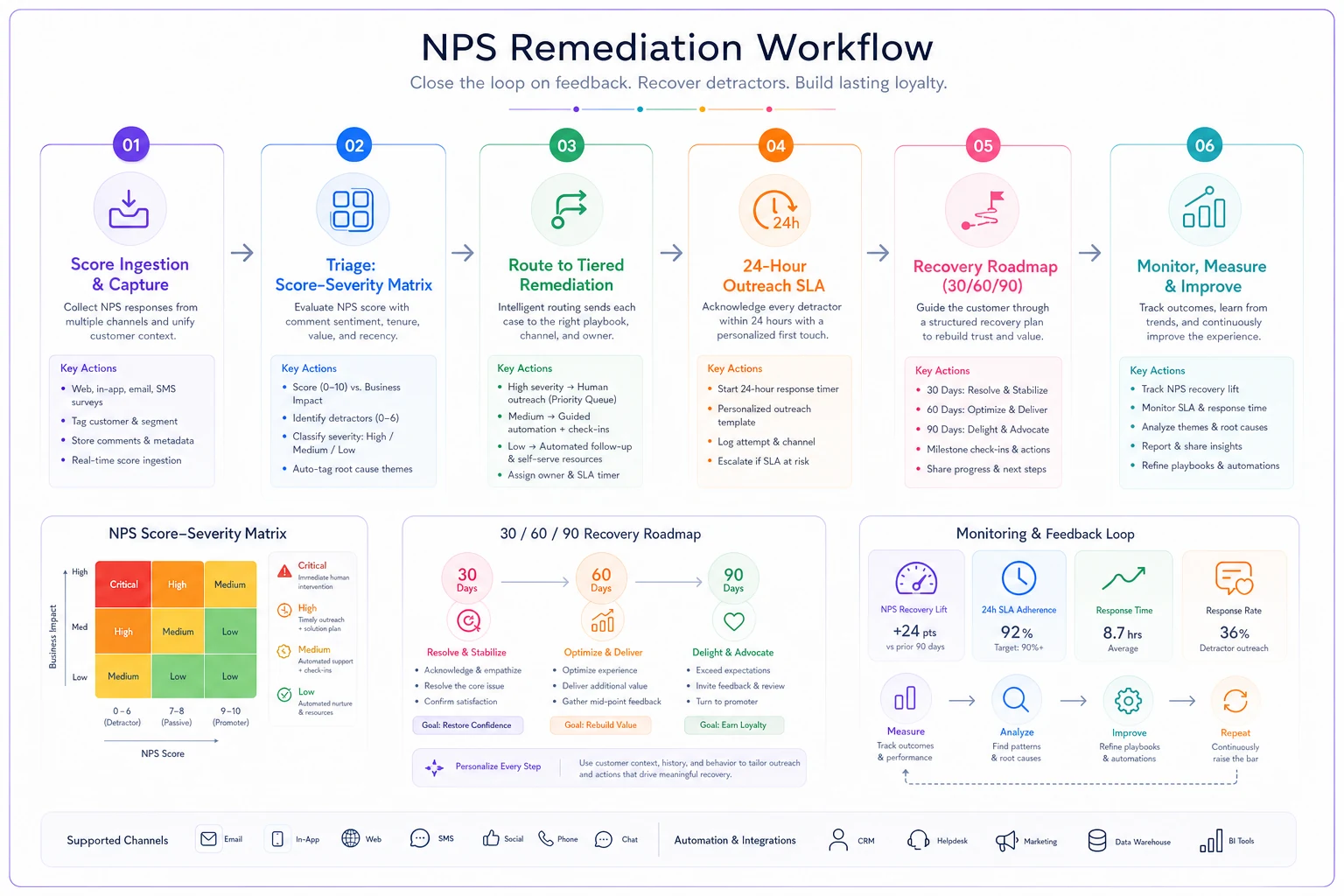
When you combine speed, personalization, and operational discipline, NPS remediation stops being damage control and starts being a competitive advantage. Customers remember who showed up when they were frustrated. They remember who actually fixed things versus who just sent an apology.
Most of your competitors are still sending generic "thanks for your feedback" emails three weeks after someone gives them a 3. The same disciplined approach that recovers stalled deals applies directly here—systematic outreach, clear value props, and relentless follow-through. The only question is whether you'll build that system before your detractors become someone else's promoters.
Ready to transform your customer relationships?
Join 2,000+ businesses using Rellyly to increase sales, improve client retention, and simplify CRM workflows.