

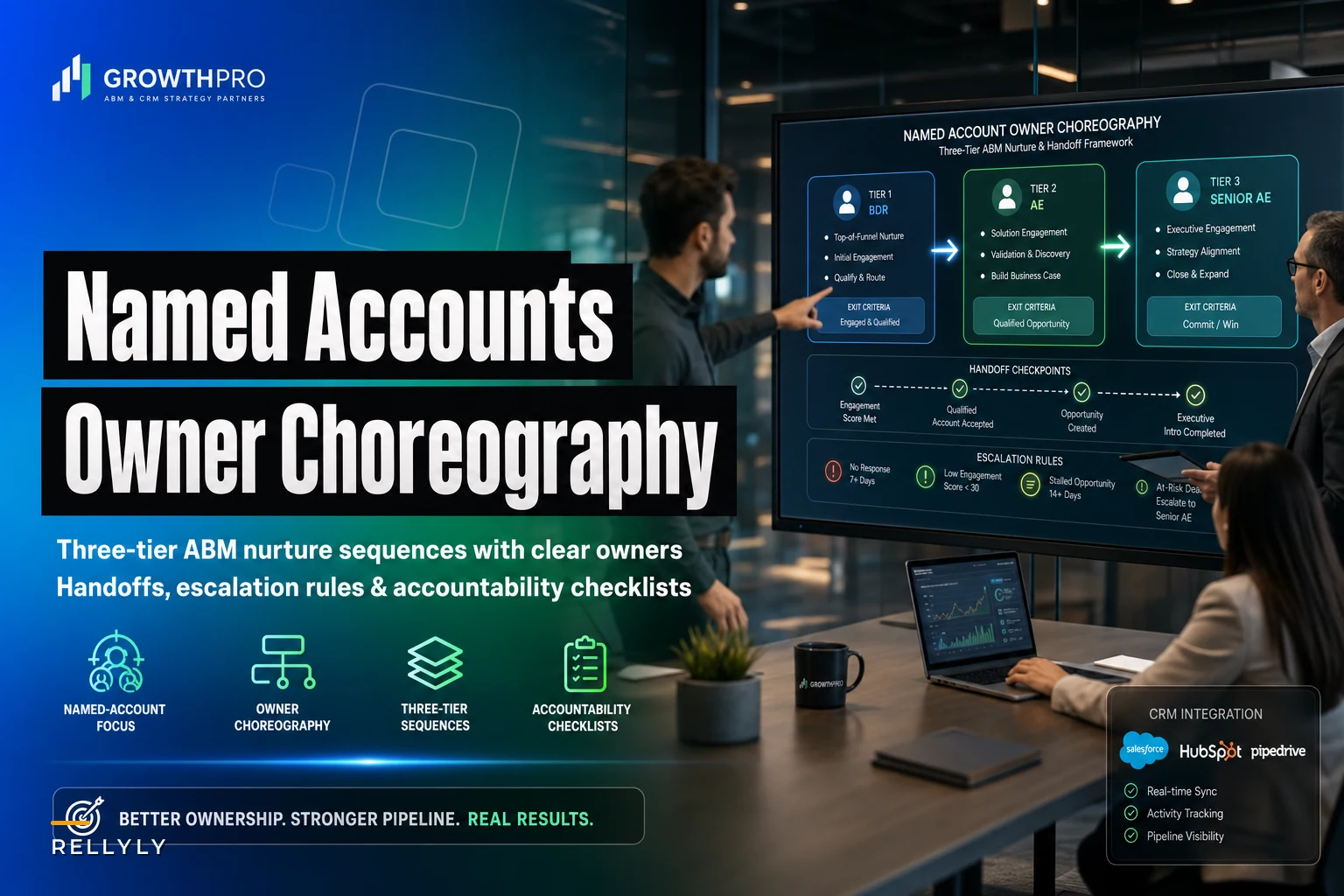

Most ABM programs fail in the handoffs. Not the messaging, not the targeting—the actual operational choreography between reps working the same named account.
Picture three sales reps touching a single enterprise account. The BDR sends tier-one outreach to the operations manager. The AE runs tier-two expansion messaging to the VP. The senior AE handles executive touches with the C-suite. Without clear ownership rules and escalation triggers, you end up with conflicting messages hitting the same inbox, reps stepping on each other's deals, and prospects getting confused about who their actual point of contact is.
The choreography problem that breaks named account campaigns
The breakdown happens fast. Rep A schedules a discovery call with procurement. Rep B, unaware, sends a pricing proposal to finance. Rep C reaches out cold to the CEO with a completely different value prop. The prospect sees three different stories from the same company and ghosts everyone.
The worst part? Most teams don't realize the choreography is broken until they lose a major account. They blame the messaging, rebuild the sequences, and run straight into the same coordination problems.
Why traditional ABM templates miss the ownership layer
Standard ABM nurture templates focus entirely on message sequencing. Day 1: send educational content. Day 7: share a case study. Day 14: offer a demo. They map out what to send and when but completely ignore who owns what part of the account relationship.
Never miss a customer touchpoint again.
Rellyly helps you manage contacts, tasks, and sales efficiently in one platform.
- Unified customer profiles
- Automated follow-ups
- Sales pipeline tracking
No credit card required
The gap becomes obvious when you watch how these campaigns actually run. Marketing creates beautiful tier-based messaging. Sales ops loads it into the CRM. Then chaos. No one knows who should send what message to which contact. Reps duplicate efforts or, worse, assume someone else is handling it and nobody reaches out at all.
Account ownership isn't just about assigning a name in Salesforce. It's about defining exactly which rep owns which relationship tier, what triggers an escalation between tiers, and how information flows between team members working that account. Without this structure, even solid messaging falls apart.
Building your three-tier ownership matrix
Here's the ownership structure that actually works for named accounts:
-
Tier 1
Introduction Layer (BDR/SDR Owned)
- Target personas: Individual contributors, managers, operational contacts - Message focus: Problem identification, educational content, initial value discovery - Engagement threshold: 2-3 touchpoints per contact, maximum 6 before escalation - Success metric: Meeting booked or qualified interest signal -
Tier 2
Value Expansion (AE Owned)
- Target personas: Directors, VPs, department heads - Message focus: Business case development, ROI modeling, solution mapping - Engagement threshold: 4-6 touchpoints, focus on multi-threaded relationships - Success metric: Champion identified, budget discussion initiated -
Tier 3
Executive Touch (Senior AE/Sales Leader Owned)
- Target personas: C-suite, EVPs, board members - Message focus: Strategic partnership, transformation outcomes, peer executive introductions - Engagement threshold: 1-2 highly personalized touchpoints per quarter - Success metric: Executive sponsor secured, strategic initiative alignment
The key difference from typical ABM templates for named accounts? Each tier has a dedicated owner with specific escalation rules. No ambiguity about who reaches out to whom.
| Tier | Owner | Personas | Message Type | Touchpoint Limit | Escalation Trigger |
|---|---|---|---|---|---|
| Introduction | BDR/SDR | ICs, Managers | Educational | 6 max | Interest signal or 6 touches |
| Value Expansion | AE | Directors, VPs | Business case | 4-6 ongoing | Budget identified |
| Executive | Senior AE | C-suite | Strategic | 1-2 quarterly | Deal >$100k or strategic |
The table above is a starting point, not a rigid prescription. Adjust thresholds based on your ACV and deal complexity.
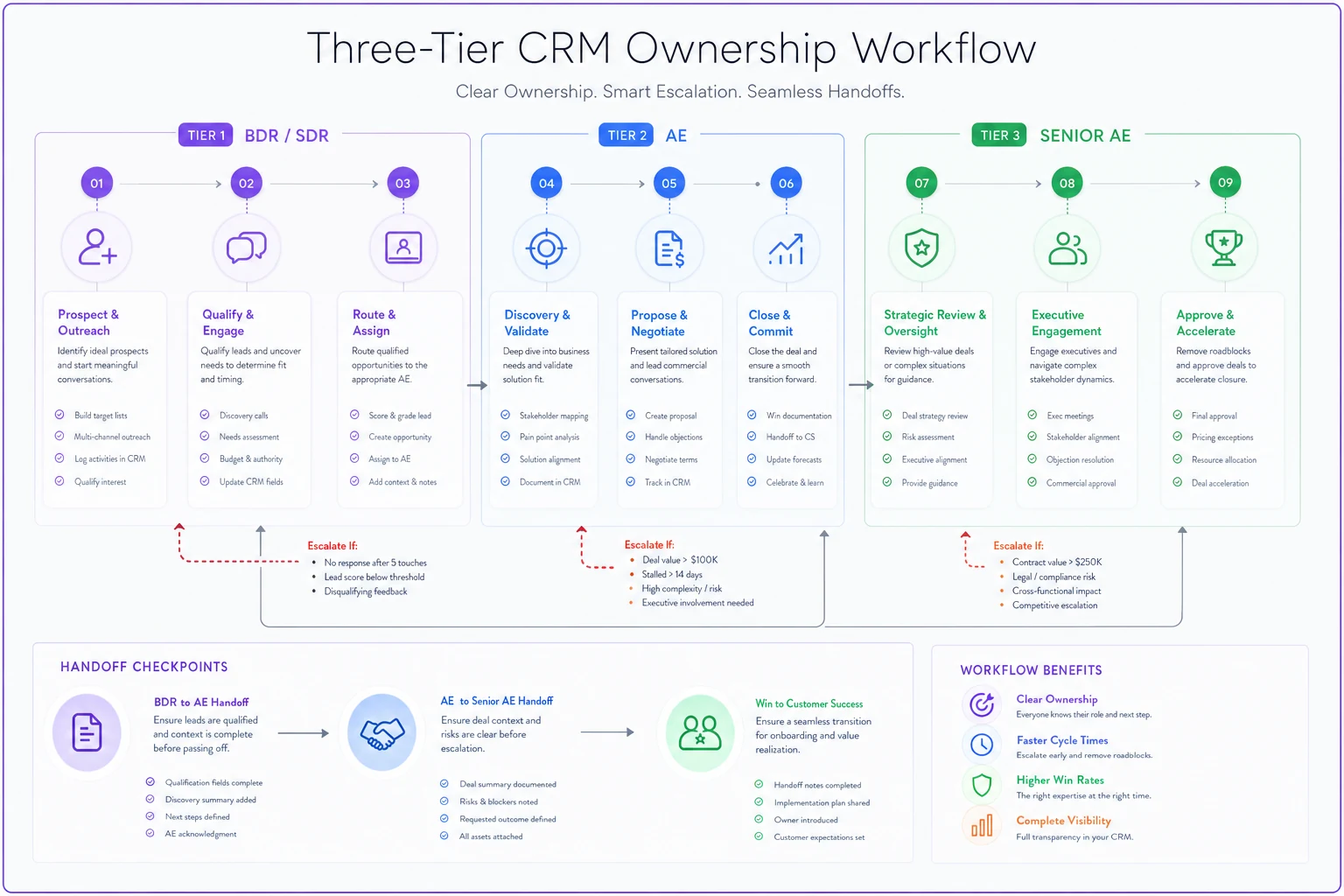
A simple visual helps teams internalize who owns which relationships and where escalations should happen.
Escalation triggers that prevent ownership conflicts
The handoff between tiers needs explicit triggers, not vague guidelines. Here's what tends to work across different deal sizes:
Upward Escalation (Moving to Higher Tier)
-
Contact explicitly requests an executive conversation
-
Deal value crosses a predetermined threshold ($50k, $100k, $250k depending on your ACV)
-
Prospect mentions board approval or a strategic initiative
-
Competitor mentioned with an active evaluation underway
-
Multiple departments engaged within 30 days
Lateral Escalation (Same Tier, Different Owner)
-
Original owner out of office more than 3 days during an active cycle
-
Prospect requests specific expertise (technical, industry, use case)
-
Geographic or vertical specialization needed
-
Language or timezone coverage required
Downward Escalation (Moving to Lower Tier)
-
Decision timeline extends beyond 6 months
-
Budget disappears or gets frozen
-
Champion leaves the organization
-
Engagement drops below response threshold
Without explicit triggers, reps make judgment calls that create conflicts. The AE thinks they should take over because the prospect seems engaged. The BDR thinks they should keep nurturing because budget isn't confirmed. Meanwhile, the prospect gets mixed signals from both.
The handoff checklist that preserves context
Account handoffs fail when context gets lost. The new owner starts from scratch, asks questions the prospect already answered, and kills the relationship momentum that took weeks to build.
Account Intelligence Transfer
-
All contacts engaged with titles, response patterns, and influence indicators
-
Pain points explicitly mentioned with direct quotes
-
Budget range discussed or implied
-
Timeline and urgency signals
-
Competition mentioned or detected
Engagement History Summary
-
Messages sent with response rates by message type
-
Meetings held with outcomes and next steps
-
Content consumed (emails opened, links clicked, materials downloaded)
-
Objections raised and how they were addressed
-
Internal champions and blockers identified
Strategic Context
-
Why this account was selected for ABM focus
-
Original hypothesis about fit and value
-
Current stage in the buying journey
-
Risks and opportunities unique to this account
-
Recommended next actions with reasoning
Use a shared CRM handoff template so the receiving owner can quickly find titles, quotes, and next steps without hunting through notes.
This isn't a five-minute Slack message. It's a structured knowledge transfer that takes 20-30 minutes but saves hours of redundant discovery and prevents real relationship damage.
Operational realities of multi-owner campaigns
Running three-tier ownership creates coordination overhead most teams seriously underestimate. You need weekly account reviews just to keep everyone aligned—not deal reviews where you discuss pipeline probability, but operational reviews where you map out who's doing what that week.
The most common breakdown: Rep A books a meeting with their contact for Tuesday. Rep B, unaware, sends an automated follow-up to their contact on Monday referencing a conversation that hasn't happened yet. The prospect's team talks internally, realizes the vendor doesn't have their act together, and confidence erodes.
This coordination tax is why simpler single-owner models often outperform complex multi-tier approaches, especially for smaller deals. The choreography overhead exceeds the value of specialization. But for true enterprise named accounts worth $500k or more, the multi-tier model drives significantly higher close rates when the operational structure actually works.
When to break your own rules
Rigid enforcement of ownership rules creates its own problems. Sometimes the BDR has the best relationship with the CFO because they went to the same school. Sometimes the senior AE should handle a manager-level contact because that person is the actual decision maker despite the title.
-
Relationship Override
If any rep has a legitimate prior relationship—worked together, personal connection, strong referral—they own that contact regardless of tier.
-
Response Override
If a contact consistently responds better to one rep, maintain that relationship even if it breaks the tier model.
-
Velocity Override
If following the tier model would delay response by more than 24 hours, the available rep responds with clear internal communication.
-
Expertise Override
If the conversation requires specific expertise (technical, industry, use case), the expert handles it regardless of tier assignment.
The point isn't perfect rules—it's preventing confusion and conflicts. When everyone knows the standard model and the approved exceptions, coordination improves dramatically.
Measuring choreography effectiveness
Most teams only measure response rates, meetings booked, and pipeline created. That's not enough. You need to track ownership metrics separately from message performance, because poor coordination shows up in the operational numbers long before it tanks your pipeline results.
Coordination Metrics
-
Handoff completion rate (% of escalations with full checklist completed)
-
Ownership conflicts per week (multiple reps engaging the same contact)
-
Average handoff time (trigger to new owner engaged)
-
Context preservation score (new owner questions vs. already captured info)
Coverage Metrics
-
Contacts engaged per account by tier
-
Tier coverage ratio (% of target personas engaged)
-
Cross-tier response rate (executive responding to BDR outreach)
-
Multi-threading depth (unique contacts engaged per account)
Poor coordination metrics predict future campaign failure even when current results look fine. That gap between what the numbers show today and what actually happens in three months is where most ABM programs quietly die.
The uncomfortable truth about named account complexity
Multi-tier ABM nurture for named accounts often costs more operationally than it's worth for accounts under $100k ACV. The coordination overhead, handoff friction, and ownership confusion eat up more time than you gain through specialization.
Teams will spend three hours weekly coordinating a five-person account team for a $50k opportunity. That same time applied to simpler single-owner outreach across five additional accounts would almost always generate better returns.
A rough guide worth keeping handy:
-
Under $50k ACV — Single owner with simple tiered messaging
-
$50k–$250k ACV — Two-tier model (BDR + AE) with clear escalation
-
Over $250k ACV — Full three-tier model with dedicated orchestration
Sounds obvious, but roughly half the teams running complex multi-tier campaigns are working deals that can't justify the overhead.
Technology coordination without the confusion
The tech stack complexity multiplies with multi-owner models. The BDR works in Outreach. The AE uses Salesloft. The senior executive sends from Gmail. Now you've got three different activity streams that don't talk to each other.
-
Activity Logging
All touchpoints log to the CRM account record, regardless of sending platform. This connects directly to task orchestration principles worth reviewing if you haven't already.
-
Sequence Conflicts
Set up mutual exclusion rules—if any contact is in an active sequence, block others in that account from entering new sequences.
-
Response Routing
All responses route to the tier owner, not the sender. Use shared inboxes or forwarding rules to maintain ownership boundaries.
-
Visibility Requirements
Every owner needs read-access to all account activity, even tiers they don't own.
AI-powered operational software can centralize these coordination points—automatically detecting ownership conflicts before they reach the prospect and routing activities to the right owner based on your tier definitions. But even basic CRM configuration helps if you've established clear operational rules first. The technology isn't the fix; the rules are.
The warning signs your choreography is broken
Watch for these patterns:
Prospect Confusion Signals
-
"I'm already talking to Sarah from your team"
-
"Didn't we discuss this last week?"
-
"Can you loop in the person I was working with?"
-
Multiple meeting invites for the same purpose
-
Prospects asking who their main contact should be
Internal Friction Indicators
-
Reps complaining about others "stealing" their accounts
-
Duplicate activities in CRM for the same account
-
Slack threads debating who should handle what
-
Meeting recordings where reps repeat discovery the previous owner already did
-
Commission disputes over account ownership
Performance Degradation
-
Response rates dropping over time
-
Longer sales cycles for multi-tier accounts
-
Lower close rates despite more touches
-
Increasing "no decision" outcomes
These problems compound. Small coordination issues in month one become major relationship problems by month three. The same patterns that cause deals to stall often trace back to confused ownership and poor handoffs, which makes fixing the choreography doubly important.
A real story of choreography transformation
A cybersecurity company targeting Fortune 1000 accounts was running standard ABM sequences with clean messaging and terrible results. Three reps per account, all following marketing's playbook, close rates stuck under 8%.
The problem wasn't the messages. Reps constantly collided, sending similar outreach to the same contacts. Prospects complained about getting multiple meeting invites for "introductory calls" from different team members. The CRO was ready to kill the ABM program entirely.
They rebuilt the approach around ownership tiers. BDRs owned security analysts and IT managers. AEs owned directors and VPs of IT. The CRO personally owned CISO relationships. Each tier had specific message tracks, escalation triggers, and handoff requirements.
-
Response rates jumped from 4% to 11%
-
Sales cycle shortened by roughly 22 days on average
-
Close rates hit 24% for multi-tier accounts
-
Average deal size increased by around $40k
The messaging stayed exactly the same. Only the choreography changed.
Making the model sustainable
Three-tier ABM models are genuinely exhausting to maintain. The initial enthusiasm fades around the six-week mark when reps realize how much coordination overhead they've signed up for. Weekly reviews become biweekly. Handoff checklists get skipped. Soon you're back to chaos.
-
Automate the mundane coordination
Use workflow automation to handle activity logging, collision detection, and basic handoff notifications. Save human attention for strategic decisions.
-
Rotate complexity
Not every account needs three-tier coverage all the time. Run full choreography for accounts in active evaluation, drop to single-owner for the nurture phase.
-
Document the wins
Track specific deals won through better coordination. Stories of a deal saved through proper executive choreography justify the overhead when people start questioning whether it's worth it.
-
Simplify ruthlessly
Every quarter, cut one coordination step that isn't proving valuable. The model should get lighter over time, not heavier.
Teams that succeed long-term with ABM nurture templates for named accounts treat choreography as a core competency, not an afterthought. They invest in the operational structure the same way they invest in messaging and targeting. Your named account strategy is only as strong as your weakest handoff—perfect messages delivered by a disorganized team will lose to decent messages delivered by a coordinated one every single time.
Your named account strategy is only as strong as your weakest handoff—perfect messages delivered by a disorganized team will lose to decent messages delivered by a coordinated one every single time.
Ready to transform your customer relationships?
Join 2,000+ businesses using Rellyly to increase sales, improve client retention, and simplify CRM workflows.