

Most mid-deal executive outreach fails before the call even starts. The rep scrambles to find the exec's LinkedIn, fires off a generic "thought you should know" email, then wonders why approval takes another six weeks. Meanwhile, your champion is getting grilled in budget meetings without the ammo they need.
Executive outreach mid-deal isn't about impressing anyone with your slide deck. It's about understanding where executives actually get stuck during approvals and giving them exactly what they need to move forward. The difference between fast approvals and endless procurement loops usually comes down to how well you prep for that 15-minute exec call.
The procurement calendar runs your deal timeline (whether you know it or not)
Corporate budgeting follows predictable cycles that most sales teams completely ignore. Q4 planning starts in August. Annual budgets lock by October. If you're reaching out to a CFO in November asking for unbudgeted spend, you're already swimming upstream.
What's actually happening inside companies during different quarters:
Q1 (Jan–March): Fresh budgets mean executives are more open to new initiatives, but they're also getting pitched by everyone else who knows this. Decision criteria gets stricter because they're comparing multiple options at once.
Q2 (April–June): Mid-year reality sets in. Executives start seeing which initiatives are working and which aren't. This creates pockets of reallocated budget if you know how to position against underperforming projects.
Q3 (July–Sept): Next year's planning begins. Executives care less about immediate implementation and more about strategic fit for the following year. Your messaging needs to shift from "quick wins" to "platform for growth."
Q4 (Oct–Dec): Use-it-or-lose-it budget dynamics create urgency, but also chaos. Executives are juggling year-end targets, next year's planning, and holiday schedules. Short, specific asks work better than comprehensive proposals.
The timing of your executive outreach should align with where they are in this cycle. A manufacturing CFO in August wants to hear about next year's efficiency gains. That same CFO in November needs to know how you'll move the needle on this quarter's numbers.
Pre-call preparation that actually matters
Forget the company overview slides. Executive prep means understanding three specific things before you dial.
Never miss a customer touchpoint again.
Rellyly helps you manage contacts, tasks, and sales efficiently in one platform.
- Unified customer profiles
- Automated follow-ups
- Sales pipeline tracking
No credit card required
Their personal metrics: Not the company's metrics — theirs specifically. A VP of Sales cares about quota attainment and rep productivity. A CFO cares about cash flow and margin. A COO obsesses over operational efficiency and system uptime. Your entire conversation should ladder up to the 2–3 numbers they personally get measured on.
Recent organizational changes: Did they just acquire a company? Implement a new ERP? Announce layoffs? These events create specific pressure points. A recent acquisition means integration headaches. New system implementations mean change fatigue. Layoffs mean doing more with less. Your positioning needs to acknowledge this reality, not dance around it.
Their approval process mechanics: Some executives are decision makers, others are influencers who need to sell internally. Understanding their actual role prevents you from asking for things they can't deliver. If they need board approval for purchases over $100K, structure your proposal accordingly.
Lead with the 2–3 numbers they personally get measured on.
One SaaS company kept losing deals at the executive level until they started tracking approval patterns. They found deals requiring CFO sign-off averaged around 47 days, while deals staying at the VP level closed in roughly 18. They restructured their pricing tiers to keep more deals under the VP threshold and cut their average sales cycle by nearly a month.
The seven-minute script that moves deals forward
Executives don't have time for discovery calls. They've already delegated evaluation to their team. When they show up, they want answers to specific concerns their team couldn't address.
Structure that consistently works:
Minute 0–1: Acknowledge their specific situation "I know you're evaluating this as part of your Q3 efficiency push following the Denver office consolidation. Your team has been thorough on the operational fit."
Minute 1–3: Address the unspoken concern "The question you're probably wrestling with isn't whether this solves the problem, but whether implementing it during your ERP migration creates too much change at once. Here's how three similar companies handled that exact situation..."
Minute 3–5: Provide comparable evidence "When Acme Corp did this during their Salesforce rollout, they found it actually reduced overall change management burden by around 30% because teams only had to learn new processes once. They tracked it through support ticket volume and training hours."
Minute 5–6: Outline the specific next steps "If this moves forward, we'd need a technical review with your IT team by the 15th to hit your Q4 implementation target. Your team has already identified the integration points. The only executive decision needed is whether to prioritize this ahead of the warehouse management system upgrade."
Minute 6–7: Create space for their actual concern "What's the one thing that would make you hesitate to move forward?"
Notice what's not in this script: feature demos, ROI calculations they've already seen, or generic value propositions. Every minute focuses on their specific situation.
Building your pre-read document (the one they'll actually read)
Executives forward emails to make decisions offline. Your pre-read document becomes the internal business case when you're not in the room. Most reps send 15-page proposals that never get opened.
The effective pre-read is one page, five sections:
-
Current situation (2 sentences) What specific problem exists today with quantified impact.
-
Proposed change (2 sentences) What specifically will be different, and when.
-
Risk mitigation (3 bullets) The three biggest concerns and how you address each.
-
Comparable outcomes (1 paragraph) Similar company, similar situation, specific results.
-
Investment and timeline (3 bullets) Total cost, payment terms, implementation timeline.
A midwest logistics company started using this format and saw their executive approval rate climb from around 35% to roughly 78%. The shift wasn't more information — it was making the information digestible for someone who has five minutes between meetings.
The one-page constraint is the point. If you can't make the case in one page, you haven't understood the exec's actual concerns well enough to distill them.
Here's a quick visual of the one-page pre-read creation workflow.
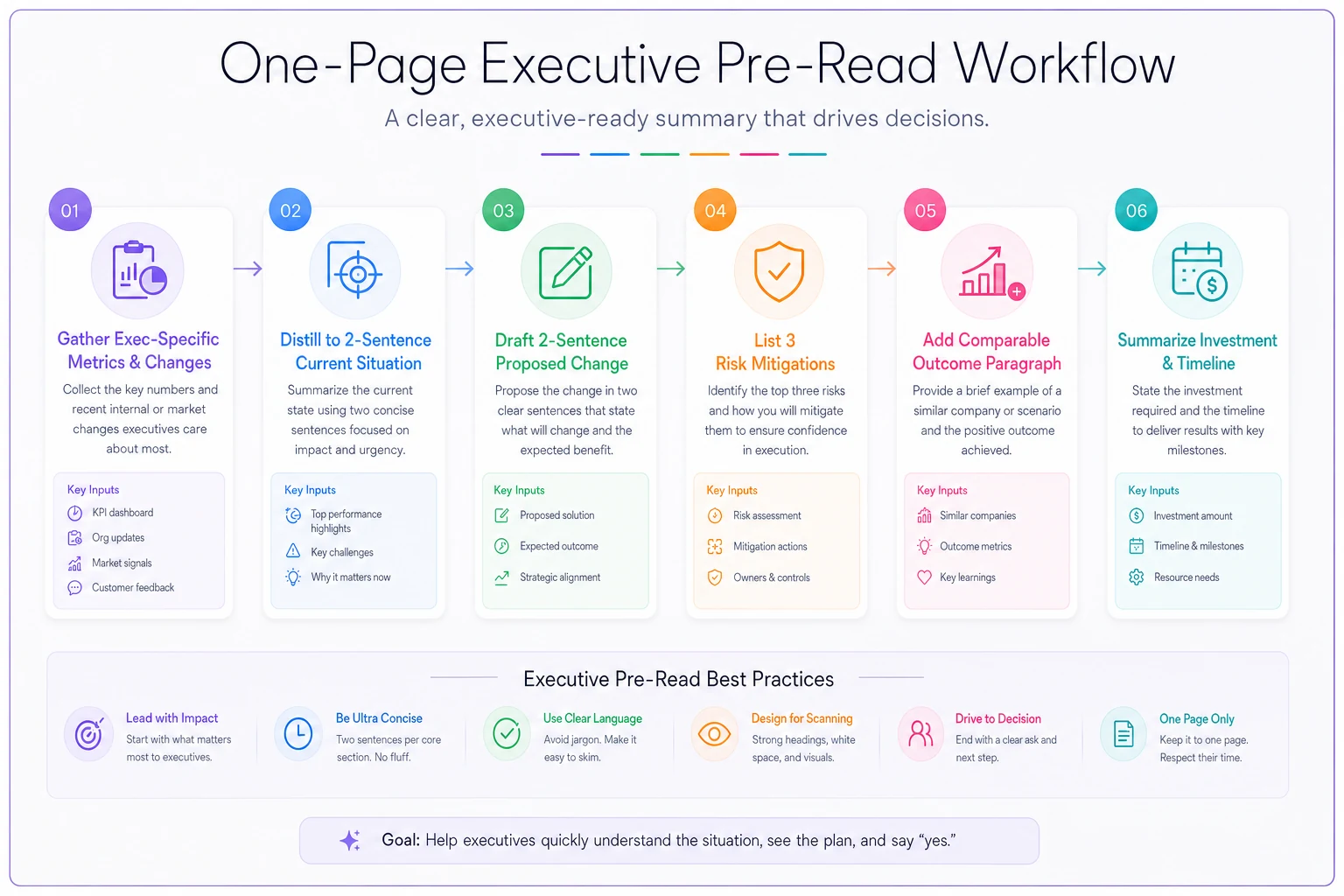
Use this workflow to keep one-pagers focused and executive-ready.
Timing your outreach for maximum impact
Timing is probably the most underrated variable in executive outreach. You can have the right message, the right contact, and the right one-pager — and still get ignored because you caught someone mid-budget-freeze or two weeks before a board presentation.
The table below maps common deal scenarios to when and how to reach out:
| Scenario | Optimal Timing | Message Focus | Who to Include |
|---|---|---|---|
| Competitive displacement | Within 48 hours of competitor stumble | Switching costs vs. ongoing pain | Current vendor's executive sponsor |
| Budget reallocation | 6–8 weeks before quarterly review | Performance vs. other initiatives | Finance + primary stakeholder |
| Year-end push | By November 10th | Q4 impact + next year setup | CFO + department head |
| New executive hire | Week 3–4 in role | Quick wins for credibility | New exec + their inherited team |
| Post-merger integration | 60–90 days post-announcement | Standardization opportunities | Integration lead + ops teams |
Reaching out to a new executive in their first week comes across as opportunistic. Waiting until month three means they've already set their priorities. Week 3–4 hits the sweet spot where they understand the problems but haven't committed to solutions yet. That window closes fast.
Measurable follow-up sequences that prevent ghosting
Executive ghosting happens when follow-up feels like nagging. More touchpoints isn't the answer — making each touchpoint valuable is.
Each message below is designed to provide something worth reading whether they buy or not:
Day 1 post-call: Send the one-page summary plus one specific insight tied to something they mentioned. "You flagged concerns about training burden. Here's a 2-minute video of how Company X handled that."
Day 4: Forward relevant industry news with brief commentary. "Saw your competitor just announced same-day shipping. The approach we discussed would cut around 3 hours off your fulfillment time."
Day 10: Share a quick win from another customer. "Just helped a similar company reduce their approval cycles by 5 days using the process we discussed. Happy to share specifics."
Day 18: Acknowledge if timing isn't right. "Seems like this might not be the right priority for Q4. If that's the case, would you prefer I circle back in January when you're doing annual planning?"
You're not chasing a sale — you're sharing relevant context with someone running a business. That distinction comes through in the tone, and executives pick up on it quickly.
Converting executive interest into actual movement
Getting an executive excited doesn't close deals. You need to convert that interest into specific actions with deadlines.
The most effective approach is what I'd call the "implementation checkpoint" method. Instead of asking "what are the next steps?" you propose: "To hit your target date, we'd need technical approval by the 20th and procurement terms agreed by the 27th. Should we proceed with those checkpoints or adjust the timeline?"
This forces a concrete decision: move forward with specific dates, or explicitly delay. Vague interest becomes clear commitment or clear postponement.
A B2B software company that adopted this approach saw their post-executive-meeting conversion rate climb from around 40% to 65%. It wasn't about pushing harder — it was making the path forward impossible to misread. There's a meaningful difference between an exec who says "this looks great, let's keep talking" and one who agrees to a technical review by the 20th. Only one of those is actually moving.
When to loop in executives (and when you're just wasting their time)
Not every deal needs executive involvement. Premature escalation annoys executives and makes your champion look like they can't drive decisions on their own.
Loop in executives when:
-
The investment exceeds normal approval limits (usually around 3x the typical deal size)
-
Multiple departments need coordination
-
Strategic initiatives require executive sponsorship
-
Competition already has executive relationships
-
Implementation requires organizational change management
Keep executives out when:
-
Your champion has clear authority and budget
-
The decision is purely technical
-
You're still in early discovery
-
The executive explicitly delegated the decision
Perfectly good deals die because overeager reps insisted on executive meetings that weren't necessary. The champion felt undermined, the executive felt their time was wasted, and trust evaporated on both sides. If your champion hasn't asked for exec involvement, ask them directly before you go around them.
The procurement pre-emption checklist
Procurement will ask roughly the same dozen questions on every deal. If you wait until they ask, you've already added weeks to your timeline. Pre-empting those concerns in your executive conversation changes the dynamic entirely — suddenly you're organized and low-risk rather than reactive.
Security and compliance:
"We maintain SOC2 Type II and ISO 27001 certifications, updated quarterly. Your security team has our complete documentation."
Vendor management:
"We're already in your vendor management system from the 2019 project with your Dallas team. Updating the scope takes about 3 days."
Payment terms:
"Standard terms are Net 30, but we can accommodate your typical Net 45 requirement with proper PO."
Contract liability:
"Our standard limitation of liability is 12 months of fees. We can discuss adjustments for critical implementations."
Integration requirements:
"Your team has identified three integration points. We've done identical integrations with four similar companies, averaging about 2 weeks each."
When executives hear you've already thought through procurement, they stop worrying about surprises derailing the timeline. That alone can shave weeks off approval cycles.
Accelerating approvals without seeming pushy
The difference between appropriate urgency and annoying pressure comes down to framing everything through their success metrics, not your quota.
Bad: "We need to close this by month-end to hit our targets."
Good: "To impact your Q1 efficiency metrics, we'd need to start implementation by December 15th, which means approval by November 30th."
The urgency comes from their business needs, not your commission check. This framing also helps you qualify whether the urgency is even real. If hitting Q1 metrics doesn't actually matter to them right now, pushing for year-end close wastes everyone's time.
Building sponsor relationships that last beyond the sale
The best executive relationships extend past contract signature. These sponsors become references, introduce you to peers, and expand projects over time. You build that by thinking beyond the immediate transaction.
During the approval process, start planting seeds:
"Once this is running smoothly — typically around month 3 — I'd love to get your thoughts on how we might help with the West Coast expansion you mentioned."
"Several of our customers formed an informal advisory group that meets quarterly to share best practices. Would that be useful for your team?"
"I noticed you're speaking at the industry conference in March. We're seeing some interesting patterns across our customer base that might be relevant for your presentation."
These conversations shift you from vendor to something closer to a strategic partner. The executive stops viewing you as someone trying to close a deal and starts viewing you as someone invested in their success.
One thing that tends to work better than asking for referrals: offer introductions instead. "I know a few other CFOs dealing with similar integration challenges. Would an informal lunch conversation be worth your time?" That positions you as a connector, not someone collecting favors.
Why most executive outreach fails (and how yours won't)
The core problem is that salespeople treat executive outreach as a presentation opportunity instead of a problem-solving session. Executives don't need more information — they need specific answers to specific concerns.
Your executive outreach mid-deal checklist isn't about the perfect script or the most polished one-pager. It's about understanding where the executive is in their business cycle, what pressures they're actually facing, and exactly how your solution maps to their immediate priorities.
Operational software platforms that handle this well build templates and workflows for executive engagement, track which messages resonate with which executive personas, time outreach based on company fiscal calendars, and surface those one-page summaries automatically. More importantly, they create consistency across the team so every rep can run effective executive conversations — not just the top two or three performers. You can learn more about standardizing your pipeline stages for better forecast accuracy as part of building that foundation.
But even without sophisticated tooling, the fundamentals hold. Prep for their specific situation. Address unspoken concerns directly. Provide comparable evidence. Create clear next steps. Executives are evaluating you as much as your solution — show them you understand their business and respect their time, and the approval usually follows.
The real sign that executive outreach is working? When the executive starts selling internally on your behalf. That's when you've shifted from vendor to partner, and that's when deals stop stalling and start moving through approval on their own momentum.
Start with the procurement calendar, build your one-page pre-read, and time your outreach accordingly. The gap between a smooth approval and procurement purgatory often comes down to those first seven minutes of conversation — so make them count.
Ready to transform your customer relationships?
Join 2,000+ businesses using Rellyly to increase sales, improve client retention, and simplify CRM workflows.