

When one rep owns 300+ contacts, the outbound math breaks fast. There's no SDR pool to burn through touches, no ops person building sequences in the background. It's one person deciding, on a Tuesday morning, whether contact #47 gets a call, a LinkedIn note, or just gets skipped because there's only so much day left.
Most outbound advice assumes a team. Somebody writes copy, somebody dials, somebody manages the CRM. For a solo rep or a two-person team, that model collapses. The real constraint isn't creativity or persistence — it's minutes. And almost nobody actually budgets minutes.
This is about building a cadence you can run when you're the only one running it: per-contact time budgets, a rule for which channel gets priority, and a small library of templates you reuse instead of rewriting every time. The goal isn't more touches. It's more reach per hour without your day dissolving into a list you never finish.
Why solo outbound quietly falls apart
The failure isn't dramatic. Nobody quits. It's slower than that.
A rep starts a quarter with a clean list and good energy. Every prospect gets a thoughtful, personalized email. Week one feels great. By week three, the follow-ups from week one are stacking on top of new contacts from week three, and now there are 180 open threads. Personalization drops because there's no time. The rep starts skipping the "hard" follow-ups — the ones that need a real answer — and reaches for whichever contact is easiest to touch.
That's the pattern worth naming: outbound work naturally drifts toward the low-value, low-effort touches because those are the ones that fit in the gaps. You send the easy "just checking in" email to someone who was never going to buy, and skip the call to the prospect who asked a real question, because that call takes 20 minutes of prep you don't have.
For outbound sequencing in small sales teams, this drift is the whole problem. Without a time budget per contact, effort flows to the wrong places by default. You end up busy and behind at the same time.
The core idea: budget minutes, not touches
Most cadences are built around touch count — 8 touches over 21 days, that kind of thing. That's fine when you have capacity. When you don't, touch count is a trap, because a touch can mean 90 seconds or 25 minutes, and the cadence treats them the same.
Never miss a customer touchpoint again.
Rellyly helps you manage contacts, tasks, and sales efficiently in one platform.
- Unified customer profiles
- Automated follow-ups
- Sales pipeline tracking
No credit card required
Flip it. Assign each contact a weekly time budget based on how much they're worth and how engaged they are. Then the channel and template you pick have to fit inside that budget.
A rough tiering that works for a single rep managing a few hundred contacts:
| Tier | Who they are | Weekly time budget | Primary channel | Touch style |
|---|---|---|---|---|
| A | Engaged + good fit (replied, booked, high ICP score) | 15–20 min | Call + personalized email | Fully custom, references their context |
| B | Good fit, no engagement yet | 5–8 min | Email + one LinkedIn touch | Template with 1–2 personalized lines |
| C | Uncertain fit or cold | 1–2 min | Email only | Pure template, batch-sent |
| D | Low fit / stale | ~0 (auto-nurture) | Automated drip | No manual time |
The point of this table isn't the exact numbers — adjust them to your list. The point is that a C-tier contact should never accidentally eat A-tier time. When you're solo, one 20-minute research rabbit hole on a mediocre prospect is 20 minutes stolen from someone who was ready to talk.
Channel prioritization when you can only do one thing
For most contacts, most days, you can realistically do one meaningful thing. So the question becomes: which channel earns that slot?
-
Respond to anything warm first. A reply, a rescheduled meeting, a question — these get answered before any new outreach happens. Warm-but-ignored is how you lose deals you already earned.
-
Calls for A-tier only. Calling is expensive in time — prep, dial, follow-up notes. Reserve it for people worth 15+ minutes. Calling a cold C-tier contact is almost always a misuse of that slot.
-
Email as the default workhorse. It scales, it batches, and templates make it fast. Most of your volume lives here.
-
LinkedIn as a supporting touch, not a primary one. A view plus a short comment or connect note is fine as a second touch on B-tier. It's rarely worth being the main channel for a solo rep — the time-to-response ratio just isn't there.
The mistake that keeps showing up: reps spread themselves across four channels for every contact because some playbook said "multi-channel wins." For a full SDR team, maybe. For one person, multi-channel on everyone means everyone gets a shallow version of your attention. Concentration beats coverage when you're alone.
Reusable templates: the part that actually saves the day
Templates get a bad reputation because people confuse "template" with "generic spam." A good template for a solo rep isn't a finished message — it's a skeleton with two or three variable slots where personalization goes.
-
Fixed opener — a line that works regardless of who you're writing to, usually a reason-for-reaching-out tied to a trigger.
-
One variable slot — the single most relevant personalized detail: their role change, a company event, something they posted.
-
Fixed value line — your core value prop, phrased for their segment.
-
Fixed low-friction ask — the same simple CTA every time ("worth a quick 15 minutes next week?").
Keep templates to 6–8 so you spend time executing, not choosing.
With that structure, a B-tier email takes about 90 seconds instead of eight minutes, and it still doesn't read like a blast. The only thing you're writing fresh is the one variable slot. Everything else is pre-decided.
Build a small set — maybe 6 to 8 templates covering your common scenarios: cold intro, no-reply bump, post-demo follow-up, re-engagement after silence, referral ask. More than that and you'll waste time deciding which template to use, which defeats the whole point.
A weekly workflow you can actually sustain
Here's how the pieces come together in a real week for one rep. Not a rigid schedule — more of a rhythm that keeps effort pointed at the right contacts.
Monday morning (30–40 min): Triage. Sort the full list into A/B/C/D for the week. Anyone who replied or engaged moves up a tier. Anyone stale for 60+ days drops to auto-nurture. This is the single most important habit — without a weekly re-sort, your tiers rot and you're back to touching whoever's on top.
-
Clear all warm replies first — no new outreach until engaged contacts are handled.
-
Work A-tier
calls and custom emails, a few contacts, real attention.
-
Batch B-tier emails using templates, filling the one variable slot each.
-
Batch-send C-tier from the pure template, minimal edits.
Friday (20 min): Review what moved. Which templates got replies? Which A-tier contacts went quiet and need a channel switch next week?
The reason this holds up is that it separates decision time (Monday triage) from execution time (daily batching). When you mix them — deciding and writing at the same time, contact by contact — every email becomes a small negotiation with yourself. That's what eats the day.
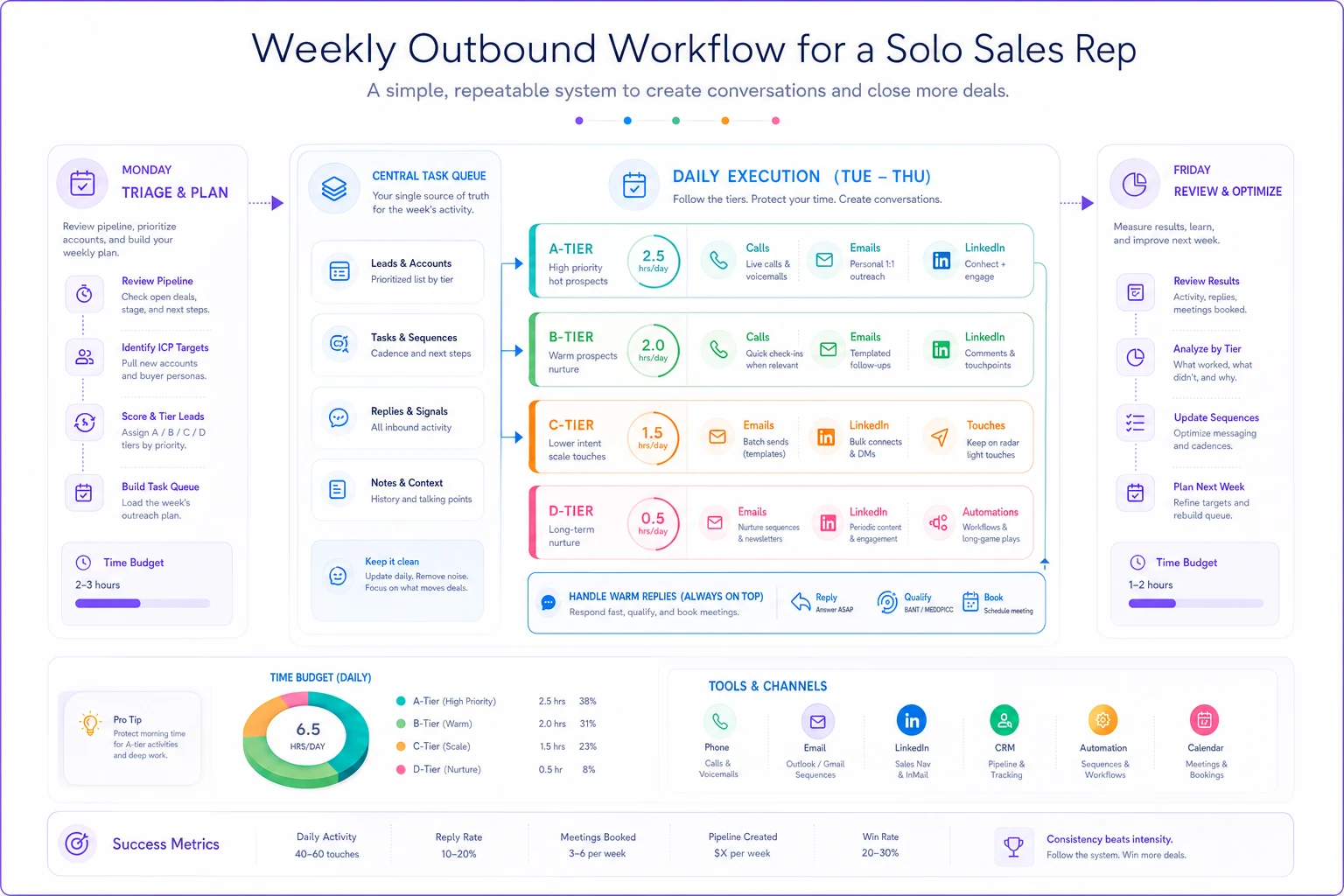
This diagram shows the weekly rhythm: triage, daily execution, review.
If you want a deeper look at compressing the handoff between a warm lead and real action, the breakdown in how small sales teams cut lead-to-activation time with a task-orchestration playbook pairs well with this cadence approach.
Where light automation earns its keep
For a solo rep, the automation question isn't "should I automate outbound?" — it's "which parts can run without me so my hours go toward A-tier?"
-
D-tier and stale C-tier nurture. These don't deserve manual time. A simple drip keeps them warm enough until they re-engage, at which point they surface back into your triage.
-
Follow-up reminders. The bump on day 3, the second touch on day 7 — you shouldn't be tracking these manually across 200 contacts. Let the system queue them; you decide whether to send.
-
Tier re-scoring. When a contact opens three emails or clicks a link, they should quietly move up your priority list so Monday triage catches them.
What should not be automated is anything A-tier. The moment a real prospect gets an auto-sequence with fake personalization, you've traded a relationship for a few saved minutes. There's a good discussion of where that line sits in automating recurring check-ins without burning customers — the throttling logic there applies just as much to outbound cadence as it does to CS check-ins.
The principle is simple: automate the low-value edges so your scarce human time concentrates on the contacts where a real reply actually changes your quarter.
When this lean model makes sense — and when it doesn't
When it fits:
-
You're one or two people covering more contacts than you can personalize individually.
-
Your deals have enough value that A-tier attention pays off, but enough volume that you can't treat everyone as A-tier.
-
You keep starting sequences and abandoning them mid-way.
When it's the wrong approach:
-
You have a real SDR team with capacity to run genuine multi-channel on everyone. Time-budgeting is a scarcity tool; if you're not scarce, it under-uses your people.
-
Your motion is pure high-touch enterprise with 20 accounts. There, everyone is A-tier and the tiering adds nothing.
-
Your list is tiny — under 50 active contacts or so. Just personalize everything. The overhead of the system isn't worth it yet.
Who should skip this entirely: reps whose whole book is inbound. If leads come to you warm, your problem is speed-to-response, not outbound reach allocation. Different playbook entirely.
A real scenario
A two-person sales team at a small B2B software company was carrying roughly 480 active contacts between them. Both were trying to personalize every touch, and both were falling behind — open sequences everywhere, follow-ups slipping past two weeks, and an honest feeling that the good prospects weren't getting the attention the cold ones somehow were.
They switched to tiered time budgets. About 40 contacts landed in A-tier, around 120 in B, the rest split between C and auto-nurture. Calls got reserved for A only. B and C moved to seven templates with a single personalized line each.
Nothing changed overnight. But within about six weeks, reply rates on the B-tier emails improved noticeably — partly because they were finally consistent, not because the copy was better. More telling: the reps stopped losing warm replies in the pile. The "someone asked a question three days ago and I never answered" problem basically disappeared, because warm-first became the daily rule. Meeting volume climbed somewhere in the 15–20% range over the quarter, and both reps described the work as calmer — which honestly matters a lot when it's just two people trying to hold the whole thing together.
Solo and small-team outbound doesn't fail because reps aren't trying hard enough. It fails because effort has no budget, so it drifts toward whatever's easiest to touch. A cadence built on per-contact time budgets, a clear channel priority, and a handful of reusable templates fixes that drift — not by adding more work, but by deciding in advance where your limited hours are allowed to go.
Start with the Monday triage. That single weekly re-sort does more to protect your quarter than any new template or channel ever will. Everything else is just execution once the priorities are set.
Ready to transform your customer relationships?
Join 2,000+ businesses using Rellyly to increase sales, improve client retention, and simplify CRM workflows.