



Most revenue teams don't have an experimentation problem. They have a governance problem dressed up as one.
You can spot the difference pretty fast. When teams say "we should test more," the ideas are usually flowing fine — sales wants to try a new discovery framework, CS wants to test a different onboarding cadence, marketing wants to swap the trial length. What's missing isn't ideas. It's a way to decide which experiments deserve traffic, how much of your customer base each one gets to touch, and who inherits the answer when the test finishes.
That's what governance actually means here. Not slowing things down — making sure the experiments you run don't collide, don't burn the same accounts twice, and don't produce a "result" nobody can act on because three teams interpreted it three different ways.
This is the part that breaks quietly. A single team running five tests is manageable. Three teams running fifteen tests against overlapping segments, with no shared budget for how many customers can be in flux at once — that's where the wheels come off. And it rarely shows up as a dramatic failure. It shows up as experiments that never conclude, wins nobody trusts, and the same idea getting "tested" three separate times across eighteen months because the first learning never made it into anyone's playbook.
Here's how the whole thing works when it's built right, and where it tends to snap when it isn't.
The collision problem nobody budgets for
There's a pattern that shows up constantly once a company has more than one revenue-facing team running tests.
Sales launches an experiment on outbound sequencing targeting mid-market accounts in a specific vertical. Same month, CS runs a proactive-outreach test aimed at "at-risk" accounts — and a chunk of those at-risk accounts happen to sit in that same mid-market vertical. Now a subset of customers is getting hit by two experimental treatments at once. When either test shows movement, you can't tell which change caused it. Worse, the customer experience got noisier for no reason anyone planned.
Nobody did anything wrong. Each team scoped a reasonable test. The failure is that no one owned the question: how much of our customer base is allowed to be in an experiment at any given time, and who's already touching these accounts?
The root cause is almost always the same — experiments are tracked at the team level, not the account level. Sales knows what sales is testing. CS knows what CS is testing. Nobody holds the map of which specific accounts are currently enrolled in something.
Sample-budgeting: treat customers as a scarce test resource
The mental shift that makes governance work: you have a limited amount of "customer exposure" to spend on experiments each quarter, and every test draws that budget down.
Never miss a customer touchpoint again.
Rellyly helps you manage contacts, tasks, and sales efficiently in one platform.
- Unified customer profiles
- Automated follow-ups
- Sales pipeline tracking
No credit card required
If you have 800 active accounts, you can't have 40% of them sitting in experimental treatments. Not because the math forbids it, but because at that point your baseline stops being a baseline. Everything is an experiment, so nothing is a control. Your reps and CSMs also lose the ability to give customers a consistent experience when half their book is on some variant.
-
Set a quarterly exposure cap. Decide the maximum share of accounts — and separately, the max share of new pipeline — that can be enrolled in experiments at once. A lot of teams land somewhere around 15–25% of accounts as a working ceiling.
-
Assign a cost per experiment. A test touching 60 accounts draws more budget than one touching 15. Big, high-risk tests should be rarer.
-
Reserve headroom for time-sensitive work. If CS is mid-quarter on a churn-remediation test, that reservation stays locked so a sales experiment can't quietly poach those accounts.
-
Force a check against the account map before launch. Any new test has to confirm its target accounts aren't already enrolled elsewhere.
-
Release budget when tests conclude. Exposure frees up when a test formally ends and hands off its learning — not when someone forgets about it.
The subtle mistake is treating sample size purely as a statistics question — "do we have enough accounts to hit significance?" That matters, and there's a whole discipline around it worth reading in a dedicated revenue experimentation playbook covering hypothesis pipelines and sample-size rules. But sample budgeting is a different lens. It's not "how many accounts do I need," it's "how many accounts can the business afford to have in a weird state right now." Those two questions pull in opposite directions, and governance is where you reconcile them.
A cross-team prioritization rubric that actually settles arguments
Once you accept that experiments spend a shared budget, you need a fair way to decide whose test gets funded when there's contention. Otherwise the loudest team wins, or whoever launched first grabs the accounts.
A prioritization rubric works best when it scores on a small number of things everyone can see:
| Factor | What you're really asking | Weight (example) |
|---|---|---|
| Revenue impact if it works | How much ARR or retention does this move, realistically? | High |
| Confidence in the hypothesis | Is this a hunch or backed by real signal? | Medium |
| Reversibility | If it goes badly, how fast can we undo it? | High |
| Account exposure required | How much of the sample budget does it consume? | Medium |
| Learning value | Even if it fails, do we learn something reusable? | Medium |
| Effort to run cleanly | Instrumentation, coordination, rep time | Low–Medium |
The point of scoring isn't precision. It's making the tradeoffs visible. A test with huge upside but low reversibility should get more scrutiny than a small, easily-undone tweak — even if both look "high revenue" on paper. The rubric forces that conversation to happen out loud instead of in a Slack thread.
One thing worth calling out: teams consistently over-weight "revenue impact" and under-weight "reversibility." They fund the exciting test, it disrupts 70 accounts, and there's no clean way to walk it back when early numbers go sideways. Reversibility deserves more weight than most teams give it, especially in CS-facing experiments where the "treatment" is something you said to a customer that you can't unsay.
Risk assessment: what could this test actually cost you
Every experiment has a downside, and most teams only think about the obvious one — the test flops and you learn nothing. The bigger risks are the ones that leak into the business quietly.
-
Customer-experience risk. Does the variant create confusion, inconsistency, or an experience you'd be embarrassed to explain if a customer asked why you did this to their account?
-
Revenue risk. Could the treatment plausibly reduce conversion or accelerate churn in the test group? What's the worst realistic case if you're wrong?
-
Attribution risk. Is this test tangled up with another one running on the same accounts? If so, you can't cleanly credit the result.
-
Operational risk. Does running this cleanly require reps to remember extra manual steps? If it does, the test data will be dirty — people will forget, apply the wrong treatment, or slip.
That last one is underrated. A test that depends on humans reliably doing something extra, every time, across dozens of accounts, is already compromised. In practice this usually happens when the experiment design ignores how stretched the front line actually is. The cleanest experiments are the ones where the treatment is baked into the workflow, not bolted onto it as an afterthought.
A useful rule: if a test's operational risk is high, either simplify it until reps can't get it wrong, or don't run it. A dirty experiment is worse than no experiment, because it produces a confident-looking answer built on bad data.
Shared instrumentation: everyone measures the same thing, the same way
This is where a lot of governance efforts fall apart. Two teams run tests, both declare success, and their definitions of "success" don't line up. Sales counts a win as a booked meeting. CS counts it as a retained account 90 days out. Neither is wrong, but you can't stack those learnings on top of each other, and leadership ends up with two dashboards that disagree.
-
The core metrics every experiment reports on, even if it also tracks test-specific ones
-
The measurement window — you'd be surprised how often two teams "measured for a month" but one meant calendar month and the other meant 30 days from enrollment
-
How the control group is defined and protected
-
Where the raw data lives, so results aren't trapped in someone's private spreadsheet
The pattern that kills learning is fragmented tracking. One test lives in a marketing tool, another in a CRM report someone built, a third in a Notion doc a CSM maintains. When the quarter ends, nobody can compare them, and the org quietly relearns the same lessons it already paid for. Centralizing where experiments are logged and measured is the single highest-leverage governance move — and it's mostly boring plumbing, which is exactly why teams skip it.
This is also where thoughtful automation earns its place. Not to run experiments for you, but to keep the instrumentation honest — automatically tagging which accounts are enrolled in what, flagging when two tests overlap the same account, surfacing when a measurement window has closed so a test doesn't just drift. Deciding which coordination tasks should be automated versus kept in human hands is its own discipline; there's a solid breakdown of that in this piece on what to automate and what to keep human in customer success. The general principle holds: automate the tracking and collision detection, keep the judgment calls human.
The learning-handoff protocol: where most of the value actually leaks
Almost nobody builds this step, and it's where the ROI of experimentation quietly disappears.
A test finishes. It produced a real answer — say, a shorter onboarding sequence retained a few more points of early-stage accounts. And then... what? The CSM who ran it knows. Maybe their manager knows. Six months later a new hire runs a nearly identical test because the learning never became a standard.
-
Adopt — it worked, so it becomes the new default and gets written into the playbook everyone follows.
-
Kill — it didn't work, and you document why so nobody wastes budget re-running it.
-
Iterate — the signal was interesting but inconclusive, so it goes back into the pipeline with a refined hypothesis.
The handoff needs an owner and a destination. Owner = the person responsible for making sure the decision gets recorded and, if adopted, actually rolled into the team's real process. Destination = the single place your team looks to see what you've already learned and what's now standard practice.
A typical failure looks like this: a mid-market team runs eight experiments over two quarters. Five reach clear conclusions. But only one makes it into the actual playbook, because the other four "wins" lived in the heads of the reps who ran them. Two of those reps leave, and the learnings leave with them. The company paid full price for eight experiments and kept maybe 20% of the value.
Handoffs are how you stop paying for the same lesson twice.
A short real scenario
A roughly 20-person B2B software company had three teams running experiments — sales, onboarding, and CS renewals — with no shared view across any of them. On paper they were data-driven. In practice they were running around 12 tests a quarter and could point to almost nothing that had permanently changed how they worked.
Two problems dominated. First, overlap: they estimated something like a third of their active accounts were sitting in more than one experiment simultaneously, which made most results uninterpretable. Second, no handoff: concluded tests just stopped, with takeaways scattered across Slack threads and personal notes.
Here's a simple visual of the governance workflow the company adopted.
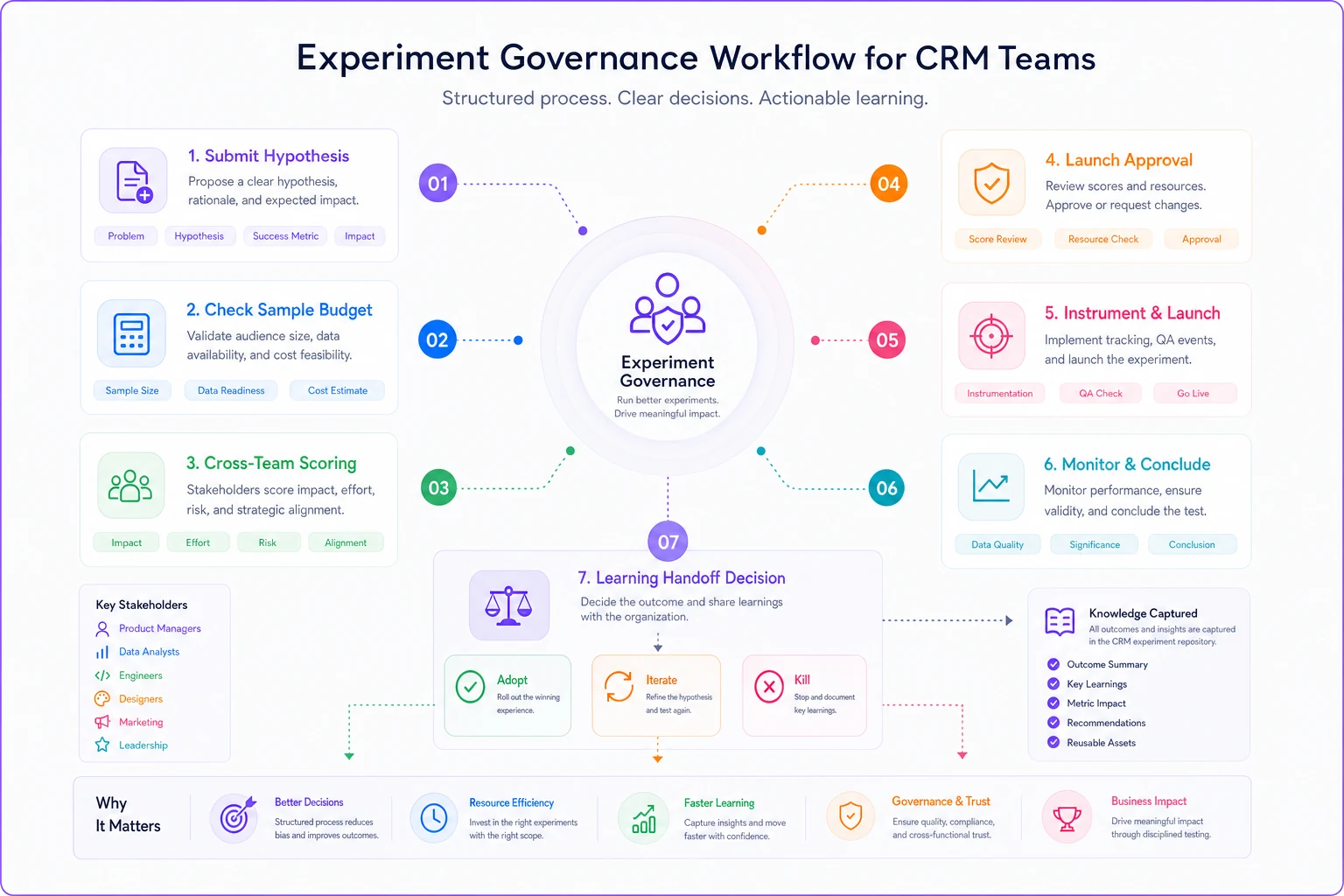
Over the next two quarters they actually ran fewer experiments — closer to seven or eight a quarter — but roughly two-thirds of them ended in a clear adopt/kill/iterate decision, versus almost none before. The onboarding team alone codified two changes that measurably improved early retention. Same team, fewer tests, dramatically more learning kept.
When this level of governance makes sense — and when it doesn't
This isn't for everyone. Over-governing a small operation is its own mistake.
When it makes sense:
-
You have two or more teams running experiments against an overlapping customer base
-
You've caught yourself re-testing something you're pretty sure you tested before
-
Experiments regularly "finish" without anyone being able to say what changed as a result
-
Leadership doesn't trust experiment results, so they quietly get ignored
When it's overkill:
-
You're a single team running two or three tests a quarter on clearly separate segments
-
Your account base is small enough that everyone already knows what's being tested
-
You haven't yet built the habit of running experiments at all — governance before you have a pipeline is just bureaucracy
Who should hold off entirely: early-stage teams still figuring out whether their core motion works. If you're pre-repeatable-process, you don't need experiment governance, you need a repeatable process. Governance is what you add once experimentation is real enough to trip over itself.
The framing that tends to help: governance isn't about control, it's about making sure the work compounds. Without it, every quarter starts mostly from scratch — same questions, same collisions, same lessons paid for and then lost. With it, the experimentation program actually gets smarter over time.
Pulling it together
The teams that get real compounding value from experimentation aren't the ones running the most tests. They're the ones who treat customer exposure as a budget, settle contention with a shared rubric instead of internal politics, assess the downside honestly before launching, measure everything the same way, and refuse to let a concluded experiment die without becoming a decision.
Everything upstream of the handoff is just setup. The prioritization, the sample-budgeting, the risk read, the shared instrumentation — all of it exists so that when a test finishes, you can actually keep what you learned. Skip the handoff, and you'll run a hundred experiments and grow no smarter. Get it right, and the rest of the system starts to justify itself.
Everything upstream of the handoff is just setup. The prioritization, the sample-budgeting, the risk read, the shared instrumentation — all of it exists so that when a test finishes, you can actually keep what you learned. Skip the handoff, and you'll run a hundred experiments and grow no smarter. Get it right, and the rest of the system starts to justify itself.
Ready to transform your customer relationships?
Join 2,000+ businesses using Rellyly to increase sales, improve client retention, and simplify CRM workflows.