


Margin doesn't usually leak in one big moment. It bleeds out quietly — a 12% discount here to hit quarter, a free onboarding thrown in to close by Friday, an extra 30 days of payment terms nobody logged. By the time finance runs the numbers three months later, the average deal in a segment has drifted 8–14 points below where it should sit, and nobody can point to a single decision that caused it. It was a hundred small ones.
That's the real problem a deal desk solves. Not "should we approve this discount," but "how do we make consistent pricing decisions fast enough that reps don't route around us." A deal desk operating model that works is less about gatekeeping and more about removing ambiguity so people stop improvising under deadline pressure.
Why margin leaks in the first place
Most companies don't have a discount problem. They have a decision-routing problem.
Here's the pattern. A rep gets a $60k deal that stalls at the end of the month. Buyer says budget is $48k. Rep pings their manager on Slack. Manager, who's carrying a quota too, says "yeah fine, do what you need to." Deal closes at $47k with an extra quarter of free support baked in verbally. None of it is documented in a way finance or the next renewal owner can see.
Multiply that across 40 reps and three quarters. Nobody was malicious. Every individual approval felt reasonable in the moment. But the aggregate is a book of business with wildly inconsistent pricing, phantom concessions that surface at renewal, and a CS team inheriting promises they never agreed to.
The root causes are almost always the same three things:
-
No clear authority thresholds. People don't know what they're allowed to approve alone, so they either over-escalate (slow) or under-escalate (risky).
-
Concessions live in people's heads and DMs. There's no record of what was given, why, and what the customer gave back.
-
No time pressure on the approvers. Deal desk becomes a black hole, so reps learn to skip it.
Fix those three and you've solved most of it. The rest is calibration.
The approval matrix: authority by ARR band, not by title
The single most useful artifact in a deal desk is a plain approval matrix that answers one question: who can say yes to this, and how fast?
Never miss a customer touchpoint again.
Rellyly helps you manage contacts, tasks, and sales efficiently in one platform.
- Unified customer profiles
- Automated follow-ups
- Sales pipeline tracking
No credit card required
The mistake most teams make is tying approval to seniority instead of deal size and discount depth. A VP shouldn't have to look at every $30k deal with a 10% discount — that's a rep-level decision. But a $200k deal at 25% off with non-standard payment terms shouldn't be approvable by a single manager under deadline, no matter how much they want it closed.
Here's a workable starting matrix. Adjust the bands to your actual ACV distribution.
| ARR band | Discount ≤10% | Discount 11–20% | Discount 21–30% | Discount >30% or non-standard terms |
|---|---|---|---|---|
| Under $25k | Rep | Manager | Deal desk | Deal desk + Finance |
| $25k–$75k | Manager | Deal desk | Deal desk + Finance | VP Sales + Finance |
| $75k–$150k | Deal desk | Deal desk + Finance | VP Sales + Finance | CRO + Finance |
| Over $150k | Deal desk + Finance | VP Sales + Finance | CRO + Finance | CRO + CFO |
Two things make this work that a lot of teams miss.
First, the highest-risk cell isn't the biggest discount — it's the "non-standard terms" column. A 15% discount is easy to model. Net-90 payment terms, a custom SLA, an uncapped liability clause, or an opt-out renewal is where the real hidden cost lives, because it doesn't show up in the discount field at all. Any deal touching legal or payment terms should jump a tier regardless of size.
Second, "deal desk" should appear as an actual approver, not a rubber stamp. Deal desk isn't a function that says no. It's a function that says "here's the version of this deal that protects margin — take it back to the buyer."
Templated concession requests: make the ask structured
When a rep needs a concession, the request should never be a free-text Slack message. A form that forces the right information every time speeds up approvals dramatically because approvers stop playing 20 questions.
A good concession request captures:
-
What's being asked — exact discount %, dollar impact, and any term changes.
-
Why — competitive pressure, budget gap, timing, multi-year commitment. Pick from a fixed list, not free text.
-
What we get back — this is the part everyone skips. Every concession should have a trade. Longer term, case study rights, upfront annual payment, expansion commitment, a reference call.
-
Effective margin after — calculated, not guessed.
-
Precedent flag — is this a one-off or will the buyer's peers expect the same next quarter?
The "what we get back" field is where discipline lives. Teams that require a documented trade for every concession give away noticeably less over a year — not because the discounts are smaller individually, but because reps stop asking for concessions they can't justify. If you have to fill in "what we got in return" and the honest answer is "nothing," you tend not to submit the request at all.
Require the 'what we get back' field to be completed before a concession request is processed.
A typical example: a rep wants to drop a $90k deal to $76k to close in-quarter. Under a structured template, the approved version comes back as $82k with a two-year term and upfront annual payment. The buyer still feels they won, effective margin is protected, and the trade is documented so the renewal owner knows exactly why the price is what it is.
SLA windows: the part everyone forgets
An approval matrix with no clock attached is where deal desks go to die. If reps can't predict when they'll get an answer, they'll route around the process during crunch time — and crunch time is exactly when margin discipline matters most.
-
Rep/Manager-level approvals same day, ideally within 2 hours.
-
Deal desk review within 4 business hours.
-
Deal desk + Finance within one business day.
-
Executive-level (VP/CRO/CFO) within one business day, with an escalation path if the exec is traveling.
The escalation path matters more than the SLA number. What kills deals isn't a one-day review — it's the CRO being on a flight while a $150k deal sits waiting. Every high-tier approval needs a named backup who can act. If you've built out an incident escalation runbook for high-value customers before, the logic is identical: define the trigger, the primary owner, the backup, and the maximum wait before it jumps a level.
Here's a simple visualization of the approval flow and SLA windows.
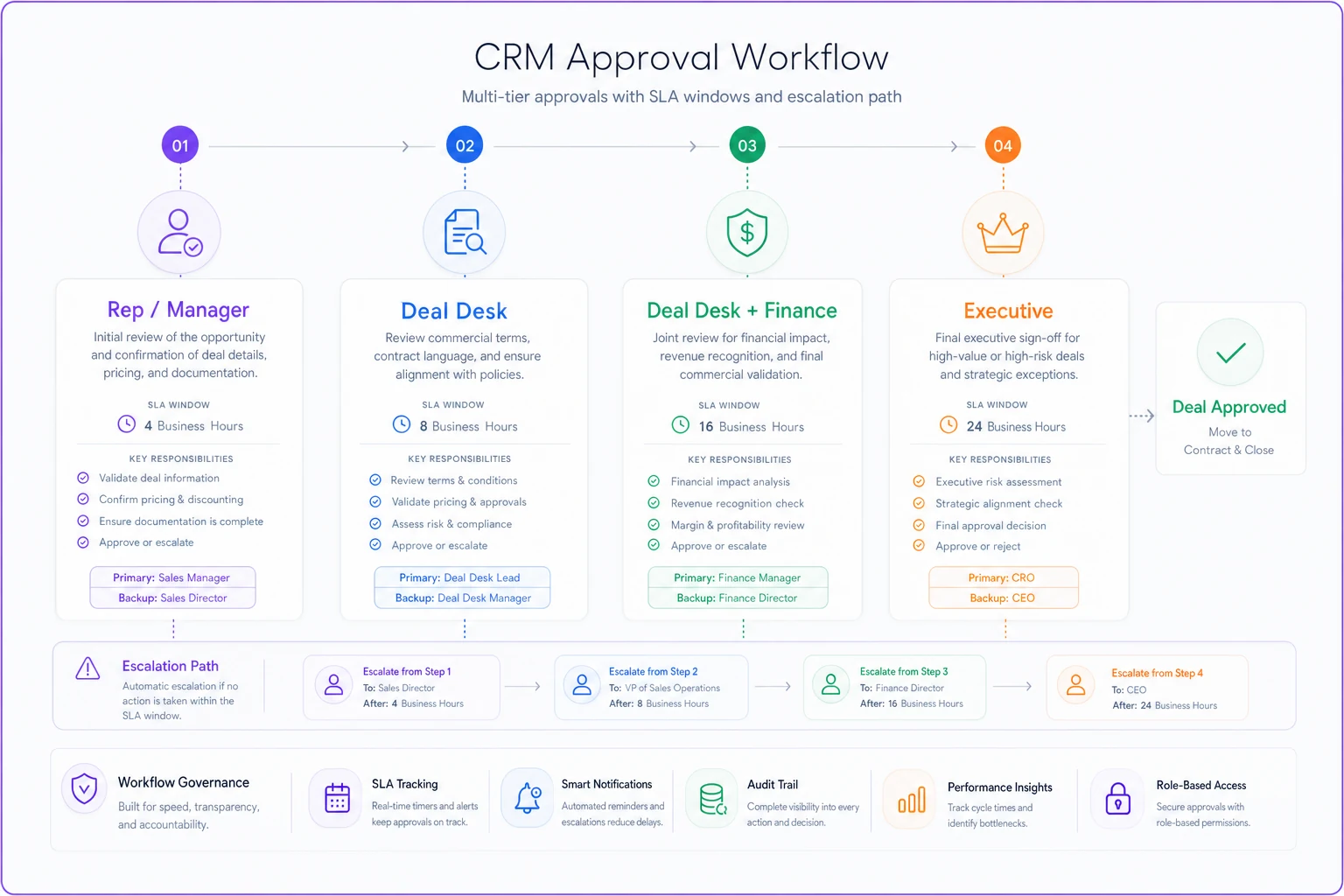
One pattern worth stealing: post approval SLAs publicly to the sales team, and report on how the desk performs against them each month. When reps trust that the desk is fast, adoption stops being a fight. When the desk misses its own windows, that's your leading indicator the process is about to get bypassed.
The audit trail: where this pays off later
Everything above only holds value if it's recorded in a way someone can reconstruct months later. The audit trail isn't bureaucracy — it's what saves the renewal.
A usable deal record should let anyone answer, in under two minutes:
-
What list price did we start from?
-
What was the final approved price and who approved it?
-
What concessions were granted, and what did we get in return?
-
Were there any non-standard terms, and where do they live in the contract?
-
Is this pricing a precedent, or was it explicitly marked one-off?
Here's why this matters concretely. A CS lead picks up a renewal 11 months later. The account is paying 22% under list. Without an audit trail, they assume that's the "real" price and renew flat — locking in the discount forever. With one, they can see it was a one-time competitive concession tied to a two-year term that's now expiring, which means the renewal is a legitimate opportunity to bring pricing back toward standard.
This connects directly to how renewals get run. If you've set up a proper renewal operating model with concession guardrails, the deal desk audit trail is the input that feeds it. The concession someone approved during the original sale is the exact thing the renewal owner needs visibility into. Break that chain and you re-give the same discount every cycle without realizing it.
A real scenario
A mid-market B2B software company — roughly 30 reps — kept hitting number but watched gross margin slide about 9 points over three quarters. Discounting was technically "within policy." The problem was that policy lived in a PDF nobody opened, and approvals happened over Slack with no record.
They rebuilt around three changes: an ARR-banded approval matrix reps could actually reference, a required concession template with a mandatory "what we get in return" field, and a 4-hour deal desk SLA with a named backup approver.
First quarter after the change, average discount depth dropped from around 18% to roughly 12–13%. Not because deals got harder to close, but because reps stopped asking for concessions they couldn't justify, and the desk started sending back margin-protected versions with trades attached. Cycle time didn't get worse; some reps said it actually improved because they stopped guessing what would get approved. The bigger win showed up at renewal — the CS team could finally see which discounts were one-offs versus permanent, and clawed back several points of margin on accounts that had been renewing flat on old concessions for years.
When a formal deal desk makes sense (and when it doesn't)
This isn't a system every company needs on day one.
It makes sense when:
-
You have more than a handful of reps making pricing decisions independently.
-
Discount depth or terms vary widely for similar-sized deals.
-
Margin is drifting and you can't attribute it to specific decisions.
-
Renewals keep inheriting concessions nobody remembers granting.
It's overkill when:
-
You have three reps and pricing is basically standard. A matrix here is overhead that slows you down for no reason.
-
Your ACV is tiny and uniform — the cost of reviewing exceeds the margin at stake.
-
Leadership isn't willing to enforce the SLAs. A deal desk nobody trusts to be fast is worse than none, because it trains reps to hide deals.
Early-stage teams still figuring out what their pricing even is shouldn't be building this yet. If you don't have a stable list price and a rough sense of your discount distribution, you need a pricing conversation first. Build the guardrails once there's something worth guarding.
Where this fits in the bigger picture
The deal desk doesn't live in isolation. It sits between the sales motion that creates the deal and the CS motion that has to live with it. A concession granted badly at close becomes a churn risk at month nine and a renewal fight at month eleven.
Tooling helps mostly by making the boring parts automatic — routing a concession request to the right approver based on ARR band, timestamping who approved what, flagging non-standard terms before they slip through, keeping the audit trail attached to the account so the renewal owner doesn't have to go digging. The point isn't the software. It's that the discipline holds even when it's quarter-end and everyone's tired and the buyer wants an answer in the next hour. That's the exact moment margin usually walks out the door, and a process that already has the rules baked in is what keeps it from leaving.
The point isn't the software. It's that the discipline holds even when it's quarter-end and everyone's tired and the buyer wants an answer in the next hour. That's the exact moment margin usually walks out the door, and a process that already has the rules baked in is what keeps it from leaving.
Ready to transform your customer relationships?
Join 2,000+ businesses using Rellyly to increase sales, improve client retention, and simplify CRM workflows.