

Most teams already have health scores, stage definitions, and some version of "SLAs" written down somewhere. And most of those teams still lose accounts to problems they technically had visibility into weeks earlier. The data was there. Nobody acted on it in time.
That gap — between knowing something is off and someone actually doing something — is what lifecycle observability is supposed to close. Not more charts. Not another color-coded scorecard. A system where a customer's signals trigger defined obligations, those obligations have owners, and when an owner misses the window, something escalates automatically instead of dying quietly in a Slack channel.
This is the part almost nobody builds well. So here's how the whole system connects, where it breaks as you scale, and what the enforcement layer actually looks like when it works.
Why "observability" is different from "reporting"
Reporting tells you what happened. Observability tells you what's happening while there's still time to change the outcome, and it ties that signal to an action with a deadline.
The distinction matters operationally. A health dashboard that shows an account dropped from green to yellow is reporting. A system that detects the drop, checks it against the account's segment SLA, assigns the CSM a 48-hour remediation task, and pings the manager if that task isn't touched — that's observability with teeth.
The pattern that shows up constantly: teams invest heavily in the measurement side (scores, signals, dashboards) and almost nothing in the enforcement side. So they end up with beautiful visibility into problems that still don't get solved. Measurement is the easy 40%. The enforcement runbook is the hard 60% nobody wants to build because it involves telling people they missed something. Lifecycle observability SLAs are mostly an accountability system wearing a data costume. If you're not prepared to enforce, you're just building nicer reports.
The three layers that have to connect
A working system has three layers, and the failures almost always happen at the seams between them, not inside any single layer.
Never miss a customer touchpoint again.
Rellyly helps you manage contacts, tasks, and sales efficiently in one platform.
- Unified customer profiles
- Automated follow-ups
- Sales pipeline tracking
No credit card required
Layer 1 — Telemetry (the signals). Product usage, support ticket volume and sentiment, login frequency, feature adoption depth, invoice/payment status, executive sponsor activity, NPS/CSAT responses. Raw inputs.
Layer 2 — Gates (the interpretation). This is where telemetry becomes a health state, and where a health state maps to an obligation. A gate isn't just "the account is yellow." A gate is "the account crossed a threshold that segment says requires action within X hours."
Layer 3 — Enforcement (the runbook). What happens when a gate trips, who owns it, what the deadline is, and what fires when the deadline passes.
Most teams have a decent Layer 1, a fuzzy Layer 2, and basically no Layer 3. And because Layer 2 is fuzzy, everyone argues about whether a gate "really" tripped instead of acting. If you've already put work into standardizing your stages and handoffs — like in a modular customer lifecycle framework that stops handoff chaos — this is the natural next layer to build on top of it.
Defining SLAs by segment (not one policy for everyone)
The single biggest mistake in this whole area: applying one SLA to every customer. A 48-hour response window makes sense for your top-tier accounts and is completely wasteful applied to a $90/month self-serve customer. Worse, when you apply the strict SLA to everyone, your team stops trusting it because it constantly cries wolf on accounts nobody should be manually touching. Segment first, then set obligations per segment. Here's a realistic structure:
| Segment | Health check cadence | Gate trip → response SLA | Escalation trigger | Owner |
|---|---|---|---|---|
| Strategic (top ~10% ARR) | Continuous / daily | 4 business hours | Missed SLA → CSM lead + AE, same day | Named CSM |
| Mid-market | Daily | 24 hours | Missed SLA → team lead, next business day | Named CSM |
| Growth / SMB | Weekly rollup | 48 hours | 2 missed gates in 30 days → pooled review | Pooled CSM |
| Self-serve / tech-touch | Weekly, automated | Automated sequence only | Payment failure or 3 red signals → human review | Nobody until escalated |
Notice the bottom row. For tech-touch accounts, the "owner" is deliberately nobody until a real threshold hits. That's not neglect — it's protecting your team's attention so the strategic-tier SLA actually gets honored. A system that treats every account as urgent produces a team that treats nothing as urgent.
One more thing on segment SLAs: define them in business hours, not calendar hours, and write down the exceptions before you need them. What happens over a holiday weekend? What happens when the CSM is out? If you don't answer that in advance, every edge case becomes an ad-hoc judgment call, and ad-hoc judgment calls are where enforcement quietly dies.
Building gates that don't false-alarm
A gate is a threshold plus a condition plus a consequence. The art is in the condition — the part that keeps the gate from firing on noise.
Bad gate: "Logins dropped." Fires constantly. Weekend dips, seasonal usage, one power user on vacation. Better gate: "Logins dropped more than 40% versus the account's own trailing 4-week average, AND the account has fewer than 2 active users this week, AND no support ticket explains the drop." Now you're catching a real disengagement pattern, not a Tuesday.
A few principles that separate gates people trust from gates people mute:
-
Compare accounts to themselves, not to a global average. A "low usage" account might just be a low-frequency-by-design customer that's perfectly healthy. Baseline against its own history.
-
Require corroboration for the expensive gates. Gates that trigger human action should usually need two or more signals to agree. Single-signal gates are fine for automated nudges, dangerous for escalations.
-
Separate leading gates from lagging gates. A drop in feature adoption is leading. A missed renewal date is lagging. Enforcement urgency should be highest on leading gates, because that's where you can still change the outcome.
-
Version your gate logic. When you change a threshold, log it. Otherwise you'll spend a quarter arguing about whether churn went up or whether you just moved the goalposts.
Version your gate logic.
If you've already built health scores, the governance discipline behind them — calibration windows, rollback plans, and knowing when a score change is real versus a measurement artifact — carries directly over here. The thinking in customer health‑score governance: calibration gates and SLA‑driven remediation is the same muscle you'll use to keep these gates honest.
The enforcement runbook: what happens when a gate fails
This is the section teams skip, and it's the entire point. A gate that trips with no defined next move is just a fancier notification.
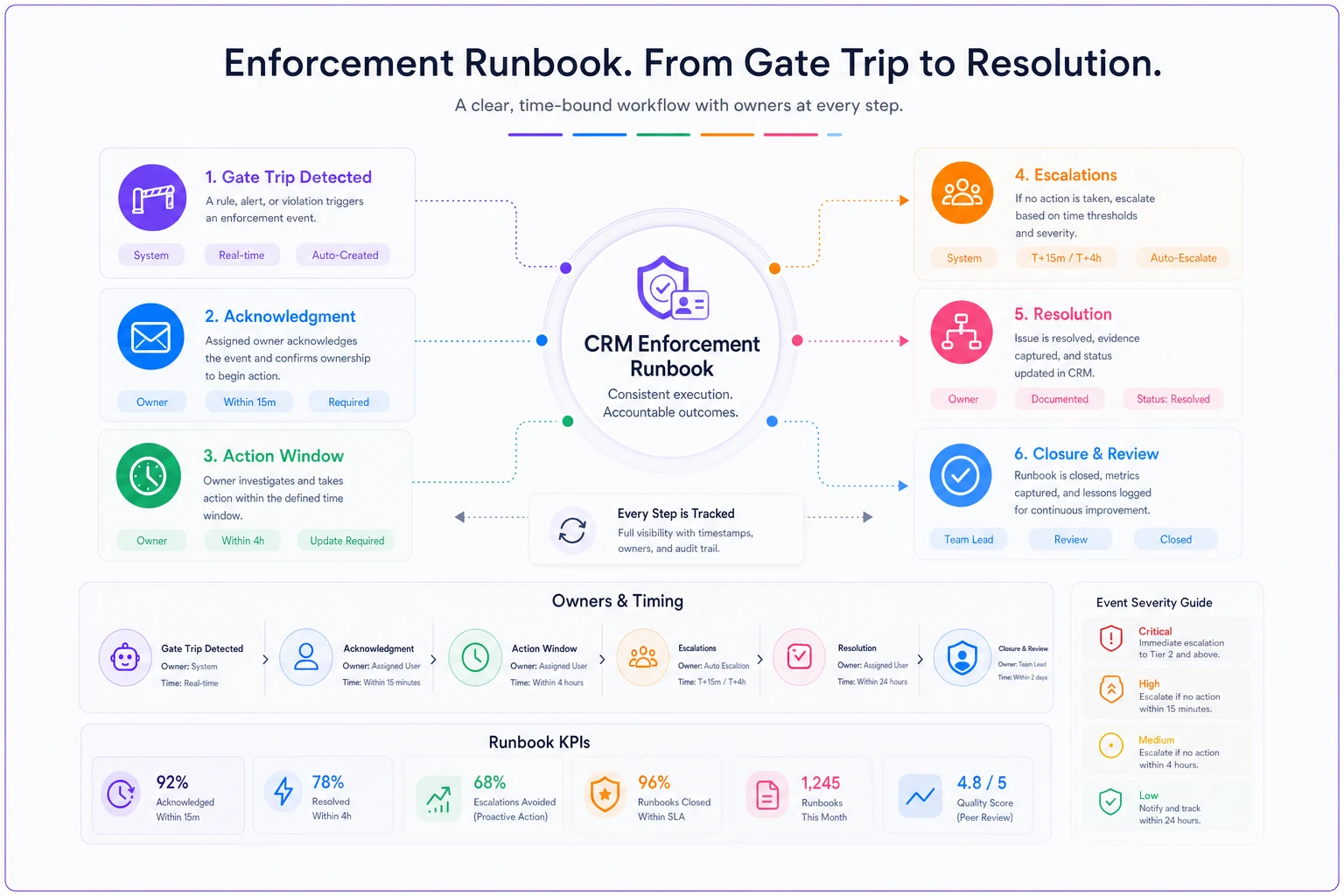
Here's a concrete enforcement flow for a strategic-tier account tripping a red usage gate:
A simple flow to visualize the enforcement runbook.
-
Gate trips. System creates a remediation task assigned to the named CSM, timestamped, with the triggering signals attached so they don't have to go digging.
-
Acknowledgment window (4 business hours). CSM must acknowledge — not resolve, just claim it. This one step catches most silent failures, because "I didn't see it" stops being a valid excuse.
-
Action window (next 2 business days). CSM logs a specific action: outreach sent, call booked, root cause identified. Vague notes like "monitoring" don't count and shouldn't be allowed to close the task.
-
First escalation (SLA missed at acknowledgment). If not acknowledged in 4 hours, the task auto-escalates to the CSM lead and the account's AE. Now two more people know.
-
Second escalation (action window missed). Manager is looped, the account gets flagged in the weekly at-risk review, and the gap becomes a coaching conversation, not just an account problem.
-
Resolution + logging. When the account recovers or the risk is formally accepted, the whole trail is recorded — trip time, acknowledgment time, action taken, outcome. That log is what makes your SLAs improvable instead of theoretical.
The escalation ladder is doing something subtle: it converts a customer risk into an internal accountability signal with each step up. That's intentional. Gates get ignored because ignoring them usually has no personal cost. Escalation adds the cost.
The owner-action templates
-
- Usage-drop gate → "Send the re-engagement note, pull the last 30 days of usage, book a 20-minute check-in."
-
- Support-sentiment gate → "Review the last 3 tickets, confirm resolution, call the sponsor if any ticket >48h open."
-
- Sponsor-gone-quiet gate → "Confirm the sponsor is still in role, identify a secondary contact, warm intro before renewal window."
-
- Payment/invoice gate → "Loop finance, confirm it's an admin issue not a satisfaction issue, don't assume."
These templates are the difference between a runbook and a wish. A CSM staring at a red account at 5pm on a Thursday will do the templated thing. They will not reliably improvise the right thing.
What breaks as you scale
At 20 accounts, none of this matters much — one person holds the whole map in their head. The system exists for what happens after that.
Around 50–150 accounts: The held-in-head model breaks. Signals get missed not because anyone's careless but because there's no shared definition of "at-risk," so two CSMs look at the same account and disagree. This is where you need Layer 2 gates written down, or every risk assessment becomes a personality-driven debate.
Around 200–500 accounts: Enforcement becomes the bottleneck. You have gates, they're tripping, but the volume exceeds what your team can manually chase. Teams either start ignoring the gates — which quietly kills the whole system — or they tighten segmentation and automate the acknowledgment and escalation layer so humans only touch what genuinely needs a human.
Past 500 accounts: The failure mode shifts to drift. Gate logic calibrated a year ago is now firing on the wrong things because the product changed, the customer base changed, and nobody re-tuned. Without a review cadence, your observability system slowly becomes a source of false confidence — arguably the most dangerous state, because leadership thinks it's covered.
Worth naming: teams tend to over-invest in more signals and under-invest in enforcement capacity. Adding a 12th telemetry input to a system where nobody responds to the existing 11 gates makes things worse. More signal into a broken enforcement layer just means more ignored alerts and more learned helplessness.
Where automation genuinely helps (and where it doesn't)
The manual version of this — someone eyeballing dashboards, remembering to assign follow-ups, chasing people who missed SLAs — collapses somewhere in the low hundreds of accounts. It just doesn't hold.
The parts that genuinely benefit from an AI-powered operational platform are the mechanical, high-volume, easy-to-forget steps: watching telemetry against per-account baselines continuously, creating and routing the remediation task the moment a gate trips, running the acknowledgment clock, and firing the escalation when a window is missed without anyone having to remember. That's the connective tissue between layers that humans do inconsistently and software does reliably.
What should stay human: the judgment inside the action window. Whether an account's quiet period is normal or ominous, what to actually say to a wobbling sponsor, whether to accept a risk or fight it. Automating the routing and enforcement while keeping the interpretation and outreach human is the balance that works. The mistake is inverting it — automating the customer-facing outreach while still manually chasing escalations. The former needs judgment; the latter just needs reliability.
Use automation to make sure nothing falls through the cracks, not to decide what to do about it.
A realistic before/after
A mid-market SaaS team managing roughly 280 accounts across three CSMs. They had health scores and a documented "we respond to at-risk accounts within 2 days" policy. In practice, nobody measured whether the 2 days was actually happening.
When they audited churned accounts from the previous quarter, the pattern was consistent: warning signals had been visible an average of around three weeks before cancellation, but the first real outreach — if it happened at all — came after the customer had already mentally checked out. The SLA existed only on paper.
They rebuilt around segment-specific gates and an enforcement ladder with mandatory acknowledgment. Nothing exotic — strategic tier got a 4-hour ack window, mid-market got 24 hours, and missed acks auto-escalated. The first month was ugly; escalations spiked because the team simply wasn't used to acknowledging things on a clock. By the second quarter it settled.
The outcome wasn't a dramatic churn miracle. It was quieter: at-risk accounts started getting a first touch in days instead of weeks, the "we didn't know" excuse basically disappeared because the acknowledgment timestamp was right there, and a handful of accounts that historically would've silently lapsed got caught while there was still room to turn them. Roughly a third of the previously-silent at-risk accounts got a real intervention that quarter that they wouldn't have received before. Fewer surprises, not zero churn — that's the realistic shape of the win.
When this is worth building — and when it isn't
Build it when: you're past the point where one person can hold every account's state in their head, you're losing accounts you had signals on, and your "SLAs" exist as policy but nobody can tell you your actual response times. That combination is the clear buy signal.
Skip or simplify it when: you have fewer than roughly 50 accounts and a tight team that genuinely talks daily. At that size, a heavy enforcement system creates more overhead than it saves — you'll be maintaining escalation logic for problems a hallway conversation already solves.
Who should not do this: teams that aren't willing to enforce. If leadership won't back the escalation ladder — if a missed SLA never actually turns into a conversation — don't build it. A runbook nobody enforces trains your team to ignore alerts, which leaves you worse off than having no system at all, because now you have false confidence and ignored signals.
The part most teams get wrong
The instinct is to treat lifecycle observability as a data problem — better signals, better scores, better dashboards. It's actually an accountability problem with a data component.
The teams that get real value aren't the ones with the most sophisticated health models. They're the ones who wired their gates to obligations, gave every obligation an owner and a clock, and made sure that missing the clock costs something. Signals are cheap. Dashboards are cheap. The scarce thing is a system where a customer's warning turns, reliably and on a deadline, into a specific person doing a specific thing — and where the whole chain is visible enough that you can actually improve it over time.
Build the enforcement layer first, keep the segments tight, and re-tune the gates before they drift. That's the whole game.
Ready to transform your customer relationships?
Join 2,000+ businesses using Rellyly to increase sales, improve client retention, and simplify CRM workflows.