

Your customer success manager just flagged an account as "healthy" three days before they churned. The scoring algorithm gave them an 82 out of 100. Product usage looked stable. Support tickets were minimal. The CSM had logged a positive check-in two weeks ago.
Then the cancellation email arrived.
This happens in every SaaS company. Not because the team is incompetent or the model is broken. It happens because health score governance gets treated like a set-it-and-forget-it metric instead of an operational system that needs constant calibration, clear decision gates, and rollback protocols when things go sideways.
The real problem isn't calculating health scores. Any decent analytics platform can aggregate usage data, support tickets, and engagement metrics into a number. The problem is building governance structures that make those scores reliable enough to actually drive decisions.
Why health scores become organizational fiction
Most companies build health scoring the same way: product team defines usage metrics, data team builds the model, CS team gets a dashboard, everyone moves on. Six months later the scores are meaningless but nobody wants to admit it because fixing them requires cross-functional alignment that nobody has bandwidth for.
The decay happens gradually. A product release changes user behavior. Your ICP shifts as you move upmarket. CSMs start gaming the metrics by logging activities that boost scores without improving actual customer health. Marketing launches a campaign that pulls in a completely different customer profile.
Each change makes the scores slightly less accurate. Enough changes and you're making retention decisions based on numbers that correlate with nothing.
A Series B company I worked with lost over $2M in ARR across eight months because their health scores kept accounts flagged as "stable" when those accounts were actively evaluating competitors. The model weighted product usage heavily — but these enterprise customers had shifted their core workflows to a competing platform while maintaining minimal usage for a few edge cases. Health score said green. The renewal conversation revealed they'd already signed elsewhere.
The calibration problem nobody talks about
Health score calibration isn't a quarterly meeting where you tweak some weightings. Real calibration requires operational infrastructure most teams never build.
Never miss a customer touchpoint again.
Rellyly helps you manage contacts, tasks, and sales efficiently in one platform.
- Unified customer profiles
- Automated follow-ups
- Sales pipeline tracking
No credit card required
Here's what actually needs to happen:
Prediction accuracy tracking Every health score makes an implicit prediction about renewal probability. An account scored 85 should renew at roughly an 85% rate. Most companies never track whether their scores actually predict outcomes — they just assume the correlation exists because the dashboard looks professional.
Cohort-based validation Different customer segments behave differently. Enterprise accounts show health differently than SMBs. Annual contracts signal differently than monthly. Your governance needs segment-specific calibration cycles, not universal adjustments applied across the board.
Temporal degradation monitoring Score accuracy degrades over time. The question isn't whether your model will become less accurate — it's how fast it's degrading and whether you'll notice before it costs you customers. Most teams discover degradation only after a string of surprise churns.
Signal contamination detection When CSMs know their performance is measured by health scores, they optimize for the metric instead of actual customer success. They'll log activities that boost scores. They'll avoid flagging concerns that might lower them. Your governance needs to detect when human behavior is polluting the signal.
Building calibration gates that actually work
Calibration gates are scheduled checkpoints where you validate score accuracy and make adjustments. Most companies run these as ad-hoc reviews when problems become obvious. That's too late.
Gate structure that works:
Weekly variance gates Every week, pull the 10 accounts with the largest score changes. For each one, the assigned CSM writes a one-paragraph explanation of what drove it. If they can't explain it, the scoring logic has disconnected from reality.
Monthly prediction gates Look at all accounts that churned or renewed in the past month. Compare their health scores from 30, 60, and 90 days prior to the event. Calculate prediction accuracy for each time horizon. If accuracy drops below 70%, trigger a calibration review.
Quarterly cohort gates Segment your customer base into behavioral cohorts. Calculate score distribution for each. If distributions look too similar across different cohorts, your scoring isn't capturing meaningful differences. If they're too different, you might need segment-specific models.
Annual methodology gates Once a year, rebuild your scoring methodology from scratch using the past year's data. Compare the new model's predictions to the existing model. If the new model performs significantly better, you've been operating with a degraded system.
Keep the monthly prediction gate process under 4 hours by automating cohort extraction and basic accuracy calculation.
This infrastructure pays for itself. A mid-market SaaS company I worked with implemented monthly prediction gates and caught a scoring error that had been quietly hiding around $800k in churn risk. The gates took their data team roughly four hours a month to run.
Rollback plans for when scores break
Every scoring adjustment is essentially a production deployment. You're changing the logic that drives operational decisions. Yet most teams treat scoring changes casually — adjust some weights, push to production, hope for the best.
When Facebook changes their newsfeed algorithm, they have rollback plans. Same discipline applies here.
Version control for scoring logic Every scoring formula should be versioned and stored — not just the weightings, but the complete logic including data sources, transformation rules, and aggregation methods. When something breaks, you need to rollback to a known-good state within hours, not days.
Parallel scoring periods Before deploying new scoring logic, run it in parallel with existing scoring for at least two weeks. Calculate both scores for every account. Flag accounts where they diverge significantly. Have CSMs validate which score better reflects reality.
Graduated rollouts Don't flip every account to new scoring simultaneously. Start with a 10% sample. Monitor for unexpected behaviors. Check if CSM interventions change. Validate that downstream systems handle the new scores correctly. Then expand to 25%, 50%, and 100%.
Automated rollback triggers Define clear conditions that trigger automatic rollback. If more than 20% of accounts see score changes greater than 30 points, rollback. If CSMs flag more than five "this doesn't make sense" cases in 48 hours, rollback. If downstream systems throw errors, rollback.
A subscription box company learned this the hard way. They adjusted their scoring to weight payment failures more heavily — reasonable given their business model — but didn't test the adjustment properly. The new logic flagged roughly 40% of their customer base as "at risk" overnight, overwhelming their CS team with false positives. They lost three days of productivity before rolling back, and several legitimate at-risk accounts slipped through during the chaos.
SLA-driven remediation gates
Health scores without action protocols are expensive decorations. You need service level agreements that define exactly what happens when scores cross specific thresholds.
Most teams build SLAs around absolute score values: "If score drops below 60, CSM must call within 48 hours." The problem is that assumes your scoring is calibrated perfectly and consistently. It never is.
Better SLAs focus on score changes and trajectories:
Velocity-based SLAs If an account's score drops more than 15 points in 7 days, trigger immediate CSM review. The absolute score matters less than the rate of change. An account dropping from 90 to 75 needs attention even if 75 technically reads as "healthy" on your scale.
Sustained decline SLAs If an account shows declining scores for three consecutive weeks, escalate to the CS manager. Small declines compound. A 3-point weekly drop doesn't feel urgent until week 8 when you've lost 24 points.
Segment-adjusted SLAs Enterprise accounts need different response times than SMBs. High-ARR customers get 4-hour response SLAs. Mid-market gets 24-hour. SMB gets 72-hour. But adjust these based on score velocity too — an SMB account in freefall might need faster response than a stable enterprise account.
Escalation gates
-
Hour 0–4
Automated email to CSM
-
Hour 4–24
CS manager notified if no action logged
-
Hour 24–48
Director of CS involved
-
Hour 48+
Executive sponsor engaged
These aren't just notification chains. Each escalation level needs defined actions and decision authority. The CSM might offer a training session. The CS manager can approve a service credit. The director can bring in the product team. The executive can negotiate contract modifications.
Decision tables that remove interpretation
The most common governance failure is ambiguous action protocols. A health score drops and the CSM has to interpret what to do — which leads to inconsistent responses, delayed interventions, and mental energy spent on decisions that should be automatic.
Build decision tables that remove interpretation:
| Score Change | Timeframe | Customer Segment | Required Action | Approval Needed | Success Metric |
|---|---|---|---|---|---|
| -20 points | 7 days | Enterprise | Executive Business Review within 72 hours | CS Director | Meeting scheduled |
| -15 points | 14 days | Mid-market | Success plan audit call | CS Manager | Plan updated |
| -10 points | 7 days | SMB | Automated email sequence + CSM follow-up | None | Engagement tracked |
| -25 points | Any | Any | Immediate escalation to CS Director | VP of CS | Intervention logged |
| Below 40 | Any | High ARR | Daily check-ins until stabilized | CS Director | Score improvement |
Every score change scenario should map to a specific action with clear ownership and success criteria. CSMs shouldn't be guessing.
That said, don't make the table so complex it becomes unusable. I've seen companies build 200-row decision matrices that CSMs ignore because finding the right row takes longer than just making a judgment call. Keep it under 20 rows. If you need more granularity, build segment-specific tables.
Runbooks for reliable signaling
Runbooks turn health score changes into predictable operations. When a score drops, the CSM shouldn't be crafting a response from scratch — they should be executing a proven playbook.
Here's what most runbooks miss:
Diagnostic sequences before intervention Don't immediately call the customer when their score drops. Run the diagnostic first:
-
Check for data quality issues (maybe usage tracking broke)
-
Review recent support tickets
-
Scan for billing or payment problems
-
Check if key contacts changed roles
-
Look for competitive mentions in call transcripts
Half the time, the score change has an obvious explanation that doesn't require customer intervention at all.
Graduated intervention paths Not every score drop warrants the same response intensity:
-
Gentle touch path
Automated email → CSM personal email → Check-in call
-
Standard path
CSM personal email → Call within 48 hours → Success plan review
-
Urgent path
Immediate CSM call → Executive alignment → Service recovery offer
The runbook should specify which path based on score velocity, customer segment, ARR, and renewal timeline.
Recovery verification loops After intervention, you need to verify the remedy worked. The runbook should specify when to check if the score stabilized, what improvement rate indicates a successful intervention, when to escalate if the intervention didn't work, and how long to maintain elevated monitoring.
An edtech company built runbooks without verification loops. CSMs would intervene, log the activity, and move on. Three months later they found that roughly 60% of interventions hadn't actually improved health scores. The CSMs were taking action — just not confirming impact.
Here's a visual of the runbook workflow.
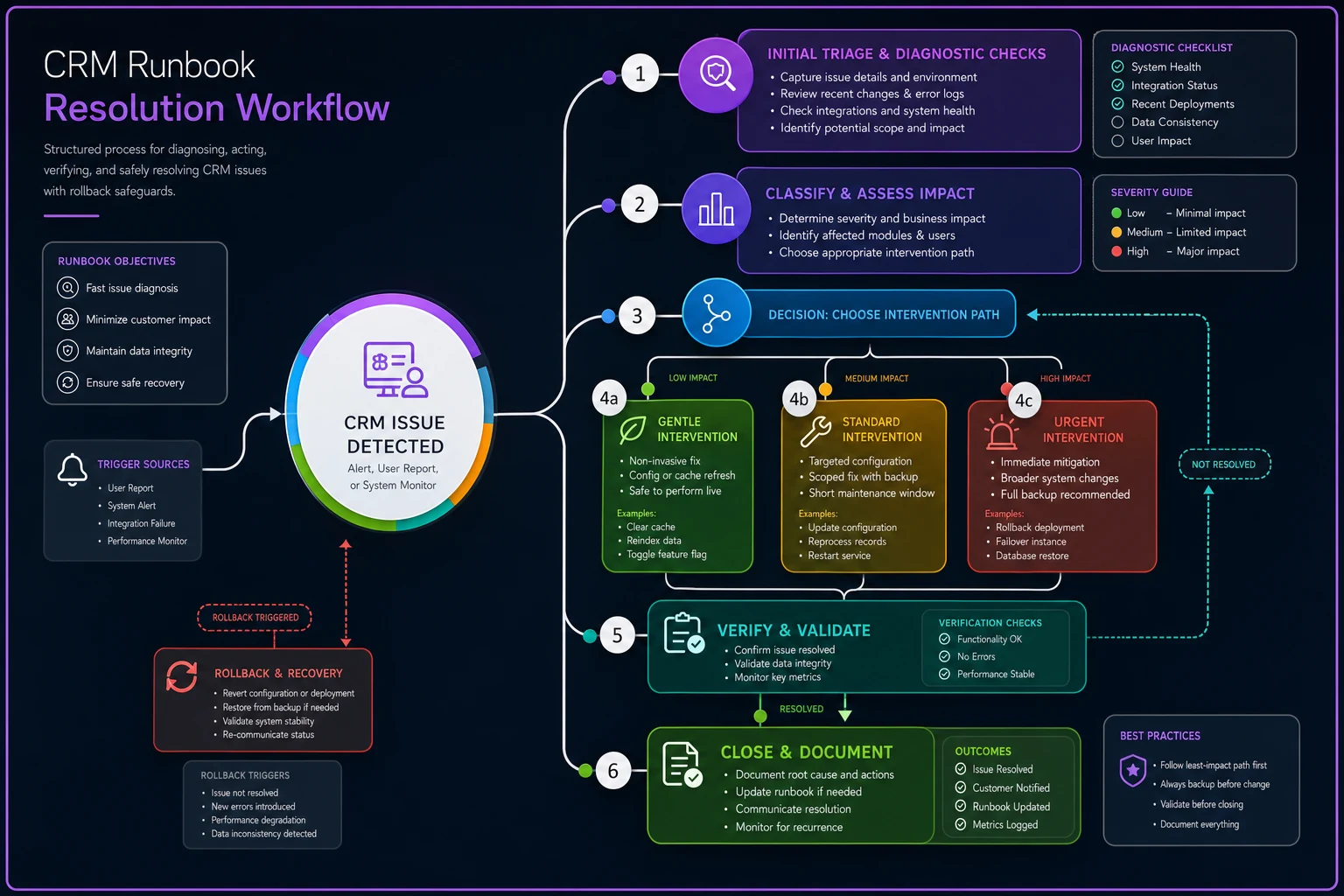
Use the diagram to align CSMs on the exact diagnostic and intervention order so everyone executes the same steps.
The operational reality of health score governance
When you implement proper governance, a few things shift pretty quickly.
Your CS team spends less time in emergency mode because problems get caught earlier. The weekly variance gates surface issues while they're still manageable. SLA-driven responses mean nobody's waiting for permission to act.
Your revenue team can actually trust renewal forecasts. When health scores have proven prediction accuracy, pipeline forecasts become reliable operational metrics rather than educated guesses. The CFO stops questioning every renewal projection.
Your product team gets better feedback loops. When health scores accurately reflect customer success, product decisions can be evaluated against real outcomes — not just usage metrics.
Clear decision tables mean fewer meetings debating what to do. Rollback plans mean less panic when an adjustment goes sideways. Escalation gates mean problems reach the right people at the right time.
The hidden complexity in multi-product scoring
Most health scoring systems break when customers use multiple products. Do you average the scores? Weight by revenue? Use the lowest score as a ceiling?
A marketing automation company found their health scores were quietly hiding risk in multi-product accounts. They averaged scores across products, so a customer doing great with email marketing but abandoning their SMS product still showed as "healthy." The renewal conversation revealed the customer viewed SMS as a failed investment and was questioning the entire relationship.
Multi-product governance needs:
Product-specific thresholds Core products need higher health thresholds than add-ons. If email marketing drops below 70, that's a problem. If social media scheduling drops below 70, that might be acceptable depending on the customer.
Cross-product correlation monitoring When one product's health drops, check whether others follow. Cascading declines indicate relationship issues, not just product issues.
Composite scoring rules
-
Lowest product score weights 40%
-
Revenue-weighted average weights 40%
-
Highest score weights 20%
This prevents one strong product from masking problems elsewhere while still reflecting overall success. The math matters less than having an explicit rule everyone follows consistently — ambiguity here is what creates blind spots.
When automation makes governance better (and when it doesn't)
The temptation is to automate everything. Auto-calculate scores, auto-trigger interventions, auto-escalate issues. But full automation in customer success often backfires.
Automate the mechanical parts:
-
Score calculation and distribution
-
SLA monitoring and alerts
-
Data quality checks
-
Report generation
-
Escalation notifications
Keep humans in the loop for:
-
Interpreting unusual patterns
-
Validating score adjustments
-
Choosing intervention strategies
-
Managing executive escalations
-
Adjusting governance rules
AI-powered operational software can handle the calculation complexity and pattern detection that overwhelms spreadsheets. It can monitor SLA compliance across hundreds of accounts simultaneously and flag statistical anomalies that humans would miss. That's genuinely useful — it's the difference between governance that runs in the background and governance that requires someone to babysit a spreadsheet every week.
But the governance decisions themselves — when to adjust scoring logic, how to handle edge cases, whether to override standard protocols — those still need human judgment. The best systems support human decision-making rather than replacing it.
Building governance that scales
Small CS teams often assume health score governance is a luxury for bigger companies. It's actually the opposite. When you have five CSMs managing 500 accounts, you can't afford to waste time on false signals or missed warnings.
Start with minimal viable governance:
-
One weekly variance check (30 minutes)
-
One monthly accuracy review (2 hours)
-
Five-row decision table
-
Three SLA thresholds
-
Basic rollback plan
This takes under four hours a month to maintain and prevents dozens of hours of crisis management.
As you scale, add complexity gradually — segment-specific calibration, more detailed runbooks, multi-product scoring, predictive modeling, automated remediation.
The governance infrastructure that works at 50 customers will break at 500. The system that works at 500 won't scale to 5,000. That's expected. Design for your current scale plus roughly 2x growth. Anything beyond that is premature optimization.
The governance investment that actually pays off
Most companies underinvest in health score governance because the ROI isn't obvious upfront. You're preventing problems that haven't happened yet. You're maintaining accuracy that's hard to measure directly. You're building infrastructure for decisions that seem to work fine on intuition.
Then a preventable churn happens. Or a string of them. Suddenly everyone wants better health scoring — but now you're in crisis mode, making hasty adjustments that might create new problems.
Build governance before you need it. The monthly calibration gates that seem excessive today will catch the scoring drift that would have hidden next quarter's churn. The rollback plans that seem paranoid will save you when an adjustment goes wrong. The decision tables that seem rigid will ensure consistent responses when your team is stretched thin.
Customer health score governance isn't about perfecting a metric. It's about building operational trust. When your team trusts the scores, they act decisively. When executives trust the predictions, they resource appropriately. When the organization trusts the governance, customer success becomes predictable rather than reactive. The companies that get this right don't have perfect health scores — they have scores that degrade gracefully, adjust systematically, and drive consistent action. That's the difference between a metric and an operational system, and in customer success, that distinction is what keeps customers from becoming former customers.
Ready to transform your customer relationships?
Join 2,000+ businesses using Rellyly to increase sales, improve client retention, and simplify CRM workflows.