



You know that moment when a hot prospect gets passed from SDR to AE to implementation, and suddenly they're asking why nobody remembers their requirements from three calls ago? That's not a communication problem. It's what happens when companies treat their customer lifecycle framework like a relay race instead of a coordinated operation.
Most revenue teams build their processes backwards. They start with individual playbooks—one for SDRs, another for account executives, maybe something for customer success if they're lucky—then wonder why customers feel like they're repeating themselves at every stage. The disconnection creates friction that shows up everywhere: deals take longer to close, implementation drags, and that promising expansion opportunity somehow falls through the cracks between teams.
Teams that actually accelerate time-to-value don't just document handoffs better. They build modular lifecycle systems where every stage has explicit operating rules, measurable exit criteria, and standardized information transfer protocols. The difference shows up in the metrics that matter—conversion rates improve, sales cycles compress, and customer satisfaction scores actually mean something.
Why traditional handoffs create operational chaos at scale
The handoff problem starts innocently enough. Your first few enterprise deals move through the pipeline based on relationships and informal check-ins. The AE walks the deal into implementation personally. Customer success joins calls when needed. Everything works because everyone knows everything about every customer.
Then you hit 20 deals per month and the informal system collapses. AEs forget to mention critical technical requirements. Implementation teams discover deal-breaking integration needs halfway through onboarding. Customer success inherits accounts with zero context about promised timelines or agreed-upon success metrics. Each team develops its own tracking system, creating information silos that make coordinated action nearly impossible.
The real damage happens in the gaps between stages. Marketing qualifies a lead based on firmographic data, but sales discovers the actual decision-maker isn't engaged. Sales closes a deal with specific promises, but implementation has no visibility into those commitments. Customer success identifies an upsell opportunity but can't access the original business case that would make the expansion obvious.
These gaps compound as deal volume increases. What worked at 10 customers per quarter breaks at 50. Response times stretch from hours to days. Customers get conflicting information from different teams. Revenue leaks through the cracks between departments, and nobody can pinpoint exactly where things went wrong because every team's data tells a different story.
The modular lifecycle approach that changes everything
A modular customer lifecycle framework treats each stage as a discrete operational unit with defined inputs, processes, and outputs. Instead of hoping teams communicate effectively, you build systematic information transfer protocols that ensure critical context moves forward automatically.
Never miss a customer touchpoint again.
Rellyly helps you manage contacts, tasks, and sales efficiently in one platform.
- Unified customer profiles
- Automated follow-ups
- Sales pipeline tracking
No credit card required
Start with stage definitions that actually reflect operational reality. Most companies use vague labels like "qualified" or "engaged" that mean different things to different teams. A modular approach defines stages based on specific customer actions and measurable criteria. "Technical Validation Complete" means the prospect has confirmed integration compatibility, identified their implementation team, and approved the security review—not just "they seem interested in moving forward."
Each module needs explicit entry and exit rules that remove ambiguity from transitions. Entry rules specify exactly what information must be present before a customer moves into a stage. Exit rules define the specific conditions that must be met before moving forward. These aren't suggestions or best practices—they're operational requirements enforced through your systems.
Consider how this works in practice. Before an opportunity moves from "Solution Validation" to "Commercial Negotiation," the system requires:
-
Technical requirements document completed and approved by prospect
-
Business case with specific ROI metrics documented
-
Decision-maker engagement score above threshold
-
Implementation timeline confirmed with customer's IT team
-
Success metrics defined and agreed upon
Without these elements, the opportunity literally cannot progress. This isn't bureaucracy—it's operational discipline that prevents downstream problems before they occur.
Building handoff templates that actually get used
Generic handoff templates fail because they try to capture everything instead of focusing on what matters for the next stage. A modular lifecycle framework uses stage-specific templates that extract exactly what the receiving team needs to be successful.
The SDR-to-AE handoff template might include:
-
Trigger event that created urgency
-
Current solution and specific pain points
-
Decision-making structure and key stakeholders
-
Timeline and budget indicators
-
Competitive context if mentioned
But the AE-to-Implementation handoff looks completely different:
-
Technical architecture and integration requirements
-
Data migration needs and volume estimates
-
User counts and deployment phases
-
Success metrics and measurement plan
-
Customer's internal project team structure
These templates work because they're not just forms to fill out—they're operational tools that embed directly into workflow. When an AE marks a deal as "Closed Won," the system automatically generates the implementation handoff template, pre-populates known information, and flags missing elements that need collection before kickoff.
Only include fields that change the receiving team's decisions—if it doesn't alter behavior, remove it.
The key is making templates actionable, not just informative. Each field should directly influence how the receiving team operates. If a field doesn't change behavior or decision-making, it doesn't belong in the template.
Decision matrices that remove politics from stage progression
The biggest source of handoff friction isn't poor communication—it's disagreement about readiness. Sales wants to move deals forward to hit quotas. Customer success wants to slow down to ensure proper onboarding. Without objective criteria, these conflicts become political battles that customers ultimately pay for.
A decision matrix removes subjectivity by defining specific conditions for stage progression. Instead of asking "Is this customer ready for implementation?" you evaluate concrete criteria:
Implementation Readiness Matrix:
| Criteria | Weight | Score | Threshold |
|---|---|---|---|
| Contract executed | 25% | Binary | Required |
| Technical validation complete | 20% | 0-10 | Minimum 7 |
| Implementation team identified | 15% | Binary | Required |
| Success metrics defined | 15% | 0-10 | Minimum 6 |
| Timeline agreed upon | 10% | Binary | Required |
| Training plan approved | 10% | 0-10 | Minimum 5 |
| Executive sponsor engaged | 5% | 0-10 | Minimum 8 |
Opportunities must hit an overall score of 80 with no required items missing to progress. These thresholds aren't arbitrary—they come from analyzing which factors actually predict successful implementations versus troubled ones.
The matrix evolves based on outcomes. If customers who score below 7 on technical validation consistently struggle during implementation, you raise the threshold. If executive sponsor engagement doesn't correlate with success, you reduce its weight or cut it entirely.
Cross-team coordination without endless meetings
Traditional lifecycle management relies on meetings to maintain alignment. Weekly pipeline reviews, daily standups, account planning sessions—the calendar fills with coordination overhead that doesn't directly serve customers. A modular framework reduces this through systematic information flow and triggered interactions.
Instead of scheduled check-ins, teams interact based on lifecycle events. When a customer hits specific milestones or warning signals, the system automatically assembles the right people with the right context. If usage drops 30% in week three of implementation, a rapid response protocol pulls in the AE who closed the deal, the implementation specialist, and the assigned CSM for a focused intervention.
Information flows continuously through the lifecycle modules, not just at handoff points. The implementation team can see sales conversations about technical requirements. Customer success can access the original business case during renewal discussions. Sales can monitor implementation progress to time expansion conversations appropriately. This visibility eliminates the constant "what's the status?" interruptions that plague revenue teams.
Here's a visual of the event-triggered coordination workflow.
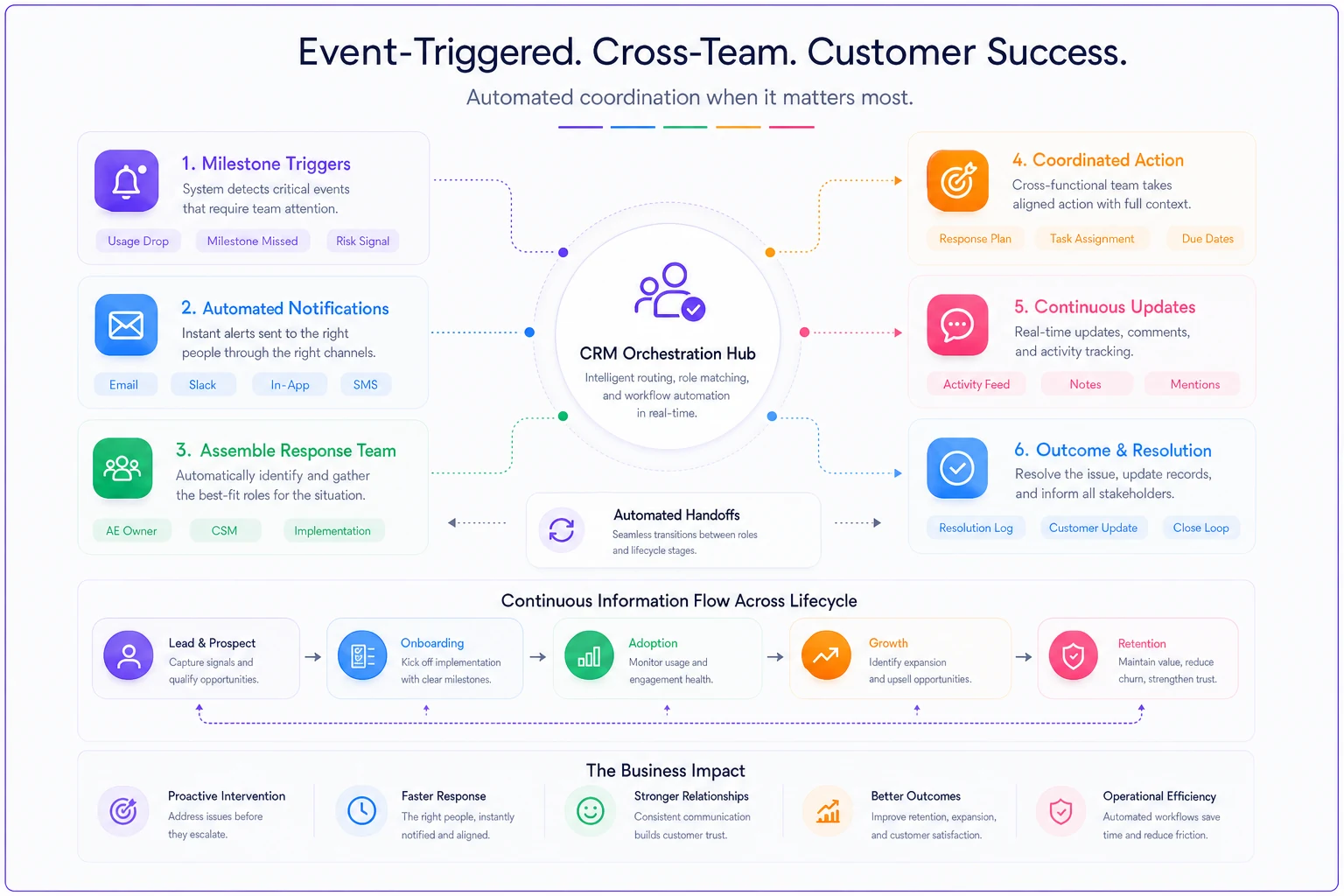
Coordination happens through workflow automation rather than manual effort. When implementation completes specific milestones, the CSM automatically receives updated success metrics to track. When usage patterns indicate expansion readiness, sales gets notified with relevant context about the customer's current state.
Measuring what matters at each lifecycle stage
Most companies track the same metrics across all lifecycle stages—conversion rates, time in stage, deal size. While these matter, they don't capture the operational health of your lifecycle system. Modular frameworks require stage-specific metrics that reflect actual operational performance.
During the qualification stage, measure information completeness, not just conversion. What percentage of opportunities have fully documented decision criteria before moving forward? How often do deals return to qualification because critical information was missed?
In the closing stage, track promise accuracy. How often do actual implementation requirements match what sales documented? What percentage of deals require scope changes within 30 days of signing? These metrics reveal whether your handoff protocols actually work.
Implementation needs different metrics entirely. Instead of just measuring time to go-live, track milestone predictability. How accurately can you forecast completion dates based on initial assessments? How often do implementations stall due to missing information from earlier stages?
Customer success metrics should connect back to initial expectations. Are customers achieving the success metrics defined during sales? How does time-to-value compare to what was promised? These measurements create accountability across the entire lifecycle.
Reducing friction through intelligent automation
The operational burden of maintaining a modular lifecycle framework can overwhelm teams if every rule requires manual enforcement. This is where AI-powered operational software turns a theoretical framework into something teams can actually sustain. Instead of requiring people to remember every rule and manually update every field, automation handles consistency while cutting administrative overhead.
Automated rule enforcement prevents deals from advancing without required information. Natural language processing can pull key details from call recordings and emails to populate handoff templates automatically. And over time, machine learning can identify patterns that predict stage success and surface optimizations to your decision matrices.
An AI-assisted platform might notice, for example, that deals with technical validation scores between 6 and 7 have a significantly higher rate of implementation delays. The system flags these automatically for additional technical review before allowing progression—catching problems before they become expensive.
Automation also enables dynamic lifecycle management. Instead of rigid stages every customer must follow identically, the system adapts based on customer characteristics. Enterprise deals might require additional security validation stages. SMB customers might skip certain technical reviews. The framework stays consistent while execution adapts to reality.
Where AI automation particularly earns its keep is information continuity. By automatically surfacing relevant historical context during customer interactions, teams operate with full visibility without digging through notes and CRM records manually. The CSM preparing for a quarterly business review instantly sees the original success criteria, implementation challenges, and every significant interaction across all teams.
When modular frameworks make sense (and when they don't)
Not every business needs a full modular lifecycle framework. If you're closing fewer than 10 deals per month with consistent customer profiles, the overhead might outweigh the benefits. Simple handoff documents and regular team meetings might honestly be enough.
The framework becomes critical when complexity multiplies. Multiple product lines, varied customer segments, distributed teams, or deal volumes above 30 per month create coordination challenges that informal systems can't handle. The investment in building modules and matrices pays off through reduced friction, faster cycles, and fewer dropped balls.
Companies in rapid growth mode benefit most. When you're doubling headcount and deal volume every year, you can't rely on tribal knowledge and relationships to maintain quality. The framework provides operational stability while everything else changes.
Avoid implementing a modular framework if your teams actively resist process. The system requires discipline and consistency to work. If teams routinely ignore existing processes or work around systems, adding more structure won't help. Fix the cultural issues first.
A real implementation that changed the game
A SaaS company selling marketing automation was stuck at $8M ARR with growing pains everywhere. Deals averaged 85 days to close. Implementation stretched to 60 days with a 22% failure rate. Annual churn sat at 18%, mostly from poor onboarding experiences.
They implemented a modular lifecycle framework with seven distinct stages, each with 5-8 exit criteria. The SDR-to-AE handoff included a required "champion identification" module documenting the internal advocate's influence and commitment level. The AE-to-Implementation handoff mandated technical architecture documentation and success metric agreement before the deal could progress.
The decision matrix for moving deals from "Proposal" to "Negotiation" required:
-
Technical validation score above 8
-
Business case ROI documented and validated by the customer
-
Implementation timeline agreed with customer's IT team
-
At least two stakeholders beyond the champion engaged
-
Competition eliminated or differentiation clearly established
Within two quarters, sales cycles compressed to 68 days as deals moved through stages more predictably. Implementation time dropped to 35 days with failure rates below 8%. Annual churn fell to 11% as customers reached value faster and more consistently.
The unexpected benefit was team satisfaction. Sales reps stopped chasing unqualified deals that would never close. Implementation teams received properly prepared customers instead of surprises. Customer success inherited accounts with clear success criteria instead of vague promises. The framework removed friction for employees as much as for customers.
Making the framework stick
Building a modular lifecycle framework is the easy part. Making it stick requires organizational commitment and continuous refinement. Start with a single high-impact handoff—usually between sales and implementation—and prove the value before expanding.
Document everything obsessively in the early stages. Which criteria actually predict success? Which handoff elements get used versus ignored? What information seems important but doesn't actually influence outcomes? This documentation becomes the foundation for optimization.
Assign clear ownership for each module. Someone must be accountable for maintaining entry and exit criteria, updating templates, and monitoring performance. Without ownership, frameworks decay into outdated documents that teams route around.
Review and refine quarterly. Analyze which stage transitions create the most friction. Identify which criteria need adjustment based on actual outcomes. Remove elements that don't influence success. Add new requirements as you discover gaps.
Most importantly, tie the framework to systems that teams use daily. If the lifecycle rules live in a document while work happens in your CRM, the framework fails. The rules must be embedded in the tools where work actually happens.
Building your own modular lifecycle system
Start by mapping your current state honestly. Document how customers actually move through your organization today, not how you wish they moved. Identify every handoff point, information transfer, and decision gate. Note where friction consistently emerges.
Define your stages based on customer milestones, not internal activities. "Proposal Sent" is an internal activity. "Solution Validated" is a customer milestone. Stages should reflect meaningful progression in the customer's journey toward value.
Start with 5-7 stages maximum. You can add complexity later, but beginning with too many stages creates confusion and resistance. Each stage should represent a significant shift in the customer relationship that requires different skills, activities, or teams.
For each stage, define:
-
Entry criteria—what must be true to enter this stage
-
Key activities—what happens during this stage
-
Exit criteria—what must be complete to progress
-
Handoff requirements—what information transfers forward
-
Fallback triggers—what causes regression to previous stages
Build templates that focus on actionability. Every field should answer a question the receiving team needs answered to do their job effectively. Test templates with actual teams and remove anything that doesn't influence behavior.
Create decision matrices for contentious transitions. If teams regularly disagree about when to move customers forward, you need objective criteria. Weight factors based on their actual correlation with success, not opinions about what should matter.
The modular lifecycle framework isn't just another process document. It's an operational system that transforms how revenue teams work together. By creating clear stages, explicit rules, and systematic handoffs, you remove the ambiguity that creates friction and delays value delivery.
This isn't about adding bureaucracy or slowing things down. It's about building predictable, scalable revenue operations that deliver consistent customer experiences regardless of who's involved or how fast you're growing. The companies that win in complex B2B sales aren't necessarily the ones with the best product or the smartest salespeople—they're the ones with operational systems that ensure every customer moves smoothly from interest to value. That's what a modular customer lifecycle framework actually delivers.
Ready to transform your customer relationships?
Join 2,000+ businesses using Rellyly to increase sales, improve client retention, and simplify CRM workflows.