

Most CRM rollouts don't fail because the software is bad. They fail because the org treats adoption as a launch event instead of an operating discipline. You buy the tool, run a two-hour training, send a Slack announcement, and then six weeks later the VP of Sales is staring at a pipeline report that's obviously wrong and asking why nobody logged their calls.
Adoption is a workflow problem sitting on top of an incentive problem sitting on top of a training problem. Fix one and ignore the other two, and you get exactly what you had before — reps working out of their inbox and a spreadsheet, CSMs keeping notes in their heads, and leadership making decisions on data that's roughly 60% complete.
This is the system-level view of how CRM adoption actually holds together, where it breaks as you scale, and how the pieces — training, incentives, pilots, enforcement gates, remediation — connect into something that survives past the honeymoon period.
Why adoption decays instead of failing outright
Adoption almost never collapses all at once. It erodes. Week one everyone's excited, logging everything. By week four, the top two reps — the ones who close and therefore have the most political capital — quietly stop updating stages because they're "too busy selling." Everyone watches. If the top performers can skip it, the norm resets for the whole team.
That's the pattern that matters: adoption is enforced socially before it's ever enforced by a system. The behavior of your highest-status people sets the floor. If you don't account for that in the rollout, no amount of training fixes it.
There's a second decay path that's quieter and more dangerous. The CRM gets used, but inconsistently. One rep logs a "demo" as a meeting, another logs it as a stage change, a third puts it in the notes field. Everyone feelsproductive. But the data underneath is now unusable for forecasting, and you won't notice until quarter-end. This is where a shaky foundation shows up — if your objects and validation rules aren't clean to begin with, adoption just means more people entering inconsistent data faster. Getting the underlying model right matters, which is why data hygiene and adoption are two sides of the same coin.
Role-based micro-training beats the big training day
The single biggest waste in CRM rollouts is the all-hands training session. You put a 30-person GTM team in a room (or a Zoom), walk through 40 features, and every person leaves having absorbed maybe four things — most of which don't apply to their job.
Never miss a customer touchpoint again.
Rellyly helps you manage contacts, tasks, and sales efficiently in one platform.
- Unified customer profiles
- Automated follow-ups
- Sales pipeline tracking
No credit card required
A sales rep needs to know how to log activity, move a deal stage, and update the close date. A CSM needs renewal fields, health status, and how to log a save. A sales manager needs pipeline views and how to run a deal review. Three completely different training needs, and cramming them into one session means everyone gets the average — which is useless to everyone.
What role-based micro-training looks like in practice
| Role | Core workflows to train | Format | Length |
|---|---|---|---|
| SDR/BDR | Log outreach, book meeting, hand off qualified lead | Recorded walkthrough + live practice | 15 min |
| AE | Stage progression, close-date discipline, next-step logging | Live, with real deals | 20 min |
| CSM | Health updates, renewal tracking, save logging | Recorded + shadowing | 20 min |
| Sales Manager | Pipeline hygiene checks, deal review views, coaching from data | Live | 30 min |
| RevOps | Reporting, data audits, exception handling | Working session | 45 min |
The pattern that separates teams that stick from teams that drift: they train on the person's actual open deals, not a sandbox with fake data. When an AE updates their real $40k opportunity during the session, they've done the workflow once for real and there's no "I'll figure it out later."
Micro-training also has a maintenance advantage. When you change a field or add a stage, you re-record one 3-minute clip for the affected role. You don't reconvene the whole company. That's the difference between training that stays current and training that's stale within a quarter.
Incentive alignment: adoption has to touch something people care about
Most playbooks go soft here. They say "align incentives" and then never say what that means. In real operations, incentive alignment means the CRM behavior you want is connected to something with actual consequences — money, recognition, or access.
-
Commission gates. Deals not logged in the CRM with required fields don't count toward attainment. Harsh, effective, and you'll get exactly one round of complaints before behavior changes. Works best when leadership is genuinely willing to enforce it.
-
Pipeline credit. Reps only get forecast credit and manager air-cover for deals that are properly staged. If it's not in the system, it doesn't exist in the deal review.
-
Recognition loops. Weekly callout of the rep with the cleanest pipeline. Sounds small; competitive salespeople respond to leaderboards more than you'd expect.
-
Manager accountability. Managers are measured on their team's data quality, not just their number. This is the one most orgs skip, and it's the highest-leverage of the bunch — because managers enforce daily and you can't.
The mistake we see constantly: incentives that reward quantity of data entry instead of quality of the workflow. Pay people to log activities and you'll get a flood of low-value logged activities that make the CRM noisier, not clearer. Tie incentives to outcomes that require good data — accurate forecasts, clean handoffs, renewals caught early — and the data quality follows because it has to.
One more thing on incentives: they should decay in intensity as adoption stabilizes. Heavy enforcement makes sense for the first quarter. Once the behavior is habit, you can loosen the gates and let the workflow carry itself. Permanent maximum enforcement breeds resentment and gaming.
Pilot criteria: prove it on a small group first
Rolling out to the entire GTM org on day one is how you turn a fixable problem into an org-wide mess. Pilots exist so you learn what breaks before it breaks everywhere.
Most pilots are chosen badly, though. Teams pick their most enthusiastic reps — the early adopters who'd use any tool you gave them. Those people succeed regardless, which tells you nothing about whether the system works for the median rep who's skeptical and busy.
How to actually pick a pilot group
-
Include a skeptic. At least one person who thinks this is a waste of time. If you can get them to adoption, you've learned something real.
-
Mix tenure. A senior rep set in their ways and a newer rep with no bad habits react to the same system completely differently.
-
Keep it small enough to observe. Five to eight people. Big enough for signal, small enough that you can watch every workflow closely.
-
Set a clear time box. Three to four weeks. Long enough for the honeymoon to wear off and real behavior to show.
-
Define what "working" means before you start. Not "people like it." Specific: 90% of pilot deals have a next step logged, close dates updated weekly, zero deals stuck in a stage past its max age.
If the pilot hits its criteria, you expand. If it doesn't, you fix the specific failure before you scale it — which is the entire point. A pilot that "sort of worked" and gets rolled out anyway just distributes the unsolved problem across more people.
Enforcement gates: where the workflow refuses to move
This is the part that makes adoption real instead of aspirational. Enforcement gates are points in the workflow where the system won't let you proceed without the required data. They convert "please update the CRM" into "you literally can't advance this deal until you do."
The trick is placing gates at natural transition points, not everywhere. Gate the moments that matter:
-
Stage progression gate A deal can't move to "Proposal" without an economic buyer identified and a close date set.
-
Handoff gate A closed-won deal can't route to the CSM without the required context fields — use case, key contacts, expected value, promised timeline.
-
Forecast gate A deal can't be marked "Commit" without a documented next step and a mutual close plan.
-
Renewal gate A CSM can't mark a renewal "on track" without a recent health update.
Gates work because they move enforcement from a human nagging people to the system enforcing consistency automatically. Nobody has to police it. This is also where AI-assisted operational tooling earns its keep quietly — modern CRM platforms can flag incomplete records, auto-summarize call notes into the right fields, and surface deals that are technically progressing but missing the substance behind the stage. The point isn't the automation itself; it's that the gate stops being a source of friction and manual chasing.
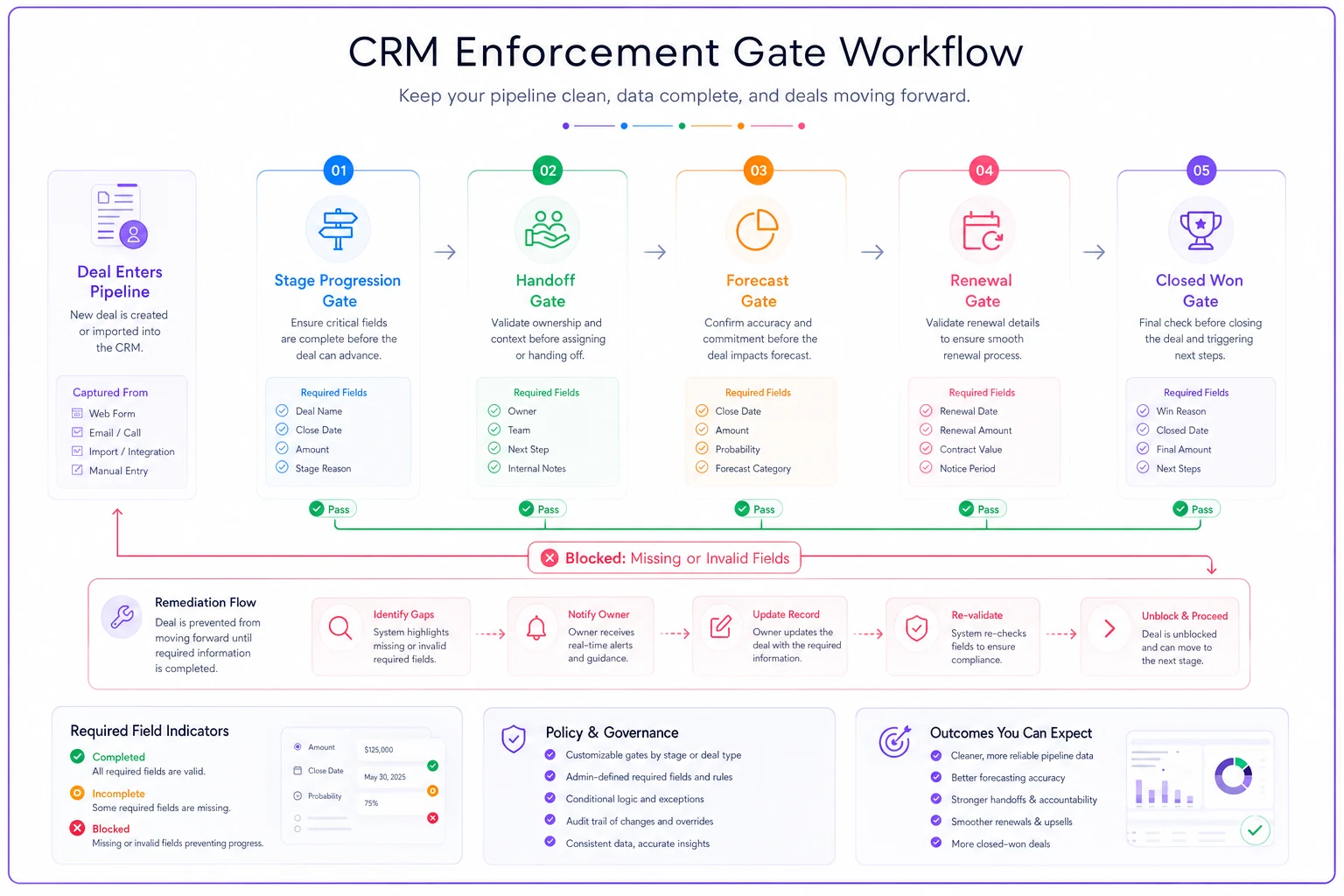
A simple flow showing how a deal hits a gate, is blocked, and routes to remediation or approval.
A word of caution: over-gate and people revolt or find workarounds. The classic failure is requiring 12 fields to move a deal one stage. Reps respond by putting garbage in all 12 to get past the gate, and now you've automated bad data. Gate the few fields that genuinely matter for the next person in the chain, and nothing else.
Gates also make your deal reviews sharper, because the data is guaranteed to be present. When every committed deal already has a documented next step, the review stops being a data-collection exercise and becomes an actual decision meeting — which connects directly to running deal reviews that force action instead of status updates.
Adoption KPIs: measure behavior, not sentiment
You can't manage adoption on vibes. But you also can't drown in metrics. Pick a handful of KPIs that describe whether the workflow is actually being followed, and watch the trend more than the absolute number.
-
Field completeness rate on required fields, by role. Trending down is an early warning.
-
Stage age / stale deal count. Deals sitting past their expected time in stage usually mean they're not being updated, not that they're genuinely slow.
-
Activity-to-stage consistency. Are stage changes backed by logged activity, or are people jumping deals forward with no evidence?
-
Next-step coverage. Percentage of open deals with a defined, dated next step. This one predicts forecast accuracy better than almost anything.
-
Time-to-log. How long between an event happening and it being recorded. Long lags mean reps are batch-updating from memory, which corrupts the data.
Watch these by role and by manager, not just company-wide. The company average hides the fact that one team is at 95% and another is at 40%. Adoption problems are almost always concentrated, and the aggregate number lets the weak spots hide.
Remediation paths: what happens when someone falls off
Every adoption system needs a plan for non-compliance, because there will be non-compliance. The mistake is treating the first missed KPI as a discipline issue. Sometimes it's a training gap. Sometimes the workflow genuinely doesn't fit how that person's deals work. Remediation should diagnose before it punishes.
-
Flag (automated). The KPI dip triggers a notification to the rep and their manager. No drama, just visibility.
-
Diagnose (manager, within a few days). Quick conversation
is this a skill gap, a workflow mismatch, or a will problem? The response depends entirely on which one it is.
-
Re-train or adjust (as needed). If it's a skill gap, re-run the relevant micro-training clip. If the workflow genuinely doesn't fit, fix the workflow — don't force a broken process on someone and call it non-compliance.
-
Accountability (if it's a will problem). This is where incentive gates apply. Deals stay uncredited until the data's right.
-
Escalation (rare). Repeated, willful non-compliance becomes a performance conversation like any other.
Most adoption failures are workflow or training failures wearing a non-compliance costume. Teams that jump straight to punishment burn trust and still don't fix the underlying issue. Teams that diagnose first find that maybe 70% of "adoption problems" are actually fixable friction.
A real scenario: mid-market SaaS team, 14 reps
A B2B software company with 14 AEs and 5 CSMs had a familiar problem: their pipeline report and their actual pipeline had almost nothing to do with each other. Forecast accuracy was somewhere around 55–60%, deals appeared and vanished without explanation, and handoffs to CS were a mess of missing context.
-
They cut the one-size training and built five short role-based clips, each under 20 minutes, trained on real deals.
-
They ran a three-week pilot with six reps — including two skeptics — and hit their completeness target before expanding.
-
They added exactly four enforcement gates
stage progression, handoff, forecast commit, and renewal.
-
Manager comp got tied partly to team data quality, not just number attainment.
Roughly a quarter in, next-step coverage went from around 40% to the high 80s. Forecast accuracy climbed into the low 80s — not perfect, but usable for the first time. The CS handoff complaints dropped off noticeably because the context fields were finally getting filled at the gate. Nobody would call it dramatic. It just started working the way it was supposed to.
When this level of rigor makes sense — and when it doesn't
Full enforcement gates and remediation paths are overkill for a five-person startup where everyone sits in one room and knows every deal by heart. At that size, the CRM is mostly a shared memory, and heavy gating just slows people down. Keep it light.
This system earns its complexity when you cross roughly 10–15 GTM people, or when you have handoffs between functions — sales to CS, SDR to AE — that keep dropping context, or when leadership can no longer personally verify the pipeline. That's the inflection point where informal coordination stops scaling and you need the workflow to carry the discipline.
And who should genuinely not do this: teams where leadership won't back enforcement. Gates and incentive consequences only work if leadership holds the line the first time a top performer tests them. If the answer to "the best rep won't log deals" is a shrug, don't bother building the system — you'll just have expensive rules nobody respects, and that's worse than no rules at all.
The takeaway
CRM adoption isn't a training problem or an incentive problem or an enforcement problem. It's all three, wired together into an operating discipline that survives the moment your best rep decides they're too busy. Micro-training gets people competent, incentives make the behavior matter, pilots prove the system before you scale it, gates make the workflow self-enforcing, KPIs tell you the truth, and remediation catches people before they drift too far.
Get the pieces working as a system and the payoff isn't just cleaner data — it's forecasts you can trust, handoffs that don't lose context, and a leadership team making decisions on reality instead of a hopeful spreadsheet. Get them working in isolation, and you'll be right back to wondering why nobody updates the CRM six weeks from now.
Ready to transform your customer relationships?
Join 2,000+ businesses using Rellyly to increase sales, improve client retention, and simplify CRM workflows.