


Most revenue leakage doesn't happen in the boardroom. It happens quietly, in a signed contract that nobody read closely — a discount someone approved over Slack, a payment term that slipped from Net 30 to Net 60, or an auto-renewal clause that got softened during negotiation and never made it back into the standard template.
By the time finance catches it, the money is already gone. The deal closed. The customer got what they were promised. And the ops team is left reconciling a mess that started three months earlier when a rep, under quota pressure, made a small concession that felt reasonable at the time.
Contract governance for revenue ops is really about closing the gap between what your sales team promises and what your business can actually deliver profitably. It's not legal work — it's operational work. A system of templated clauses, approval thresholds, and fast audit steps that keeps deals moving without letting margin, cash flow, or renewal terms quietly erode.
This isn't a "get legal to review everything" article. That approach kills deal velocity and everyone knows it. What works is a lightweight governance layer that lets 80% of deals fly through untouched and forces a real conversation only when something crosses a line that actually matters.
Where the leakage actually comes from
If you trace revenue leakage back to its source, it almost never looks dramatic. It's death by a thousand reasonable-sounding exceptions.
-
Discount creep. A rep offers 12% to close by end of quarter. The next rep sees that deal and offers 15% on a similar account "because the last one got 12." Six months later your average discount has drifted five points and nobody made that call on purpose.
-
Payment terms drift. Standard is Net 30. A procurement team pushes for Net 60. The rep says yes because it doesn't affect their commission. Finance now finances the customer's business for an extra month, at scale, across dozens of accounts.
-
Renewal and cancellation clause softening. The original template has a 60-day cancellation notice and auto-renewal. During negotiation it becomes 30 days, then "cancel anytime," and suddenly your predictable ARR base is a lot less predictable.
-
Scope ambiguity. The contract says "onboarding support" without defining hours. CS eats the cost. Multiply that across a year and you've quietly funded a services team you never budgeted for.
-
Missing or vague SLAs. Either you promised something you can't measure, or you left it out entirely and now you're arguing about it at renewal.
What makes this hard to catch is that every one of these decisions looked fine when it was made. The rep wasn't being reckless — they were trying to win a deal. The problem isn't judgment. It's that nobody set the boundaries in advance, so every rep improvises their own version of "reasonable."
Why this breaks worse as you grow
When you're a five-person sales team, governance is basically your VP looking at every deal. Informal, fast, works fine. The VP has the whole picture in their head — pricing, margin floors, which terms are actually dangerous.
Never miss a customer touchpoint again.
Rellyly helps you manage contacts, tasks, and sales efficiently in one platform.
- Unified customer profiles
- Automated follow-ups
- Sales pipeline tracking
No credit card required
That system quietly collapses somewhere between 15 and 40 reps, and most teams don't notice until the damage shows up in a board deck.
The context leaves the building. When your founder or first sales leader knew every account, they caught the weird stuff instinctively. Add three sales managers, two regions, and a partner channel, and nobody has the full picture anymore. The "obviously bad" term isn't obvious to a manager who joined four months ago.
Exceptions become the norm. Early on, a non-standard term is rare enough to get scrutiny. At scale, non-standard becomes so common that reviewing everything is impossible — so reviewing turns into rubber-stamping. Approval becomes theater.
Handoffs multiply. Sales closes it, CS delivers it, finance bills it, and each team assumes someone else validated the terms. In reality, nobody did. It's the same handoff-chaos failure that shows up across the whole revenue lifecycle — a signed contract is just another handoff with no clear owner.
The audit trail disappears. Someone approved the 20% discount. Who? When? On what basis? If that lives in a DM or a hallway conversation, you can't audit it, learn from it, or defend it later.
A typical example: a mid-market SaaS company scaled from around 12 to 30 reps over 18 months. Nobody changed the approval process. Average discount drifted from roughly 8% to something closer to 14%, payment terms stretched on about a third of new deals, and finance was spending close to two days a month manually reconciling billing against actual contract terms. None of it was one big mistake. It was the absence of a system.
The governance layer that doesn't slow deals down
The goal isn't to review more. It's to review the right things and let everything else pass automatically. Good governance is mostly about deciding in advance what's allowed, so the vast majority of deals never need a human gatekeeper.
Three components make this work: templated clauses, approval thresholds, and quick audits.
1. Templated clauses with pre-approved variants
Your standard contract should have a small library of pre-approved clause variants for the terms reps negotiate most. Not a free-text field — a menu.
For payment terms, you might pre-approve Net 30 (standard), Net 45 (needs a manager note), and Net 60 (needs finance sign-off). The rep picks from the menu. Anything outside it triggers a real approval.
The insight most teams miss: the point of templated clauses isn't the legal language — it's removing the improvisation. When a rep has three approved discount tiers to choose from, they stop inventing a fourth. You've turned an open-ended negotiation into a bounded one, and bounded negotiations leak far less.
Clauses worth templating first:
-
Discount tiers (with margin impact attached to each)
-
Payment terms
-
Contract length and auto-renewal language
-
Cancellation and notice periods
-
SLA commitments and remedies
-
Scope of onboarding / included services
-
Price-increase caps at renewal
Attach margin impact to each discount tier to make trade-offs explicit for reps and approvers.
2. Approval thresholds (the matrix that actually gets used)
An approval matrix maps who has to sign off based on how far a deal deviates from standard. The mistake is building a matrix so detailed that reps ignore it, or one so vague ("big deals need approval") that it's meaningless.
Tie thresholds to the things that actually cost you money: discount depth, payment term length, non-standard SLAs, and contract value. A workable starting structure:
| Deviation | Auto-approved | Manager approval | Finance + Sales leader |
|---|---|---|---|
| Discount | 0–10% | 11–18% | 19%+ |
| Payment terms | Net 30 | Net 45 | Net 60+ |
| Contract length | 12 mo standard | Month-to-month | Multi-year custom |
| SLA / remedies | Template only | Minor edits | Any credit/penalty clause |
| Non-standard legal redlines | None | — | All redlines |
The important design principle: most deals should clear the "auto-approved" column. If more than a third of your deals are hitting escalation tiers, your standard terms are wrong — not your reps. Fix the template, don't add more approvals.
One more thing that separates matrices that work from ones that don't: every approval tier needs a response SLA. "Finance sign-off required" is useless if finance takes four days. Attach a clock — manager approvals within a few hours, finance within one business day. Governance that slows deals gets routed around, and once reps start routing around it, you've already lost.
3. Quick audit steps
Approval catches problems before signing. Audits catch what slipped through and tell you whether your thresholds are set correctly. This is where governance becomes a feedback loop instead of a one-time gate.
-
Pull a sample of recently closed deals — around 10–15% of the month's contracts, weighted toward the larger ones.
-
Check signed terms against the approved template. Did the discount match what was approved? Are payment terms what the CRM says they are?
-
Verify the approval trail exists. Every exception should have a documented approver and reason. No trail is a finding, even if the term itself was fine.
-
Confirm billing matches the contract. This is where cash actually leaks — the contract says one thing, the invoice says another.
-
Log deviations by type. Not to punish reps, but to spot patterns. If Net 60 keeps showing up, that's a market signal, not a discipline problem.
-
Feed findings back into thresholds. Adjust the matrix and template based on what the audit keeps flagging.
That last step is the one everyone skips, and it's the whole point. An audit that doesn't change your governance rules is just paperwork.
Below is roughly how these three components connect in practice:
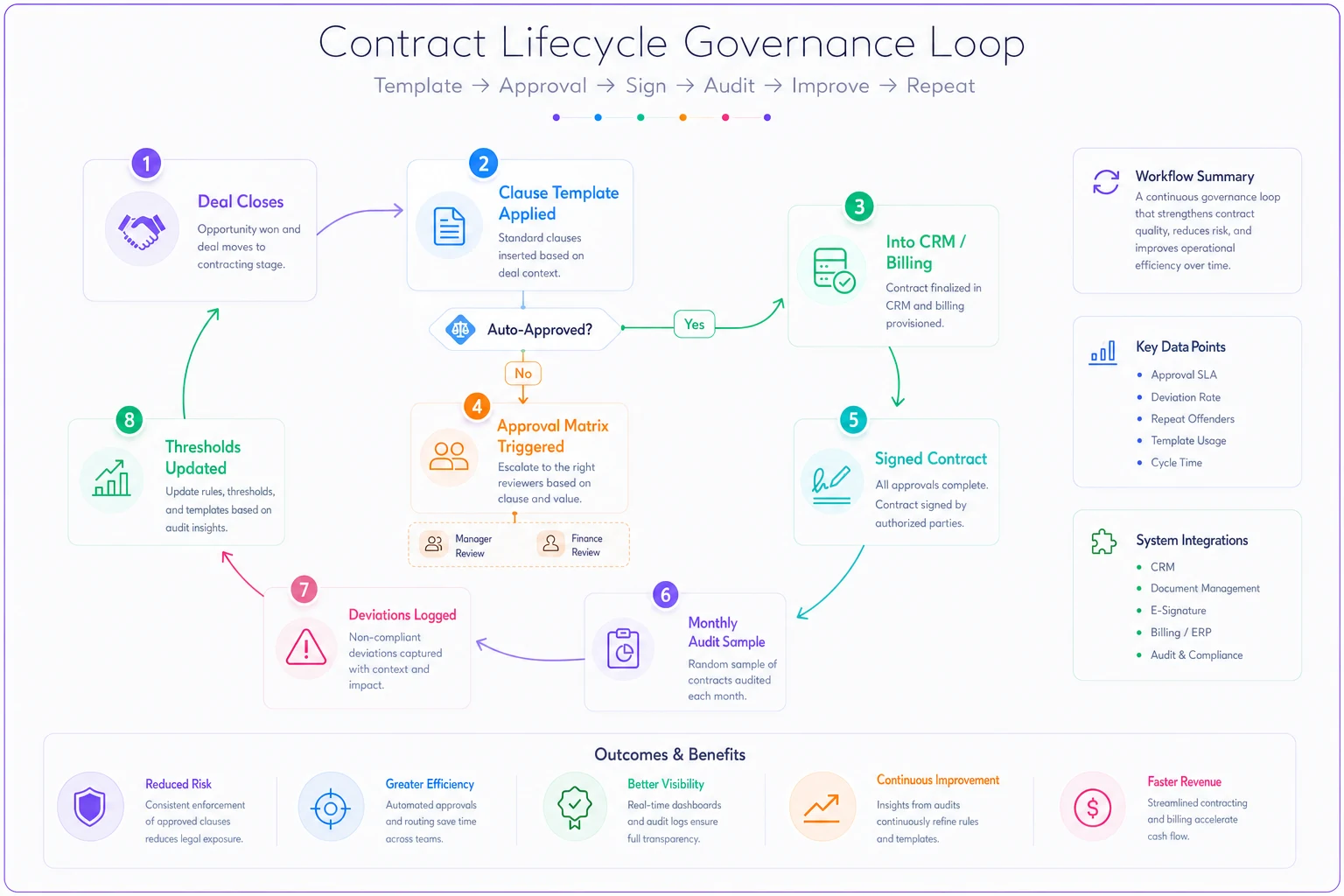
It's not glamorous, but that loop — template, threshold, audit, adjust — is what keeps the system from decaying over time. Most teams set the rules once and never revisit them, which is roughly equivalent to not having rules at all.
The handoff to finance and CS
Governance lives or dies at the handoff. A perfectly negotiated contract still leaks if finance bills it wrong or CS delivers scope that wasn't in the deal.
The workflow that keeps it tight: when a deal closes, the approved contract terms should flow — not get re-typed — into whatever finance uses to bill and whatever CS uses to onboard. The key fields are the ones that leak: discount, payment terms, contract dates, renewal terms, and included scope. Finance validates the invoice against those exact fields before the first bill goes out. CS reads the scope section before onboarding starts, not after they've already over-delivered.
The failure mode is re-keying. Every time someone manually copies terms from a signed PDF into a billing system, you introduce a chance for the invoice to drift from the contract. This single copy-paste step accounts for a surprising share of billing disputes — not fraud, just transcription error. Reducing manual handoffs between the signed contract and the systems that bill and deliver removes a whole category of leakage that no amount of approval discipline would catch, because the terms were correct — they just got typed wrong downstream.
This connects directly to how you run renewals. The same terms you're governing at signing — auto-renewal language, price caps, cancellation notice — are the ones that shape your leverage months later. If you want the downstream view, the renewal operating model with timelines, stakeholder mapping and concession guardrails covers how those clauses play out when the contract comes back around.
A real scenario
A B2B services company, roughly 25 people on the revenue side, was closing somewhere around 40–50 contracts a month. No formal governance. Reps negotiated discounts and payment terms on their own judgment, approvals happened over chat, and finance found out about non-standard terms when they went to bill.
The visible symptoms: average discount had crept to around 15%, finance was spending close to a day and a half each month reconciling contracts against invoices, and roughly one in eight new customers had a billing dispute in their first quarter — almost always because the invoice didn't match what the rep had verbally promised.
They didn't hire a legal team. They built a clause library with three discount tiers and two payment-term options, a simple approval matrix (manager for mid-tier, finance for anything past 18% or Net 60), and a monthly audit on a sample of about a dozen deals.
Over the next two quarters, average discount settled back toward 10–11%, first-quarter billing disputes dropped to roughly one in twenty, and the monthly reconciliation shrank to a couple of hours because most contracts now matched the template exactly. Nothing dramatic — they stopped improvising, and the leakage that came from improvisation went away with it.
When this makes sense — and when it doesn't
When it's worth building:
-
You've got more than a handful of reps and no single person sees every deal anymore.
-
Discounts and payment terms vary a lot across similar deals for no clear reason.
-
Finance regularly finds surprises when billing.
-
You're heading into a fundraise, audit, or acquisition where clean, defensible terms matter.
When it's overkill:
-
You're a small team where one person genuinely reviews every deal and knows the full context. Formalizing this too early just adds friction you don't need yet.
-
Your product is truly one-price, no-negotiation. If there's nothing to negotiate, there's not much to govern.
Who should be careful: teams that respond to leakage by adding more approval layers. Every extra required signature slows deals and pushes reps to work around the system. If your fix makes reps hide deals instead of surfacing them, you've made governance worse, not better. The best systems approve fast and audit after, rather than gating everything up front.
Tying it back to the deal desk
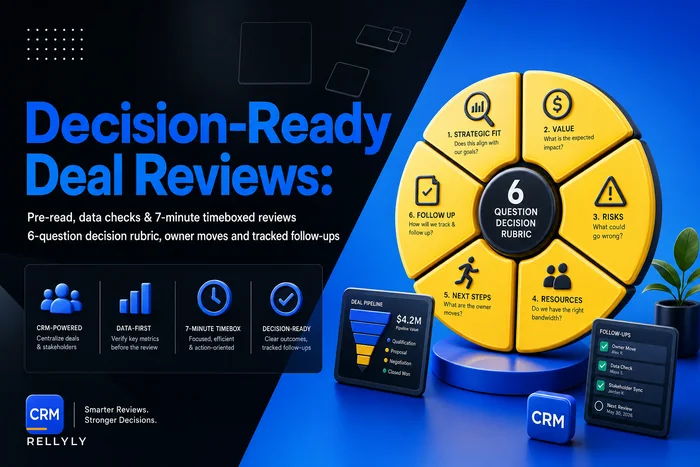
Contract governance isn't a standalone process — it's the enforcement layer on top of the decisions your team makes during deal reviews. If your deal review already forces a real conversation about pricing and terms, governance just makes sure those decisions make it into the signed document and stay there. The deal-review blueprint with a six-question decision rubric and owner moves pairs naturally with this — the review sets the terms, governance holds the line.
The teams that keep the most of what they close aren't the ones with the strictest legal review. They're the ones who decided in advance what's allowed, made the approved path the easy path, and checked their own work often enough to catch drift before it added up. Revenue leakage isn't usually a discipline problem. It's the predictable result of asking people to make consistent decisions without giving them consistent rules — and that's exactly the kind of gap a good governance system is built to close.
The teams that keep the most of what they close aren't the ones with the strictest legal review. They're the ones who decided in advance what's allowed, made the approved path the easy path, and checked their own work often enough to catch drift before it added up. Revenue leakage isn't usually a discipline problem. It's the predictable result of asking people to make consistent decisions without giving them consistent rules — and that's exactly the kind of gap a good governance system is built to close.
Ready to transform your customer relationships?
Join 2,000+ businesses using Rellyly to increase sales, improve client retention, and simplify CRM workflows.