

Every enterprise deal dies the same way. Not from price objections or feature gaps, but from committee dynamics the rep never bothered to map. The champion loves you, procurement stalls you, and somewhere in between, three stakeholders you never identified are having the real conversation about your solution.
Most sales teams treat buying committees like a contact list when they should treat them like a political map. Closing versus losing often comes down to understanding who actually moves deals forward versus who just shows up to meetings.
The committee structure nobody teaches you
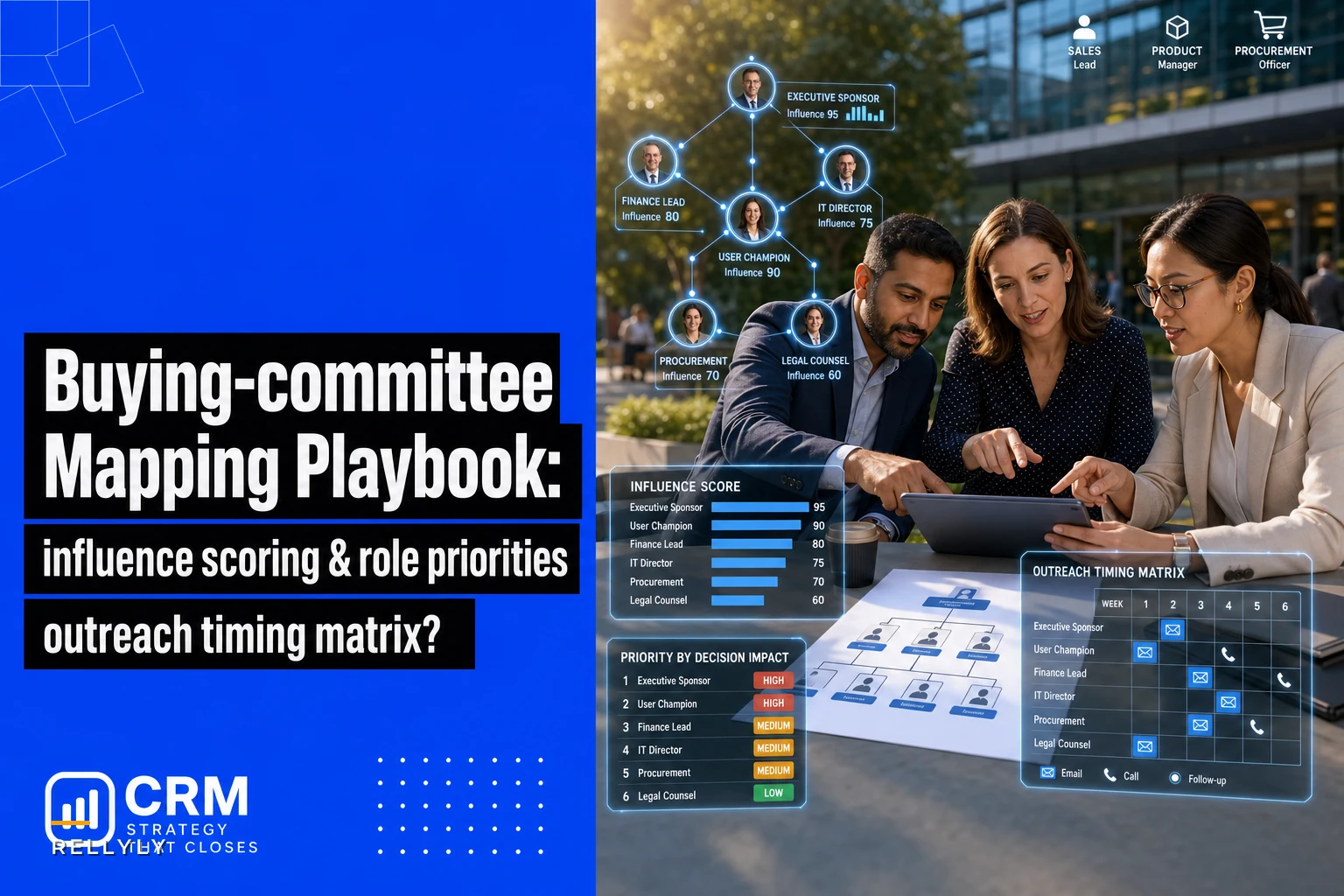
Buying committees in mid-market and enterprise deals typically run 6-11 people, but the power distribution looks nothing like the org chart. What matters isn't title or department—it's decision influence and veto power.
The real structure breaks into four influence tiers that shape your entire engagement strategy:
Mobilizers (15-20% of committee) These people stake their internal reputation on your solution. They don't just support you—they actively sell internally when you're not in the room. Usually operational leaders who feel the pain daily. They carry roughly 40% of the actual decision weight despite being outnumbered.
Economic validators (10-15% of committee) Finance, procurement, sometimes IT security. They can't say yes alone but they can kill everything with a single "no." They hold around 30% of decision influence through veto power. Most reps engage them too late, after opinions are already formed.
Technical evaluators (25-30% of committee) IT, operations managers, power users. They influence about 20% of the decision by validating feasibility. They become deal killers when mobilizers can't answer their questions—which happens constantly because reps brief champions on benefits, not implementation details.
Passive participants (40-50% of committee) Department heads invited for visibility, future users who won't touch the system for months, compliance folks checking boxes. They show up to meetings but carry maybe 10% of real influence. Reps waste enormous time trying to convert these people.
The mistake is giving equal attention to unequal players. Same deck for everyone, identical discovery calls, and then confusion when deals stall despite "full committee buy-in" from people who don't actually decide anything.
Influence scoring that reflects reality
Generic scoring models fail because they're built on org charts, not actual decision dynamics. A VP title means nothing if they joined two months ago. A senior analyst with eight years at the company might carry more weight than their director.
Never miss a customer touchpoint again.
Rellyly helps you manage contacts, tasks, and sales efficiently in one platform.
- Unified customer profiles
- Automated follow-ups
- Sales pipeline tracking
No credit card required
Here's the scoring framework that actually predicts deal movement:
Political capital indicators (0-40 points)
-
Tenure at company
2 points per year, max 10
-
Previous successful initiatives led
5 points each, max 15
-
Cross-department relationships visible in meetings
5 points
-
Speaking time in group calls
Over 30% = 10 points
-
Direct reports attending meetings with them
5 points
Economic authority signals (0-30 points)
-
Budget ownership for your solution area
15 points
-
Historical spending approval without escalation
10 points
-
Questions about ROI methodology, not just numbers
5 points
Urgency indicators (0-30 points)
-
Personal KPIs affected by your solution
15 points
-
Mentioned specific timeline pressures
10 points
-
Scheduling flexibility (meets outside normal calendar)
5 points
Above 70 indicates a true mobilizer. Between 40-70 suggests an important validator. Below 40 and you're looking at a passenger, regardless of title.
Prioritize observable behavioral signals (speaking time, calendar flexibility, forwarded emails) over job titles when scoring influence.
This scoring consistently surfaces patterns that contradict traditional account mapping. That enthusiastic VP who takes every call might score 35 while the quiet director of operations asking about integration timelines scores 75. Guess who actually moves the decision.
Role-specific messaging that lands
Different committee members care about completely different outcomes, but most sales teams send variations of the same message to everyone. The CFO doesn't care about user experience. End users don't care about TCO models. Yet they're getting nearly identical pitches.
What actually resonates by role:
For mobilizers: Focus entirely on their specific operational pain and how they'll look internally after implementation. Skip the company benefits—make it about their department's transformation. Share stories of similar leaders who drove change. Give them internal selling tools: one-page business cases they can forward without you, quotes from peers at other companies.
For economic validators: Lead with risk mitigation, not ROI. They assume your numbers are inflated anyway. Show them what happens if they don't move forward—competitive disadvantage, growing technical debt, escalating costs of doing nothing. Provide third-party validation like analyst reports. Never promise specific savings; show ranges and scenarios.
For technical evaluators: Skip the features, focus on implementation reality. APIs, data migration, training requirements, support SLAs—that's what they want. Send actual integration documentation, not marketing sheets. Connect them with your implementation team, not sales engineers reading scripts. They'll respect you more for acknowledging complexity than for pretending it doesn't exist.
For passive participants: Don't try to activate them. Send executive summaries only. Keep them informed enough that they don't feel excluded but don't seek their input. One-page updates after key milestones, no calls unless they ask.
Sending technical details to economic buyers or ROI models to end users doesn't just miss the mark—it creates confusion that actively slows deals down.
The timing matrix everyone ignores
When you engage each committee member matters as much as how. The default instinct of "get everyone involved early" creates more problems than it solves. Too many voices too early leads to scope creep and decision paralysis.
Engagement timing should follow influence patterns, not org hierarchy:
| Phase | Weeks | Who | Goal |
|---|---|---|---|
| Mobilizer activation | 1–3 | Champion only | Lock commitment, test real influence |
| Technical validation | 4–6 | Technical evaluators | Confirm feasibility while momentum is high |
| Economic alignment | 7–9 | Finance, procurement | Present validated assumptions |
| Broader socialization | 10+ | Passive participants | Inform, not consult |
Weeks 1-3: Mobilizer activation only Lock down your champion's commitment before expanding. If you can't get one person genuinely excited, adding more people won't fix that. Build their confidence to sell internally, then test their actual influence by asking for specific introductions. If they can't deliver, you've got a coach, not a champion.
Weeks 4-6: Technical validation in parallel Bring in technical evaluators while mobilizer enthusiasm is highest—they'll be more receptive to a solution their colleague is actively pushing. Run technical deep-dives separate from business discussions. This keeps feature rabbit holes out of strategic meetings.
Weeks 7-9: Economic framework alignment Engage economic validators only after technical feasibility is confirmed. They won't spend time on solutions that might not even work. Present validated assumptions, not projections built on hope. Having your mobilizer in these discussions changes the dynamic considerably.
Week 10+: Broader socialization Loop in passive participants after core decisions are directionally made. Frame it as "keeping you informed" not "seeking your input." This prevents late-stage objections from people who haven't been paying attention.
The timeline assumes a 3-4 month sales cycle typical for mid-market. Enterprise moves slower, SMB faster—but the sequence stays consistent: mobilizer, technical, economic, everyone else.
Reading the committee dynamics
Committee behavior predicts outcomes better than any forecast model. The subtle patterns tell you more about where a deal stands than anything people actually say.
Signs you're actually progressing:
-
Mobilizer starts using "when" instead of "if"
-
Technical evaluators ask about edge cases, not basic functionality
-
Economic validators discuss payment terms, not just total cost
-
Internal emails get forwarded to you without being asked
-
Meeting attendance stays consistent or grows
-
Follow-up questions come between meetings, not just during calls
Warning signals most reps miss:
-
New stakeholders appearing after week 8 (scope expansion incoming)
-
Mobilizer delegates your meetings to subordinates (losing interest)
-
Technical evaluators go quiet after deep-dives (found a blocker)
-
Reference requests before pricing discussions (price shopping)
-
Sudden legal interest in contract terms (risk review triggered)
-
Calendar delays blamed on "internal priorities" (competing initiative won)
Behavioral patterns are more reliable than what people say. A committee might tell you they're moving forward while everything they do says otherwise. That's why tracking engagement beats relying on verbal commitments.
Committee plays that actually work
The technical proof trap: Never run technical validation sessions with economic buyers present. Technical evaluators won't ask real questions with their bosses in the room. Economic buyers will fixate on minor technical concerns they don't understand. Run separate tracks, then bring groups together only for alignment—not discovery.
The reference power move: Don't send the same references to everyone. CFOs want to talk to other CFOs about ROI reality. Technical teams want to hear from admins about daily operations. End users want peer perspectives on actual usage. Match reference roles to committee roles, or don't bother.
The champion test: Ask your mobilizer to schedule an internal meeting without you where they present your solution. If they resist or can't get attendance, you don't have a real champion. If they run it and it goes well, you've validated their actual influence. Most deals die because reps never bother testing this.
The procurement bypass: Economic validators often hide behind procurement to avoid direct negotiation. Counter by having your mobilizer request a "business terms alignment" session before procurement gets involved. Frame it as making sure procurement has correct requirements. This surfaces real objections before you're stuck in vendor management cycles.
What kills committee consensus
Most deal killers aren't about your solution—they're about internal dynamics you accidentally triggered.
The expertise challenge: When you make technical evaluators look uninformed in front of their bosses, they'll find reasons to disqualify you. Brief them separately on anything that might surface in group meetings. Let them look smart by asking questions they already know the answers to.
The autonomy threat: Some economic validators resist solutions that reduce their control over vendor relationships or budget allocation. Frame your solution as enhancing their oversight, not replacing it. Show how they'll have better visibility, not less.
The change exhaustion: Committees in the middle of other major initiatives will deprioritize you regardless of value. Ask about competing projects early. If they're doing an ERP implementation or going through a merger, either position yourself as complementary or wait. Fighting for attention during organizational chaos is rarely worth it.
The consensus fantasy: Requiring unanimous agreement guarantees failure. Focus on "sufficient consensus"—mobilizer enthusiasm, economic validation, technical clearance. One or two passive objectors won't kill a deal if core stakeholders align.
When multi-threading becomes a problem
The current obsession with multi-threading often backfires in complex sales. More relationships don't equal better outcomes when you're engaging the wrong people the wrong way.
Quality beats quantity. Three strong relationships with 70+ scored influencers beats ten weak touchpoints scattered across the org chart. Excessive stakeholder engagement dilutes your message and creates coordination overhead that slows deals down.
Smart threading means:
-
One primary relationship per influence tier
-
Direct lines to actual decision makers, not just friendly faces
-
Parallel tracks that converge at specific milestones
-
Clear ownership of different committee segments
The best enterprise reps maintain 4-5 deep relationships while keeping 6-7 others appropriately informed. They're not trying to be everyone's best friend.
Tracking committee dynamics without losing your mind
Committee management creates a lot of operational overhead that most teams handle in spreadsheets. Tracking influence scores, engagement patterns, and message timing across 20+ opportunities gets unmanageable fast.
The smarter approach automates intelligence gathering while keeping relationship building human. AI-powered platforms can track email engagement, calendar patterns, and stakeholder interactions to surface things people miss—who's actually reading proposals, which stakeholders forward materials internally, when committees typically expand.
Here's a simple workflow that shows how automated signals feed seller action.
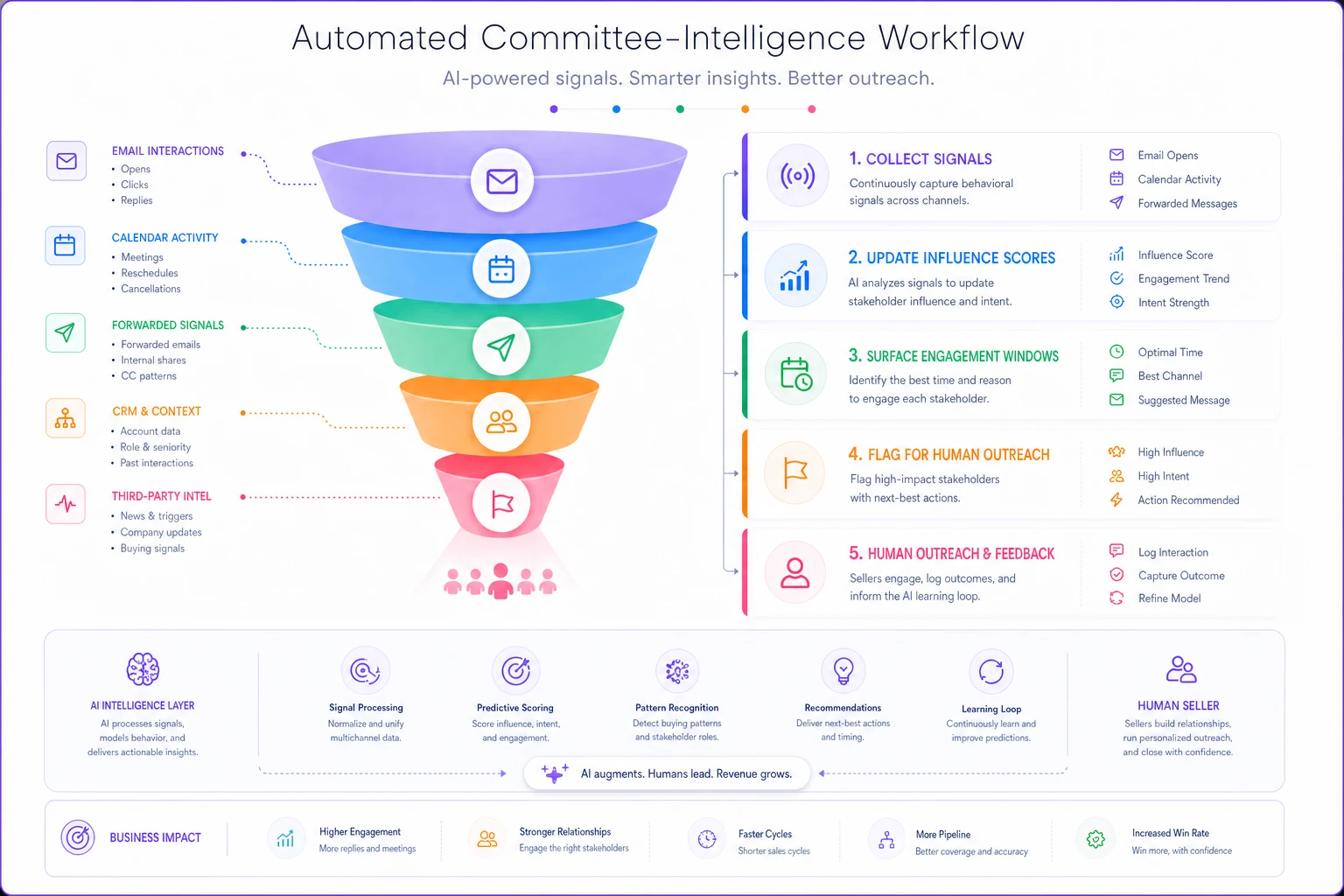
Automated influence scoring based on digital behavior can reveal patterns you'd never catch in CRM notes. That quiet technical evaluator might show significant internal email activity. The economic validator might be visibly disengaged based on response times and meeting participation.
The distinction matters: automate intelligence, not relationships. Use operational software to identify patterns, track complex dynamics, and surface insights at scale. Keep the actual engagement human. No committee member making a six-figure purchasing decision wants to feel like they're in an automated sequence.
Modern platforms can maintain stakeholder maps, update influence scores based on behavior, and flag optimal engagement windows—without making everything feel robotic. They work as intelligence layers that make human sellers more effective, not as replacements for human judgment.
The reality check most teams need
Buying committees aren't getting simpler. The average enterprise software purchase now involves more stakeholders than it did five years ago, and mid-market deals aren't far behind. Six to eight person committees for sub-100k deals have become fairly standard.
Traditional single-threaded selling is essentially dead in B2B. But the opposite extreme—treating everyone equally—creates its own problems. The path forward requires real committee intelligence combined with genuine relationship building.
Most sales teams drastically underinvest in committee mapping relative to its impact on win rates. Hours spent perfecting pitch decks, minutes spent understanding who actually influences decisions. Pipeline stages tracked obsessively, influence scores tracked never.
The companies winning complex deals consistently treat committee intelligence as a core operational capability, not an advanced tactic. They build systematic approaches to identifying, scoring, and engaging stakeholders based on actual influence rather than assumed authority.
The scoring model, engagement timeline, and committee tactics outlined here reflect patterns across hundreds of real enterprise deals—not ideal-world theory. Your next deal won't be won by the best product or even the best price. It'll be won by whoever best understands the invisible dynamics that actually drive decisions. That requires systematic intelligence, thoughtful engagement strategies, and tools that scale human relationship building rather than replace it.
Ready to transform your customer relationships?
Join 2,000+ businesses using Rellyly to increase sales, improve client retention, and simplify CRM workflows.