

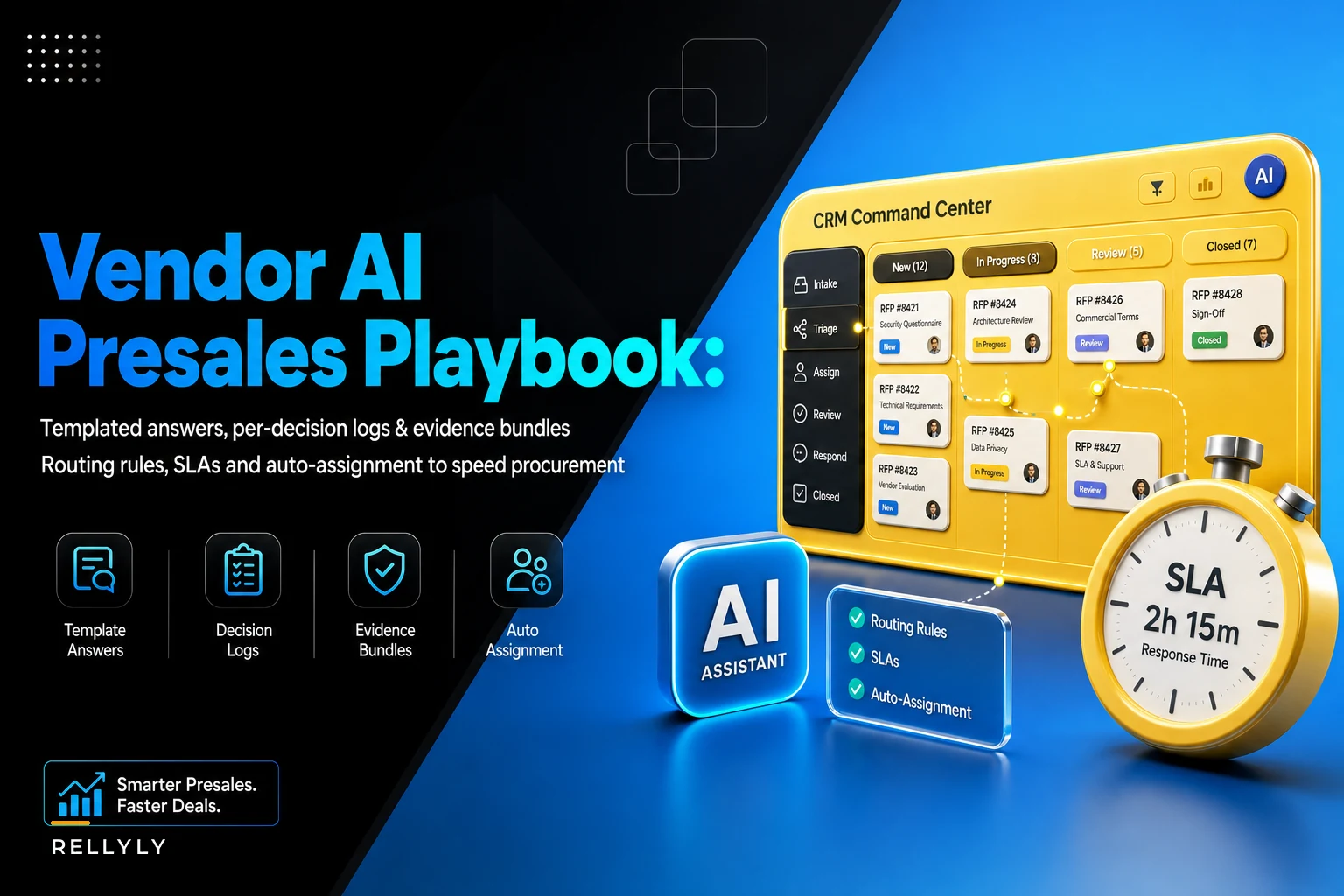

The security questionnaire used to arrive late — somewhere between legal review and signature. Now it shows up on the second call, and roughly a third of the questions are specifically about how your product handles AI threats: prompt injection, training data poisoning, model hallucinations feeding into automated actions. Procurement teams have added a whole new category, and most vendors are improvising answers in real time on a shared Google Doc while the deal clock keeps running.
That improvisation is the actual problem. Not the questions themselves — those are answerable. It's that sales, security, and product each hold a fragment of the answer, nobody owns the full response, and the buyer experiences a vendor who looks disorganized about the exact thing they're worried about. This guide is about fixing the vendor side: concrete product and documentation features, pre‑written responses, routing logic, and contract language that make your AI security story come out clean and fast.
If you want the broader security review framework this builds on, our pre‑sales security checklist for enterprise deals covers the general twelve questions and routing plan. This piece drills specifically into the AI layer that's now sitting on top of it.
The friction is almost always a documentation gap, not a capability gap
When a deal stalls on AI security, the vendor usually does have reasonable controls in place. What they don't have is a document that describes those controls in the buyer's language, pre‑reviewed by their own security team, that a sales engineer can send without waiting three days for sign‑off.
So the question "How do you prevent prompt injection from exfiltrating other customers' data?" gets forwarded to an engineer, who answers in Slack with something technically accurate but phrased for other engineers, which the AE then paraphrases badly into an email, which the buyer's security analyst reads and flags as vague, which generates a follow‑up question. Each round trip is three to five business days. A question that should have been closed in one reply becomes a two‑week thread.
What buyers are actually testing in these exchanges is whether you've thought about this before they asked. A fast, specific, pre‑written answer signals maturity. A slow, improvised one signals that you're figuring out your AI security posture live, on their deal. The content of the answer matters less than the speed and confidence of delivery — within reason.
The vendor features procurement AI security teams actually ask to see
Across enterprise reviews that touch AI functionality, the requests cluster into a predictable set. Build the artifact once for each, and you stop rebuilding answers deal by deal. These are the vendor features procurement AI security reviewers consistently want evidence of:
Never miss a customer touchpoint again.
Rellyly helps you manage contacts, tasks, and sales efficiently in one platform.
- Unified customer profiles
- Automated follow-ups
- Sales pipeline tracking
No credit card required
-
Per‑customer data isolation disclosure — a plain statement of whether prompts, outputs, and any retrieval context are logically or physically separated between tenants, and whether one customer's data can ever enter another's model context.
-
Training and fine‑tuning data policy — whether customer data is used to train or fine‑tune shared models, with an explicit opt‑out or a flat "we never do this" if that's true.
-
Prompt injection mitigations — the specific controls that stop injected instructions in user content or retrieved documents from triggering unauthorized actions.
-
Output handling before automated actions — whether model output can directly execute writes, API calls, or external messages without a validation or human‑in‑the‑loop gate.
-
Per‑decision audit logging — the ability to reconstruct, for any AI‑generated output or action, what inputs produced it and what the model returned.
-
Hallucination handling — what happens when the model produces confidently wrong output in a workflow that matters.
-
Model and provider inventory — which models you use, who hosts them, and where inference happens geographically.
-
Incident response SLA for AI‑specific events — defined timelines for AI‑driven security incidents, not just generic breach language.
The teams that close enterprise deals fastest have each of these written down, owned by a named person, and retrievable in under five minutes.
Ready‑to‑copy templated responses
These are drafting starting points. Get them reviewed by your own security and legal teams, then lock the approved versions into a shared library so AEs send the same vetted language every time instead of rewriting from scratch.
Prompt injection
> Q: How do you prevent prompt injection from causing data exfiltration or unauthorized actions? > > Our system treats all user‑supplied content and retrieved documents as untrusted input, never as instructions. Model outputs cannot directly execute privileged actions — writes, external API calls, and outbound messages pass through a separate authorization layer that enforces the requesting user's existing permissions, independent of anything the model produced. Retrieval is scoped to the requesting tenant and the requesting user's access rights, so injected instructions cannot widen data access beyond what that user already holds. We log the full input context and model output for each AI‑assisted action, which lets us detect and investigate injection attempts after the fact.
Training data poisoning
> Q: How do you protect against poisoning of training or retrieval data? > > We do not fine‑tune shared models on customer data, so cross‑tenant poisoning of a shared model is not a vector in our architecture. For retrieval‑augmented features, each customer's retrievable content is isolated to their tenant and sourced only from data they've authorized — there is no shared knowledge pool across customers. Ingestion into any retrieval index runs through validation and is attributable to the user and source that submitted it, so anomalous content can be traced and removed.
Hallucinations
> Q: What happens when the model produces incorrect output? > > AI‑generated output in workflows with material consequences is never auto‑executed. For [X category of action], output is presented as a suggestion requiring user confirmation; for [Y category], it passes through rule‑based validation that rejects outputs failing defined constraints before anything downstream happens. We disclose to users which parts of the product are AI‑assisted so they apply appropriate judgment, and every AI output is logged against its inputs so an incorrect result can be reviewed and the pattern corrected.
The bracketed placeholders matter. Leaving them generic is how you end up with a response that sounds reassuring but says nothing — and experienced security reviewers catch that instantly. Fill them with your actual action categories before anyone sends these out.
A per‑decision audit‑log schema buyers will accept
When a procurement team asks "can you reconstruct what the AI did and why," they want to see that you capture enough to investigate an incident and tie a decision back to its inputs. A per‑decision schema answers that directly. Here's a workable baseline:
| Field | Purpose | Example |
|---|---|---|
decision_id | Unique ID for this AI output/action | dec_8f2a19 |
timestamp | When the decision occurred | 2025-11-18T14:22:07Z |
tenant_id | Which customer's context | cust_4471 |
actoruserid | User who triggered it | usr_9920 |
feature | Which AI feature ran | draftrenewalemail |
modelid / modelversion | Exact model used | provider-x / 2025-09 |
input_hash | Hash of the full input context | sha256:... |
retrieval_sources | Doc IDs pulled into context | [doc221, doc889] |
output_summary | What the model returned | 3‑paragraph draft |
action_taken | Executed, suggested, or rejected | suggested |
human_confirmed | Whether a person approved | true |
validation_result | Pass/fail of rule checks | pass |
Retention guidance: keep per‑decision logs for a minimum that matches your incident response window plus your contractual breach‑notification obligations — in practice 12 to 24 months is a defensible default for most enterprise agreements, with the ability to extend for customers under stricter regulatory regimes. Store the input_hash rather than raw inputs where you can, so you prove integrity without indefinitely retaining sensitive prompt content. State the retention period explicitly in your documentation; "we log everything" without a stated duration tends to generate a follow‑up question rather than close one.
Routing and automation playbook
The speed problem gets solved by routing, not heroics. The goal is that an incoming AI security question lands on the right owner automatically, with an SLA attached, so nothing sits in an AE's inbox for four days.
-
Intake form, not freeform. Every security questionnaire gets logged as a ticket with a required field:
question_category(values: prompt‑injection, data‑isolation, training‑data, audit‑logging, incident‑SLA, hallucination, model‑inventory, other). -
Auto‑assignment by category. Route
data‑isolation,training‑data, andaudit‑loggingto the security owner. Routehallucinationandprompt‑injectionto the AI/product owner. Routeincident‑SLAand contract language to legal/deal‑desk. The AE stays on the ticket as watcher, not assignee. -
Templated‑response linkage. Each category auto‑attaches the approved templated response from your library as a starting comment, so the owner is editing a vetted base, not writing from scratch.
-
SLA clock by deal tier. Enterprise/strategic deals get a 1‑business‑day first response; standard deals get 2. The ticket escalates to a manager if the clock breaches.
-
Close‑loop back to the library. When a new question comes up that no template covers, the resolved answer gets added to the library before the ticket closes. The library grows, and the next deal is faster.
A concrete auto‑assignment rule in Jira terms: IF questioncategory = "data-isolation" AND dealtier IN ("enterprise","strategic") THEN assignee = securitylead, priority = High, SLA = 1bd, auto-comment = templatedata_isolation. Build one of these per category and the routing runs itself.
Route by owner, not by who's available, so answers stay consistent across deals.
A diagram of the routing workflow:
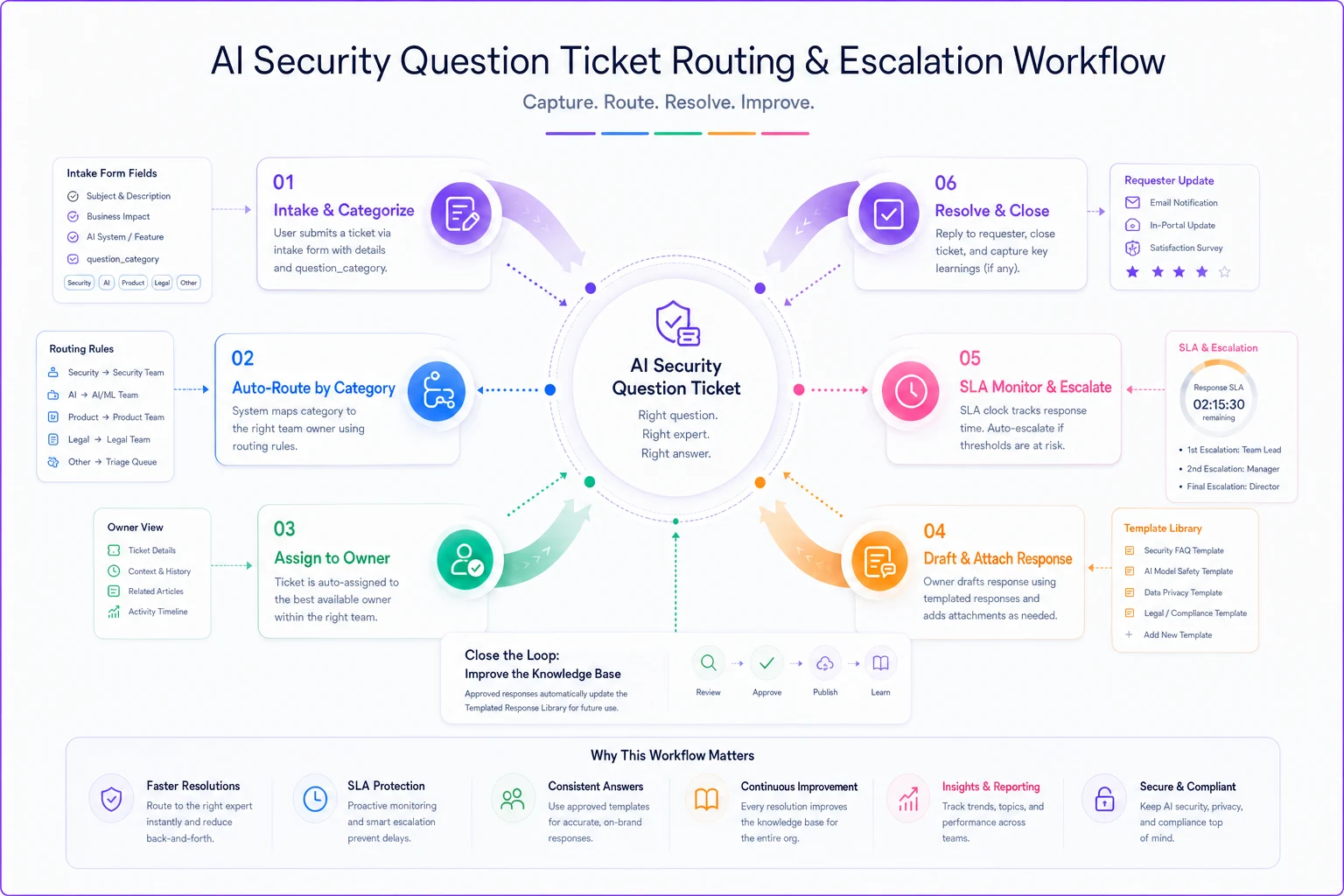
The mistake most teams make here is routing by who's available instead of who owns the answer. Availability routing means the same question gets answered differently by different people across deals — which is exactly what makes a buyer's security team nervous when they compare notes.
Evidence‑bundle structure
Enterprise buyers increasingly ask for a bundle rather than scattered email answers. Assemble it once, version it, and hand the whole thing over early — ideally before they ask. A clean structure:
-
Overview — one page
which product features are AI‑assisted, which models/providers power them, where inference runs.
-
Data handling — per‑customer isolation disclosure, training/fine‑tuning policy, retrieval scoping.
-
Threat‑specific controls — the prompt injection, poisoning, and hallucination responses above, in document form.
-
Audit and logging — the per‑decision schema and retention policy.
-
Incident response — AI‑specific SLA language and escalation path.
-
Supporting attestations — SOC 2 / ISO scope, pen test summary, subprocessor list.
Handing a buyer a structured bundle on the second call instead of answering questions one at a time over three weeks is one of the clearest ways to shorten the security phase. It changes the buyer's read of you from "reactive" to "ready."
Incident SLA language and contract snippets
Generic breach notification clauses don't cover AI‑specific events well, and sharp procurement teams now ask for language that does. Starting points — again, lawyer‑review required:
> AI incident notification. Vendor shall notify Customer within [24/48] hours of confirming an AI‑related security incident, defined to include unauthorized actions triggered through prompt injection, confirmed poisoning of retrieval or training data affecting Customer's tenant, or model behavior resulting in unauthorized disclosure of Customer data.
> Audit cooperation. Upon a confirmed incident affecting Customer, Vendor shall provide relevant per‑decision audit records within [5] business days to support Customer's investigation.
> Human‑in‑the‑loop warranty. Vendor warrants that AI‑generated outputs within [defined action categories] will not execute irreversible actions without either human confirmation or rule‑based validation as described in the applicable documentation.
That last one is worth including even when buyers don't ask, because it converts your architecture into a contractual commitment and preempts the "but what if it acts on its own" line of questioning.
Metrics worth disclosing
A few numbers, offered proactively, do more to build confidence than paragraphs of prose:
-
Audit log coverage — percentage of AI actions captured in per‑decision logs (target: 100% for material actions).
-
Human‑confirmation rate for high‑consequence features.
-
Mean time to respond to AI security questions in pre‑sales (your own internal metric — a vendor who can say "we close these in a day" signals operational maturity).
-
Incident count and MTTR for AI‑specific events over the trailing period.
Incident count and MTTR for AI‑specific events over the trailing period.
A real scenario
A mid‑market B2B software vendor — roughly 60 people, selling into regulated enterprise buyers — was losing two to three weeks per deal to AI security back‑and‑forth. Every AI question routed informally through two engineers, answers varied between deals, and one prospect's security team flagged inconsistency between what two different AEs had told them. That triggered a full re‑review.
They did the unglamorous work: wrote the per‑decision audit schema, drafted and legal‑approved the three threat‑specific templates, built category‑based routing in Jira with a 1‑day enterprise SLA, and assembled a versioned evidence bundle. Nothing about the underlying product changed — the controls were already there.
The security phase on their next several enterprise deals dropped from roughly two to three weeks down to around four to six days. The consistency complaint disappeared because every answer now came from the same vetted library. One deal that had been drifting closed noticeably faster once the buyer's analyst got the bundle upfront instead of extracting answers one email at a time.
Where this makes sense — and where it doesn't
This level of structure pays off when you're selling into enterprise or regulated buyers who run formal security reviews and your product has genuine AI functionality touching customer data. If you're selling self‑serve to small businesses who never send a questionnaire, building a per‑decision audit schema and a six‑part evidence bundle is premature.
It's also a bad idea to publish templated responses that overstate your controls. A confident, specific answer that doesn't match reality is far more damaging than an honest "we don't do that yet, here's our roadmap," because enterprise security teams verify — and a gap between your documentation and your architecture becomes a trust problem that follows you into every future renewal.
The teams that get this right treat their AI security answers as a product artifact — owned, versioned, measured, and improved deal by deal — rather than something sales regenerates from memory under deadline pressure. The questions aren't getting fewer. The vendors who've written the answers down, routed them to the right owners, and can hand over a clean bundle on the second call are the ones who stop losing weeks to a problem that was always a documentation gap in disguise.
The teams that get this right treat their AI security answers as a product artifact — owned, versioned, measured, and improved deal by deal — rather than something sales regenerates from memory under deadline pressure. The questions aren't getting fewer. The vendors who've written the answers down, routed them to the right owners, and can hand over a clean bundle on the second call are the ones who stop losing weeks to a problem that was always a documentation gap in disguise.
Ready to transform your customer relationships?
Join 2,000+ businesses using Rellyly to increase sales, improve client retention, and simplify CRM workflows.