

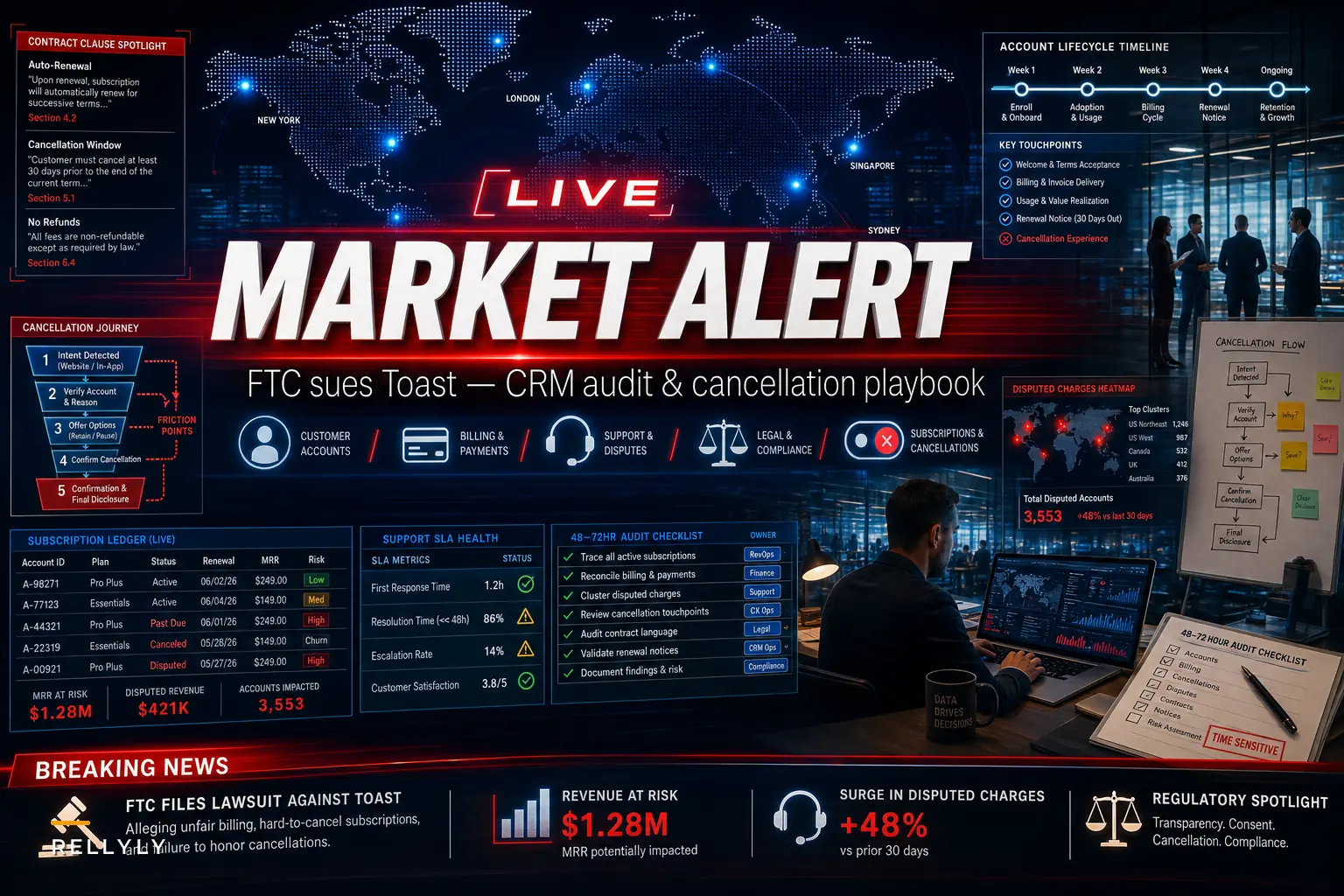

When the FTC and eight states filed suit against Toast on October 29, 2026, the allegations weren't exotic. Hidden fees, charges customers didn't expect, cancellation paths that felt deliberately annoying, and support promises that didn't hold up. Reuters reported the complaint focuses heavily on subscription "traps" and misleading claims about 24/7 support and free hardware — the kind of stuff a lot of SaaS and payments companies have quietly tolerated in their own flows for years.
The uncomfortable part for anyone running recurring revenue: most of the behaviors being called out aren't the product of some villainous boardroom plan. They're the slow accumulation of small operational decisions. A fee that got added during a pricing change and never clearly communicated. A cancellation form that requires a phone call because someone, five years ago, decided that was the best way to "save" the account. Support SLAs that were marketed aggressively and then never staffed to match.
So this isn't really an article about Toast. It's about what the lawsuit exposes in how revenue teams actually run subscription operations — and what you can fix this quarter before a regulator, a plaintiff's attorney, or a frustrated customer cohort forces the issue.
What the complaint actually signals (beyond the headlines)
The specific allegations matter less than the pattern regulators are now rewarding themselves for chasing. Payments Dive's coverage of the suit framed it as part of a broader push on fee transparency and cancellation friction across subscription businesses. That tells you the enforcement appetite isn't limited to one restaurant-tech vendor.
-
Enrollment and disclosure are being treated as one continuous obligation. It's not enough to disclose a fee at signup if the customer never actually saw it clearly. The burden has shifted toward provable, conspicuous disclosure.
-
Cancellation friction is now a legal liability, not a retention tactic. The "make them call to cancel" model is squarely in the crosshairs.
-
Marketing claims about support and inclusions are enforceable promises. If sales said 24/7 support, your SLA data had better back it up.
The underlying problem is that most companies don't have a single owner for the full subscription lifecycle. Sales owns the pitch. Billing owns the invoice. Support owns cancellations. Marketing owns the claims. Nobody owns the coherence between them — and that gap is exactly where the risk lives.
The audit most teams skip: tracing one customer end-to-end
Before you touch policy, trace a real account through your own system as if you were the customer. Not a demo account — a real one, ideally a mid-tenure customer who's gone through at least one renewal or pricing change.
Never miss a customer touchpoint again.
Rellyly helps you manage contacts, tasks, and sales efficiently in one platform.
- Unified customer profiles
- Automated follow-ups
- Sales pipeline tracking
No credit card required
-
A brand-new customer on your standard plan
-
A customer who added an optional module or upgrade mid-term
-
A customer going through an auto-renewal
-
A customer who recently hit a price increase
-
A customer actively trying to cancel
For each one, write down every fee that appears, where it was disclosed, when it was disclosed, and how hard it is to stop. You'll almost always find at least one charge that nobody on the team can confidently explain the disclosure for. That's your first fire to put out.
Where cancellation flows quietly create liability
Cancellation is where good intentions go to die. Retention teams are measured on saves, so friction gets engineered in — a required phone call, an "are you sure" gauntlet, a cancellation that only processes at the end of a billing cycle that's conveniently 29 days away. The pattern that gets companies in trouble isn't one big barrier. It's layered small ones.
| Cancellation step | Common "retention" version | Lower-risk version |
|---|---|---|
| Finding the cancel option | Buried in account settings or phone-only | One click from the billing page |
| Confirming intent | Multi-screen survey required to proceed | Single confirmation, survey optional |
| Effective date | End of next full cycle | End of current cycle or prorated |
| Final charge clarity | Vague "final charges may apply" | Exact amount and date shown before confirming |
| Confirmation record | None, or email only after a delay | Immediate on-screen + emailed receipt |
The lower-risk version does cost you some saves. But the saves you lose this way were mostly customers who were going to churn anyway — and now they churn angry. Angry churned customers file complaints, post reviews, and show up in regulator intake forms.
if your cancellation path has more steps than your signup path, you have a problem.
Signup took three clicks? Cancellation should take three clicks too.
Surfacing contested charges before they become a pattern
The accounts most likely to hurt you are the ones already disputing charges quietly. Chargebacks, support tickets mentioning "I didn't sign up for this," and refund requests tied to specific fees are leading indicators of systemic disclosure problems.
-
Filed a chargeback or payment dispute
-
Opened a ticket referencing an unexpected or unexplained charge
-
Requested a refund tied to an add-on or fee rather than product dissatisfaction
-
Canceled within 60 days of a pricing or billing change
Cluster them. If forty accounts all disputed the same add-on fee, that's not forty isolated incidents — it's one disclosure failure repeated forty times. That cluster is both your legal exposure and your clearest fix.
In practice, this clustering is where things break down. The chargeback data sits with finance, the ticket sentiment sits in the support tool, and the renewal timing sits in the CRM. Nobody has the full picture until someone manually exports three spreadsheets. That manual join is exactly the kind of recurring work worth automating — pulling dispute flags, ticket keywords, and billing-change dates into one view so contested-charge clusters surface on their own instead of after a complaint escalates.
The contract and fee-language problem underneath all of this
Most disclosure failures trace back to contract and fee language that drifted out of sync with how billing actually works. A pricing change goes live in the billing system on Monday. The order form template gets updated three weeks later, maybe. The terms of service mention a fee structure that stopped being accurate two quarters ago.
This is where subscription cancellation compliance really lives — not in the cancel button, but in whether your documented terms match your actual billing behavior and whether a customer could reasonably have understood what they agreed to.
Getting this right is fundamentally a governance problem: who's allowed to change fee language, who approves it, and how fast changes propagate to every customer-facing surface. If you don't already have a tight process for this, our breakdown of contract governance for revenue ops walks through templated clauses, approval thresholds, and quick audit cycles that keep terms and billing aligned. The core idea applies directly here — treat fee and cancellation language as controlled artifacts with a clear owner, not copy that anyone can quietly edit.
-
[ ] Every active fee has matching language in the current signed agreement or terms
-
[ ] Auto-renewal terms state the renewal date, amount, and how to opt out
-
[ ] "Free" inclusions specify duration and what happens after
-
[ ] Support SLAs in marketing match SLAs in the contract match actual staffing
-
[ ] Cancellation method and timing are stated plainly, not buried
-
[ ] Price-increase notice periods are documented and actually followed
If you don't already have a tight process for this, treat fee and cancellation language as controlled artifacts with a clear owner and add them to change-control so billing behavior and customer-facing text don't drift apart.
Fixing support claims you can't back up
The "24/7 support" allegation is worth pausing on because it's the easiest trap to fall into and, honestly, the easiest to fix. Sales and marketing make support promises to close deals. Then the support org gets staffed to a budget that doesn't match the promise. The gap doesn't show up until a customer tries to get help at 2 a.m. and finds out the promise was fiction.
Reconcile your public claims against your actual SLA performance. If your site says 24/7 and your median first response outside business hours is nine hours, you have two honest options: staff to the claim or change the claim. There's no third option where the claim stays and the staffing doesn't. Pull ninety days of response-time data broken out by time-of-day and channel. Compare it against every public and contractual support promise. Wherever reality doesn't match, decide deliberately which direction to close the gap — and document that decision so sales stops making the promise if you've chosen to narrow the claim.
A real scenario: a 220-location franchise vendor
A regional SaaS vendor selling scheduling and billing tools to service franchises — around 220 active locations on recurring plans — ran this audit after the Toast news landed. They found a payment-facilitation fee that had been added during a 2024 pricing refresh and disclosed clearly on new order forms but never communicated to roughly 90 of their older accounts, who were still billing on the legacy agreement language.
The fee was only around $14–$19 a month per location, so no single customer screamed loudly. But across the legacy cohort it added up to something like $16k–$20k a year in revenue that technically wasn't covered by those customers' signed terms. Their cancellation flow also required an email to a support address and processed at end-of-cycle, averaging an 11-day lag.
They did three things over about six weeks: sent a plain-language disclosure to the legacy cohort with an opt-out window, moved cancellation to a self-serve button with same-cycle proration, and walked back their "priority support" marketing claim to match actual coverage hours. They lost roughly a dozen accounts who opted out — a mix of people who'd have churned anyway and a few who were genuinely annoyed. Contested-charge tickets on that fee dropped to near zero. The near-term revenue hit was real but small; the avoided risk was the point.
When tightening this is worth it — and when you're overcorrecting
When it clearly makes sense: you rely on auto-renewals, you've layered on add-on fees over time, you've changed pricing more than once, or your cancellation path requires human contact. Any one of those puts you in the risk zone the complaint targets.
When you might be overcorrecting: if you strip out every retention touchpoint entirely, you'll lose saves you legitimately earned through good service. The goal isn't zero friction — it's zero deceptive friction. An optional "before you go, here's a discount" offer that the customer can skip in one click is fine. A mandatory three-screen survey blocking the cancel button is not.
Who should be cautious about moving too fast: teams with complex enterprise contracts where cancellation genuinely involves data migration, contractual notice periods, and multi-stakeholder sign-off. Don't force a one-click consumer-style cancel onto a six-figure enterprise agreement that has real operational handoffs. There, the fix is clarity and documented process, not raw speed.
A 30-day action plan
If you own recurring revenue and want to get ahead of this, here's a realistic sequence:
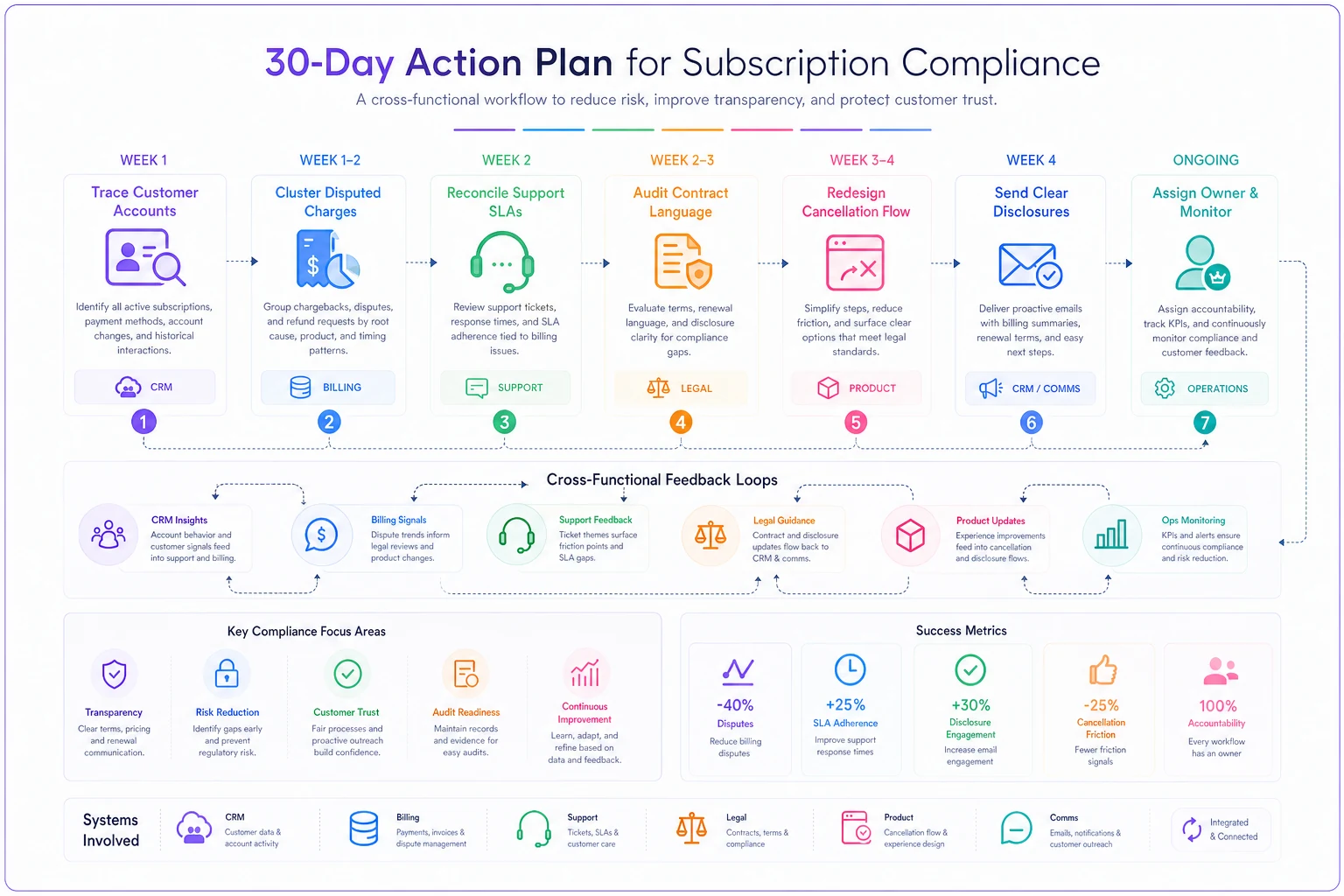
A quick visual of the 30-day action workflow.
-
Week 1 — Trace five real customer types end-to-end and document every fee, disclosure point, and cancellation step.
-
Week 1–2 — Pull the contested-charge cohort (chargebacks, fee-related tickets, refund requests, post-change churn) and cluster by cause.
-
Week 2 — Reconcile every public support and inclusion claim against actual SLA data and staffing.
-
Week 2–3 — Audit contract and fee language against live billing behavior; flag every mismatch.
-
Week 3–4 — Redesign the cancellation flow so it's no harder than signup, with clear final-charge disclosure and immediate confirmation.
-
Week 4 — Draft and send plain-language disclosures to any cohort billing on outdated terms, with a genuine opt-out window.
-
Ongoing — Assign a single owner for subscription-lifecycle coherence and add fee/cancellation language to your change-control process.
Ongoing — Assign a single owner for subscription-lifecycle coherence and add fee/cancellation language to your change-control process.
The deeper takeaway
The Toast suit is a reminder that subscription billing is now a coordinated obligation across sales, billing, support, and marketing — and regulators are increasingly willing to treat the gaps between those teams as the violation. You don't need to be doing anything you'd consider deceptive to end up exposed. You just need four teams making reasonable local decisions that never got reconciled into a coherent whole.
The teams that handle this well won't be the ones with the fanciest cancellation UX. They'll be the ones who treat fee disclosure, cancellation paths, support claims, and contract language as a single governed system with a clear owner — and who audit it before someone external does it for them.
Ready to transform your customer relationships?
Join 2,000+ businesses using Rellyly to increase sales, improve client retention, and simplify CRM workflows.