

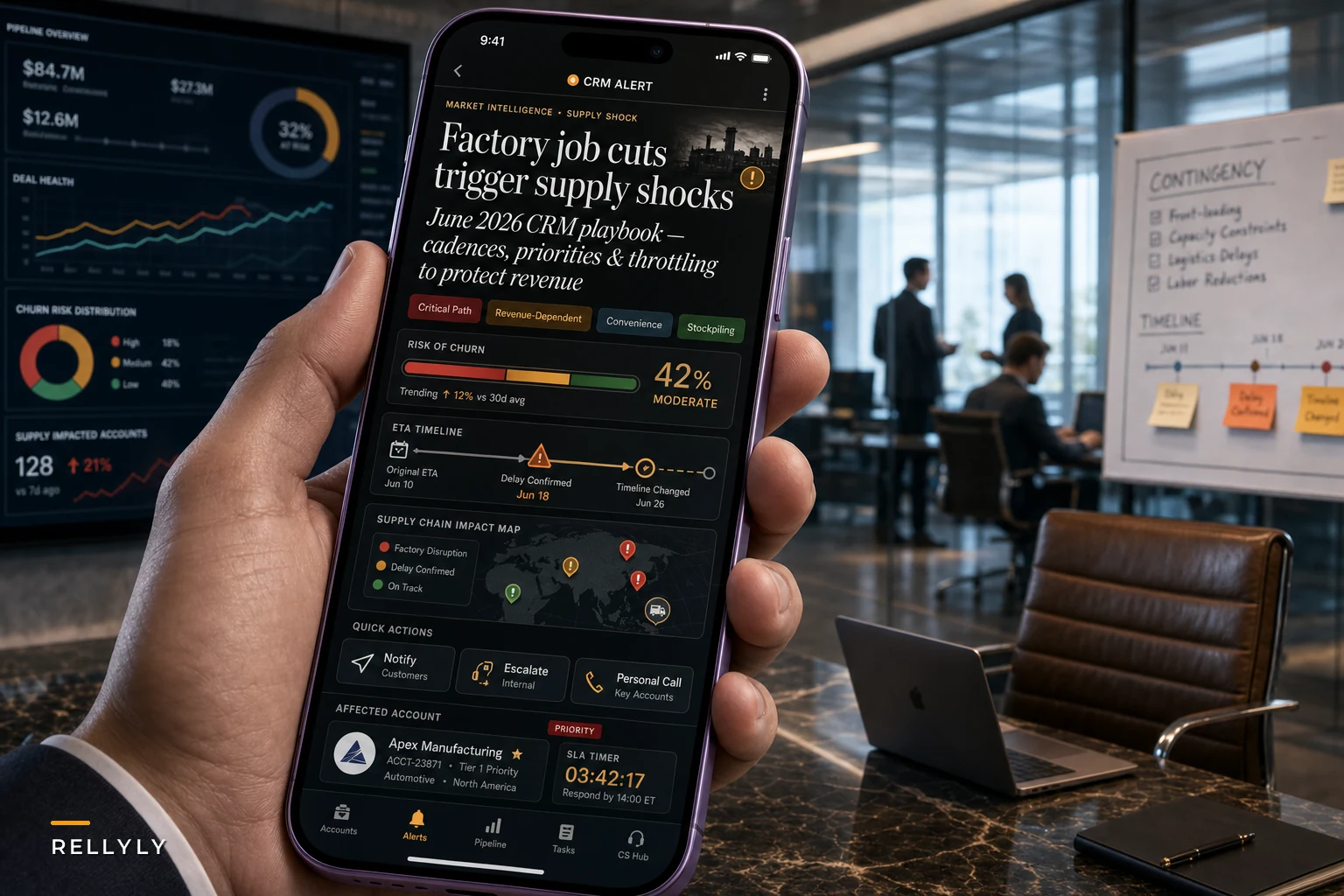

Manufacturing just got weird again. According to Reuters' latest analysis, U.S. factories are seeing a strange split right now: companies front-loading orders aggressively while simultaneously cutting shop floor workers at levels not seen since 2020. The result is delayed shipments, surprise price changes, and inventory chaos that's about to hit your customers hard.
For sales and customer success teams, this creates a real problem. Your standard communication playbooks weren't built for this.
The triple threat hitting your order delay communication cadence right now
Factory disruptions create three problems most teams aren't prepared for.
Problem 1: The volume spike paradox When manufacturing gets unpredictable, customer inquiries don't just increase—they cluster. Dead silence for two days, then 400 tickets about the same delayed shipment hitting your queue within three hours. Your normal response times collapse when half your customer base needs answers simultaneously about the same supply issue.
Problem 2: Information decay speed Supply chain updates have a brutally short shelf life. That email you sent yesterday saying orders would ship in 7-10 days? By Thursday it's 14-21 days. By next Monday the product might be discontinued entirely. Every communication becomes outdated faster than you can revise it.
Problem 3: Trust erosion through repetition What kills customer relationships during supply shocks isn't silence—it's sending the same vague update every 48 hours. "We're monitoring the situation closely" becomes toxic after the third identical message. Customers start ignoring your emails, then explode when their order actually gets canceled.
Why traditional cadences break during supply volatility
Most sales and CS teams run their order delay communication cadence on fixed intervals. Customer places order → delay notification at day 3 → update at day 7 → escalation at day 14. Clean, predictable, and completely useless when your supply chain is in freefall.
Never miss a customer touchpoint again.
Rellyly helps you manage contacts, tasks, and sales efficiently in one platform.
- Unified customer profiles
- Automated follow-ups
- Sales pipeline tracking
No credit card required
The problem isn't the intervals—it's the assumption that all delays are equal. A two-week delay from a port strike requires completely different messaging than a two-week delay because your manufacturer just laid off 30% of their workforce. One is temporary. The other might signal deeper problems affecting product quality, future availability, and pricing stability. Standard cadences also assume information flows in a straight line. During manufacturing disruptions, you often know less on day 5 than you did on day 1. Your supplier's initial "slight delay" estimate goes quiet, then suddenly becomes "indefinite hold" with no warning in between.
Building shock-resistant communication frameworks
Companies that actually maintain customer trust during supply disruptions do something counterintuitive: they communicate less frequently but with much higher specificity.
Instead of daily "still delayed" updates, they segment customers by impact severity and rebuild their entire communication strategy around that.
Segment by actual business impact, not order value
Most teams segment by order size or customer tier. During supply shocks, that's the wrong instinct. A $50k enterprise order might have built-in buffer time, while a $2k order from a small business could shut down their entire operation if it's late.
Critical path customers: Their business stops without your product
Revenue-dependent customers: Delays cost them real money daily
Convenience customers: Delays are annoying but not devastating
Stockpiling customers: Ordering ahead anyway, delays barely register
Segment by actual business impact rather than order size.
Create information state triggers, not time triggers
Traditional cadences trigger on elapsed time—day 3, day 7, day 14. During supply volatility, trigger on information state changes instead:
-
Delay confirmed but timeline unknown → immediate notification
-
Timeline estimated → update within 2 hours
-
Timeline changed by >20% → update within 4 hours
-
Alternative product available → personalized outreach within 24 hours
-
Cancellation likely → manual call from account owner
This means some customers might get three updates in one day while others hear nothing for a week. That's exactly right. Communication frequency should match information volatility, not calendar intervals.
This flow maps triggers to actions so teams know who should send what and when.
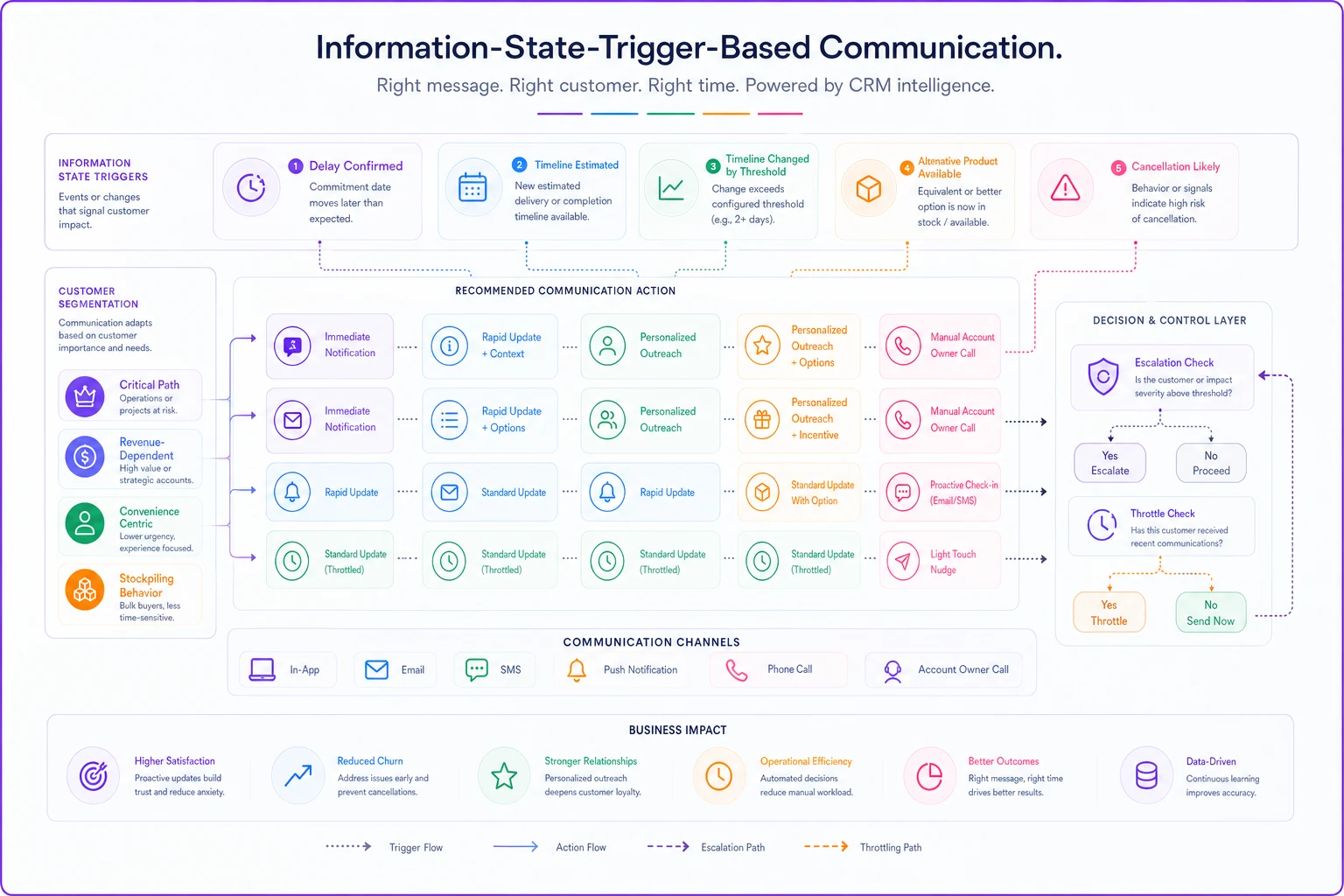
Some customers will get more frequent comms because their information state changes more rapidly.
The proactive pivot: getting ahead of the chaos
The companies that handle supply shocks best don't wait for customers to ask about delays. They spot likely problems before orders are even placed and adjust their sales process accordingly.
Pre-order transparency frameworks
Before a customer submits an order, they should already know:
-
Current fulfillment timeline with realistic confidence ranges
-
Which products have stable vs. volatile supply
-
Historical delay patterns for their product category
-
Alternatives with better availability
This isn't about scaring customers off—it's about setting expectations that prevent rage-quits later. A customer who knows upfront that shipping might take 3-4 weeks is far less likely to cancel than one who expected 3-5 days and got blindsided.
Dynamic handoff protocols between sales and CS
During normal operations, sales hands off to CS after order confirmation. During supply shocks, that handoff needs to be conditional and reversible.
Sales should keep ownership when:
-
The customer's primary concern is timeline certainty
-
Alternatives could actually solve their problem
-
The delay might kill the relationship entirely
CS should take ownership when:
-
The issue is purely operational
-
The customer just needs regular status updates
-
Multiple orders are affected in the same way
Make these rules explicit in your CRM. Nobody has bandwidth to negotiate account ownership when 200 delays land simultaneously.
Communication throttling during crisis periods
Where most teams destroy customer relationships: they panic and over-communicate. A customer getting six "delay update" emails in four days doesn't feel informed—they feel harassed.
Smart throttling prevents this while making sure critical information still gets through. The logic here mirrors what we covered in the piece on automating recurring check-ins without burning customers.
The cascade priority system
Priority 1: Order cancellations or >50% delay increases Send immediately, override all throttles
Priority 2: New timeline information Send if no communication in the last 48 hours
Priority 3: General status updates Send only if no communication in the last 5 days
Priority 4: "No change" confirmations Never send automatically—only on customer request
This prevents the update fatigue that causes customers to ignore the messages that actually matter.
Measuring what matters during disruption
Standard CS metrics fall apart during supply shocks. Response time, ticket volume, CSAT—they all spike regardless of how well your team is actually performing. You need disruption-specific metrics instead:
| Standard Metric | Disruption Metric | Why It Matters |
|---|---|---|
| Average response time | Time to first meaningful update | Customers need real information, not acknowledgment |
| Ticket volume | Unique issue clusters | 400 tickets about one delay = one problem to solve |
| Resolution rate | Expectation alignment rate | % of customers who got accurate timeline estimates |
| CSAT | Voluntary cancellation rate | Customers can rate low but still stay |
| First contact resolution | Proactive reach rate | % of affected customers contacted before they asked |
Track these daily during disruption periods. They'll tell you if your communication strategy is actually working or just creating noise.
The uncomfortable truth about automation during chaos
Every team wants to automate their way through high-volume communication challenges. During supply shocks, that instinct is exactly wrong for your highest-value relationships.
Automation works well for:
-
Sending initial delay notifications
-
Updating estimated timelines
-
Providing tracking information
-
Answering basic FAQ questions
It fails badly for:
-
Explaining why this specific delay happened
-
Negotiating alternatives with frustrated customers
-
Identifying customers about to churn
-
Making exceptions for critical situations
The balance: automate the broadcast, personalize the conversation. Use automation to make sure everyone gets baseline information, then layer in human outreach for customers showing distress signals.
Distress signals that trigger human intervention
Monitor for:
-
Multiple support tickets from the same customer within 72 hours
-
Any mention of "competitor" or "cancel" in tickets
-
Customers checking order status more than three times daily
-
Previously delayed orders (compound frustration compounds fast)
-
B2B customers vs. consumers—businesses usually need more direct handling
When these triggers fire, skip the queue. Have a senior CS rep or account manager reach out directly within four hours.
Building your supply shock communication playbook
Start here and adjust based on your situation:
Phase 1: Initial disruption (Days 1-3)
-
Segment all affected customers by impact severity
-
Send broad notification with known facts only—no speculation
-
Disable automated marketing to affected segments
-
Set up a dedicated internal channel for supply updates
Phase 2: Information gathering (Days 4-7)
-
Daily supplier calls
-
Build an internal FAQ for the CS team
-
Begin personal outreach to critical path customers
-
Offer alternatives proactively where you have them
Phase 3: Stabilization (Days 8-14)
-
Establish new timeline expectations
-
Resume a throttled update cadence
-
Flag customers who need extra attention
-
Start documenting what you're learning
Phase 4: Recovery (Days 15+)
-
Gradual return to normal cadences
-
Win-back outreach for canceled customers
-
Post-mortem with the full revenue team
-
Update playbooks with new triggers before the next disruption
Adjust the phases to match your business rhythm and supplier reliability.
The real cost of getting this wrong
Poor supply shock communication doesn't just lose individual orders—it poisons future pipeline. A customer who feels abandoned during a crisis tells somewhere between 8 and 12 other potential buyers about it. In B2B sales, where reference calls still matter, one badly handled delay can turn an entire industry vertical cold on you.
The flip side holds too. Customers who feel genuinely supported during disruption become real advocates. They saw how you operated when things were falling apart. That trust shows up in renewal rates, upsell acceptance, and referral quality in ways that are hard to replicate any other way.
Think about what this looks like in practice. A small electronics distributor counting on your shipment to fulfill their own customer orders gets blindsided by a three-week delay. With proper segmentation and proactive outreach, you catch them early, call them personally, help source alternatives, maybe expedite a partial shipment. They stay, even if the margin takes a hit temporarily.
Without that framework? They get the same generic delay email as everyone else, panic, cancel everything, and move to a competitor. You lose not just their $40k annual contract but also their sister companies who ask them for vendor recommendations.
Preparation beats reaction
Manufacturing disruptions aren't going away. Between geopolitical tensions, climate volatility, and economic unpredictability, supply shocks are starting to feel like the baseline rather than the exception. Sales and CS teams that build real communication frameworks now will be in a fundamentally better position when the next one hits—and it will.
The goal isn't perfecting your message. It's building systems that adapt to changing information velocity. Segment by real impact, trigger on information state changes, throttle intelligently, and always keep the human touch available for high-stakes situations.
During supply shocks, your order delay communication cadence isn't really about managing logistics. It's about maintaining trust when everything else is uncertain. Get that right and customers will forgive a lot. Get it wrong and flawless operations won't save the relationship.
Ready to transform your customer relationships?
Join 2,000+ businesses using Rellyly to increase sales, improve client retention, and simplify CRM workflows.