

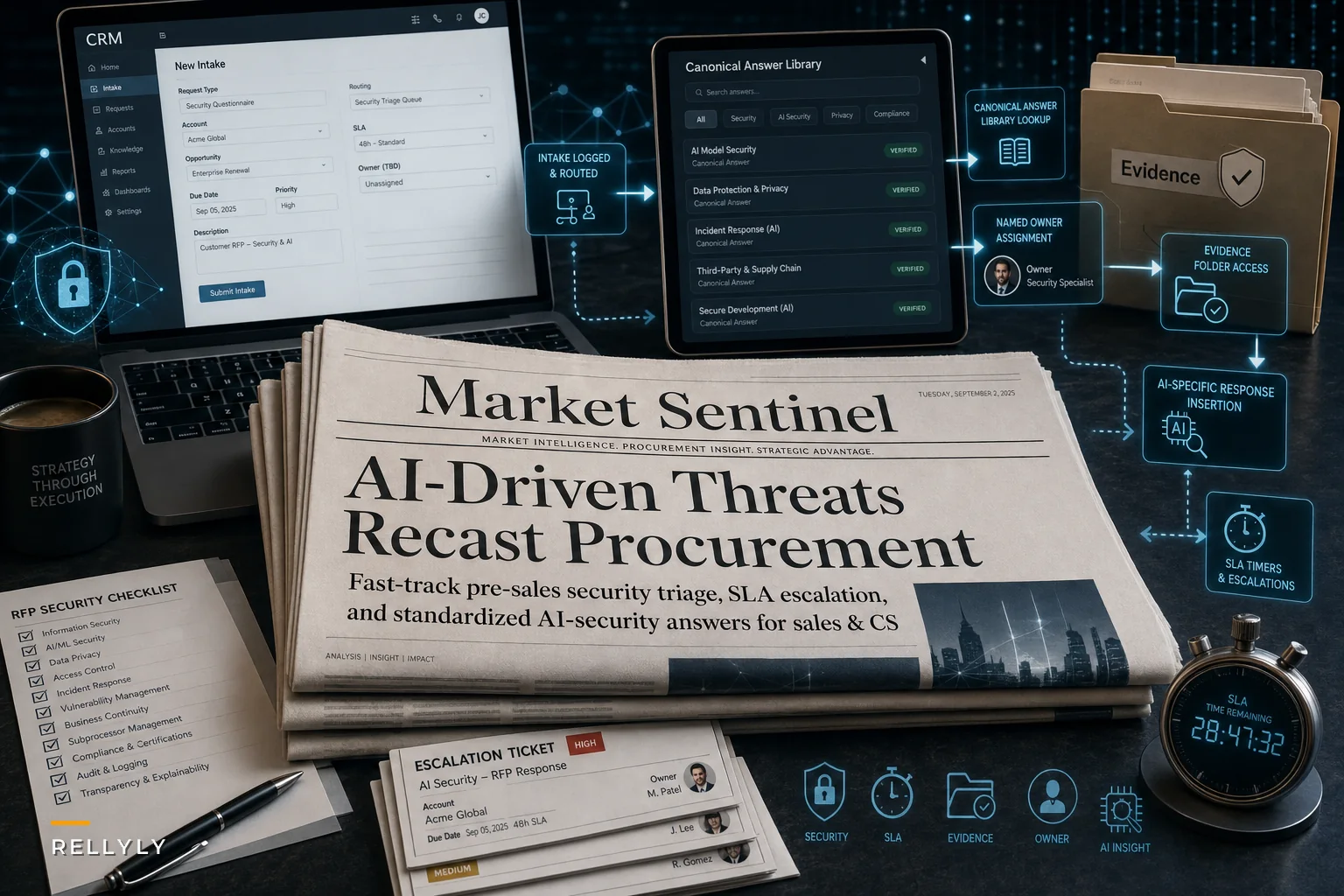

Something shifted in late August. A group of the biggest names in tech — OpenAI, Anthropic, Microsoft, Alphabet, and Amazon — publicly called for a "society-wide defensive surge" to counter the growing wave of AI-enabled hacking. Reuters covered the joint call for a defensive surge against AI-driven hacks, and the framing matters: these aren't security vendors trying to sell fear. These are the companies building the models. When they say attackers are getting faster and more scalable, buyers listen.
And sales and CS teams feel the downstream effect almost immediately. When the industry's loudest voices warn about AI-driven cyberthreats, enterprise procurement teams tighten their grip. Security reviews get longer. Questionnaires get harder. Legal adds new clauses. Deals that used to close in six weeks start slipping into quarter-end limbo.
This post isn't about cybersecurity architecture — that's not your job. It's about the operational reality that a threat-environment shift creates a procurement shift, and how revenue teams should respond before it costs them closed-won.
The real problem isn't the threat — it's the lag it creates in your funnel
Most sales teams think about security as a gate at the end: legal signs, security approves, deal closes. But rising AI-driven cyberthreats don't just add one more gate — they change how buyers behave throughout the entire evaluation.
It's subtler than it sounds. A CISO reads the same headlines you did. Suddenly they're not just reviewing your SOC 2 report — they're asking how you use AI internally, whether your support team can be socially engineered, and what happens if one of your subprocessors gets breached. The scope of the review quietly expands, and nobody tells the account exec until the deal has already stalled for two weeks.
In practice, this shows up as a very specific pattern: the technical champion is sold, the budget exists, and yet the opportunity sits in "security review" for 30, 45, sometimes 60 days with no clear owner on your side pushing it forward. The deal isn't lost. It's suspended. And suspended deals have a nasty habit of dying at quarter-end when priorities reshuffle.
The underlying issue is that security review gets treated as their process, when it's really a shared one. The buyer controls the questions. You control the response speed. And response speed is almost entirely an operational problem, not a security one.
Where the delays actually come from (it's rarely the security team)
When you break down a stalled security review, the time almost never gets eaten by the actual assessment. It gets eaten in the gaps between steps.
Never miss a customer touchpoint again.
Rellyly helps you manage contacts, tasks, and sales efficiently in one platform.
- Unified customer profiles
- Automated follow-ups
- Sales pipeline tracking
No credit card required
| Stage | What eats the time | Typical delay |
|---|---|---|
| Questionnaire intake | AE doesn't know who owns the response | 3–7 days |
| Drafting answers | Rewriting the same responses from scratch | 5–10 days |
| Evidence gathering | Hunting for the current SOC 2, pen test, DPA | 2–5 days |
| Internal review | Waiting on security/legal to approve wording | 4–8 days |
| Buyer follow-ups | Round-trips on unclear answers | 5–15 days |
Only one row — buyer follow-ups — is genuinely outside your control. Everything else is an internal coordination failure dressed up as a "security delay."
The single biggest time sink is the second row. Teams answer the same questionnaire questions over and over, slightly differently each time, because nobody maintains a canonical set of approved responses. One rep says the data is encrypted "at rest and in transit." Another says "using AES-256." A third leaves it blank and asks the security lead over Slack, who's on PTO. That inconsistency is exactly what makes a nervous buyer send three more questions.
What's new because of AI-driven attacks — and what buyers now want to see
The threat environment shift means the content of questionnaires is changing, not just their length. If your templated answers were written 18 months ago, they're already stale in a few predictable places.
-
How your own team uses AI internally. Do support agents paste customer data into public models? Do you have an AI usage policy?
-
How you'd detect and respond to AI-assisted social engineering. Deepfake voice calls to your support desk are no longer hypothetical.
-
What your subprocessors do. If you added an AI vendor to your stack, that's now part of their risk surface.
-
Your incident-response timelines specifically for AI-misuse scenarios, not just generic breaches.
The mistake most teams make is answering these with old boilerplate that dodges the question. A buyer who's genuinely worried about AI-driven cyberthreats can smell a non-answer, and a non-answer triggers a follow-up loop — the exact thing that adds two weeks to the review.
A better approach is having specific, honest, pre-approved answers ready. "We restrict which AI tools can process customer data via an internal policy, enforced through X, reviewed quarterly" closes the loop. "We take security seriously and follow industry best practices" reopens it.
Building a fast-track that actually holds up
The fix isn't more effort per deal. It's front-loading the work once so every deal moves faster — a security-response operating system that lives outside any single opportunity.
-
Inventory your last 10 security questionnaires. Pull the actual questions buyers asked, not what you assume they ask. You'll find 70–80% overlap across deals.
-
Write one canonical answer per recurring question, reviewed and locked by your security lead. This becomes your source of truth.
-
Assign a named owner for security review at deal level — usually a sales engineer or a designated CS/security liaison, not "whoever's free."
-
Create an evidence folder that's always current
latest SOC 2, pen test summary, DPA template, subprocessor list, AI usage policy. Set a recurring reminder to refresh it.
-
Add the new AI-specific answers covering internal AI use, social-engineering defenses, and subprocessor risk.
-
Define an SLA for your side
intake acknowledged within 1 business day, first draft response within 3.
Teams that do this consistently turn a 45-day review into something closer to two weeks — not because the buyer moves faster, but because they stop introducing delay.
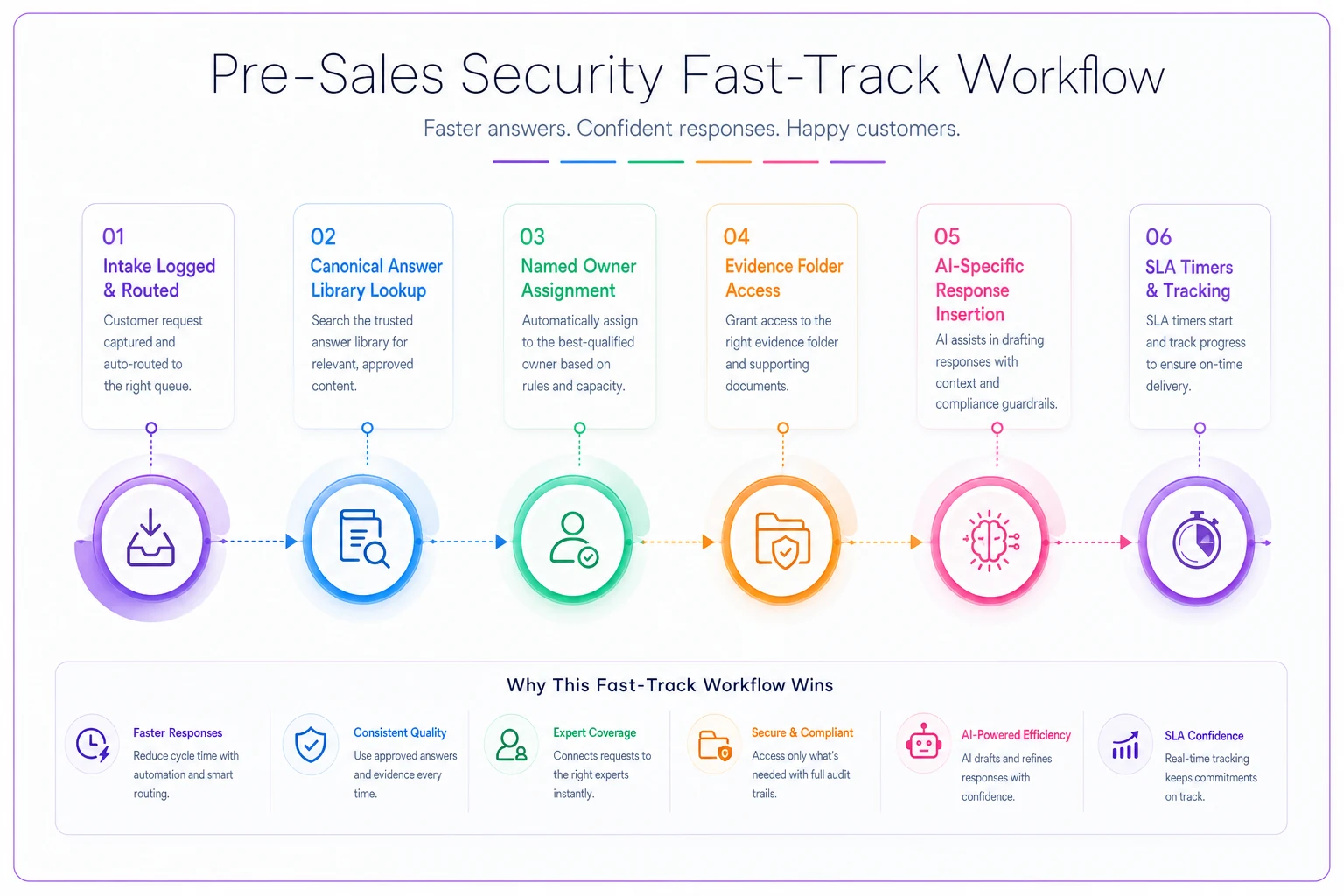
A visual of the sequence can help align teams.
Prioritize building canonical answers for the questions that appear most often across your deals.
If you want a ready-made starting point for steps one and two, the pre-sales security checklist for enterprise deals breaks down the top questions, templated responses, and a routing plan you can adapt directly.
A real scenario: the deal that almost slipped a quarter
A mid-market SaaS company selling into financial services had a roughly $90k ACV deal stuck. Technical champion loved it. Budget approved. Then the buyer's security team sent a 140-question spreadsheet, and the AE — who'd never handled one — sat on it for nine days trying to figure out who owned what.
By the time the first responses went back, they were inconsistent enough that the buyer's security analyst flagged six answers for clarification. Another round-trip. Another two weeks. The deal drifted to "security pending," and the forecast took the hit.
After that near-miss, the team built exactly what's described above: a canonical answer library, a named SE owner for every security review, and a same-day intake SLA. The next comparable deal — similar size, similar industry — came with an even longer questionnaire. It cleared security in about 11 days with zero clarification loops, because the answers were consistent and the evidence was already sitting in a shared folder. Same buyer scrutiny. Very different outcome.
Their actual security posture didn't change at all. What changed was the operational coordination around responding.
Where the right systems quietly help
Once you've built the canonical answers and evidence library, the bottleneck moves to keeping everything current and routing questionnaires to the right owner without manual chasing. This is where an operational platform earns its keep — not by answering security questions for you, but by making sure the intake gets logged, the owner gets pinged, the SLA clock starts, and stale documents get flagged before a buyer catches them.
AI automation is genuinely useful in a narrow, unglamorous way here: matching incoming questionnaire questions against your approved answer library so a rep isn't rewriting from scratch, and flagging which answers need a human review because they touch something new — like an AI-misuse scenario the old library doesn't cover. The judgment stays human. The retrieval and routing don't have to be.
The point isn't to automate security. It's to remove the coordination lag that turns a two-week review into a two-month one.
When to invest in this — and when not to
This makes sense when you're selling into enterprise or regulated industries, your average deal size justifies the setup effort, and you've had at least a couple of deals slip into "security review" limbo. If security questionnaires are a recurring feature of your pipeline, building the fast-track pays for itself quickly.
This is overkill when you sell low-ACV, self-serve, or SMB deals where formal security reviews rarely happen. Building a canonical answer library for a $200/month product that nobody vets is wasted effort.
Who should not rush this: early-stage teams still figuring out their ICP. If you don't yet know which industries you're winning in, you'll build answers for the wrong buyer. Get a few enterprise deals under your belt first, then systematize the pattern that's actually showing up.
The takeaway for revenue teams
The industry's warning about AI-driven cyberthreats isn't primarily a signal to your engineering team — it's a signal to your pipeline. Buyer scrutiny is rising, and that scrutiny lands squarely in the space between your sales process and your security posture.
You don't control the threat environment. You don't control how cautious a CISO feels after reading the news. But you fully control how fast and how consistently your team responds when the questionnaire arrives. Teams that treat security review as an operational discipline — owned, templated, SLA-driven — will keep closing on schedule while everyone else watches deals drift into next quarter.
Fix the coordination, and the "security delay" mostly disappears. It was never really about security in the first place.
Ready to transform your customer relationships?
Join 2,000+ businesses using Rellyly to increase sales, improve client retention, and simplify CRM workflows.