

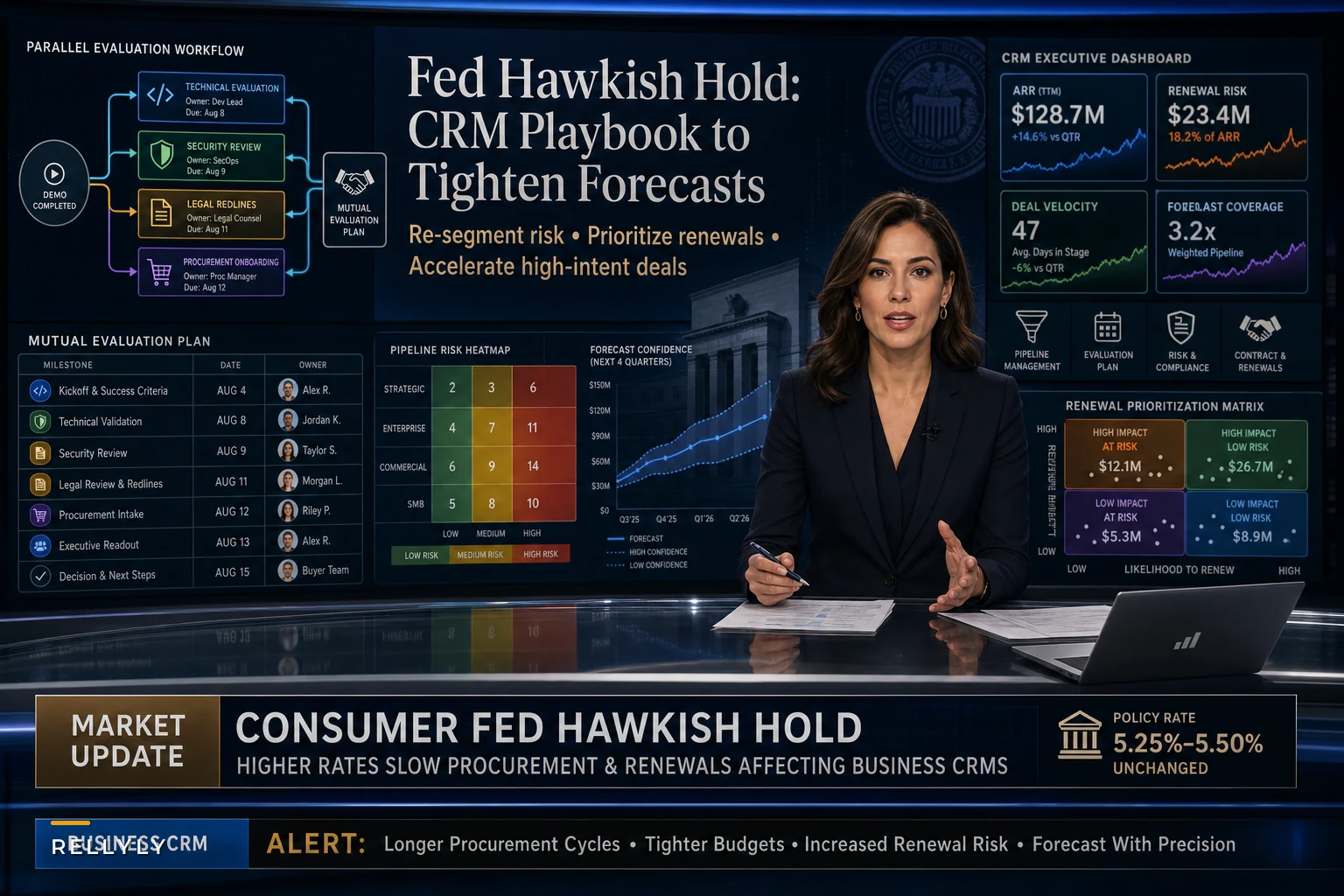

Yesterday's Fed meeting delivered exactly what nobody wanted to hear clearly. Reuters reported the central bank holding rates at 3.50%–3.75% while Warsh basically signaled he'll keep fighting inflation for as long as it takes. The market heard "hawkish hold" and started recalculating everything.
Your sales team probably felt it within hours. That enterprise deal "definitely closing this quarter" suddenly needs another round of CFO review. The mid-market renewal you thought was automatic just asked for a discount conversation. Three expansion opportunities quietly pushed their decision dates to Q4.
This isn't about the Fed being difficult. When borrowing costs stay elevated and the future looks murky, procurement behavior shifts in pretty predictable ways. Companies hoard cash, stretch evaluation cycles, and scrutinize every renewal like it's a brand new purchase decision. This exact pattern wrecked forecasts at dozens of SaaS companies during the 2022–2023 rate hike cycle.
The difference now is we've seen it before. And we know which CRM adjustments actually protect revenue when buyers lock up.
The three pipeline shifts that happen every time rates stay high
Forget the macro analysis. Here's what actually happens to your deals when the Fed signals prolonged tightness:
Deal velocity drops 20–35% in the middle funnel
Watch your 30–60 day conversion rates crater first. Not because prospects stop caring about your product, but because they suddenly need three more approval layers. That $40K marketing automation deal that used to be a departmental call? Now it needs executive sign-off because "all new vendors" require board review when cash preservation becomes the company-wide priority.
The cruel part: these deals don't die. They zombie-walk through your pipeline for months, destroying forecast accuracy while reps burn time on check-in calls that go nowhere.
Renewal conversations turn into renegotiations
Every customer suddenly becomes a procurement expert. They've been paying $8K/month for two years without question, but now they want to "right-size" the contract. They'll ask about usage data you've never tracked. They'll mention competitors they haven't looked at since the original implementation.
What's really happening: their CFO mandated 15% software spend cuts across the board. Your champion still likes you, but they need ammunition to protect your line item when the cutting starts.
New logo acquisition costs spike while close rates fall
The math is rough. Prospects need significantly more touches before agreeing to a demo. Demo-to-opportunity conversion drops. Opportunity-to-close shrinks. A deal that used to cost $3,000 to acquire can balloon to $7,500 or more. Meanwhile, average contract values stay flat or shrink because everyone wants to "start small and expand later."
Your forecast just became fiction
Most sales orgs are running pipeline stages built during growth mode. "Qualified" means they took a demo. "Negotiation" means they asked about pricing. "Commit" means your champion said they're buying this quarter.
Never miss a customer touchpoint again.
Rellyly helps you manage contacts, tasks, and sales efficiently in one platform.
- Unified customer profiles
- Automated follow-ups
- Sales pipeline tracking
No credit card required
These stages assume buyers move linearly. That assumption breaks down fast when rates stay high.
Working with 40+ B2B companies on forecast accuracy during uncertain cycles, the consistent lesson was this: you need double-gated stage progression based on both buyer actions and confirmed organizational triggers.
Traditional stage definition:
| Stage | Criteria |
|---|---|
| Discovery | Had initial call |
| Qualified | Completed demo |
| Proposal | Received pricing |
| Negotiation | Discussing terms |
| Commit | Verbal agreement |
Rate-adjusted stage definition:
| Stage | Criteria |
|---|---|
| Discovery | Initial call + confirmed budget exists + specific cost/revenue impact identified |
| Qualified | Demo complete + technical champion mapped + economic buyer introduced |
| Proposal | Pricing received + procurement timeline documented + competing priorities ranked |
| Negotiation | Terms discussion active + legal review started + implementation resources assigned |
| Commit | Verbal agreement + PO number generated + CFO approval confirmed |
Every stage now requires proof of organizational momentum, not just individual interest. This will cut your "committed" pipeline by 40–60%, which feels terrible until you realize those deals were never real anyway.
The renewal triage matrix that actually protects revenue
When cash gets tight, customers don't evaluate all vendors the same way. They sort them into three mental buckets, and your retention strategy needs to match how they're thinking.
Mission Critical — protect at all costs
-
Daily active usage above 80%
-
Multiple integrated systems
-
More than 3 departments using the platform
-
Custom workflows built out
-
Consistent support ticket history (shows real usage)
Action plan: Lock these in 120 days early with multi-year incentives. Offer 15% off for a 2-year commit, 25% for 3 years. You're leaving some money on the table, but a locked renewal beats a renegotiation where the customer has leverage.
Efficiency Drivers — negotiate to keep
-
Weekly active usage 40–70%
-
Single department adoption
-
Standard workflows, low customization
-
Few integrations
-
Sporadic support engagement
Action plan: Start renewal conversations 90 days out with usage data in hand. Frame value around cost reduction, not growth. Prepare 2–3 downgrade options that preserve some revenue rather than losing it entirely.
Nice-to-Haves — high churn risk
-
Monthly active usage below 40%
-
No executive users
-
Minimal configuration
-
No integration dependencies
-
Support tickets mostly about billing
Action plan: Either push for immediate usage or accept the churn and redirect resources elsewhere. Reps shouldn't burn time trying to save deals that customers have already mentally cancelled.
Deal acceleration when buyers pump the brakes
The instinct when deals slow is to push harder. More emails, more demos, more check-ins. This is exactly wrong when buyers are dealing with internal economic pressure.
You need to remove friction from their internal selling process. Your champion wants to buy. They're struggling to navigate their organization's new procurement maze.
Build the business case they can't write themselves
-
Current state problem definition with their specific metrics
-
Cost of maintaining status quo over 18 months
-
Implementation risk mitigation plan
-
Stakeholder impact analysis
-
Phased rollout option to reduce upfront commitment
This single tactic has recovered a meaningful chunk of stalled deals — not because it convinces the buyer (they're already sold), but because it gives them the ammunition to convince everyone else.
Compress evaluation through parallel processing
Traditional: Demo → Technical evaluation → Security review → Legal → Procurement → Close
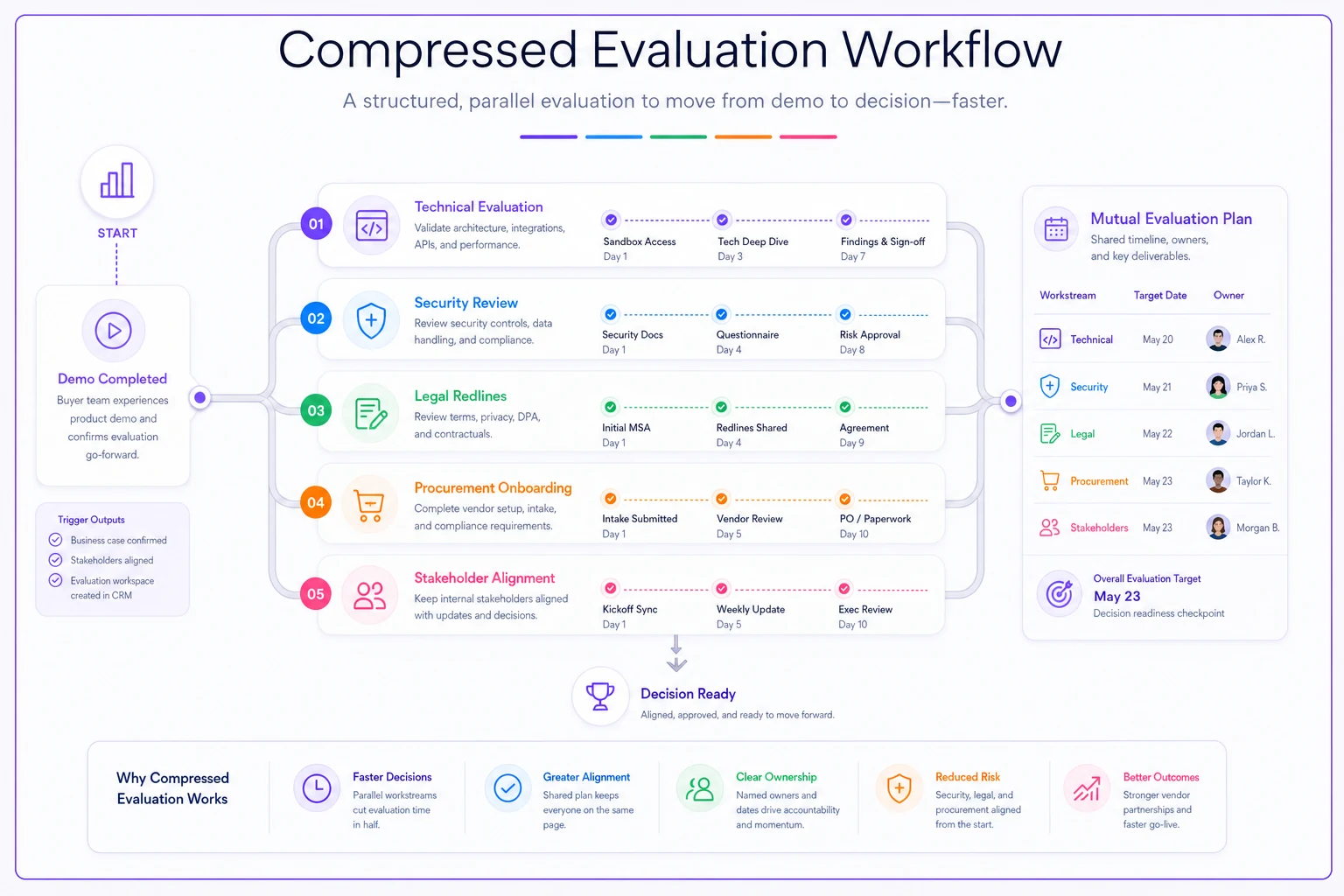
Compressed: Demo triggers all workstreams simultaneously. Technical team evaluates while security starts documentation review. Legal gets redlines while the POC runs. Procurement begins vendor onboarding during the trial.
More project management on your side, but it can cut time-to-close significantly. Build a mutual evaluation plan with specific dates and owners. Update it weekly and share across all stakeholders.
Provide champions a pre-filled, company-specific business case they can forward directly to finance and legal to save them time.
A visual of the compressed evaluation workflow:
Tie urgency to their business, not your quota
Outreach cadence adjustments that preserve pipeline
Current cadences probably assume prospects are actively evaluating solutions. That shifts when Reuters reports consumer sentiment ticking up but businesses still can't afford to borrow at current rates. You get this strange dynamic where demand exists but purchasing power doesn't.
Top-of-funnel: education over activation
Old: Problem agitation → Solution positioning → Demo offer → Follow up until dead
New: Industry insight → Peer benchmarking → Process optimization content → Gradual solution introduction → Consultative conversation offer
Stretch sequences from 8 touches over 3 weeks to 16 touches over 8 weeks. Drop direct selling touches from 70% to around 30%. Lean into content that helps them regardless of whether they buy.
Mid-funnel: support over selling
-
Week 1–2
Relevant customer success story, no ask
-
Week 3–4
Industry report or competitive analysis
-
Week 5–6
Offer to connect them with a current customer in a similar situation
-
Week 7–8
Template or framework they mentioned needing
-
Week 9–10
Check if priorities shifted, offer to pause and revisit
This patience feels wrong when pipeline is thin, but it's genuinely what works when buyers are frozen by uncertainty.
Bottom-funnel: flexibility over persistence
-
Monthly payment option instead of annual only
-
"Pilot to production" pricing that starts small
-
Flexibility to scale down if business conditions change
-
Termination clauses that reduce risk perception
-
Separate software from services to reduce initial commitment
Flexible terms that close beat perfect terms that don't.
Where operational software actually helps here
When deals take longer and require more touches, you can't just add reps. The unit economics break down fast.
AI-powered operational software handles the coordination layer so reps can stay focused on actual selling:
Automated forecast hygiene
-
Set up automation to continuously scan your CRM for stage mismatches. Deal in "Commit" with no activity in 14 days? Automatic flag and required rep update.
-
Opportunity missing an economic buyer? Can't advance past Qualified.
-
Close date already passed? Instant manager alert.
This isn't about policing reps. It's about preventing the forecast surprises that destroy board credibility when every deal matters more.
Renewal monitoring that actually scales
-
Usage dropped 30%+ month-over-month
-
Decision maker hasn't logged in for 45 days
-
Support tickets mentioning "budget" or "alternatives"
-
Contract utilization below 50% with renewal 90 days out
CSMs can focus on saving deals rather than hunting for ones to save.
Smarter deal routing
-
Enterprise with multiple stakeholders → Rep with project management background
-
Technical evaluation heavy → Rep with implementation experience
-
Price-sensitive mid-market → Rep with strong negotiation track record
-
Quick-close SMB → Rep with high activity metrics
Routing happens automatically from discovery call data. Deals stay with the reps most likely to close them.
The execution timeline
Doing everything at once guarantees nothing gets done right. This sequence minimizes disruption while actually building momentum:
Week 1–2: Forecast reality check
-
Audit all deals in commit and negotiation
-
Apply double-gated criteria
-
Adjust forecast down 30–40%
-
Communicate the new reality to leadership
-
Set up automated stage hygiene monitoring
Week 3–4: Renewal triage
-
Categorize all renewals in the next 180 days
-
Assign acceleration plans for mission-critical accounts
-
Build usage reports for efficiency drivers
-
Accept churn risk on nice-to-haves
-
Create renewal playbooks for each category
Week 5–6: Deal acceleration
-
Identify top 10 stalled deals worth saving
-
Build business case templates
-
Create mutual evaluation plans
-
Design parallel process workflows
-
Test with 2–3 willing prospects
Week 7–8: Cadence rebuild
-
Redesign top-of-funnel sequences
-
Build value-add content library
-
Create patience protocols for quiet deals
-
Develop flexible term sheets
-
Train SDRs on the new approach
Week 9–12: Automation layer
-
Set up forecast hygiene rules
-
Deploy renewal monitoring
-
Configure deal routing logic
-
Build performance dashboards
-
Iterate based on early results
Most teams skip straight to automation or spend months planning without executing. This timeline forces action while building systematically.
Separating winners from casualties
Some teams will come out of this environment stronger. Most won't. The difference isn't better reps or more pipeline — it's whether leadership accepts reality and adapts operations before the damage shows up in the numbers.
Winners will take the forecast hit early, protect renewals through proactive outreach and flexible terms, support their buyer's internal selling process instead of pushing harder, and execute systematically instead of pivoting every time the board asks a tough question.
Casualties will keep projecting last year's close rates onto this year's pipeline, wait until renewal date to address customer concerns, blame reps for longer cycles, and add more manual process when things slow down.
The Fed's hawkish hold isn't a temporary inconvenience. It's the operating environment for at least the next 6–12 months. Teams that adapt their CRM operations, forecasting discipline, and renewal strategy now will be in a much better position heading into next year. Those that don't will spend every quarter explaining why the numbers missed again.
The playbook isn't complicated. The execution timeline is manageable. Whether it happens before your competition does is the only real variable.
Ready to transform your customer relationships?
Join 2,000+ businesses using Rellyly to increase sales, improve client retention, and simplify CRM workflows.