

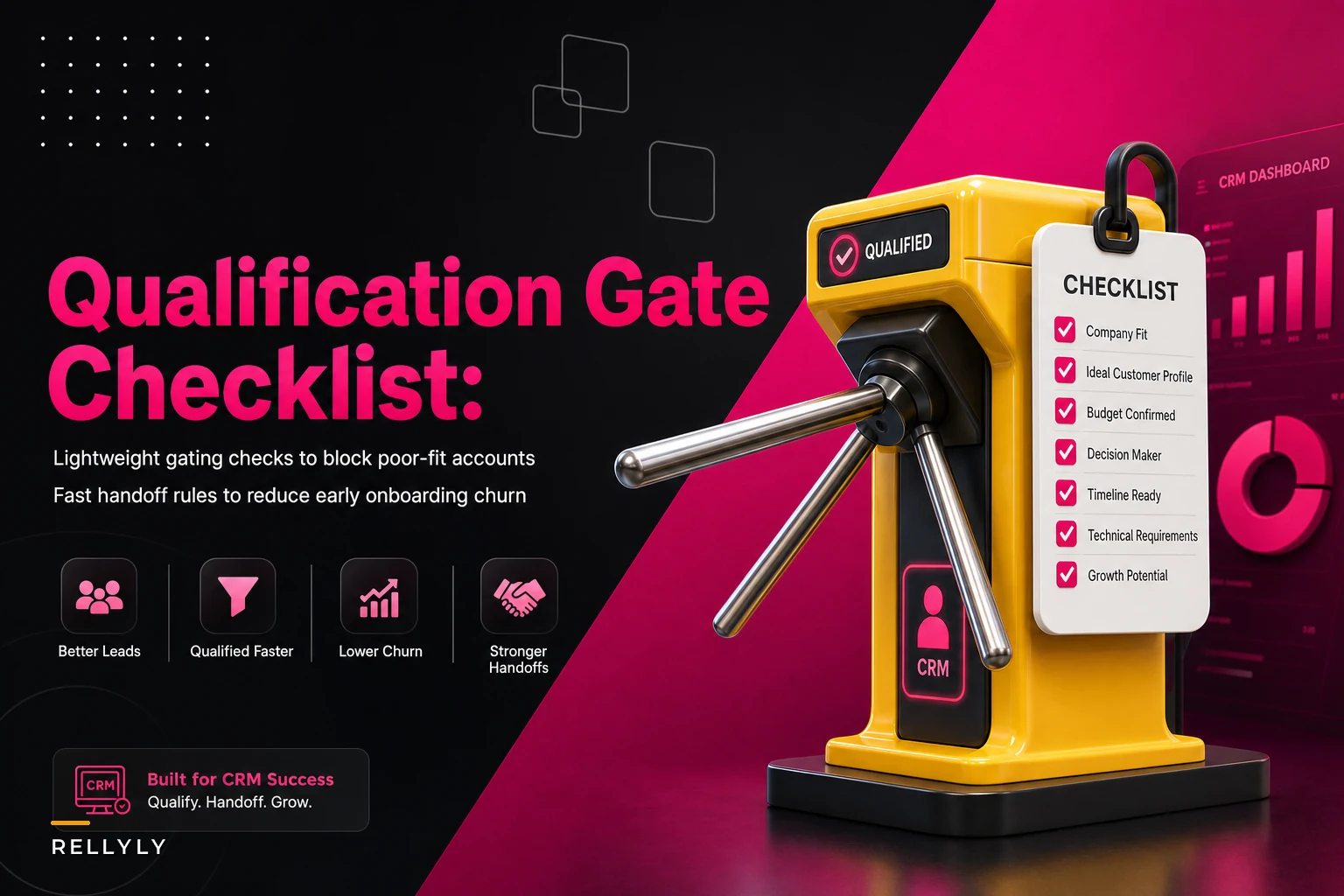

Most churn that shows up at day 70 was actually decided before onboarding ever started. The account was never a fit — wrong use case, no budget owner, a champion who sold internally on something the product doesn't do. But because the deal closed, it rolled straight into onboarding, and now a CSM is spending six weeks trying to activate an account that was dead on arrival.
A gating checklist fixes a narrow, specific thing: it stops accounts that will predictably fail from entering onboarding, and it forces a clean handoff for the ones that pass. That's it. This isn't lead scoring, and it isn't a full qualification framework for your pipeline. It's the last checkpoint before you commit CS hours.
The handoff gap where bad-fit accounts slip through
The mechanic that creates this problem is simple. Sales qualifies for closing. CS qualifies for success. Those are different bars, and almost nobody checks the second one before kickoff.
A rep's job is to find a reason to say yes. A CSM's job is to make the account actually use the thing. When there's no gate between those two, the account inherits whatever assumptions the rep made during the deal — and reps, under quota pressure, make generous assumptions. "They'll figure out the integration." "The admin seemed technical enough." "They said budget renews in Q2." None of that gets verified.
A typical example: a 40-seat deal closes on a Friday. The MSA is signed by procurement. On Monday the CSM reaches out and discovers the actual users haven't been told the tool is coming, there's no data source connected, and the person who championed the deal left two weeks ago. The account technically qualified to buy. It never qualified to succeed.
What shows up across a lot of these breakdowns is that the failure isn't dramatic. Nobody flags it. The account just quietly stalls, and by the time health scores catch it, you're 60 days in and the renewal math already looks bad.
What actually predicts early failure
You don't need a 30-point rubric. Across onboarding failures, the same handful of missing pieces show up again and again. Most bad-fit accounts are missing two or three of these before kickoff:
Never miss a customer touchpoint again.
Rellyly helps you manage contacts, tasks, and sales efficiently in one platform.
- Unified customer profiles
- Automated follow-ups
- Sales pipeline tracking
No credit card required
-
No named owner on the customer side. Someone has to own the outcome internally. Not an executive sponsor who signed the contract — an actual day-to-day owner.
-
No confirmed first use case. "We'll use it for a bunch of things" is not a use case. If they can't name the one workflow they're replacing or improving, activation has nothing to aim at.
-
No access to data or systems the product needs. If activation requires a CRM connection, a data export, or an IT approval, and that hasn't been scoped, you're about to lose weeks.
-
Champion with no authority or no staying power. A champion who can't get colleagues to show up to a kickoff call is a warning sign, not a win.
-
Expectations that don't match the product. The gap between what the rep described and what the product does is where the loudest churn comes from.
-
No realistic timeline. "Whenever" means never. Accounts without a go-live date drift.
What most teams miss: these are binary, verifiable facts, not judgment calls. You can check every one of them in a 20-minute conversation or by reading the deal notes. The reason they get skipped isn't difficulty — it's that nobody owns the check.
The gate itself
Keep it compact. The whole point is that it's fast enough that reps and CSMs actually run it instead of routing around it. Here's a gate that takes a few minutes per account.
| Gate item | Pass condition | Hard stop? |
|---|---|---|
| Named day-to-day owner | Person identified by name and role | Yes |
| First use case | One specific workflow named | Yes |
| Data/system access | Required connections confirmed available | Yes |
| Champion durability | Champion still employed, engaged, has pull | No — flag |
| Expectation match | Rep's pitch matches delivered scope | Yes |
| Go-live timeline | Target date within 60 days | No — flag |
Make some items hard stops; otherwise the gate does nothing.
Two tiers matter here. Hard stops mean the account does not enter onboarding until resolved — the CSM kicks it back to the rep. Flags mean the account can proceed, but with a documented risk the CSM plans around from day one.
The mistake teams make is treating everything as a flag. If nothing is a hard stop, the gate does nothing. The whole value is that a few items can actually block kickoff. A gate that can't say no isn't a gate.
The handoff process that makes the gate stick
A checklist without a handoff ritual just becomes a form nobody fills out. The gate needs to live inside the moment the deal moves from sales to CS. Here's the sequence that works:
-
Deal marked closed-won. Rep completes a short handoff packet — the gate items, filled in with what they actually know.
-
CSM reviews within one business day. Fast turnaround matters. The customer's energy is highest right after signing; a four-day silence kills momentum.
-
CSM runs the gate. Any hard-stop gaps get kicked back to the rep with a specific ask ("confirm the named admin before we schedule kickoff").
-
Rep closes the gap or escalates. If the rep can't resolve it, a manager decides whether to proceed with eyes open.
-
Account enters onboarding — or doesn't. Passing accounts get a kickoff date. Flagged accounts get a documented risk note attached.
-
Flags become onboarding priorities. If a champion looked shaky, the CSM's first job is building a second contact.
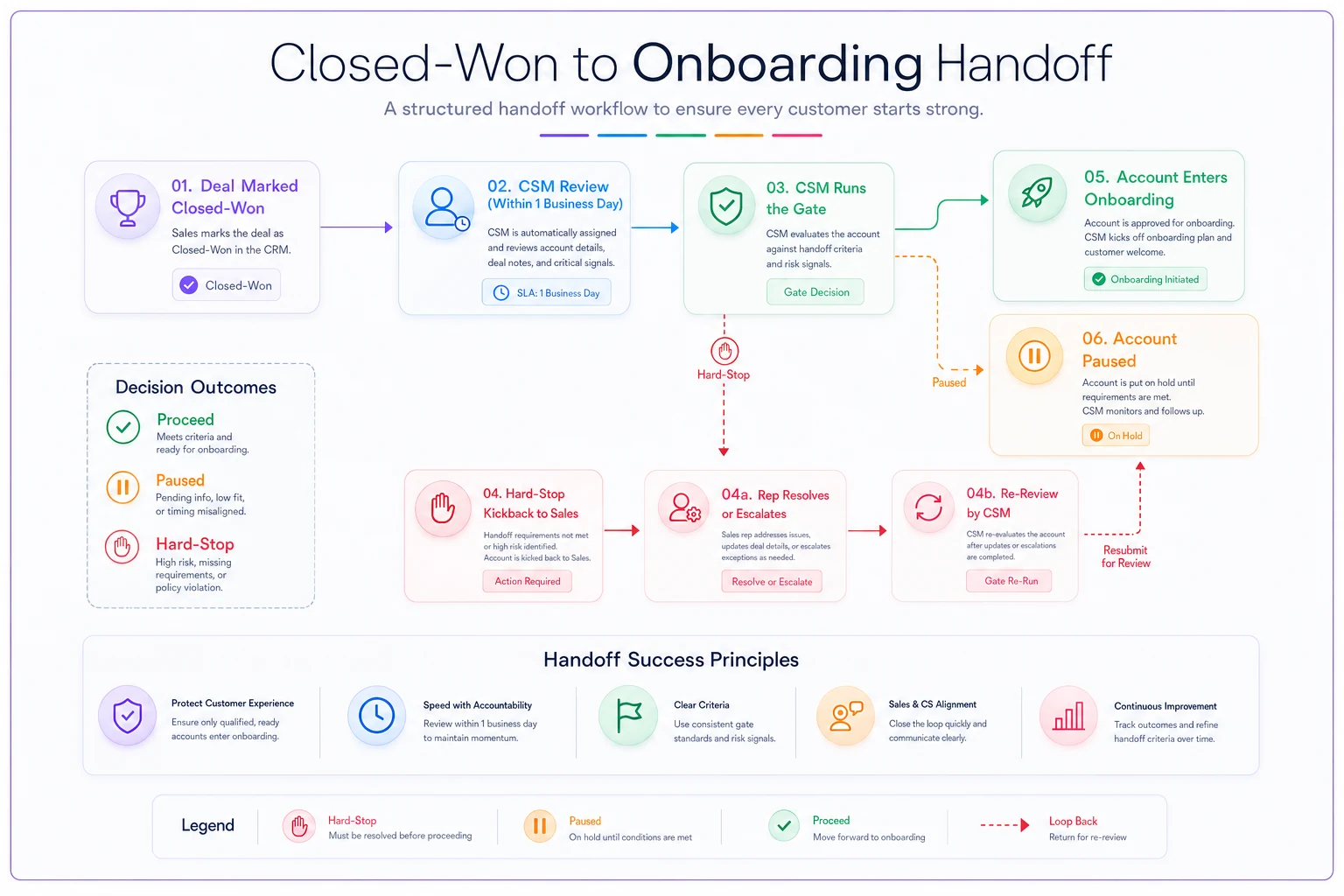
The hidden benefit of this flow is that it changes rep behavior over time. When reps know the gate will catch a missing owner, they start asking about it during the deal. The gate stops being a CS tool and becomes a shared discovery habit.
A real scenario
A mid-market B2B software company — roughly 25 new accounts a month — was seeing about 18% of new logos churn or go dark inside the first 90 days. When they went back through the failures, most of them shared a pattern: no confirmed owner and no first use case at kickoff. The deals closed clean, but onboarding had nothing to grab onto.
They added a two-tier gate with three hard stops (owner, use case, data access) and a one-day CSM review SLA. Nothing fancy — a shared checklist and a rule that CS could bounce accounts back to sales.
In the first quarter, around 4–5 accounts a month got kicked back before kickoff. Most were resolved within a few days once the rep chased the missing piece; a couple got paused. Early churn dropped into the low single digits — not zero, but a clear, sustained improvement. The part the CS lead didn't expect: onboarding time for the accounts that did pass got shorter too, because the CSMs weren't spending week one tracking down basics.
When this makes sense — and when it doesn't
This is worth building when you have a real handoff between sales and CS, enough volume that bad-fit accounts are a recurring cost, and onboarding that requires customer participation to succeed. If activation depends on the customer connecting data, assigning an owner, or changing a workflow, the gate pays for itself fast.
This is a bad idea when your onboarding is fully self-serve and low-touch. If a customer can activate alone in ten minutes, gating adds friction for no reason — a bad-fit account just doesn't use the product and cancels cheaply. The gate is for high-touch onboarding where CS time is the scarce, expensive resource.
Who should skip this: very early-stage teams closing a handful of deals a quarter. At that volume, every account already gets human attention and the founder knows each one personally. Formalize the gate when the deals outpace your ability to remember them.
One more caution: don't let the gate grow. The pull is always to add "just one more" check until it's a 20-item form that reps route around and CSMs rubber-stamp. The compact version works because it's compact. Every item you add is an item someone will eventually skip.
Where this fits with the rest of your retention work
A gating checklist isn't a churn strategy on its own — it's the front door. It catches the accounts that were never going to work before they consume CS hours. Everything downstream — health scoring, activation milestones, early-warning triage — gets cleaner when the accounts entering onboarding actually belong there.
Teams that get this right treat the gate as a cheap filter, not a bureaucratic layer. A few minutes per account, a one-day review, a couple of hard stops that can genuinely block a kickoff. That's enough to stop the slow, quiet failures that show up as day-70 churn — and to give your CSMs a fighting chance with the accounts that were worth winning in the first place.
Teams that get this right treat the gate as a cheap filter, not a bureaucratic layer. A few minutes per account, a one-day review, a couple of hard stops that can genuinely block a kickoff. That's enough to stop the slow, quiet failures that show up as day-70 churn — and to give your CSMs a fighting chance with the accounts that were worth winning in the first place.
Ready to transform your customer relationships?
Join 2,000+ businesses using Rellyly to increase sales, improve client retention, and simplify CRM workflows.